


28 Jul PM E-DRIVE Scheme: ₹10,900 Cr Boost for Electric Mobility in India
Subject Relevance — Where This Topic Fits
- GS Paper II — Government Policies and Interventions for Development in various sectors | GS Paper III — Environment, Conservation, Environmental Pollution and Degradation, Environmental Impact Assessment | GS Paper III — Infrastructure: Energy, Ports, Roads, Airports, Railways etc.
- Prelims: FAME-II Scheme, PLI Scheme for Auto and Auto Components, National Electric Mobility Mission Plan (NEMMP) 2020, Battery Swapping Policy, Gross Vehicle Weight (GVW), Charging Infrastructure for Electric Vehicles (EVPI) Guidelines, State EV Policies, Li-ion Battery Recycling Ecosystem, Vehicle Scrappage Policy, National Mission on Transformative Mobility and Battery Storage
- Essay: India’s Energy Transition: Balancing Economic Growth with Environmental Sustainability, The Role of Public Policy in Shaping Sustainable Mobility Futures
Quick Revision: The PM E-DRIVE Scheme is a ₹10,900 crore intervention integrating demand incentives, supply-side support, and charging infrastructure to achieve 30% EV penetration by 2030, reduce fossil fuel dependence, and support India’s net-zero emissions target.
Why is this in the news?
The Union Ministry of Heavy Industries notified the PM E-DRIVE (Prime Minister’s Electric Drive Revolution in Innovative Vehicle Enhancement) Scheme on 29 September 2024, integrating and superseding the earlier EMPS 2024 scheme. With a total outlay of ₹10,900 crore, the scheme aims to catalyse electric vehicle adoption, strengthen domestic manufacturing under the ‘Make in India’ initiative, and build a robust charging infrastructure to reduce fossil fuel dependence and vehicular emissions. The scheme’s operational phase and its structured incentive framework across multiple EV categories have drawn attention as a critical instrument in India’s decarbonisation trajectory and the ‘Viksit Bharat @2047’ vision.
Background
- India’s transport sector accounts for approximately 18% of the country’s total energy consumption and 12% of CO₂ emissions, with road transport contributing the majority share.
- The National Electric Mobility Mission Plan (NEMMP) 2020 and the Faster Adoption and Manufacturing of Hybrid & Electric Vehicles (FAME) schemes (FAME-I in 2015 and FAME-II in 2019) laid the foundation for India’s EV ecosystem, targeting 30% EV penetration by 2030.
- The scheme aligns with India’s Nationally Determined Contributions (NDCs) under the Paris Agreement, targeting a 45% reduction in emissions intensity of GDP by 2030 and net-zero emissions by 2070.
- The ‘Make in India’ initiative and the Production-Linked Incentive (PLI) Scheme for Advanced Chemistry Cell (ACC) Battery Storage (₹18,100 crore) complement the PM E-DRIVE scheme by fostering domestic battery and EV component manufacturing.
- The scheme’s timeline (2024–2028) coincides with the Bharat Stage-VI emission norms and the Vehicle Scrappage Policy, creating a synergistic regulatory environment for EV adoption.
What is the PM E-DRIVE Scheme?
- The PM E-DRIVE Scheme is a centrally sponsored programme notified by the Ministry of Heavy Industries to accelerate the adoption of electric vehicles (EVs), enhance domestic manufacturing, and establish a nationwide charging infrastructure.
- The scheme integrates demand-side incentives (subsidies on EV purchases), supply-side support (PLI for battery and component manufacturing), and infrastructure development (public charging stations) under a unified policy framework.
- The total financial outlay of ₹10,900 crore is allocated with a focus on fiscal prudence and targeted interventions to maximise impact.
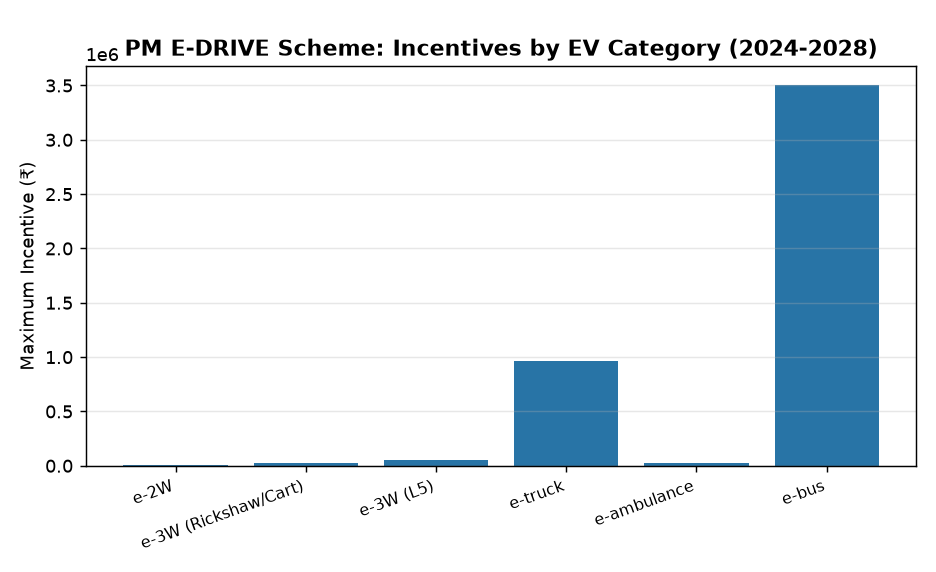
- The scheme covers multiple EV categories, including electric two-wheelers (e-2W), electric three-wheelers (e-3W: passenger and goods), electric trucks (e-trucks), electric ambulances (e-ambulances), and electric buses (e-buses), each with distinct incentive structures.
- Incentives are structured as per-kilowatt-hour (kWh) subsidies or percentage-based support on ex-factory prices, with caps to ensure fiscal sustainability and prevent market distortions.
- The scheme mandates compliance with domestic content requirements (DCR) for incentive eligibility, aligning with the ‘Make in India’ and PLI schemes to boost local manufacturing and reduce import dependence.
Key Features
| Feature | Significance |
|---|---|
| Primary Objective | Accelerate adoption of electric vehicles (EVs), establish charging infrastructure, and develop domestic EV manufacturing ecosystem under ‘Make in India’. |
| Financial Outlay | ₹10,900 crore total allocation, with ₹2,000 crore earmarked for public charging infrastructure. |
| Incentive Structure | Differential incentives based on vehicle category (e-2W, e-3W, e-truck, e-ambulance, e-bus), scaled down post-2025-26 to prioritise fiscal prudence. |
| Implementation Timeline | Operational from 01.04.2024 to 31.03.2028 (e-2W incentives until 31.07.2026; e-3W(L5) incentives until 26.12.2025). |
| Coverage of Vehicle Segments | Includes e-2W, e-3W (L5 category excluded post-2025), e-trucks, e-ambulances, and e-buses with category-specific caps on incentives. |
Why it Matters
Economic & Industrial
- Stimulates domestic EV manufacturing under ‘Make in India’, reducing import dependence on lithium-ion batteries and components.
- Creates demand-side pull for ancillary industries (battery packs, motors, controllers) through OEM-linked incentives.
- Promotes job creation in Tier-II/III cities via localized EV and charging infrastructure supply chains.
Environmental
- Directly reduces vehicular emissions and fossil fuel consumption, aligning with India’s NDC targets under the Paris Agreement.
- Supports transition to cleaner urban mobility, particularly in high-pollution zones (e.g., Delhi-NCR, Mumbai).
Fiscal & Governance
- Leverages demand-side subsidies to correct market failures in EV adoption, where upfront costs deter consumers.
- Integrates with existing schemes (e.g., Faster Adoption and Manufacturing of Hybrid and Electric Vehicles, FAME-II) for continuity and scalability.
Technological
- Encourages R&D in battery technology, charging standards, and recycling ecosystems to enhance energy density and lifecycle efficiency.
- Facilitates standardization of charging infrastructure, reducing interoperability challenges across regions.
Challenges
1. Battery Supply Chain Dependency
- Heavy reliance on imported lithium-ion batteries and critical minerals (e.g., lithium, cobalt), exposing India to geopolitical and price volatility risks.
- Limited domestic lithium extraction and refining capacity necessitates long-term strategic partnerships (e.g., with Australia, Argentina).
UPSC Link: GS-III: Energy Security
2. Charging Infrastructure Bottlenecks
- Uneven distribution of public charging stations, with urban-rural divide and congestion in metropolitan areas.
- High capital expenditure for fast-charging networks and grid integration challenges in high-density regions.
UPSC Link: GS-III: Infrastructure
3. Affordability & Consumer Adoption
- Despite subsidies, upfront costs of EVs (especially e-buses and e-trucks) remain prohibitive for small fleet operators and low-income segments.
- Lack of awareness and financing options (e.g., low-interest loans for commercial EV buyers) hampers mass adoption.
UPSC Link: GS-III: Inclusive Growth
4. Waste Management & Recycling
- Emerging challenge of end-of-life battery disposal, requiring robust Extended Producer Responsibility (EPR) frameworks.
- Limited domestic recycling capacity for lithium-ion batteries, risking environmental contamination if unregulated.
UPSC Link: GS-III: Environmental Pollution
5. Grid Stability & Energy Transition
- High EV penetration may strain grid capacity, necessitating smart grid solutions and renewable energy integration.
- Dependence on coal-based electricity generation in some states could offset emissions benefits of EVs.
UPSC Link: GS-III: Renewable Energy
Challenges — UPSC Perspective
| Issue | Concern |
|---|---|
| Battery Recycling | Absence of a formalized recycling ecosystem leading to environmental hazards and resource wastage. |
| Charging Desert | Rural and remote areas lack sufficient charging stations, creating mobility deserts for EV users. |
| Subsidy Rationalization | Phased reduction in incentives post-2025-26 may slow adoption without alternative financing mechanisms. |
| Interstate Disparities | Unequal distribution of incentives and infrastructure across states, exacerbating regional inequalities. |
| Safety Standards | Lack of uniform safety protocols for EV batteries and charging stations, raising fire and electrocution risks. |
Way Forward
- Expand PLI schemes for battery manufacturing and recycling to reduce import dependence and enhance circular economy.
- Launch state-specific ‘EV Mobility Clusters’ in Tier-II/III cities to decentralize manufacturing and charging infrastructure.
- Introduce interest subvention schemes for commercial EV buyers (e.g., e-trucks, e-buses) to improve affordability.
- Develop a national EV charging corridor plan linking major highways and industrial hubs with fast-charging stations.
- Strengthen R&D in alternative battery chemistries (e.g., sodium-ion, solid-state) to diversify supply chains.
- Establish a unified digital platform for real-time tracking of EV incentives, charging availability, and subsidy disbursements.
- Mandate 100% renewable energy integration for public charging stations to ensure zero-emission operations.
UPSC Value Addition
Keywords for Mains Answer-Writing
PM E-DRIVE Scheme · Electric Mobility Promotion · FAME-II Scheme Integration · EV Incentives Framework · Gross Vehicle Weight (GVW) based incentives · Battery Swapping Policy · Charging Infrastructure Deployment · Make in India in EV Sector · State-wise EV Adoption Data · Fossil Fuel Substitution · Carbon Emission Reduction · Tier-II and Tier-III City Focus · Aspirational Districts EV Incentives · EV Manufacturing Ecosystem · Battery Recycling Policy
Concept Flow
Fossil fuel dependence → Vehicular emissions → Climate change impacts → Government intervention via PM E-DRIVE → High EV upfront costs → Market failure → Demand-side subsidies → Accelerated adoption → Subsidies → Increased OEM production → Domestic manufacturing growth → ‘Make in India’ alignment → EV adoption → Reduced fossil fuel consumption → Lower emissions → NDC targets achievement → Battery imports → Supply chain risks → Need for recycling ecosystem → Circular economy development → Charging infrastructure gaps → Consumer hesitancy → Policy push for public charging → Grid integration challenges → Grid stability concerns → Smart grid solutions → Renewable energy integration → Sustainable transition
Prelims Practice Questions
Q1. Consider the following statements regarding the PM E-DRIVE Scheme: 1) The scheme integrates the FAME-II scheme into its framework. 2) The scheme provides incentives for electric two-wheelers (e-2W) up to ₹10,000 per vehicle. 3) The scheme offers incentives for electric buses based on their length. 4) The scheme has a total financial outlay of ₹15,000 crore. Which of the above statements are correct?
- 1, 2 and 3 only
- 1, 2 and 4 only
- 2, 3 and 4 only
- 1, 2, 3 and 4
Answer: 1, 2 and 3 only — Statement 1 is correct as the PM E-DRIVE Scheme integrates the FAME-II scheme. Statement 2 is correct as the scheme provides incentives for e-2W up to ₹10,000 per vehicle. Statement 3 is correct as incentives for e-buses are based on their length. Statement 4 is incorrect as the total financial outlay is ₹10,900 crore, not ₹15,000 crore.
Q2. Which of the following categories of electric vehicles are eligible for incentives under the PM E-DRIVE Scheme as per the latest provisions?
- e-2W, e-3W (registered e-rickshaws and e-carts), e-3W (L5), e-trucks, e-ambulances, and e-buses
- e-2W, e-3W (registered e-rickshaws and e-carts), e-trucks, and e-buses only
- e-2W, e-3W (L5), e-trucks, and e-ambulances only
- e-2W, e-3W (registered e-rickshaws and e-carts), e-3W (L5), e-buses, and e-ambulances only
Answer: e-2W, e-3W (registered e-rickshaws and e-carts), e-3W (L5), e-trucks, e-ambulances, and e-buses — The PM E-DRIVE Scheme includes incentives for e-2W, e-3W (registered e-rickshaws and e-carts), e-3W (L5), e-trucks, e-ambulances, and e-buses as per the latest provisions.
Mains Practice Question
✍ Critically examine the role of the PM E-DRIVE Scheme in accelerating India’s transition to electric mobility. How does the scheme address challenges related to charging infrastructure, battery manufacturing, and recycling? Discuss the scheme’s alignment with the ‘Make in India’ initiative and its potential impact on reducing fossil fuel consumption and vehicular emissions.
Approach: The candidate should structure the answer in three parts: (1) Overview of the PM E-DRIVE Scheme, including its objectives, financial outlay, and key provisions for different categories of electric vehicles (e-2W, e-3W, e-trucks, e-ambulances, and e-buses). (2) Analysis of the scheme’s measures to strengthen charging infrastructure, promote domestic battery manufacturing, and establish a recycling ecosystem, highlighting the role of public-private partnerships and policy incentives. (3) Evaluation of the scheme’s contribution to reducing fossil fuel dependence, lowering vehicular emissions, and supporting the ‘Make in India’ initiative, while also addressing limitations such as state-wise disparities in adoption and the need for tier-II and tier-III city focus. Conclude with a balanced assessment of the scheme’s effectiveness and future prospects.
Source: PIB (Press Information Bureau)
Generated by AanyaAi for educational purpose.

- महाराष्ट्र में त्योहार जुलूसों पर बॉम्बे हाईकोर्ट का बड़ा फैसला: पटाखे, लेजर और संगीत पर रोक - September 24, 2026
- Bombay HC Bans Firecrackers, Music in Maharashtra Processions: Key UPSC Analysis - September 24, 2026
- तमिलनाडु में महिला कर्मचारियों के लिए सवैतनिक माहवारी अवकाश नीति पर HC का आदेश - September 24, 2026

No Comments