


11 Aug PM GatiShakti NMP: Integrated Infrastructure Planning for UPSC 2026
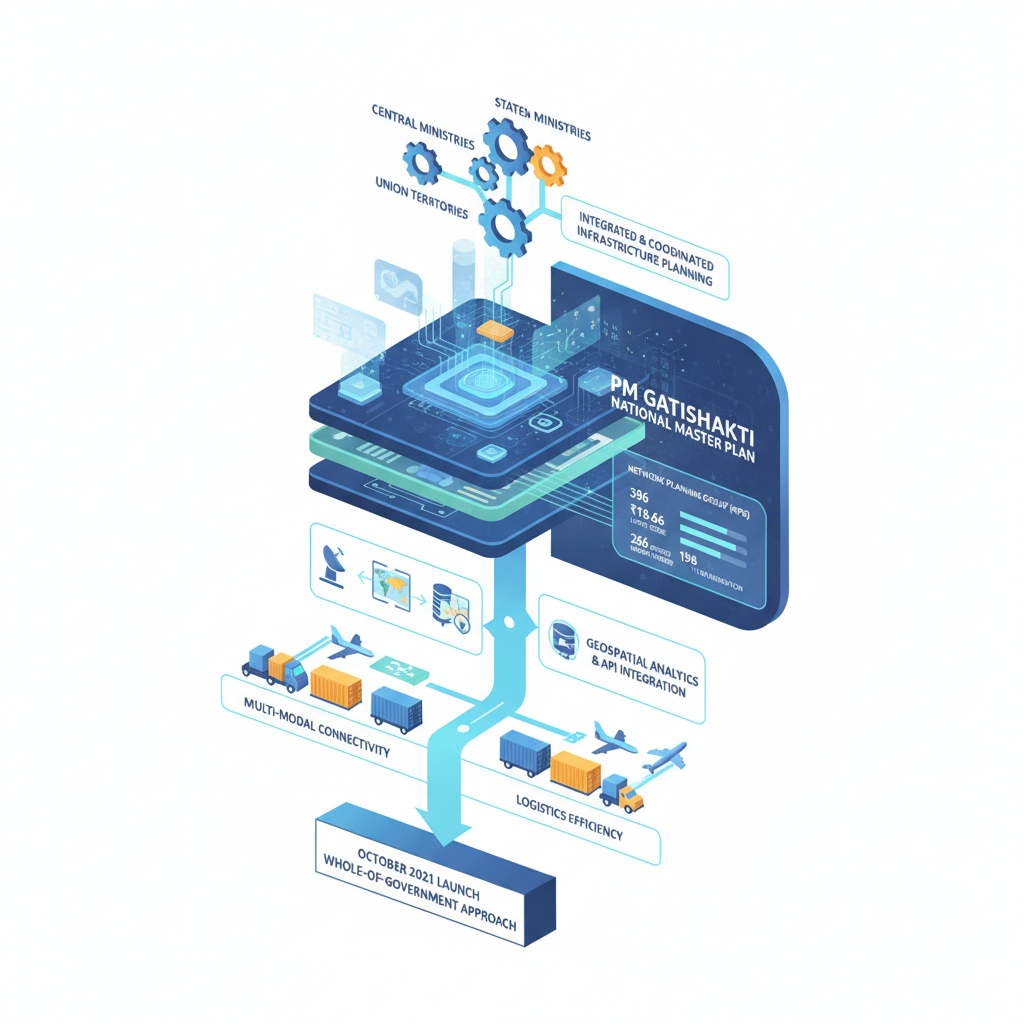
National Master PlanNetwork Planning GroupGeospatial analyticsAPI integrationMulti-modal connectivityLogistics efficiency✎ PM GatiShakti NMP is a geospatial data-driven, multi-ministerial framework for integrated infrastructure planning and execution, evaluated by the Network Planning Group (NPG), with 396 projects worth ₹18.66 lakh crore under…
Subject Relevance — Where This Topic Fits
- GS Paper III — Infrastructure: Energy, Ports, Roads, Railways, Airports, Urban Infrastructure | GS Paper III — Investment Models and PPP | GS Paper III — Logistics Efficiency and Supply Chain Management | GS Paper III — Digital Governance and Geospatial Technologies
- Prelims: PM GatiShakti NMP, Network Planning Group (NPG), Geospatial Data Integration, Multi-modal Connectivity, Logistics Cost as % of GDP, National Logistics Policy, Sagarmala, Bharatmala, Dedicated Freight Corridors, PM GatiShakti Public Platform
- Essay: The Role of Technology in Governance: PM GatiShakti as a Case Study of Integrated Public Service Delivery, Infrastructure as a Catalyst for Economic Growth: Lessons from India’s Holistic Planning Approach
Quick Revision: PM GatiShakti NMP is a geospatial data-driven, multi-ministerial framework for integrated infrastructure planning and execution, evaluated by the Network Planning Group (NPG), with 396 projects worth ₹18.66 lakh crore under assessment.
Why is this in the news?
The PM GatiShakti National Master Plan (NMP) has been highlighted by the Ministry of Commerce and Industry for its role in enabling integrated and coordinated infrastructure planning across central ministries, states, and union territories. The initiative, launched in October 2021, facilitates data-driven decision-making through geospatial analytics and API integration, ensuring seamless multi-modal connectivity and improving logistics efficiency. Recent updates emphasize its operationalization through the Network Planning Group (NPG), which has evaluated 396 projects worth ₹18.66 lakh crore, with 256 approved and 198 under implementation.
Background
- In October 2021, the Government of India launched the PM GatiShakti National Master Plan (NMP) as a transformative ‘whole-of-government’ approach to integrate planning and execution of infrastructure projects across sectors.
- The initiative was conceptualized to address fragmented planning in infrastructure development, which often led to delays, cost overruns, and suboptimal connectivity outcomes.
- Prior to PM GatiShakti, infrastructure projects were planned in silos by individual ministries or states, resulting in inefficiencies such as duplication of efforts, lack of inter-modal synergy, and suboptimal resource allocation.
- The plan leverages geospatial technologies, satellite imagery, and API integrations to provide a unified data platform for real-time monitoring and decision-making in infrastructure development.
- The framework operates without a separate budgetary allocation, integrating existing schemes and funds of ministries and states to achieve synergies in project execution.
- The initiative aligns with broader national objectives such as the National Logistics Policy (2022), Sagarmala, Bharatmala, and the development of dedicated freight corridors to enhance India’s global competitiveness.
What is the PM GatiShakti National Master Plan (NMP)?
- A holistic, integrated infrastructure planning framework launched in October 2021 to ensure seamless multi-modal connectivity across India.
- Operates on a ‘whole-of-government’ principle, bringing together various central ministries/departments and states/union territories under a unified planning and execution mechanism.
- Utilizes geospatial data analytics, satellite imagery, and API integrations to enable real-time monitoring, planning, and optimization of infrastructure projects.
- Facilitates data-driven decision-making by providing ministries and states with actionable insights on project feasibility, resource allocation, and inter-modal connectivity.
- Ensures end-to-end connectivity improvement by integrating social and economic infrastructure projects, including roads, railways, ports, airports, power, petroleum, and telecommunications.
- The Network Planning Group (NPG), a key component of the framework, evaluates major infrastructure projects for multi-modal integration, inter-ministerial coordination, and comprehensive regional development.
- As of August 2026, the NPG has evaluated 396 projects worth approximately ₹18.66 lakh crore, with 256 projects approved and 198 under implementation.
- The framework does not introduce new budgetary provisions but optimizes existing allocations across ministries and states to achieve integrated outcomes.
- Aims to reduce logistics costs, improve ease of doing business, and enhance India’s manufacturing and export competitiveness through improved connectivity and efficiency.
Key Features
| Feature | Significance |
|---|---|
| Integrated National Master Plan (NMP) framework | Provides a unified planning and coordination mechanism across 58 central ministries, 36 states/UTs, and all infrastructure sectors (transport, energy, telecom, etc.) under the ‘Whole of Government’ approach. |
| Geospatial data integration (satellite imagery, APIs) | Enables real-time monitoring, data-driven decision-making, and precision in infrastructure planning, reducing redundancy and optimizing resource allocation. |
| Network Planning Group (NPG) | Evaluates 396 multi-modal projects (₹18.66 lakh crore) for integrated planning, inter-ministerial coordination, and end-to-end connectivity, ensuring alignment with national priorities. |
| PM GatiShakti Public Platform (launched September 2025) | Facilitates public and private sector access to analytics, enhancing transparency, stakeholder collaboration, and evidence-based infrastructure governance. |
| Multi-modal connectivity focus | Aims to reduce logistics costs (7.9% of GDP, per NCAER 2025), improve turnaround times, and enhance business ease of doing business through seamless movement of goods, services, and people. |
Why it Matters
Economic and Logistical Efficiency
- Reduces logistics costs by improving multi-modal connectivity (roads, railways, ports, airports, and pipelines), aligning with global benchmarks (7.9% of GDP, comparable to advanced economies).
- Enhances supply chain resilience and competitiveness by synchronizing infrastructure development across sectors, reducing bottlenecks and transit times.
- Supports domestic manufacturing and export competitiveness, as highlighted in the Economic Survey 2023-24, by enabling just-in-time logistics and industrial corridor integration.
Strategic Infrastructure Development
- Promotes balanced regional development through the integration of hinterland connectivity (e.g., Dedicated Freight Corridors, expressways, and industrial hubs), reducing urban-rural disparities.
- Facilitates energy and telecom infrastructure alignment, ensuring that power and digital networks keep pace with physical connectivity projects.
- Strengthens India’s position in global trade by improving port and hinterland connectivity via initiatives like Sagarmala and Bharatmala.
Governance and Institutional Synergy
- Institutionalizes cross-sectoral and inter-governmental coordination through the NPG, which evaluates projects for technical, economic, and environmental feasibility before approval.
- Leverages geospatial technology to minimize land-use conflicts, environmental degradation, and project delays, ensuring sustainable infrastructure growth.
- Enhances transparency and accountability by providing a centralized data repository (PM GatiShakti Public Platform) for public scrutiny and stakeholder engagement.
Impact on Business Ecosystem
- Reduces transaction costs and improves ease of doing business by streamlining approvals and eliminating siloed planning across ministries and states.
- Supports the development of industrial corridors and logistics parks, attracting private investment and fostering industrial clusters.
- Improves last-mile connectivity, particularly in remote and tribal regions, by prioritizing projects based on data-driven assessments of demand and accessibility.
Challenges
1. Inter-Ministerial Coordination Gaps
- Despite the NPG mechanism, siloed bureaucratic cultures and competing priorities among ministries may delay project approvals or implementation.
- Lack of standardized data-sharing protocols across states and UTs can lead to inconsistencies in project evaluation and execution.
UPSC Link: Mains GS-II: Governance, Cooperative Federalism
2. Geospatial Data Accuracy and Accessibility
- Dependence on high-resolution satellite imagery and APIs requires continuous updates, which may be constrained by budgetary or technological limitations.
- Data privacy concerns and proprietary restrictions on certain geospatial datasets could hinder seamless integration across platforms.
UPSC Link: Mains GS-III: Science & Technology, Data Governance
3. Land Acquisition and Environmental Clearances
- Multi-modal projects often face delays due to land acquisition hurdles, environmental clearances, and rehabilitation challenges, despite integrated planning.
- Balancing infrastructure development with environmental sustainability remains a critical challenge, particularly for linear projects like highways and freight corridors.
UPSC Link: Mains GS-II: Land Reforms, Environmental Governance
4. Public-Private Partnership (PPP) Mobilization
- While the PM GatiShakti framework facilitates private sector participation, attracting investment for long-gestation infrastructure projects remains a challenge due to perceived risks and regulatory uncertainties.
- Ensuring equitable revenue-sharing models and risk mitigation strategies is essential to sustain private sector interest.
UPSC Link: Mains GS-III: Investment Models, Infrastructure Financing
5. Monitoring and Evaluation Framework
- The absence of quantifiable targets or budgetary allocations under PM GatiShakti complicates performance measurement and accountability for outcomes.
- Need for robust third-party audits and real-time progress tracking to ensure that projects meet their intended socio-economic objectives.
UPSC Link: Mains GS-II: Performance Budgeting, Outcome-Based Governance
Challenges — UPSC Perspective
| Issue | Concern |
|---|---|
| Data silos across ministries | Hinders seamless integration and delays decision-making despite the NPG mechanism. |
| Land acquisition bottlenecks | Delays project timelines and increases costs, particularly for linear infrastructure like highways. |
| Environmental compliance | Balancing rapid infrastructure growth with sustainability goals remains a persistent challenge. |
| Private sector participation | Regulatory uncertainties and risk perceptions deter long-term investment in infrastructure projects. |
| Standardized geospatial protocols | Inconsistent data-sharing practices across states/UTs affect project evaluation accuracy. |
Government Initiatives — Must-Memorise for Prelims
- PM GatiShakti National Master Plan (NMP)
- National Logistics Policy (NLP)
- Sagarmala Programme
- Bharatmala Pariyojana
- Dedicated Freight Corridors (DFCs)
Way Forward
- Strengthen inter-ministerial coordination by institutionalizing regular NPG reviews and cross-sectoral task forces to address siloed governance.
- Develop a standardized national geospatial data policy to ensure consistency, accessibility, and privacy compliance across all stakeholders.
- Accelerate land acquisition and environmental clearance processes by leveraging digital land records (e.g., DILRMP) and expedited approval mechanisms.
- Enhance PPP frameworks by introducing viability gap funding, risk-sharing instruments, and transparent bidding processes to attract private investment.
- Establish a real-time monitoring dashboard for all PM GatiShakti projects, with third-party audits to ensure accountability and outcome measurement.
- Expand the PM GatiShakti Public Platform to include multi-lingual interfaces and mobile applications for wider accessibility among rural stakeholders.
- Integrate climate resilience into infrastructure planning by mandating green certification for projects and adopting climate-proofing standards.
- Promote skill development in geospatial technologies and infrastructure governance through partnerships with IITs, NITs, and industry bodies.
UPSC Value Addition
Keywords for Mains Answer-Writing
PM Gati Shakti National Master Plan (NMP) · Holistic Governance · Integrated Infrastructure Planning · Network Planning Group (NPG) · Geospatial Data Analytics · Multi-modal Connectivity · Logistics Efficiency · Ease of Doing Business · National Logistics Policy · Sagarmala and Bharatmala · Dedicated Freight Corridors · Economic Corridors · Logistics Cost Reduction · GDP Multiplier Effect of Infrastructure · Data-Driven Decision Making
Concept Flow
Initiation of PM GatiShakti NMP (October 2021) → Unified ‘Whole of Government’ framework for infrastructure planning. → Geospatial data integration (satellite imagery, APIs) → Real-time monitoring and data-driven decision-making. → Network Planning Group (NPG) evaluation → Multi-modal project assessment for technical, economic, and environmental feasibility. → Approval and implementation by ministries/states → Seamless project execution under existing budgetary provisions. → Public platform launch (September 2025) → Transparency, stakeholder engagement, and accountability enhancement. → Outcome: Reduced logistics costs, improved connectivity, and enhanced business ecosystem competitiveness.
Prelims Practice Questions
Q1. Consider the following statements regarding the PM Gati Shakti National Master Plan (NMP):
1. It is a centrally sponsored scheme with a dedicated budgetary allocation.
2. The Network Planning Group (NPG) evaluates infrastructure projects under the PM Gati Shakti framework.
3. The PM Gati Shakti platform integrates data from multiple ministries for seamless planning.
4. The initiative aims to reduce logistics costs to below 5% of GDP.
How many of the above statements are correct?
- Only one
- Only two
- Only three
- All four
Answer: Only three — Statements 2 and 3 are correct. Statement 1 is incorrect as PM Gati Shakti does not have a separate budgetary provision. Statement 4 is incorrect as the logistics cost is estimated at 7.9% of GDP, not below 5%.
Q2. Assertion (A): The PM Gati Shakti National Master Plan (NMP) employs geospatial technology for integrated infrastructure planning.
Reason (R): The use of satellite imagery and API integration enables real-time monitoring and data-driven decision-making.
Options:
A. Both A and R are true, and R is the correct explanation of A.
B. Both A and R are true, but R is not the correct explanation of A.
C. A is true, but R is false.
D. A is false, but R is true.
Answer: ? — Both Assertion (A) and Reason (R) are true, and Reason (R) correctly explains Assertion (A). The PM Gati Shakti NMP uses geospatial data, satellite imagery, and API integration for integrated planning and monitoring.
Q3. Match the following infrastructure initiatives with their primary objectives:
Column I (Initiative) | Column II (Objective)
———————————————–|————————————————————–
A. Sagarmala | 1. Development of expressways and national highways
B. Bharatmala | 2. Expansion of port-led development and coastal connectivity
C. Dedicated Freight Corridors | 3. Enhancing rail-based freight movement
D. PM Gati Shakti National Master Plan (NMP) | 4. Integrated, multi-modal connectivity across sectors
- A-2, B-1, C-3, D-4
- A-1, B-2, C-3, D-4
- A-3, B-1, C-2, D-4
- A-4, B-3, C-1, D-2
Answer: A-2, B-1, C-3, D-4 — Sagarmala (A) focuses on port-led development (2). Bharatmala (B) aims at expressways and highways (1). Dedicated Freight Corridors (C) enhance rail-based freight movement (3). PM Gati Shakti NMP (D) integrates multi-modal connectivity (4).
Mains Practice Question
✍ The PM Gati Shakti National Master Plan (NMP) represents a paradigm shift in India’s infrastructure planning by adopting a ‘whole-of-government’ approach. Critically examine its key features, institutional mechanisms, and the challenges in achieving its objectives. (15 Marks)
Approach: MODEL-ANSWER SKELETON:
1. **Introduction** (2 marks): Define PM Gati Shakti NMP and its launch (October 2021). Emphasise its objective: integrated, multi-modal infrastructure planning to enhance connectivity, reduce logistics costs, and improve ease of doing business.
2. **Key Features** (4 marks):
– ‘Whole-of-government’ approach: Integration of 58 ministries/departments and 36 states/UTs.
– Use of geospatial technology: Satellite imagery, API integration, and data analytics for real-time monitoring and planning.
– Focus on multi-modal connectivity: Roads, railways, ports, airports, telecom, and power sectors.
– Network Planning Group (NPG): Evaluates projects (396 projects worth ₹18.66 lakh crore, 256 approved, 198 under implementation).
– No separate budgetary allocation: Projects are funded under existing schemes of ministries/states.
3. **Institutional Mechanisms** (4 marks):
– PM Gati Shakti National Master Plan Secretariat: Coordination among ministries.
– NPG: Multi-disciplinary body chaired by the CEO, NITI Aayog; includes representatives from infrastructure ministries.
– PM Gati Shakti Public Platform: Launched in September 2025 for data analytics and public access.
– Role of NITI Aayog and state governments in aligning regional and national priorities.
4. **Challenges and Criticisms** (4 marks):
– **Coordination Gaps**: Siloed approach persists despite the framework; inter-ministerial delays.
– **Data Quality and Integration**: Inconsistencies in geospatial data across states/UTs.
– **Implementation Bottlenecks**: Land acquisition, environmental clearances, and funding constraints.
– **Monitoring and Evaluation**: Need for robust feedback mechanisms to assess impact on logistics efficiency and GDP growth.
– **Stakeholder Engagement**: Limited participation of private sector and local bodies in planning.
5. **Conclusion** (1 mark): Summarise the transformative potential of PM Gati Shakti NMP while acknowledging the need for sustained institutional reforms, capacity building, and stakeholder collaboration to realise its vision of a ‘connected and competitive India’.
Source: PIB (Press Information Bureau)
Generated by AanyaAi for educational purpose.


No Comments