


11 Aug PM GatiShakti NMP: Integrated Infrastructure Planning for UPSC & State PCS
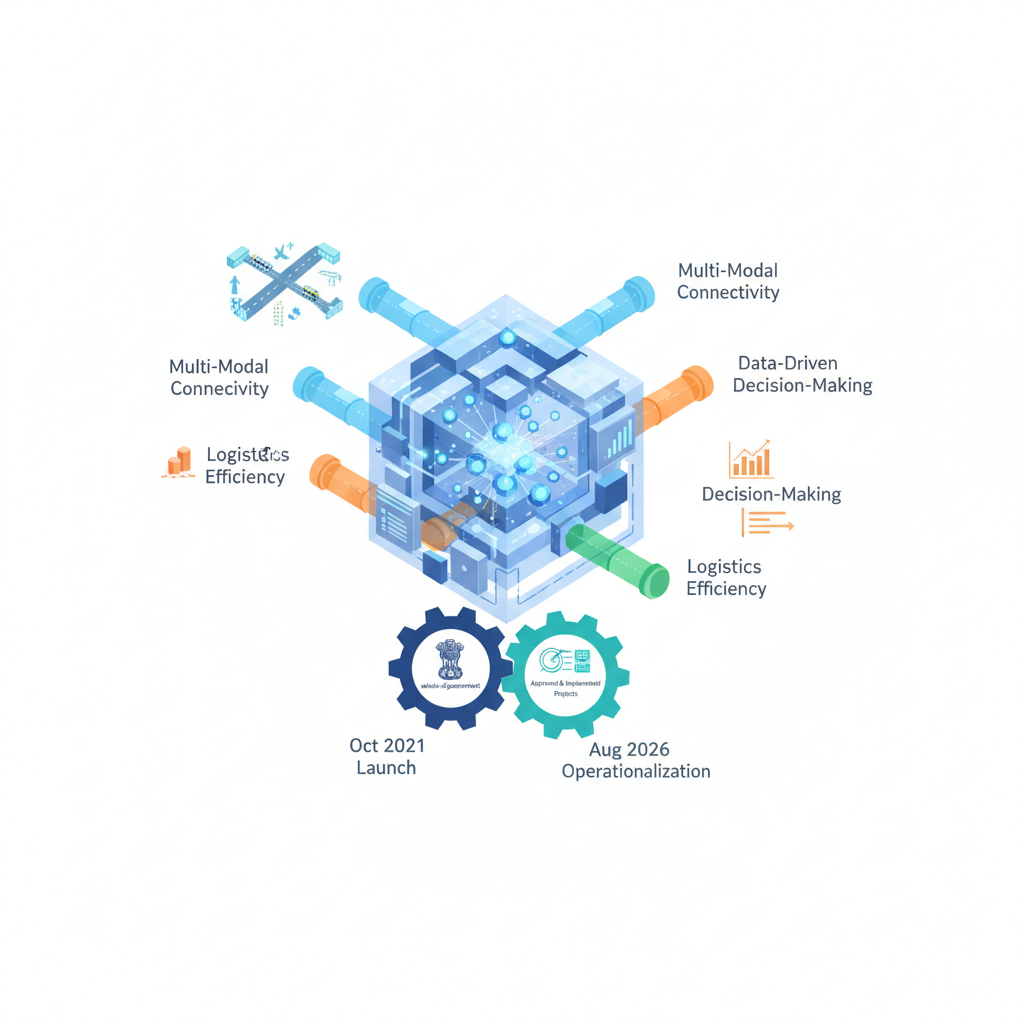
PM GatiShakti NMPMulti-modal connectivityData-driven planningLogistics efficiency✎ PM GatiShakti NMP is an integrated, data-driven framework for multi-modal infrastructure planning that synchronises ministries and states to enhance logistics efficiency and last-mile connectivity without additional budgetary…
Subject Relevance — Where This Topic Fits
- GS Paper II — Governance, Constitution, Polity, Social Justice and International Relations (Policy Frameworks and Implementation) | GS Paper III — Infrastructure, Investment Models, Logistics, Transport, Economic Development
- Prelims: PM GatiShakti NMP, Network Planning Group (NPG), National Logistics Policy, Sagarmala, Dedicated Freight Corridors, Multi-modal connectivity, Logistics cost as % of GDP, Geospatial data integration, PM GatiShakti Public Platform
- Essay: Infrastructure-led economic growth: The role of integrated planning in India’s development, Logistics efficiency and global competitiveness: Lessons from PM GatiShakti
Quick Revision: PM GatiShakti NMP is an integrated, data-driven framework for multi-modal infrastructure planning that synchronises ministries and states to enhance logistics efficiency and last-mile connectivity without additional budgetary provisions.
Why is this in the news?
The Press Information Bureau (PIB) released an official update on 11 August 2026 highlighting the operationalisation and outcomes of the PM GatiShakti National Master Plan (NMP), particularly its role in enabling integrated and coordinated infrastructure planning across ministries, states, and union territories. The update underscores the framework’s contribution to seamless multi-modal connectivity, data-driven decision-making, and improved logistics efficiency, with quantified assessments of approved and implemented projects under the initiative.
Background
- In October 2021, the Government of India launched the PM GatiShakti National Master Plan (NMP) as a transformative ‘whole-of-government’ approach to integrate infrastructure planning and execution across central ministries, state governments, and union territories.
- The initiative was conceived to address fragmentation in infrastructure development by fostering multi-sectoral coordination, reducing project gestation periods, and enhancing last-mile connectivity.
- PM GatiShakti NMP operates without a separate budgetary allocation, functioning as a planning framework that leverages existing schemes and funds of participating ministries and states.
- The framework integrates geospatial data, satellite imagery, and API-based systems to enable real-time monitoring, planning, and optimisation of infrastructure projects.
- Key supporting policies and initiatives such as the National Logistics Policy (2022), Sagarmala Programme, and Dedicated Freight Corridors (DFCs) align with PM GatiShakti to enhance logistics efficiency and economic competitiveness.
What is the PM GatiShakti National Master Plan (NMP)?
- A holistic, data-driven infrastructure planning framework launched in October 2021 to integrate and synchronise development across roads, railways, ports, airports, power, petroleum, telecom, and industrial corridors.
- Utilises geospatial technology, satellite imagery, and API integrations to provide a unified platform for monitoring, planning, and optimising infrastructure projects in real time.
- Facilitates seamless multi-modal connectivity by synchronising social and economic infrastructure projects to reduce travel time, improve logistics efficiency, and enhance business ease.
- Operates through the Network Planning Group (NPG), which evaluates major infrastructure projects to ensure multi-modal integration, inter-ministerial coordination, and last-mile connectivity.
- Approximately 396 infrastructure projects with an estimated total cost of ₹18.66 lakh crore have been evaluated by the NPG, of which 256 projects have been approved and 198 are under implementation as of August 2026.
- The framework does not introduce new budgetary allocations but aligns existing funds and schemes of participating ministries and states to achieve integrated outcomes.
Key Features
| Feature | Significance |
|---|---|
| Holistic Government Approach | Integrates 58 central ministries, 36 states/UTs, and all infrastructure sectors into a unified planning framework under PM GatiShakti NMP. |
| Geospatial Data Integration | Uses satellite imagery, APIs, and GIS to enable data-driven decision-making for infrastructure development and monitoring. |
| Network Planning Group (NPG) | Evaluates 396 projects (₹18.66 lakh crore) for multi-modal connectivity, inter-ministerial synergy, and end-to-end integration. |
| Seamless Multi-Modal Connectivity | Ensures coordinated planning of roads, railways, ports, airports, and logistics corridors to reduce travel time and improve business efficiency. |
| PM GatiShakti Public Platform (UGI) | Provides open access to analytics for private entities and citizens, enhancing transparency and stakeholder participation. |
Why it Matters
Economic Efficiency
- Reduces logistics cost to 7.9% of GDP (2025 estimate by NCAER), aligning with advanced economies and improving export competitiveness.
- National Highway investments generate ₹3.2 GDP growth per ₹1 spent (IIM Bangalore study), demonstrating high multiplier effect.
- Enhances business ease-of-doing-business by synchronising infrastructure approvals and reducing project gestation periods.
Strategic Infrastructure
- Accelerates development of Dedicated Freight Corridors, Industrial Corridors, and multimodal logistics hubs for industrial decentralisation.
- Supports ‘Make in India’ and ‘Atmanirbhar Bharat’ by ensuring reliable last-mile connectivity for manufacturing and exports.
- Integrates energy (power, petroleum), telecommunications, and civil aviation sectors for resilient supply chains.
Governance & Coordination
- Eliminates siloed planning through inter-ministerial and Centre-State collaboration, reducing duplication and inter-departmental delays.
- Leverages digital public infrastructure (DPI) for real-time monitoring and evidence-based policy adjustments.
- Facilitates ‘whole-of-government’ approach under Article 263 (Inter-State Council) principles for cooperative federalism.
Sustainability & Inclusivity
- Promotes balanced regional development by prioritising connectivity in hinterlands and aspirational districts.
- Supports green logistics through optimised freight movement and reduced carbon footprint in transport networks.
Challenges
1. Data Quality & Interoperability
- Fragmented geospatial datasets across ministries may lead to inconsistencies in planning and delays in implementation.
- Need for standardised APIs and data-sharing protocols to ensure seamless integration across government agencies.
UPSC Link: GS-III: Infrastructure
2. Implementation Bottlenecks
- Land acquisition and environmental clearances remain critical hurdles despite integrated planning frameworks.
- Coordination gaps between Centre and States in project execution, particularly for state-funded components.
UPSC Link: GS-II: Federalism
3. Financial Sustainability
- Reliance on existing budgetary allocations without dedicated PM GatiShakti funds may limit scalability of high-impact projects.
- Need for innovative financing models (e.g., viability gap funding, public-private partnerships) to bridge resource gaps.
UPSC Link: GS-III: Investment Models
4. Stakeholder Engagement
- Limited awareness among local governments and private sector about PM GatiShakti platform and its benefits.
- Ensuring real-time feedback from industry and citizens to refine planning and address ground-level challenges.
UPSC Link: GS-II: Governance
5. Technological Adoption
- Digital divide in rural and remote areas may hinder effective use of geospatial tools and public platform.
- Cybersecurity risks in handling sensitive infrastructure data require robust governance frameworks.
UPSC Link: GS-III: Science & Tech
Challenges — UPSC Perspective
| Issue | Concern |
|---|---|
| Data Fragmentation | Inconsistent geospatial datasets across ministries delay integrated planning. |
| Land Acquisition Delays | Protracted clearances for linear infrastructure (e.g., highways, railways) stall projects. |
| Centre-State Coordination | Divergent priorities between Union and State governments lead to implementation gaps. |
| Budgetary Constraints | Reliance on existing allocations limits PM GatiShakti’s ability to fund transformative projects. |
| Digital Literacy Gaps | Low awareness among local stakeholders reduces platform utilisation and feedback loops. |
| Environmental Clearances | Stringent compliance requirements for greenfield projects increase project timelines. |
Government Initiatives — Must-Memorise for Prelims
- PM GatiShakti National Master Plan (NMP)
- National Logistics Policy (NLP)
- Sagarmala
- Pradhan Mantri Gram Sadak Yojana (PMGSY) (for rural connectivity linkage)
- Bharatmala Pariyojana
Way Forward
- Strengthen inter-ministerial data-sharing protocols to ensure real-time geospatial integration and reduce planning redundancies.
- Fast-track land acquisition and environmental clearances through digital dashboards and single-window clearance mechanisms.
- Introduce viability gap funding and blended finance models to supplement budgetary allocations for high-impact projects.
- Expand PM GatiShakti Public Platform’s outreach to local governments, MSMEs, and rural stakeholders via multilingual campaigns.
- Establish a dedicated PM GatiShakti Innovation Fund to pilot emerging technologies (e.g., AI for demand forecasting, blockchain for land records).
- Conduct periodic third-party audits of NPG’s project evaluations to enhance transparency and accountability in approvals.
- Integrate PM GatiShakti with state-level logistics plans (e.g., State Logistics Policy) to align national and sub-national priorities.
- Develop a national logistics cost dashboard, updated biennially, to track progress against 7.9% GDP target and inform policy corrections.
UPSC Value Addition
Keywords for Mains Answer-Writing
PM Gati Shakti National Master Plan (PMGS-NMP) · Integrated Infrastructure Planning Framework · Network Planning Group (NPG) · Logistics Efficiency and Cost Reduction · Multi-modal Connectivity · Geospatial Data Utilisation in Governance · National Logistics Policy · Economic Survey 2023-24 on Infrastructure · Multi-Ministry Coordination Mechanism · Infrastructure Investment and GDP Growth Correlation
Constitutional & Policy Linkages
- Article 263: Inter-State Council for Centre-State coordination in infrastructure planning.
- Article 298: Power of Union and States to carry on trade or business for economic development.
- Seventh Schedule: Concurrent List (Entry 20: Economic and Social Planning) for integrated governance.
Concept Flow
Initiation of PM GatiShakti NMP (October 2021) → Holistic Government Approach → Integration of 58 ministries and 36 states/UTs → Geospatial Data Integration & NPG Evaluation → 396 projects (₹18.66 lakh crore) assessed for multi-modal connectivity → Seamless Multi-Modal Planning → Roads, Railways, Ports, Airports, and Logistics Corridors synchronised → Implementation & Monitoring → 256 projects approved; 198 under execution with reduced travel time and logistics costs → Public Platform Launch (September 2025) → Transparency and stakeholder engagement enhanced → Economic Impact → Logistics cost reduction to 7.9% GDP; GDP multiplier effect of infrastructure investments → Feedback Loop → Third-party audits and innovation fund to address challenges and refine framework
Prelims Practice Questions
Q1. Consider the following statements regarding the PM Gati Shakti National Master Plan (PMGS-NMP):
1. The PMGS-NMP is implemented through a dedicated budgetary allocation under the Ministry of Finance.
2. The Network Planning Group (NPG) evaluates central government infrastructure projects under the PMGS-NMP framework.
3. The PMGS-NMP utilises geospatial data and satellite imagery for infrastructure planning and monitoring.
How many of the above statements are correct?
- Only one
- Only two
- All three
- None
Answer: Only two — Statement 1 is incorrect: PMGS-NMP does not have a separate budgetary provision; projects are approved under existing schemes of ministries/departments. Statements 2 and 3 are correct as per the PMGS-NMP framework and its operational mechanisms.
Q2. Assertion (A): The PM Gati Shakti National Master Plan (PMGS-NMP) aims to improve logistics efficiency and reduce costs in India.
Reason (R): The Economic Survey 2023-24 highlights that integrated infrastructure planning initiatives like PMGS-NMP have contributed to enhancing domestic manufacturing and export competitiveness.
In the context of the above two statements, which one of the following is correct?
- Both A and R are true, and R is the correct explanation of A
- Both A and R are true, but R is not the correct explanation of A
- A is true, but R is false
- A is false, but R is true
Answer: Both A and R are true, and R is the correct explanation of A — Both Assertion (A) and Reason (R) are true. The PMGS-NMP is designed to enhance logistics efficiency and reduce costs. The Economic Survey 2023-24 explicitly states that such integrated planning initiatives have improved domestic manufacturing and export competitiveness, directly linking to the objectives of PMGS-NMP.
Q3. Match the following initiatives with their primary objectives:
Column I (Initiative) | Column II (Primary Objective)
— | —
A. PM Gati Shakti National Master Plan | 1. Development of dedicated freight corridors and industrial corridors
B. Sagarmala Programme | 2. Enhancing port-led development and coastal connectivity
C. Bharatmala Pariyojana | 3. Integrated planning and multi-modal connectivity for seamless logistics
D. Dedicated Freight Corridors | 4. Expansion of national highways and road connectivity
Choose the correct match:
- A-3, B-2, C-4, D-1
- A-1, B-3, C-2, D-4
- A-4, B-1, C-3, D-2
- A-2, B-4, C-1, D-3
Answer: A-3, B-2, C-4, D-1 — A-3: PM Gati Shakti NMP focuses on integrated planning and multi-modal connectivity. B-2: Sagarmala Programme aims at port-led development and coastal connectivity. C-4: Bharatmala Pariyojana is primarily for the expansion of national highways and road connectivity. D-1: Dedicated Freight Corridors are developed to enhance freight movement efficiency and industrial corridor development.
Mains Practice Question
✍ The PM Gati Shakti National Master Plan (PMGS-NMP) represents a paradigm shift from sectoral silos to a holistic, data-driven approach in infrastructure planning. Critically examine the institutional mechanisms, technological tools, and governance reforms under PMGS-NMP that enable this transformation. Also, analyse the challenges in its implementation and suggest measures to enhance its effectiveness. (15 Marks)
Approach: MODEL-ANSWER SKELETON:
1. **Institutional Mechanisms**:
– **Multi-Ministry Coordination**: Role of the Network Planning Group (NPG) in evaluating 396 projects (~₹18.66 lakh crore) across 58 ministries/departments and 36 states/UTs. Highlight the ‘whole-of-government’ approach.
– **Federalism**: Inclusion of states/UTs in the planning process; cite the example of 256 approved projects (198 under implementation).
2. **Technological Tools**:
– **Geospatial Data Utilisation**: Use of satellite imagery, GIS, and API integration for real-time monitoring and planning. Reference the PM Gati Shakti Public Platform (launched September 2025) for data analytics and stakeholder access.
– **Data-Driven Decision Making**: How geospatial data improves route optimisation, reduces logistics costs (e.g., India’s logistics cost at 7.9% of GDP, per NCAER 2025), and enhances turnaround time.
3. **Governance Reforms**:
– **Integrated Planning Framework**: PMGS-NMP provides a unified framework without separate budgetary allocation, leveraging existing schemes of ministries/departments.
– **Multi-Modal Connectivity**: Focus on seamless integration of roads, railways, ports, aviation, and telecom to reduce travel time and improve last-mile connectivity.
4. **Challenges in Implementation**:
– **Inter-Ministerial Coordination**: Delays due to bureaucratic silos, lack of standardised data-sharing protocols, and competing priorities among ministries.
– **State-Level Implementation**: Variability in state capacities, land acquisition hurdles, and regulatory bottlenecks.
– **Technological Gaps**: Limited adoption of geospatial tools in some states/UTs; need for capacity building.
– **Monitoring and Evaluation**: Ensuring real-time tracking of project progress and addressing data gaps.
5. **Measures to Enhance Effectiveness**:
– **Strengthening NPG**: Expand the NPG’s mandate to include post-implementation audits and performance benchmarking.
– **Capacity Building**: Training programmes for state officials on geospatial tools and integrated planning.
– **Data Standardisation**: Develop a national geospatial data repository with APIs for seamless integration across ministries.
– **Public-Private Partnerships (PPPs)**: Encourage private sector participation in data analytics and infrastructure monitoring.
– **Legal and Policy Reforms**: Streamline land acquisition processes and align state-level policies with PMGS-NMP objectives.
6. **Evidence-Based Outcomes**:
– Cite studies (e.g., IIM Bangalore) showing that every ₹1 spent on national highway development yields ₹3.2 in GDP growth.
– Reference Economic Survey 2023-24 on improved logistics efficiency and export competitiveness.
7. **Balanced View**:
– Acknowledge successes (e.g., 198 projects under implementation) while critiquing challenges (e.g., inter-ministerial delays).
– Highlight the need for sustained political will and institutional accountability.
Source: PIB (Press Information Bureau)
Generated by AanyaAi for educational purpose.


No Comments