


01 Sep PM Modi at SCO Summit: Condemns Terrorism Double Standards
✎ The SCO is a Eurasian regional organisation that prioritises counter-terrorism, connectivity, and people-to-people cooperation, with India advocating for a rules-based approach to regional security and economic integration.
Subject Relevance — Where This Topic Fits
- GS Paper II — International Relations: Regional and global groupings involving India and/or affecting India’s interests | GS Paper II — Bilateral, Regional and Global Groupings and Agreements involving India and/or affecting India’s interests | GS Paper II — India’s Foreign Policy: Objectives, Principles, and Contemporary Challenges
- Prelims: Shanghai Cooperation Organisation (SCO), Council of Heads of State (SCO-CHS), Counter-Terrorism Cooperation Framework (SCO-RATS), SCO Start-up Forum, SCO Young Scientists’ Forum, SCO Civilisational Dialogue Forum, SCO membership: 10 full members, 2 observers, 15 dialogue partners
- Essay: The Role of Multilateral Institutions in Addressing Global Challenges: A Case Study of the SCO, Balancing Sovereignty and Connectivity: Lessons from Regional Cooperation Initiatives
Quick Revision: The SCO is a Eurasian regional organisation that prioritises counter-terrorism, connectivity, and people-to-people cooperation, with India advocating for a rules-based approach to regional security and economic integration.
Why is this in the news?
Prime Minister Narendra Modi’s address at the 26th Meeting of the Council of Heads of State of the Shanghai Cooperation Organisation (SCO) in Bishkek, Kyrgyzstan, on 1 September 2026, underscored India’s strategic priorities within the SCO framework. The Prime Minister articulated India’s stance on counter-terrorism, emphasising the need to dismantle the entire ecosystem of terrorism, including financing, recruitment, radicalisation, and safe havens, while rejecting any double standards in addressing this global threat. Additionally, he highlighted India’s vision for the SCO centred on security, connectivity, and opportunity, reaffirming India’s commitment to resolving conflicts through dialogue and diplomacy and promoting people-to-people ties. The address also marked the announcement of the first session of the SCO Civilisational Dialogue Forum in India, reflecting India’s emphasis on cultural and civilisational cooperation within the organisation.
Background
- The Shanghai Cooperation Organisation (SCO) was established in 2001 in Shanghai, China, by the leaders of China, Kazakhstan, Kyrgyzstan, Russia, Tajikistan, and Uzbekistan. It evolved from the Shanghai Five grouping, which was formed in 1996 to address border security issues.
- India and Pakistan became full members of the SCO in 2017, expanding the organisation’s geographical and geopolitical footprint. The SCO now includes 10 full members: Belarus, India, Iran, Kazakhstan, China, Kyrgyzstan, Pakistan, Russia, Tajikistan, and Uzbekistan.
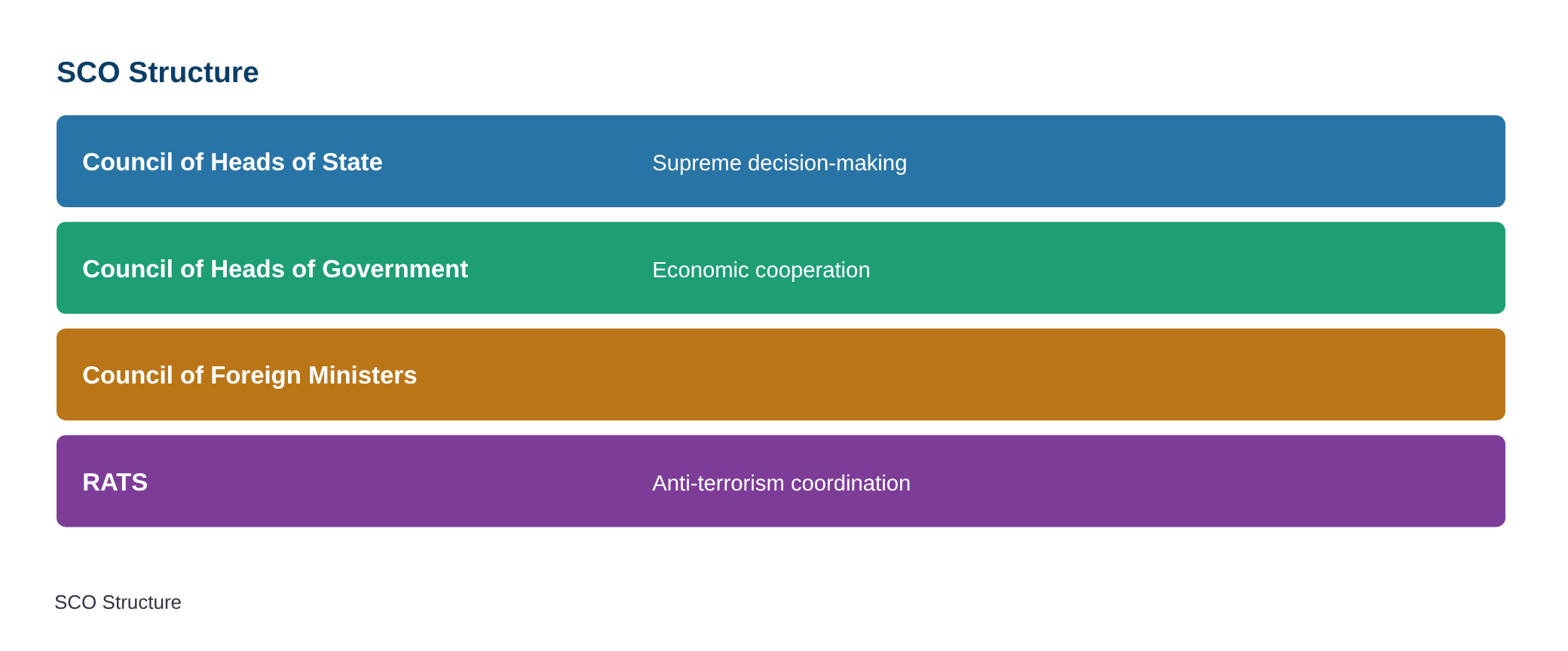
- The SCO operates through several mechanisms, including the Council of Heads of State (the supreme decision-making body), the Council of Heads of Government (for economic cooperation), the Council of Foreign Ministers, and the Regional Anti-Terrorist Structure (RATS), which coordinates counter-terrorism efforts among member states.
- India has consistently advocated for a rules-based international order and has used the SCO platform to address issues such as counter-terrorism, connectivity, and cultural diplomacy, aligning with its broader foreign policy objectives of strategic autonomy and multi-alignment.
- The SCO summit in Bishkek in 2026 follows a period of heightened geopolitical tensions and evolving global security paradigms, including the rise of transnational terrorism, cyber threats, and the need for resilient supply chains in the post-pandemic era.
- The SCO’s emphasis on connectivity aligns with India’s initiatives such as the International North-South Transport Corridor (INSTC) and the Chabahar Port, which aim to enhance trade and economic integration in the Eurasian region.
What is the Shanghai Cooperation Organisation (SCO)?
- The Shanghai Cooperation Organisation (SCO) is a permanent intergovernmental international organisation established to address regional security, economic cooperation, and cultural exchanges among its member states.
- The SCO’s primary objectives include strengthening mutual trust and neighbourliness among member states, promoting effective cooperation in political, trade, economic, scientific, technical, cultural, and educational spheres, and maintaining and ensuring peace, security, and stability in the region.
- The SCO operates through several institutional mechanisms, including the Council of Heads of State (the apex body), the Council of Heads of Government, the Council of Foreign Ministers, and the Regional Anti-Terrorist Structure (RATS), which is tasked with coordinating counter-terrorism efforts among member states.
- The SCO’s observer states include Azerbaijan and Armenia, while its dialogue partners encompass a diverse range of countries, including Azerbaijan, Armenia, Egypt, Cambodia, Qatar, Kuwait, Laos, Maldives, Myanmar, Nepal, UAE, Saudi Arabia, Turkey and Sri Lanka, indicating the organisation’s outreach beyond its core membership.
- The SCO’s focus on counter-terrorism is institutionalised through the Regional Anti-Terrorist Structure (RATS), which facilitates intelligence-sharing, joint exercises, and capacity-building among member states to combat terrorism, separatism, and extremism.
- The SCO’s emphasis on connectivity aligns with global initiatives such as the Belt and Road Initiative (BRI), though member states have differing approaches to infrastructure development and trade facilitation, reflecting the organisation’s diversity and strategic autonomy.
- The SCO’s cultural and civilisational initiatives, such as the SCO Civilisational Dialogue Forum, aim to promote mutual understanding and cooperation among member states by highlighting shared historical, cultural, and civilisational ties.
Key Features
| Feature | Significance |
|---|---|
| Call for unified anti-terrorism stance | Reinforces India’s position on non-negotiable principles in counter-terrorism cooperation within multilateral forums. |
| Dismantling terrorism ecosystem | Emphasises addressing financing, recruitment, radicalisation, and safe havens as a holistic security strategy. |
| SCO Civilisational Dialogue Forum | Proposes a platform for cultural and civilisational exchanges to foster long-term people-to-people ties. |
| Connectivity with sovereignty safeguards | Advocates for trade and infrastructure linkages while respecting territorial integrity and national sovereignty. |
| Diplomacy over military solutions | Reiterates India’s preference for dialogue and negotiation in resolving international disputes. |
Why it Matters
Security Architecture
- Highlights the need for a collective and unambiguous stance against terrorism, addressing gaps in multilateral counter-terrorism frameworks.
- Underscores the importance of addressing cross-border terrorism and state-sponsored safe havens as a regional security imperative.
- Reinforces India’s role in shaping global counter-terrorism narratives within the SCO, a grouping with diverse geopolitical interests.
Economic Diplomacy
- Positions connectivity as a tool for regional integration, while ensuring it does not compromise sovereignty or territorial integrity.
- Promotes trade facilitation and market linkages as engines for economic growth, aligning with India’s Act East Policy.
- Showcases India’s soft power through initiatives like the Start-up Forum and Young Scientists’ Forum to foster long-term partnerships.
Geopolitical Positioning
- Demonstrates India’s proactive engagement in Central Asia through the SCO, balancing its strategic interests with regional stakeholders.
- Reinforces India’s commitment to multilateralism while advocating for a rules-based order in counter-terrorism and connectivity.
- Highlights India’s civilisational diplomacy as a bridge between diverse cultural and ideological blocs within the SCO.
Challenges
1. DIVERGENT NATIONAL INTERESTS
- SCO members hold varied perspectives on terrorism, with some states prioritising sovereignty over collective action.
- Geopolitical rivalries (e.g., India-Pakistan, China-India) may hinder consensus on counter-terrorism measures.
- Economic and strategic interests often overshadow security commitments, complicating unified policy responses.
UPSC Link: GS II: Regional Groupings
2. TERRORISM FINANCING & SAFE HAVENS
- Cross-border terror financing networks remain resilient due to weak regulatory frameworks in certain SCO states.
- State sponsorship of terrorism persists, with safe havens providing operational freedom to non-state actors.
- Limited intelligence-sharing mechanisms hinder coordinated crackdowns on terror financing and recruitment.
UPSC Link: GS III: Internal Security
3. CONNECTIVITY VS. SOVEREIGNTY TRADE-OFFS
- Infrastructure projects (e.g., CPEC) often disregard territorial disputes, exacerbating regional tensions.
- Economic corridors may inadvertently facilitate illicit flows (e.g., arms, drugs) if governance is weak.
- Balancing connectivity with sovereignty requires robust legal frameworks and mutual trust.
UPSC Link: GS II: Bilateral Groupings
4. PEOPLE-TO-PEOPLE TIES LIMITATIONS
- Cultural and civilisational exchanges face logistical and bureaucratic hurdles, limiting grassroots engagement.
- Language barriers and visa regimes restrict mobility, undermining the efficacy of dialogue forums.
- Historical grievances and political narratives may impede genuine cultural cooperation.
UPSC Link: GS II: Global Groupings
Challenges — UPSC Perspective
| Issue | Concern |
|---|---|
| State-sponsored terrorism | Safe havens and tacit support for non-state actors undermine regional security. |
| Divergent counter-terrorism definitions | Varied interpretations of terrorism hinder consensus on joint action. |
| Infrastructure connectivity risks | Projects may inadvertently strengthen adversarial logistics or illicit networks. |
| Intelligence-sharing gaps | Lack of standardised frameworks delays coordinated counter-terrorism operations. |
| Cultural diplomacy bottlenecks | Bureaucratic and political barriers limit the impact of people-to-people initiatives. |
Way Forward
- Strengthen SCO’s Regional Anti-Terrorism Structure (RATS) with binding commitments and real-time intelligence sharing.
- Develop a standardised definition of terrorism within SCO to eliminate ambiguities in counter-terrorism cooperation.
- Establish a dedicated fund for counter-terrorism financing, with stringent audits and regulatory oversight.
- Promote bilateral and plurilateral agreements on infrastructure connectivity, incorporating sovereignty safeguards.
- Expand the SCO Civilisational Dialogue Forum to include grassroots participation, bypassing bureaucratic hurdles.
- Enhance cybersecurity cooperation within SCO to address digital radicalisation and terror financing via cryptocurrencies.
- Advocate for a SCO-led early-warning mechanism to preempt terror attacks and disrupt financing networks.
UPSC Value Addition
Keywords for Mains Answer-Writing
Shanghai Cooperation Organisation (SCO) · Counter-terrorism cooperation · Security architecture in Eurasia · Transnational terrorism · SCO Bishkek Summit 2026 · India’s SCO vision · SCO pillars: Security, Connectivity, Opportunity · SCO Civilisational Dialogue Forum · People-to-people ties in SCO · Sovereignty and territorial integrity in international relations · SCO member states and observer states · SCO dialogue partners · Diplomacy over military solutions
Constitutional & Policy Linkages
- [‘Article 51 (Fundamental Duties)’, ‘Promotion of international peace and security.’]
Concept Flow
Cross-border terrorism → State-sponsored safe havens → Divergent national interests → Weak multilateral counter-terrorism frameworks → Call for unified stance at SCO → Terror financing and radicalisation → Weak governance in SCO states → Persistent security threats → Need for holistic ecosystem dismantling → Economic connectivity initiatives → Sovereignty concerns → Risk of illicit flows → Balancing growth with security → People-to-people ties → Cultural diplomacy → Long-term trust-building → SCO Civilisational Dialogue Forum → Diplomatic resolution of conflicts → Preference for dialogue over military action → Reinforcement of multilateralism → SCO’s geopolitical diversity → Policy divergences → Challenges in consensus-building → Need for binding frameworks
Prelims Practice Questions
Q1. Consider the following statements regarding the Shanghai Cooperation Organisation (SCO):
1. The SCO comprises 10 member states, including India and Pakistan.
2. Belarus and Iran are observer states of the SCO.
3. The SCO was established in 2001 with the signing of the Shanghai Convention.
4. The SCO’s primary focus is on economic cooperation and does not address security issues.
How many of the above statements are correct?
- Only one
- Only two
- Only three
- All
Answer: Only three — Statements 1 and 3 are correct. The SCO comprises 10 member states, including India and Pakistan. The SCO was established in 2001 with the signing of the Shanghai Convention. Statement 2 is incorrect as Belarus and Iran are member states, not observer states. Statement 4 is incorrect as the SCO addresses both security and economic cooperation.
Q2. Assertion (A): The Prime Minister of India, during the 26th SCO Summit in Bishkek, emphasized the need for a unified stance against terrorism.
Reason (R): The SCO has no mechanism to address transnational terrorism and relies solely on bilateral agreements between member states.
Options:
A. Both A and R are true, and R is the correct explanation of A.
B. Both A and R are true, but R is not the correct explanation of A.
C. A is true, but R is false.
D. A is false, but R is true.
- A
- B
- C
- D
Answer: C — Assertion (A) is true as the Prime Minister did emphasize a unified stance against terrorism. Reason (R) is false as the SCO has institutional mechanisms, such as the Regional Anti-Terrorist Structure (RATS), to address transnational terrorism.
Q3. Match the following initiatives proposed by India within the SCO with their respective domains:
Column I (Initiative) | Column II (Domain)
———————-|——————
A. Start-up Forum | 1. Cultural exchange
B. Young Authors’ Conclave | 2. Economic cooperation
C. SCO Civilisational Dialogue Forum | 3. Youth engagement
D. Regional Anti-Terrorist Structure (RATS) | 4. Security cooperation
Options:
A. A-2, B-3, C-1, D-4
B. A-3, B-2, C-1, D-4
C. A-1, B-3, C-2, D-4
D. A-2, B-1, C-3, D-4
- A
- B
- C
- D
Answer: A — A. Start-up Forum aligns with economic cooperation (2). B. Young Authors’ Conclave aligns with youth engagement (3). C. SCO Civilisational Dialogue Forum aligns with cultural exchange (1). D. Regional Anti-Terrorist Structure (RATS) aligns with security cooperation (4).
Mains Practice Question
✍ The Shanghai Cooperation Organisation (SCO) represents a critical platform for addressing transnational threats such as terrorism while fostering economic connectivity and cultural exchanges. Critically analyse India’s vision for the SCO as articulated during the 26th SCO Summit in Bishkek, 2026. In your response, examine the pillars of Security, Connectivity, and Opportunity, and evaluate the challenges to their implementation. (15 Marks)
Approach: MODEL-ANSWER SKELETON:
1. **Introduction (2 marks)**
– Briefly define the SCO, its membership (10 member states, 2 observer states, 15 dialogue partners), and its foundational objectives (Shanghai Convention, 2001).
– Highlight India’s engagement with the SCO since its accession in 2017.
2. **India’s Vision for the SCO (6 marks)**
– **Security Pillar**:
– India’s emphasis on dismantling the “ecosystem of terrorism” (financing, recruitment, radicalisation, safe havens).
– Reference to India’s proposal for a unified stance against terrorism and the role of the Regional Anti-Terrorist Structure (RATS).
– Challenges: Differing national priorities, geopolitical rivalries (e.g., India-Pakistan tensions), and the lack of a binding counter-terrorism framework.
– **Connectivity Pillar**:
– India’s focus on connectivity projects respecting sovereignty and territorial integrity (e.g., International North-South Transport Corridor, Chabahar Port).
– Challenges: Geopolitical constraints (e.g., Pakistan’s opposition to Indian-led connectivity projects), funding gaps, and logistical hurdles.
– **Opportunity Pillar**:
– Initiatives like the Start-up Forum, Young Authors’ Conclave, and SCO Civilisational Dialogue Forum.
– Challenges: Limited institutional capacity, uneven participation, and the need for sustained follow-up.
3. **Evaluation of Challenges (5 marks)**
– **Structural Challenges**:
– The SCO’s consensus-based decision-making limits its effectiveness in addressing security threats.
– Divergent national interests (e.g., China’s Belt and Road Initiative vs. India’s preference for sovereignty-respecting projects).
– **Operational Challenges**:
– Implementation gaps in connectivity projects due to geopolitical sensitivities.
– Limited tangible outcomes from cultural and people-to-people initiatives.
– **Opportunity for India**:
– Leveraging the SCO as a platform to counterbalance China’s influence in Eurasia.
– Strengthening economic ties with Central Asian states through connectivity projects.
4. **Conclusion (2 marks)**
– Summarise the potential of the SCO as a multilateral platform for India while acknowledging the structural and operational challenges.
– Emphasise the need for pragmatic diplomacy to align the SCO’s objectives with India’s national interests.
Source: orissapost.com
Generated by AanyaAi for educational purpose.
Related guides on our sites
- Anthropology VS PSIR
- Best PSIR optional coaching
- Best PSIR optional coaching online
- Best PSIR optional teacher

- सीएक्यूएम ने दिल्ली में धूल प्रदूषण नियंत्रण के लिए उठाए कदम, एमसीडी को मिले निर्देश - October 22, 2026
- India-Australia AUSTRAHIND 2026 Exercise: Key Highlights for UPSC & State PCS - October 22, 2026
- एससीओ बैठक में भारत का आतंकवाद विरोध: क्षेत्रीय सहयोग पर जोर - October 22, 2026

No Comments