


17 Jul PM Modi Inaugurates ₹14,700 Cr Projects, India’s First Hydrogen Train in Jind
Subject Relevance — Where This Topic Fits
- GS Paper I — Art and Culture; Geography (Infrastructure) | GS Paper II — Government Policies and Interventions; Health | GS Paper III — Infrastructure (Railways, Roads); Science and Technology (Green Technology, Indigenous Development); Environment (Climate Change, Pollution); Economy (Growth and Development)
- Prelims: Hydrogen Train, Make in India, Green Mobility, National Sports Policy, Khelo India, TOPS Scheme, PM Gati Shakti, National Hydrogen Mission, Zero Emission Transport, Infrastructure Development
- Essay: Green Technologies as a Driver of Sustainable Development and Economic Growth., Infrastructure Development: A Prerequisite for India’s Amrit Kaal Vision.
Quick Revision: India’s first hydrogen train, a ‘Make in India’ success, launched from Jind, Haryana, signifies a major leap towards zero-emission transport and sustainable infrastructure development, aligning with national climate and economic goals.
Why is this in the news?
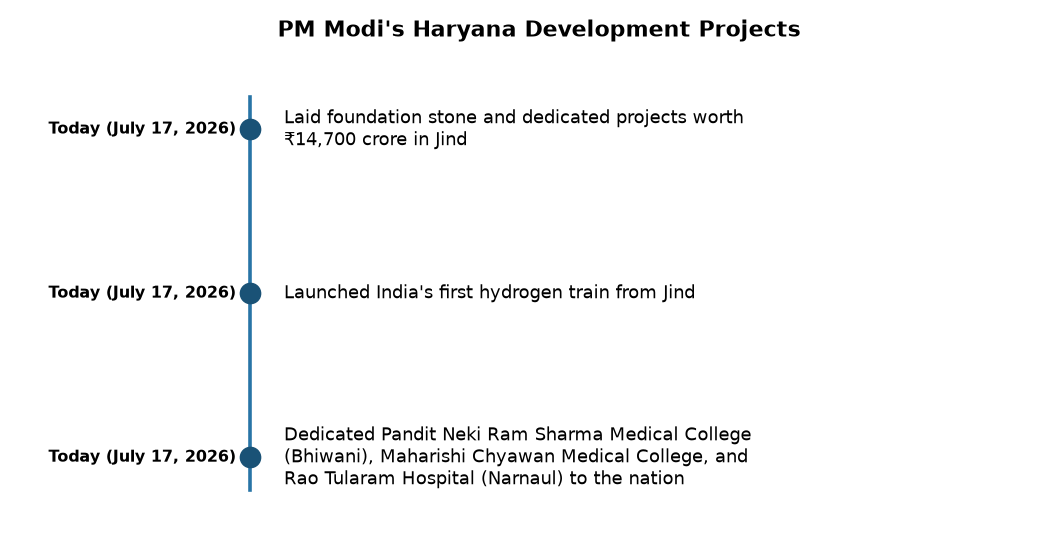
Prime Minister Shri Narendra Modi recently laid the foundation stone and dedicated various development projects worth approximately ₹14,700 crore to the nation in Jind, Haryana. A key highlight was the launch of India’s first hydrogen-powered train, marking a significant stride in green transportation and ‘Make in India’ initiatives. The projects span across connectivity, healthcare, and cultural heritage, aiming to enhance ‘Ease of Living’ and accelerate Haryana’s development trajectory.
Background
- The launch of India’s first hydrogen train from Jind, Haryana, signifies a major leap towards sustainable and emission-free transportation, aligning with India’s climate commitments.
- The projects, valued at ₹14,700 crore, encompass diverse sectors including rail, road infrastructure, healthcare facilities (medical colleges and hospitals), and cultural heritage preservation.
- The Prime Minister emphasized the historical significance of Jind, linking it to the nation’s first hydrogen train and drawing parallels with the first train journey between Mumbai and Thane.
- The initiative underscores the government’s focus on comprehensive infrastructure development, leveraging technology for progress, and promoting indigenous manufacturing under the ‘Make in India’ framework.
- The event also highlighted the importance of public participation in initiatives like Swachhata Abhiyan, reinforcing community involvement in national development goals.
- The projects are expected to generate new opportunities in the medical sector and strengthen healthcare accessibility in Haryana.
What is a Hydrogen-Powered Train?
- A hydrogen-powered train, also known as a hydrogen fuel cell train, uses hydrogen as its primary fuel source to generate electricity.
- It operates by converting hydrogen and oxygen into electricity through a fuel cell, with water being the only byproduct, making it a zero-emission transport system.
- The electricity generated powers electric motors, which in turn drive the train, offering an environmentally friendly alternative to traditional diesel locomotives.
- These trains typically store hydrogen in tanks on board, and the fuel cells are integrated into the train’s power car or roof.
- They offer significant advantages in terms of reduced carbon footprint, lower noise pollution, and potential for energy independence.
- The technology represents a significant advancement in rail transport, moving from 19th-century steam engines and 20th-century electric trains to 21st-century hydrogen propulsion.
- India’s first hydrogen train is a ‘Make in India’ initiative, demonstrating indigenous capabilities in advanced green technologies.
- The initial route for India’s hydrogen train is the 90-kilometer stretch between Jind and Sonipat in Haryana.
Key Features
| Feature | Significance |
|---|---|
| Hydrogen Fuel Cell Technology | Zero tailpipe emissions (only water vapor), contributing to cleaner air and combating climate change. Aligns with India’s net-zero targets. |
| ‘Make in India’ Initiative | Showcases indigenous technological prowess, fosters domestic manufacturing, creates jobs, and reduces reliance on foreign technology. |
| Integrated Infrastructure Development | Simultaneous development of rail, road, and healthcare infrastructure ensures holistic regional growth and improved connectivity. |
| Healthcare Expansion | Establishment of new medical colleges and hospitals (e.g., Pandit Neki Ram Sharma Medical College, Maharishi Chyawan Medical College, Rao Tula Ram Hospital) enhances medical education and healthcare accessibility. |
| Focus on ‘Ease of Living’ | Improved transport, healthcare, and sports facilities directly contribute to better quality of life for citizens. |
| National Sports Policy (‘Khelo India’, ‘TOPS’) | Provides unprecedented facilities and support for athletes, promoting sports culture and excellence at national and international levels. |
Why it Matters
Environmental and Climate Action
- The hydrogen train, with its zero-emission operation, is a crucial step towards decarbonizing the Indian railway network, aligning with India’s climate commitments and Net-Zero 2070 target.
- It reduces air pollution, particularly in urban and semi-urban areas, leading to improved public health outcomes.
- Promotes the development and adoption of green hydrogen as a clean energy source, fostering a sustainable energy transition.
Economic and Industrial Growth
- The ‘Make in India’ aspect of the hydrogen train boosts domestic manufacturing, innovation, and job creation in the green technology sector.
- Infrastructure projects worth ₹14,700 crore stimulate economic activity, attract investments, and enhance regional connectivity, facilitating trade and commerce.
- Improved rail and road networks reduce logistics costs and travel times, enhancing economic efficiency and competitiveness.
Social Development and Human Capital
- Expansion of healthcare infrastructure (medical colleges and hospitals) addresses regional disparities in healthcare access and creates opportunities for medical professionals.
- Enhanced connectivity improves access to education, employment, and essential services for rural populations, fostering inclusive growth.
- Promotion of sports through ‘Khelo India’ and ‘TOPS’ schemes encourages physical fitness, talent identification, and national pride, contributing to youth development.
Technological Advancement and Energy Security
- Positions India as a leader in advanced green transportation technologies, demonstrating its capability in indigenous research and development.
- Reduces reliance on fossil fuels for transportation, enhancing India’s energy security and resilience against global energy price fluctuations.
- Paves the way for further innovation in hydrogen-based technologies across various sectors.
Challenges
1. Hydrogen Production and Infrastructure
- Producing green hydrogen (from renewable sources) at scale is energy-intensive and currently expensive.
- Developing a robust infrastructure for hydrogen storage, transportation, and refueling across the vast railway network presents significant logistical and financial challenges.
UPSC Link: GS Paper III — Infrastructure, Energy Security
2. Cost and Investment
- The initial capital cost of hydrogen fuel cell trains and associated infrastructure is significantly higher than conventional diesel or electric trains.
- Securing adequate funding and investment for widespread adoption remains a hurdle, requiring substantial public and private sector collaboration.
UPSC Link: GS Paper III — Economy, Government Budgeting
3. Safety and Regulatory Framework
- Hydrogen, being a highly flammable gas, necessitates stringent safety protocols for its production, storage, and use in trains.
- Developing comprehensive regulatory frameworks and standards for hydrogen-powered rail transport is crucial for safe operation and public confidence.
UPSC Link: GS Paper III — Science & Technology, Disaster Management
4. Technological Maturity and Maintenance
- While promising, hydrogen fuel cell technology for heavy-duty applications like railways is still evolving, requiring continuous R&D and refinement.
- Specialized skills and infrastructure for maintenance and repair of hydrogen trains will be needed, posing a challenge for workforce training and capacity building.
UPSC Link: GS Paper III — Science & Technology, Skill Development
5. Integration with Existing Rail Network
- Integrating new hydrogen-powered trains and their refueling infrastructure seamlessly into India’s extensive and diverse existing railway network requires careful planning and execution.
- Compatibility issues with signaling, track, and operational systems need to be addressed.
UPSC Link: GS Paper III — Infrastructure
Challenges — UPSC Perspective
| Issue | Concern |
|---|---|
| Green Hydrogen Availability | Current reliance on grey/blue hydrogen (fossil fuel-based) undermines environmental benefits; scaling up green hydrogen production is critical. |
| Refueling Network | Lack of extensive hydrogen refueling stations along railway routes limits operational flexibility and widespread deployment. |
| Battery Backup and Range | Limited range of hydrogen trains and the need for efficient battery backup for peak power demands or during refueling gaps. |
| Public Perception and Acceptance | Addressing public concerns regarding safety and reliability of a new, unfamiliar technology like hydrogen trains. |
| Skilled Workforce | Shortage of trained personnel for operating, maintaining, and repairing advanced hydrogen fuel cell systems. |
| Supply Chain Development | Establishing a robust domestic supply chain for components and materials required for hydrogen train manufacturing and infrastructure. |
Government Initiatives — Must-Memorise for Prelims
- National Green Hydrogen Mission
- PM Gati Shakti National Master Plan
- Make in India Initiative
- Khelo India Programme
- Target Olympic Podium Scheme (TOPS)
- Swachh Bharat Abhiyan
- National Rail Plan (NRP)
- Ayushman Bharat Pradhan Mantri Jan Arogya Yojana (AB-PMJAY)
- National Health Mission (NHM)
- UDAN (Ude Desh ka Aam Naagrik)
Way Forward
- Invest significantly in research and development to reduce the cost of green hydrogen production and improve fuel cell efficiency.
- Develop a comprehensive national hydrogen infrastructure plan, including production, storage, transportation, and refueling stations, in a phased manner.
- Formulate clear regulatory frameworks and safety standards for hydrogen-powered rail transport, ensuring public and operational safety.
- Promote public-private partnerships to mobilize necessary investments and leverage expertise for scaling up hydrogen train deployment.
- Implement skill development programs and training initiatives to create a specialized workforce for the operation and maintenance of hydrogen technologies.
- Integrate hydrogen train development with broader smart city and sustainable mobility initiatives to create synergistic benefits.
- Explore international collaborations for technology transfer, best practices, and joint research in hydrogen fuel cell applications.
- Conduct pilot projects on diverse routes and terrains to gather data, refine technology, and build confidence in hydrogen rail solutions.
UPSC Value Addition
Keywords for Mains Answer-Writing
Green Mobility Revolution · Decarbonization Pathway · Indigenous Technological Prowess · Sustainable Infrastructure · Energy Transition · Circular Economy Principles · Regional Development Catalyst · Ease of Living Paradigm · Human Capital Formation · Climate Resilience · Atmanirbhar Bharat · Inter-sectoral Convergence
Constitutional & Policy Linkages
- Article 21: Right to life (clean environment, health)
- Article 48A: Protection and improvement of environment
- Seventh Schedule: Railways (Union List), Public Health (State List)
- National Green Hydrogen Mission: Policy framework for green hydrogen
- National Sports Policy: Government’s vision for sports promotion
- PM Gati Shakti: Integrated infrastructure planning
Concept Flow
Government Vision for Green Mobility → Investment in Hydrogen Technology & Infrastructure → Launch of Hydrogen-Powered Trains → Reduced Carbon Emissions & Air Pollution → Enhanced ‘Ease of Living’ & Economic Growth → India’s Leadership in Sustainable Transport
Prelims Practice Questions
Q1. With reference to India’s first hydrogen-powered train, consider the following statements:
1. It is a fully indigenous ‘Make in India’ initiative.
2. It produces only water vapor as a byproduct, making it a zero-emission transport.
3. The first operational route is between Mumbai and Thane.
Which of the statements given above is/are correct?
- A. 1 only
- B. 1 and 2 only
- C. 2 and 3 only
- D. 1, 2 and 3
Answer: B. 1 and 2 only — Statement 1 is correct as the Prime Minister explicitly mentioned it as a ‘Make in India’ success. Statement 2 is correct as hydrogen fuel cells produce water as the only byproduct. Statement 3 is incorrect; the first operational route is between Jind and Sonipat in Haryana, while Mumbai-Thane was the route for India’s first historical train journey.
Q2. The ‘Khelo India’ campaign and ‘TOPS’ scheme, recently mentioned in the context of infrastructure projects, are primarily associated with which of the following sectors?
- A. Healthcare infrastructure
- B. Digital literacy
- C. Sports development
- D. Rural electrification
Answer: C. Sports development — ‘Khelo India’ (Khelo India Programme) aims to promote sports at the grassroots level and identify young talent, while ‘TOPS’ (Target Olympic Podium Scheme) provides financial and logistical support to elite athletes for Olympic preparation. Both are directly related to sports development.
Mains Practice Question
✍ The launch of India’s first hydrogen-powered train marks a significant milestone in the nation’s journey towards sustainable development and energy security. Discuss the potential benefits and challenges associated with the widespread adoption of hydrogen fuel cell technology in the Indian railway system. How can India leverage its ‘Make in India’ initiative to overcome these challenges and emerge as a leader in green mobility?
Approach: Begin by introducing the significance of the hydrogen train launch in the context of India’s climate goals and ‘Make in India’. Subsequently, elaborate on the multi-faceted benefits, including environmental advantages, economic opportunities, and technological advancements. In the next part, critically analyze the challenges such as hydrogen production costs, infrastructure development, safety concerns, and technological maturity. Conclude by suggesting a comprehensive strategy involving policy support, R&D investment, public-private partnerships, and skill development, emphasizing how ‘Make in India’ can be instrumental in fostering indigenous solutions and establishing India’s leadership in green mobility.
Source: PIB (Press Information Bureau)
Generated by AanyaAi for educational purpose.

- मद्रास उच्च न्यायालय ने तमिलनाडु धर्मार्थ विभाग की लापरवाही पर कड़ी टिप्पणी की - October 23, 2026
- PM Modi’s Vision: Capacity Building Commission & Mission Karmayogi for Civil Services - October 23, 2026
- रक्षा मंत्री का सेना प्रमुखों को महत्वपूर्ण निर्देश: सुरक्षा चुनौतियों का सामना करने की तैयारी - October 23, 2026

No Comments