


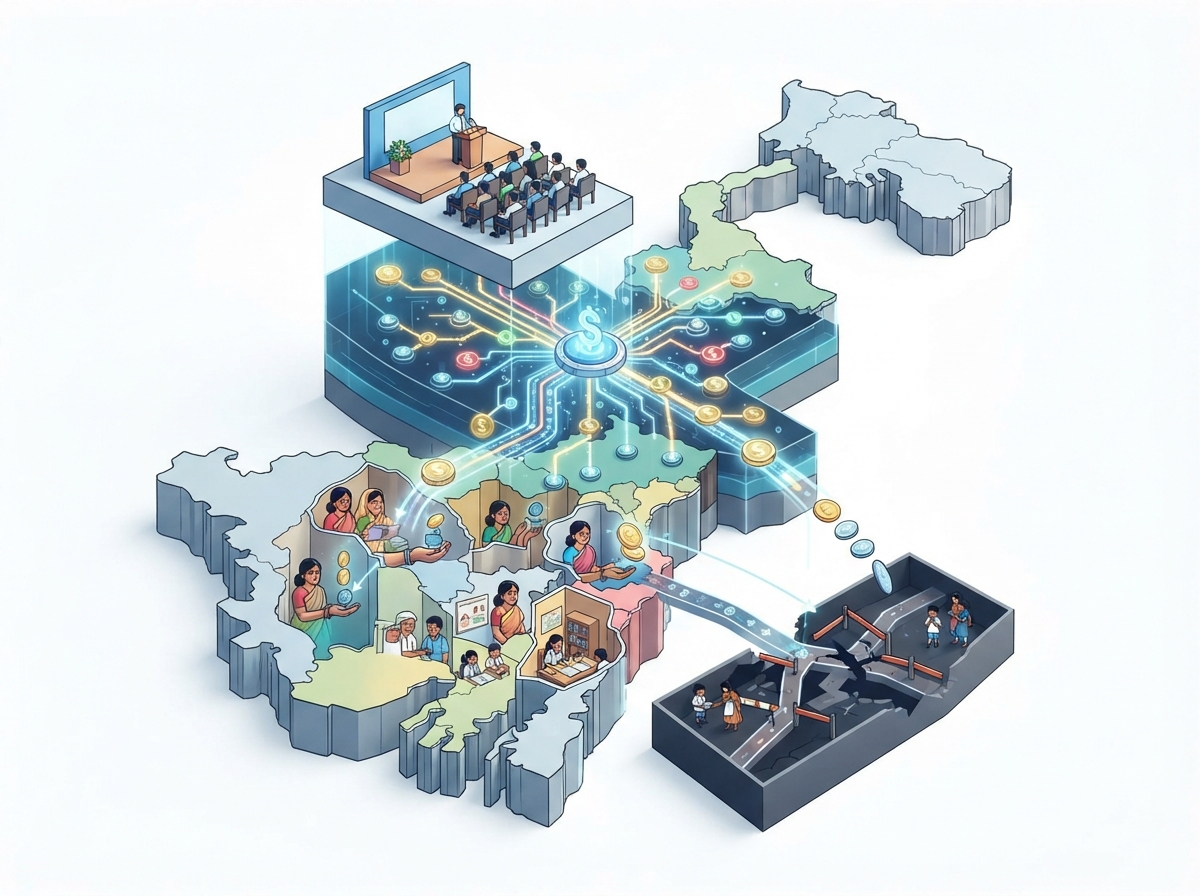
17 Sep PM Modi Launches 4th Installment of Annapurna Yojana for Bengal Women
✎ Annapurna Yojana is a cash transfer scheme in West Bengal that provides ₹3,000 as a fourth instalment to 1.5 crore women, delivered via DBT to enhance financial inclusion and household resilience.
Subject Relevance — Where This Topic Fits
- GS Paper II — Governance, Transparency and Accountability | GS Paper III — Issues relating to Poverty and Hunger, Government Budgeting and Financial Inclusion
- Prelims: Direct Benefit Transfer (DBT), Pradhan Mantri Garib Kalyan Anna Yojana (PM-GKAY), Women’s Self-Help Groups (SHGs), Financial Inclusion Index, Mahatma Gandhi National Rural Employment Guarantee Scheme (MGNREGS), Recurring Deposit Schemes, Jan Dhan Yojana, Aadhaar-enabled Payment System (AePS)
- Essay: Women’s empowerment as a catalyst for national development, Role of financial inclusion in reducing gender disparities
Quick Revision: Annapurna Yojana is a cash transfer scheme in West Bengal that provides ₹3,000 as a fourth instalment to 1.5 crore women, delivered via DBT to enhance financial inclusion and household resilience.
Why is this in the news?
The announcement by the Prime Minister on 17 September 2026 regarding the disbursement of the fourth instalment under the Annapurna Yojana in West Bengal underscores the central government’s emphasis on targeted welfare delivery to women, particularly in states with significant socio-economic disparities. This initiative aligns with broader national policies aimed at enhancing women’s financial autonomy through direct benefit transfers, thereby reinforcing the principle of inclusive governance and equitable resource distribution.
Background
- West Bengal, with a significant proportion of its population engaged in informal and low-income employment, has historically faced challenges in ensuring timely and equitable access to welfare benefits.
- The scheme operates under the broader framework of the Direct Benefit Transfer (DBT) mechanism, which aims to reduce leakages and ensure transparency in welfare disbursements.
- Financial inclusion policies in India, including the Jan Dhan Yojana and Aadhaar-enabled payment systems, have been instrumental in facilitating the implementation of such schemes.
- The scheme’s design reflects a shift from in-kind transfers (e.g., food grains) to cash transfers, aligning with global best practices in social protection.
- The announcement coincides with the celebration of Vishwakarma Puja, a festival symbolising craftsmanship and self-reliance, which the Prime Minister highlighted as a metaphor for the scheme’s ethos.
What is the Annapurna Yojana?
- The scheme disburses a fixed amount directly into the bank accounts of eligible beneficiaries, ensuring financial dignity and autonomy.
- The assistance is designed to cover essential household expenditures, including medical expenses, educational costs for children, and daily necessities.
- The fourth instalment of ₹3,000 is being credited to approximately 1.5 crore beneficiaries, marking a significant scale-up in coverage.
- The scheme operates under the Direct Benefit Transfer (DBT) framework, leveraging Aadhaar and Jan Dhan Yojana infrastructure for seamless disbursements.
- It complements national schemes such as the Pradhan Mantri Garib Kalyan Anna Yojana (PM-GKAY) by addressing liquidity constraints faced by women in managing household budgets.
- The scheme’s design reflects a gender-sensitive approach to poverty alleviation, recognising the pivotal role of women in household financial decision-making.
- The initiative is part of a broader governance strategy to enhance women’s participation in economic activities and reduce dependency on informal credit sources.
Key Features
| Feature | Significance |
|---|---|
| Guaranteed Monthly Financial Assistance | Provides a fixed monthly deposit of ₹3,000 directly to beneficiaries’ bank accounts, ensuring financial dignity and reducing dependency on informal credit sources. |
| Direct Benefit Transfer (DBT) | Eliminates intermediaries, reducing leakages and ensuring timely, transparent delivery of welfare benefits to 1.5 crore women in West Bengal. |
| Empowerment of Women Heads of Household | Targets women managing household finances, thereby enhancing their decision-making authority within familial and economic spheres. |
| Recurring Support Mechanism | Designed as a recurring financial lifeline, enabling beneficiaries to meet essential expenses such as healthcare, education, and household necessities without financial distress. |
| Cultural Integration and Symbolism | Launched during Vishwakarma Puja, the scheme aligns with traditional festivals, fostering social acceptance and reducing stigma associated with welfare interventions. |
Why it Matters
Economic Empowerment
- Enhances household purchasing power by providing a predictable income stream, thereby stimulating local economies in West Bengal.
- Reduces financial vulnerability of women, particularly in rural and semi-urban areas, by mitigating the impact of economic shocks.
- Promotes financial inclusion by linking beneficiaries to formal banking systems, fostering long-term savings and credit access.
Social Empowerment
- Strengthens the agency of women in household decision-making, particularly in matters of health, education, and consumption.
- Acknowledges and rewards the unpaid care work performed by women, thereby enhancing their social status and self-esteem.
- Encourages intergenerational benefits as financial stability improves educational and health outcomes for children in beneficiary households.
Governance and Policy
- Demonstrates the efficacy of direct benefit transfer (DBT) mechanisms in reducing corruption and improving welfare delivery efficiency.
- Highlights the role of state-led welfare initiatives in complementing central schemes, particularly in addressing gender-specific economic disparities.
- Showcases the integration of cultural symbolism in policy design to enhance public participation and acceptance of welfare programs.
Macroeconomic Impact
- Contributes to reducing income inequality by targeting financial support to women in lower-income households.
- Supports the achievement of Sustainable Development Goal 5 (Gender Equality) by promoting economic independence and decision-making power for women.
- Acts as a counter-cyclical measure during economic downturns, providing a safety net for vulnerable populations.
Challenges
1. Ensuring Universal Coverage
- Identifying and including all eligible beneficiaries without exclusion errors, particularly in remote or marginalized communities.
- Addressing administrative bottlenecks in updating beneficiary lists and ensuring seamless integration with existing welfare databases.
UPSC Link: GS II: Welfare Schemes
2. Financial Sustainability
- Balancing the fiscal burden of recurring payments with state revenue constraints, particularly in resource-constrained states like West Bengal.
- Exploring innovative financing mechanisms, such as public-private partnerships or outcome-based funding, to sustain long-term implementation.
UPSC Link: GS III: Indian Economy
3. Monitoring and Evaluation
- Establishing robust grievance redressal mechanisms to address beneficiary complaints and ensure transparency in fund disbursement.
- Conducting periodic impact assessments to measure the scheme’s effectiveness in achieving socio-economic outcomes.
UPSC Link: GS II: Governance
4. Cultural and Social Barriers
- Overcoming societal resistance to women’s financial independence, particularly in patriarchal communities where control over household finances is traditionally male-dominated.
- Ensuring that the scheme does not inadvertently reinforce gender stereotypes by framing women solely as recipients rather than active economic agents.
UPSC Link: GS I: Social Empowerment
5. Digital Divide and Financial Literacy
- Addressing the digital divide by ensuring that beneficiaries, particularly in rural areas, have access to banking infrastructure and digital literacy programs.
- Providing financial education to empower women to make informed decisions about savings, investments, and credit management.
UPSC Link: GS II: Government Policies
6. Inter-State Coordination
- Ensuring seamless coordination between central and state governments to prevent duplication or gaps in welfare delivery, particularly for migrant workers and their families.
- Harmonizing eligibility criteria and benefit structures across states to facilitate portability of welfare benefits.
UPSC Link: GS II: Federalism
Challenges — UPSC Perspective
| Issue | Concern |
|---|---|
| Exclusion Errors | Risk of eligible beneficiaries being left out due to outdated or incomplete beneficiary databases. |
| Leakages and Corruption | Potential for diversion of funds through ghost beneficiaries or administrative malpractices. |
| Digital Literacy Gaps | Limited access to banking infrastructure and digital tools in rural and remote areas may hinder effective participation. |
| Socio-Cultural Resistance | Traditional gender norms may undermine the scheme’s objective of empowering women financially. |
| Fiscal Constraints | Long-term sustainability of the scheme may be challenged by state budgetary limitations. |
| Monitoring and Grievance Redressal | Inadequate systems for tracking fund disbursement and addressing beneficiary grievances may erode trust in the scheme. |
Government Initiatives — Must-Memorise for Prelims
- Annapurna Scheme (West Bengal)
- Pradhan Mantri Matru Vandana Yojana (PMMVY)
- Direct Benefit Transfer (DBT) initiative
Way Forward
- Strengthen beneficiary identification processes through Aadhaar seeding and real-time data integration with existing welfare databases to minimize exclusion errors.
- Enhance financial literacy programs for beneficiaries, particularly in rural areas, to ensure informed decision-making and long-term financial planning.
- Establish a robust grievance redressal mechanism with multi-level monitoring to address beneficiary complaints and ensure transparency in fund disbursement.
- Explore public-private partnerships to supplement state funding, ensuring the scheme’s long-term financial sustainability without compromising its core objectives.
- Integrate the scheme with other welfare initiatives, such as healthcare and education programs, to maximize its socio-economic impact on beneficiary households.
- Conduct periodic impact assessments to evaluate the scheme’s effectiveness in achieving its stated goals of women’s empowerment and economic independence.
- Promote inter-state coordination to ensure portability of benefits for migrant workers and harmonize eligibility criteria across states.
- Leverage digital infrastructure, including mobile banking and UPI platforms, to enhance accessibility and reduce the digital divide for rural beneficiaries.
UPSC Value Addition
Keywords for Mains Answer-Writing
Annapurna Yojana · Women empowerment · Direct Benefit Transfer · Financial inclusion · Social security schemes · Gender parity in decision-making · Recurrent financial assistance · State welfare schemes · Digital governance · Targeted delivery of welfare · Financial autonomy for women · Empowerment through economic independence · Welfare governance model · Socio-economic transformation through policy
Constitutional & Policy Linkages
- Article 15(3) – Empowerment of Women
- Article 21 – Right to Livelihood
- Article 39(a) – Equal pay for equal work
- Article 39(f) – Children’s rights to development
Concept Flow
Economic Vulnerability of Women Heads of Household → Identification of Need for Recurring Financial Support → Design of Annapurna Scheme with Guaranteed Monthly Deposits → Direct Benefit Transfer (DBT) Mechanism → Financial Inclusion and Empowerment → Enhanced Decision-Making Authority → Improved Household Well-being → Long-Term Socio-Economic Development
Prelims Practice Questions
Q1. Consider the following statements regarding the Annapurna Yojana:
1. It is a state-specific welfare scheme aimed at providing financial assistance to women.
2. The scheme guarantees a fixed monthly deposit to eligible beneficiaries.
3. The financial assistance under the scheme is disbursed directly into the bank accounts of beneficiaries.
4. The scheme is implemented by the central government with no role for state governments.
How many of the above statements are correct?
- Only one
- Only two
- Only three
- All
Answer: Only three — Statements 1, 2, and 3 are correct as the Annapurna Yojana is a state-specific scheme providing guaranteed monthly financial assistance directly to women’s bank accounts. Statement 4 is incorrect because the scheme involves active participation of the state government in implementation.
Q2. Assertion (A): The Annapurna Yojana is designed to enhance the financial autonomy of women by providing a fixed monthly deposit.
Reason (R): Financial autonomy for women is a key component of gender equality and socio-economic empowerment in contemporary governance models.
In the context of the above two statements, which of the following is correct?
- Both A and R are true, and R is the correct explanation of A.
- Both A and R are true, but R is not the correct explanation of A.
- A is true, but R is false.
- A is false, but R is true.
Answer: Both A and R are true, but R is not the correct explanation of A. — The Annapurna Yojana (A) provides a fixed monthly deposit to women, thereby enhancing their financial autonomy. The Reason (R) correctly explains that financial autonomy is a critical component of gender equality and socio-economic empowerment, aligning with the objectives of such schemes.
Q3. Match the following welfare schemes with their respective objectives:
Column I (Scheme) | Column II (Objective)
1. Annapurna Yojana | A. Providing financial assistance to women for essential expenses
2. PM-KISAN | B. Direct income support to small and marginal farmers
3. Ujjwala Yojana | C. Providing LPG connections to below poverty line households
4. Ayushman Bharat | D. Providing health insurance to vulnerable sections
Choose the correct match:
- 1-A, 2-B, 3-C, 4-D; 1-B, 2-A, 3-C, 4-D; 1-D, 2-B, 3-A, 4-C; 1-C, 2-A, 3-B, 4-D
- answer_string_indexed_answer_1-A_2-B_3-C_4-D
Answer: 1-A, 2-B, 3-C, 4-D; 1-B, 2-A, 3-C, 4-D; 1-D, 2-B, 3-A, 4-C; 1-C, 2-A, 3-B, 4-D — The correct matches are: Annapurna Yojana (1-A) for financial assistance to women, PM-KISAN (2-B) for income support to farmers, Ujjwala Yojana (3-C) for LPG connections, and Ayushman Bharat (4-D) for health insurance.
Mains Practice Question
✍ The Annapurna Yojana exemplifies a transformative approach to women’s empowerment through targeted financial inclusion. Critically examine its design, implementation challenges, and potential socio-economic impacts. Also, analyse how such schemes align with the broader framework of welfare governance in India. (15 Marks)
Approach: MODEL-ANSWER SKELETON:
1. **Design of Annapurna Yojana**:
– Objective: Provide recurrent financial assistance (₹3,000 monthly) to women in West Bengal to enhance financial autonomy and decision-making power.
– Mechanism: Direct Benefit Transfer (DBT) to bank accounts, ensuring transparency and minimising leakages.
– Target group: Women, particularly those managing household expenses, to address gender-specific vulnerabilities.
2. **Implementation Challenges**:
– **Identification of beneficiaries**: Ensuring no eligible woman is left out (e.g., exclusion errors due to outdated databases).
– **Financial inclusion**: Access to bank accounts and digital literacy among marginalised women.
– **State-Centre coordination**: Role of state governments in implementation vs. centralised oversight.
– **Sustainability**: Long-term funding and scalability beyond state-specific models.
3. **Socio-Economic Impacts**:
– **Financial autonomy**: Empowerment to meet essential expenses (medicines, education, household needs) without dependency.
– **Decision-making**: Enhanced agency in household and community-level choices.
– **Gender parity**: Contribution to reducing gender gaps in financial decision-making.
– **Economic multiplier effect**: Increased local spending and stimulation of rural economies.
4. **Alignment with Welfare Governance Framework**:
– **Targeted delivery**: Focus on vulnerable sections (women) aligns with the ‘Sabka Saath, Sabka Vikas’ paradigm.
– **DBT mechanism**: Reflects the shift from in-kind subsidies to cash transfers, enhancing efficiency.
– **State-led innovation**: Demonstrates how states can pioneer welfare models within federal structures.
– **Challenges to federalism**: Potential conflicts over funding and implementation roles between Centre and states.
5. **Comparative Perspective**:
– Contrast with national schemes like PM-KISAN (farmers) or Ujjwala Yojana (LPG connections) to highlight the gendered focus of Annapurna.
– Lessons from international models (e.g., Brazil’s Bolsa Família) on cash transfers and women’s empowerment.
6. **Conclusion**:
– Annapurna Yojana is a progressive step towards gender-sensitive welfare governance but requires robust implementation to realise its full potential.
– Emphasise the need for data-driven monitoring, grievance redressal, and periodic evaluation to ensure inclusivity and effectiveness.
Source: PIB (Press Information Bureau)
West Bengal PCS (WBPSC / WBCS) — State PCS Practice
Prelims: Under the Annapurna Scheme, which state-specific initiative was announced by Prime Minister Narendra Modi during his address in West Bengal?
- A. Release of a new welfare scheme for farmers
- B. Distribution of 30 kg free rice per beneficiary under the Annapurna Scheme
- C. Launch of a solar power project in Purulia district
- D. Introduction of a special scholarship for SC/ST students
Answer: B. Distribution of 30 kg free rice per beneficiary under the Annapurna Scheme — The Prime Minister released the next installment of the Annapurna Scheme, ensuring 30 kg of free rice per beneficiary in West Bengal.
Mains: Discuss the significance of the Annapurna Scheme in addressing food security challenges in West Bengal, with special reference to its recent expansion under the Central Government’s initiatives. (Word limit: 200)
Generated by AanyaAi for educational purpose.
Related guides on our sites
- Current affairs for upsc 2026
- Best PSIR optional coaching for upsc
- Best PSIR optional teacher for upsc
- Best teacher of PSIR optional for upsc

- PM Modi Launches 4th Installment of Annapurna Yojana for Bengal Women - September 17, 2026
- केरल में बुजुर्ग महिलाओं की सुरक्षा को लेकर राज्य महिला आयोग की चिंता - September 17, 2026
- Kerala Commission Flags Elderly Women’s Safety Crisis: UPSC Polity Analysis - September 17, 2026

No Comments