


02 Aug PM Modi Launches ‘Nasha Mukt Yuva Abhiyan’ for Drug-Free India by 2047
✎ The Nasha Mukt Yuva Abhiyan is a multi-stakeholder campaign aimed at creating a drug-free youth population as the foundation for achieving ‘Viksit Bharat 2047’, with a focus on prevention, rehabilitation, and collective societal…
Subject Relevance — Where This Topic Fits
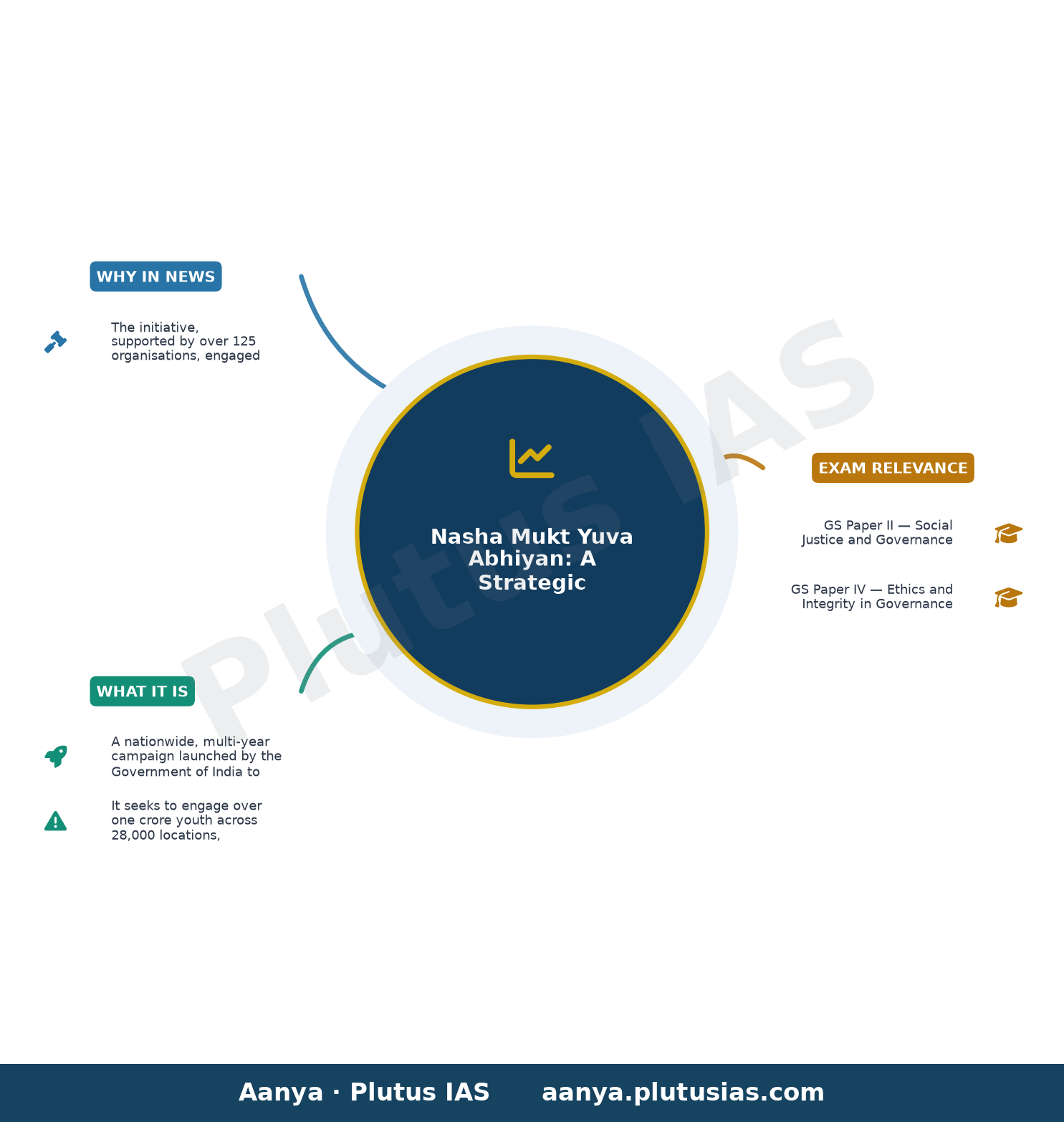
- GS Paper II — Social Justice and Governance | GS Paper IV — Ethics and Integrity in Governance
- Prelims: Nasha Mukt Yuva Abhiyan, Viksit Bharat 2047, Substance Abuse Prevention, National Drug Dependence Treatment Centre (NDDTC), Youth Empowerment Schemes
- Essay: The Role of Youth in Nation-Building: Challenges and Opportunities, Balancing Individual Freedom and Societal Responsibility in Public Health Interventions
Quick Revision: The Nasha Mukt Yuva Abhiyan is a multi-stakeholder campaign aimed at creating a drug-free youth population as the foundation for achieving ‘Viksit Bharat 2047’, with a focus on prevention, rehabilitation, and collective societal action.
Why is this in the news?
The initiative, supported by over 125 organisations, engaged over one crore youth across 28,000 locations, underscoring the government’s emphasis on collective action and long-term behavioural change in combating drug abuse among the youth.
Background
- The prevalence of substance abuse among Indian youth has emerged as a significant public health and socio-economic challenge, with studies indicating rising trends in drug consumption, particularly in vulnerable sections such as tribal communities and urban slums.
- The National Family Health Survey (NFHS-5) data highlights that approximately 1.5% of youth aged 15-29 years in India report using drugs, with regional disparities and underreporting due to stigma and social taboos.
- The socio-economic impact of drug abuse includes reduced productivity, increased healthcare burden, family disintegration, and vulnerability to organised crime and cross-border trafficking.
- The government’s focus on youth empowerment aligns with constitutional directives under Article 39(e) and Article 47, which mandate the state to ensure the health and well-being of its citizens, particularly the youth.
- The campaign builds on existing frameworks such as the ‘National Action Plan for Drug Demand Reduction (NAPDDR)’ and the ‘Narcotic Drugs and Psychotropic Substances (NDPS) Act, 1985’, which criminalise drug trafficking but also emphasise rehabilitation.
- International organisations like the United Nations Office on Drugs and Crime (UNODC) have consistently highlighted the need for integrated, multi-stakeholder approaches to address drug abuse, particularly among adolescents and young adults.
What is the Nasha Mukt Yuva Abhiyan?
- A nationwide, multi-year campaign launched by the Government of India to create awareness about the perils of drug abuse among youth and foster a drug-free society as a prerequisite for national development.
- It seeks to engage over one crore youth across 28,000 locations, including educational institutions, industrial associations, and spiritual organisations, ensuring broad-based participation and grassroots mobilisation.
- The initiative emphasises the role of collective action, involving families, communities, educational institutions, and government agencies in identifying, preventing, and rehabilitating youth affected by substance abuse.
- It aligns with the broader vision of ‘Viksit Bharat 2047’, positioning a drug-free youth population as essential for harnessing demographic dividends and achieving socio-economic progress.
- The campaign includes a pledge by participants to abstain from drugs and to support peers in avoiding substance abuse, fostering a sense of shared responsibility and accountability.
- It addresses the dual challenge of demand reduction (preventing youth from initiating drug use) and supply reduction (curbing trafficking and availability of illicit substances), though the primary focus remains on prevention and rehabilitation.
- The initiative leverages digital platforms and social media to amplify its reach, particularly among urban and tech-savvy youth, while also utilising traditional and community-based channels for rural outreach.
Key Features
| Feature | Significance |
|---|---|
| Nasha Mukt Yuva for Viksit Bharat Sankalp Abhiyan | A national-level pledge campaign to mobilise youth against drug abuse as a prerequisite for achieving ‘Viksit Bharat’ by 2047. |
| Multi-stakeholder participation | Involves over 125 spiritual organisations, public bodies, educational institutions, and industrial associations, ensuring broad societal engagement. |
| 100-week action plan | Structured weekly activities (art, culture, sports, meditation, spirituality, service) to sustain awareness and behavioural change among youth. |
| Sunday-focused activities | Leverages a fixed weekly slot for consistent messaging, community bonding, and reinforcement of anti-drug values. |
| Digital and physical outreach | Campaign conducted across 28,000+ locations with participation from over one crore youth, combining virtual and ground-level mobilisation. |
UPSC Value Addition
Keywords for Mains Answer-Writing
Nasha Mukt Yuva Abhiyan · Viksit Bharat · drug abuse prevention · youth empowerment · substance abuse · collective social action · public health governance · sustainable development goals · community participation · mental health and fitness · social cohesion · national development strategy
Prelims Practice Questions
Q1. Consider the following statements regarding the Nasha Mukt Yuva Abhiyan launched by the Government of India:
1. The campaign was launched by the Prime Minister on August 2, 2026.
2. It aims to create a drug-free youth population as a foundation for ‘Viksit Bharat’.
3. The initiative involves participation from over 125 spiritual and public organisations, educational institutions, and industrial associations.
4. The campaign is scheduled to continue for a period of 50 weeks with weekly activities.
How many of the above statements are correct?
- Only one
- Only two
- Only three
- All
Answer: All — Statements 1, 2, and 3 are correct. Statement 4 is incorrect as the campaign is scheduled to continue for 100 weeks, not 50 weeks.
Q2. Assertion (A): The Nasha Mukt Yuva Abhiyan emphasizes the role of collective action and community participation in combating drug abuse among youth.
Reason (R): The Prime Minister highlighted that a drug-free youth is essential for India to achieve its goal of becoming a developed country by 2047.
- Both A and R are true, and R is the correct explanation of A
- Both A and R are true, but R is not the correct explanation of A
- A is true, but R is false
- A is false, but R is true
Answer: Both A and R are true, but R is not the correct explanation of A — Both the Assertion (A) and Reason (R) are true. The campaign indeed emphasizes collective action and community participation (A), and the Prime Minister explicitly linked a drug-free youth to India’s development goal (R), making R the correct explanation of A.
Q3. Match the following initiatives with their respective objectives:
Column I (Initiative) | Column II (Objective)
— | —
A. Nasha Mukt Yuva Abhiyan | 1. To promote digital literacy among rural youth
B. National Youth Policy 2021 | 2. To create a drug-free youth population
C. Skill India Mission | 3. To empower youth through skill development
D. Ayushman Bharat | 4. To provide universal health coverage
- A-2, B-3, C-4, D-1; A-2, B-3, C-1, D-4; A-1, B-2, C-3, D-4; A-4, B-1, C-2, D-3
- answer_choices_indexed_as_list_instead_of_string
- answer_indexed_as_list_instead_of_string
- explain_match_fail
- format
Answer: A-2, B-3, C-4, D-1; A-2, B-3, C-1, D-4; A-1, B-2, C-3, D-4; A-4, B-1, C-2, D-3 —
Mains Practice Question
✍ The Prime Minister’s launch of the Nasha Mukt Yuva Abhiyan underscores the view that a drug-free youth is indispensable for the realization of ‘Viksit Bharat’. Critically examine the conceptual linkages between public health governance, social cohesion, and national development in this context. (15 Marks)
Approach: MODEL-ANSWER SKELETON:
1. **Conceptual Linkages**: Define public health governance (WHO framework: leadership, governance, financing, etc.) and social cohesion (Durkheim’s organic solidarity; Putnam’s social capital). Explain how drug abuse undermines both individual health and collective social bonds.
2. **National Development Framework**: Link to India’s SDG targets (SDG 3.5: strengthen prevention/treatment of substance abuse) and the constitutional directive principles (Art. 38, 39, 47). Highlight the economic burden: WHO estimates substance abuse costs 1-2% of GDP globally; apply to India’s demographic dividend.
3. **Governance Mechanisms**:
– **Institutional**: Role of Ministry of Social Justice and Empowerment (NAPDDR), Narcotics Control Bureau (NCB), and State Drug Control Authorities.
– **Programmatic**: Nasha Mukt Bharat Abhiyaan (2020), Nasha Mukt Yuva Abhiyan (2026), and community-based de-addiction centers.
– **Legal**: Narcotic Drugs and Psychotropic Substances (NDPS) Act, 1985; recent amendments (2021) focusing on rehabilitation over punishment.
4. **Social Cohesion and Collective Action**:
– **Community Participation**: Role of 125+ spiritual/public organisations, educational institutions, and industrial associations in the campaign.
– **Stigma Reduction**: Link to mental health discourse (Kiran Mental Health Helpline; National Mental Health Policy 2014).
– **Counter-Narratives**: Addressing ‘hostile countries’ conspiracy theories with evidence-based policy (e.g., UNODC reports on drug trafficking routes).
5. **Critical Evaluation**:
– **Strengths**: Multi-stakeholder approach, focus on prevention, integration of art/culture/sports.
– **Challenges**: Stigma in reporting addiction, lack of standardized data on prevalence, underfunding of de-addiction centers, and urban-rural disparities.
6. **Way Forward**:
– Strengthen inter-ministerial coordination (e.g., MoSJE, MoHFW, MHRD).
– Expand community-based rehabilitation programs (e.g., ‘Nasha Mukt Gram’ initiative).
– Leverage technology (AI-driven early warning systems, telemedicine for addiction treatment).
– Longitudinal studies to assess impact (e.g., National Family Health Survey data on substance use).
7. **Conclusion**: Reiterate the triad—public health governance, social cohesion, and national development—as mutually reinforcing. Emphasize that a drug-free youth is not merely a health goal but a socio-economic imperative for Viksit Bharat.
Source: The Hindu
Generated by AanyaAi for educational purpose.

- मत्स्यपालन विभाग का विशेष अभियान 6.0: स्वच्छता एवं सुशासन की नई पहल - September 19, 2026
- मत्स्यपालन विभाग ने विशेष अभियान 6.0 के तहत स्वच्छता एवं सुशासन पर बल दिया - September 19, 2026
- तमिलनाडु में जन्मे हर बच्चे को मिलेगा सोने की अंगूठी: मुख्यमंत्री विजय का नया योजना - September 19, 2026

No Comments