


02 Aug PM Modi Launches ‘Nasha Mukt Yuva’ Campaign for Drug-Free India
✎ The 'Nasha Mukt Yuva – Vikasit Bharat Sankalp Abhiyan' is a national campaign to combat youth substance abuse, launched on 2 August 2026, with a focus on prevention, education, and rehabilitation through multi-stakeholder…
Subject Relevance — Where This Topic Fits
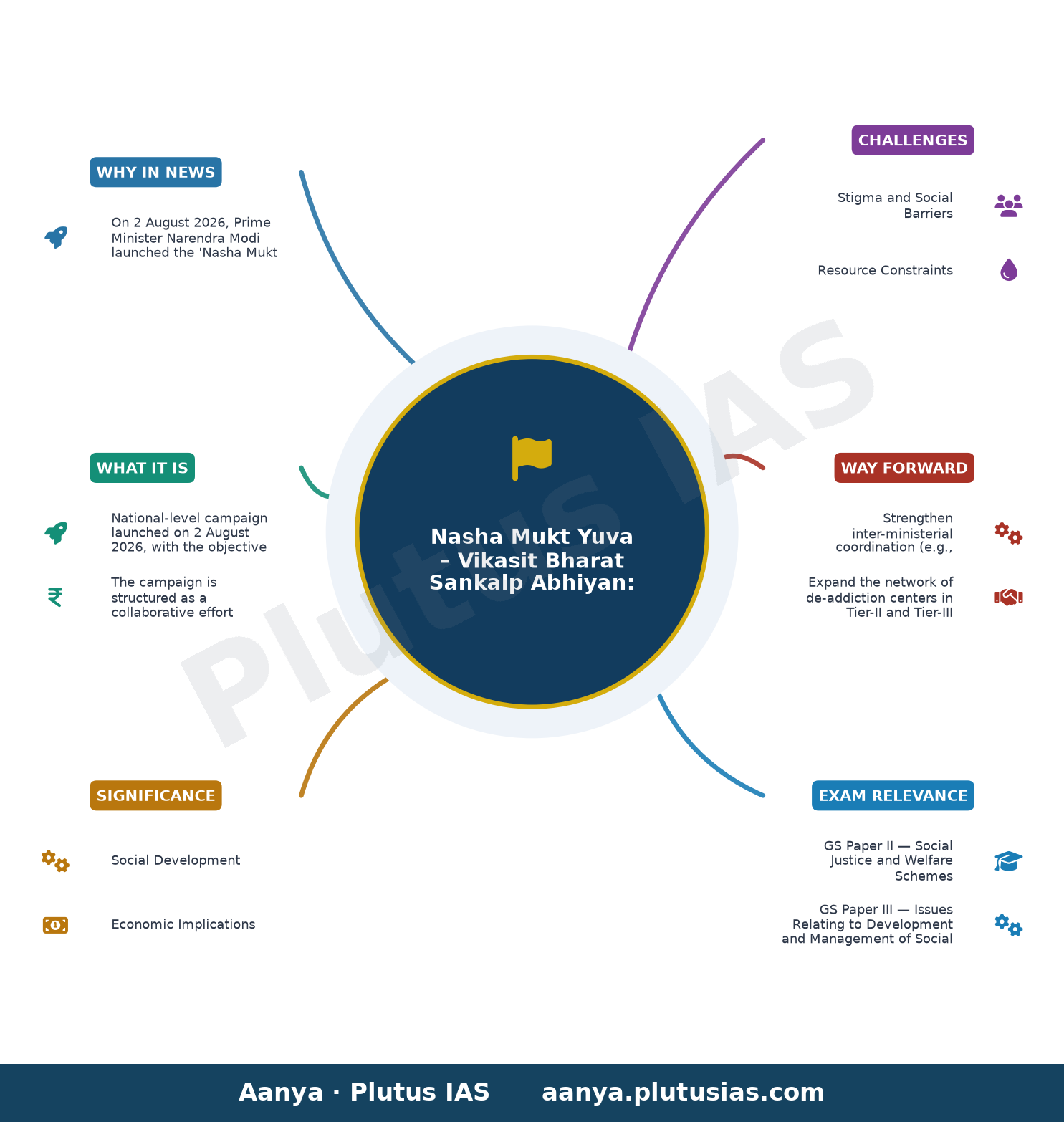
- GS Paper II — Social Justice and Welfare Schemes | GS Paper III — Issues Relating to Development and Management of Social Sector/Services relating to Health, Education, Human Resources
- Prelims: Nasha Mukt Bharat Abhiyaan, Youth Empowerment, Substance Abuse Prevention, National Drug Dependence Treatment Centre (NDDTC), Narcotic Drugs and Psychotropic Substances (NDPS) Act, 1985, SAMHSA (Substance Abuse and Mental Health Services Administration) model
- Essay: The Role of Youth in Nation-Building: Challenges and Opportunities, Balancing Individual Freedom and Societal Responsibility in Public Health Interventions
Quick Revision: The ‘Nasha Mukt Yuva – Vikasit Bharat Sankalp Abhiyan’ is a national campaign to combat youth substance abuse, launched on 2 August 2026, with a focus on prevention, education, and rehabilitation through multi-stakeholder collaboration.
Why is this in the news?
On 2 August 2026, Prime Minister Narendra Modi launched the ‘Nasha Mukt Yuva – Vikasit Bharat Sankalp Abhiyan’ via video conference, marking a national-scale initiative to combat substance abuse among youth. The campaign, originating from Varanasi, aims to leverage collective action to create a drug-free India by engaging educational institutions, youth organisations, and civil society. The Prime Minister’s address underscored the societal and individual costs of drug abuse, urging youth to protect their potential and calling upon professors across colleges and universities to lead the movement.
Background
- The campaign aligns with India’s broader public health and social justice priorities, particularly the Sustainable Development Goals (SDG 3.5) which calls for strengthening the prevention and treatment of substance abuse.
- Substance abuse among youth in India has been identified as a critical public health challenge, with studies indicating rising trends in opioid, cannabis, and synthetic drug use, particularly in urban and peri-urban areas.
- The National Drug Dependence Treatment Centre (NDDTC) under AIIMS, New Delhi, has been instrumental in research, policy formulation, and capacity building for substance abuse prevention and treatment in India.
- The Narcotic Drugs and Psychotropic Substances (NDPS) Act, 1985, provides the legal framework for controlling and regulating narcotic drugs and psychotropic substances in India, with stringent penalties for trafficking and possession.
- The ‘Nasha Mukt Bharat Abhiyaan’ (NMBA), launched in 2020, serves as the foundational programme under which this new initiative is structured, focusing on awareness, education, and rehabilitation.
- Varanasi, as the cultural and spiritual epicentre of the campaign, symbolises the integration of traditional values with modern public health interventions.
What is the ‘Nasha Mukt Yuva – Vikasit Bharat Sankalp Abhiyan’?
- National-level campaign launched on 2 August 2026, with the objective of creating a drug-free youth population to realise the vision of a ‘Viksit Bharat’ (Developed India) by 2047.
- The campaign is structured as a collaborative effort involving central ministries, state governments, educational institutions, youth organisations, civil society, and community leaders.
- Core focus areas include prevention through awareness campaigns, education on the harms of substance abuse, and rehabilitation support for affected individuals.
- The initiative leverages digital platforms and social media to disseminate information, engage youth, and mobilise collective action across the country.
- Educational institutions, particularly colleges and universities, are designated as key nodal points for implementation, with faculty members and student leaders playing a pivotal role in outreach and advocacy.
- The campaign incorporates a multi-sectoral approach, integrating health, education, social justice, and law enforcement agencies to address the issue holistically.
- It builds upon the existing ‘Nasha Mukt Bharat Abhiyaan’ (NMBA), which was launched in 2020 under the Ministry of Social Justice and Empowerment, and expands its scope to include a stronger youth-centric focus.
- The campaign’s messaging emphasises the dual harm of substance abuse: immediate euphoric effects (‘High’) contrasted with long-term damage to career prospects, family life, and societal well-being (‘Low’).
Key Features
| Feature | Significance |
|---|---|
| National-level campaign launch | Demonstrates government’s commitment to addressing drug abuse as a developmental challenge, aligning with the broader ‘Viksit Bharat’ vision. |
| Focus on youth empowerment | Targets the demographic segment most vulnerable to substance abuse, ensuring long-term societal and economic benefits. |
| Multi-stakeholder engagement | Involves educational institutions (colleges, universities) and faculty, leveraging academia for grassroots awareness and rehabilitation. |
| Metaphorical framing (‘High’ vs ‘Low’) | Uses relatable language to underscore the transient euphoria of drugs versus the lasting damage to careers and family life. |
| Kashi-origin narrative | Connects the initiative to Varanasi (Kashi), emphasizing cultural and spiritual roots while scaling it nationally. |
Why it Matters
Social Development
- Addresses the critical issue of drug abuse among youth, which undermines human capital formation and intergenerational equity.
- Promotes mental health and well-being, aligning with Sustainable Development Goal 3 (Good Health and Well-being).
- Encourages collective responsibility, fostering community-based solutions to a complex social problem.
Economic Implications
- Reduces healthcare costs associated with addiction treatment and rehabilitation.
- Enhances workforce productivity by preventing premature career disruptions due to substance abuse.
- Mitigates the economic burden on families, particularly in low-income households.
Governance and Policy
- Demonstrates a shift from punitive measures to preventive and rehabilitative approaches in drug policy.
- Highlights the role of educational institutions as agents of social change and policy implementation.
- Aligns with the ‘Sabka Saath, Sabka Vikas’ ethos by prioritizing marginalized youth.
Cultural and Symbolic
- Leverages the spiritual and cultural symbolism of Kashi to imbue the campaign with moral authority.
- Fosters national unity by framing the issue as a collective responsibility rather than a regional or sectoral concern.
Challenges
1. Stigma and Social Barriers
- Deep-rooted societal stigma around addiction discourages individuals from seeking help or admitting to substance abuse.
- Familial and peer pressure may exacerbate denial, complicating early intervention efforts.
UPSC Link: GS I: Social Empowerment
2. Resource Constraints
- Limited availability of rehabilitation centers, especially in rural and semi-urban areas.
- Insufficient funding for awareness programs, counseling services, and aftercare support.
UPSC Link: GS II: Governance
3. Legal and Policy Gaps
- Inconsistent enforcement of existing drug laws across states, leading to porous borders and trafficking.
- Lack of standardized protocols for de-addiction and rehabilitation in government-run facilities.
UPSC Link: GS III: Internal Security
4. Digital and Technological Challenges
- Emergence of new synthetic drugs and online platforms facilitating their sale and distribution.
- Cyberbullying and peer pressure via social media exacerbating substance abuse trends among youth.
UPSC Link: GS III: Science & Tech
5. Behavioral and Psychological Factors
- Normalization of substance use in peer groups and popular culture, particularly among adolescents.
- Underlying mental health disorders (e.g., depression, anxiety) often co-occurring with addiction.
UPSC Link: GS IV: Ethics
Challenges — UPSC Perspective
| Issue | Concern |
|---|---|
| Stigma and denial | Prevents early intervention and discourages affected individuals from seeking help. |
| Resource disparities | Urban-centric rehabilitation facilities leave rural youth underserved. |
| Trafficking routes | Porous borders enable cross-border drug smuggling, complicating law enforcement. |
| Mental health comorbidity | Addiction often coexists with untreated psychological disorders, requiring integrated care. |
| Digital drug markets | Online platforms facilitate access to illicit substances, bypassing traditional controls. |
| Cultural normalization | Peer influence and media portrayals normalize substance use, particularly among youth. |
Way Forward
- Strengthen inter-ministerial coordination (e.g., Ministry of Social Justice and Empowerment, Ministry of Health) to ensure a unified policy response.
- Expand the network of de-addiction centers in Tier-II and Tier-III cities, leveraging public-private partnerships.
- Integrate substance abuse prevention into school and college curricula, with mandatory modules on mental health and addiction.
- Leverage digital platforms for awareness campaigns, including AI-driven chatbots for confidential counseling.
- Enhance border surveillance and intelligence-sharing mechanisms to curb drug trafficking.
- Promote community-based support groups (e.g., Narcotics Anonymous) to reduce stigma and foster peer accountability.
- Conduct periodic national surveys to assess the prevalence of drug abuse and evaluate the efficacy of interventions.
UPSC Value Addition
Keywords for Mains Answer-Writing
Nasha Mukt Bharat Abhiyaan · Drug abuse prevention · Youth empowerment · Social transformation · Collective action · Substance abuse · National mission · Kashi Vishwanath Corridor initiative · Public health governance · Intergenerational equity · Sustainable development · National integration
Constitutional & Policy Linkages
- Article 21: Right to Life and Personal Liberty (includes right to health and dignity).
- Article 47: Duty of the State to raise the level of nutrition and standard of living.
- Directive Principles of State Policy (Part IV): Promotion of health and welfare of citizens.
Concept Flow
Substance abuse among youth → Decline in human capital and productivity → Socio-economic burden on families and state. → Normalization of drug use in peer groups → Early exposure and addiction → Long-term health and career consequences. → Inadequate rehabilitation infrastructure → Stigma and lack of support → Relapse and chronic addiction. → Cross-border drug trafficking → Accessibility of illicit substances → Escalation of youth addiction. → Government launches ‘Nasha Mukt Yuva’ campaign → Multi-stakeholder engagement (academia, community) → Prevention and rehabilitation. → Cultural and spiritual framing (e.g., Kashi) → Moral authority and national unity → Sustained behavioral change. → Policy integration with SDGs (Goal 3) and ‘Viksit Bharat’ vision → Long-term societal well-being.
Prelims Practice Questions
Q1. Consider the following statements regarding the Nasha Mukt Bharat Abhiyaan:
1. It was launched from Kashi Vishwanath Corridor, Varanasi.
2. The campaign focuses exclusively on rehabilitation of drug addicts.
3. It is a centrally sponsored scheme under the Ministry of Social Justice and Empowerment.
How many of the above statements are correct?
- Only one
- Only two
- Only three
- None
Answer: Only two — Statement 1 is correct as the campaign was launched from Kashi. Statement 2 is incorrect as the campaign emphasizes prevention and collective action among youth. Statement 3 is incorrect as it is a national initiative led by the Prime Minister’s Office, not a centrally sponsored scheme under the Ministry of Social Justice and Empowerment.
Q2. Assertion (A): The Nasha Mukt Bharat Abhiyaan aims to create a drug-free India by 2026.
Reason (R): The campaign is rooted in the philosophy of collective responsibility and youth empowerment.
In the context of the above two statements, which one of the following is correct?
- Both A and R are true and R is the correct explanation of A
- Both A and R are true but R is NOT the correct explanation of A
- A is true but R is false
- A is false but R is true
Answer: A is false but R is true — The campaign does not explicitly target a drug-free India by 2026; it is a long-term mission focused on youth empowerment and collective action. However, the Reason (R) correctly explains the underlying philosophy of the campaign.
Q3. Match the following initiatives with their respective ministries/departments:
Initiative Ministry/Department
1. Nasha Mukt Bharat Abhiyaan A. Ministry of Education
2. Ayushman Bharat B. Ministry of Health and Family Welfare
3. National Education Policy 2020 C. Ministry of Social Justice and Empowerment
4. Pradhan Mantri Matru Vandana Yojana D. Ministry of Women and Child Development
Select the correct match:
- 1-A, 2-B, 3-C, 4-D
- 1-C, 2-B, 3-A, 4-D
- 1-B, 2-C, 3-D, 4-A
- 1-D, 2-A, 3-B, 4-C
Answer: 1-C, 2-B, 3-A, 4-D — Nasha Mukt Bharat Abhiyaan is led by the Ministry of Social Justice and Empowerment, Ayushman Bharat by the Ministry of Health and Family Welfare, National Education Policy 2020 by the Ministry of Education, and Pradhan Mantri Matru Vandana Yojana by the Ministry of Women and Child Development.
Mains Practice Question
✍ ‘The Nasha Mukt Bharat Abhiyaan represents a paradigm shift from punitive approaches to preventive and participatory models in addressing substance abuse among youth.’ Critically analyse this statement with reference to the campaign’s objectives, institutional mechanisms, and the role of higher educational institutions. (15 Marks)
Approach: MODEL-ANSWER SKELETON:
1. **Introduction** (2 marks): Briefly define the Nasha Mukt Bharat Abhiyaan, its launch context from Kashi Vishwanath Corridor, and its alignment with the broader ‘Viksit Bharat Sankalp Abhiyaan’.
2. **Paradigm Shift Analysis** (5 marks):
– **Preventive Model**: Highlight the campaign’s focus on prevention through awareness, education, and early intervention (e.g., anti-drug clubs in colleges, peer-led initiatives).
– **Participatory Model**: Emphasise the role of youth, educational institutions, and civil society in driving the campaign (e.g., PM’s call to professors, youth-led movements).
– **Contrast with Punitive Approaches**: Discuss traditional law-enforcement-centric models (e.g., Narcotic Drugs and Psychotropic Substances Act, 1985) and their limitations in addressing root causes.
3. **Institutional Mechanisms** (4 marks):
– **Multi-Stakeholder Governance**: Identify key institutions involved (e.g., PMO, Ministry of Social Justice and Empowerment, State Governments, NGOs like Sankalp India Foundation).
– **Role of Higher Educational Institutions**: Discuss the PM’s appeal to professors, establishment of anti-drug cells in universities, and integration of substance abuse prevention in curricula.
– **Data-Driven Interventions**: Reference the use of National Drug Dependence Treatment Centre (NDDTC) data and National Family Health Survey (NFHS) findings to target interventions.
4. **Critical Evaluation** (3 marks):
– **Challenges**: Highlight implementation gaps (e.g., uneven state participation, lack of standardised protocols, stigma in reporting cases).
– **Sustainability**: Discuss the need for long-term funding, inter-ministerial coordination, and community ownership.
5. **Conclusion** (1 mark): Summarise the transformative potential of the campaign while acknowledging the need for robust monitoring and evaluation frameworks.
Source: PIB (Press Information Bureau)
Generated by AanyaAi for educational purpose.

- यूपीएससी तैयारी: आरबीआई द्वारा 91, 182 और 364 दिनों के ट्रेजरी बिलों की नीलामी - September 19, 2026
- RBI to Auction ₹24,000 Crore T-Bills: Key Dates & Process for UPSC Aspirants - September 19, 2026
- संयुक्त राष्ट्र महासभा अध्यक्ष का Rohingya संकट से सीख: विश्वास और AI पर बल - September 19, 2026

No Comments