


02 Aug PM Modi Launches ‘Nasha Mukt Yuva’ Campaign for Drug-Free India
✎ The 'Nasha Mukt Yuva – Vikasit Bharat Sankalp Abhiyaan' is a national campaign to foster a drug-free youth population, leveraging educational institutions and community participation as key pillars for prevention, awareness, and…
Subject Relevance — Where This Topic Fits
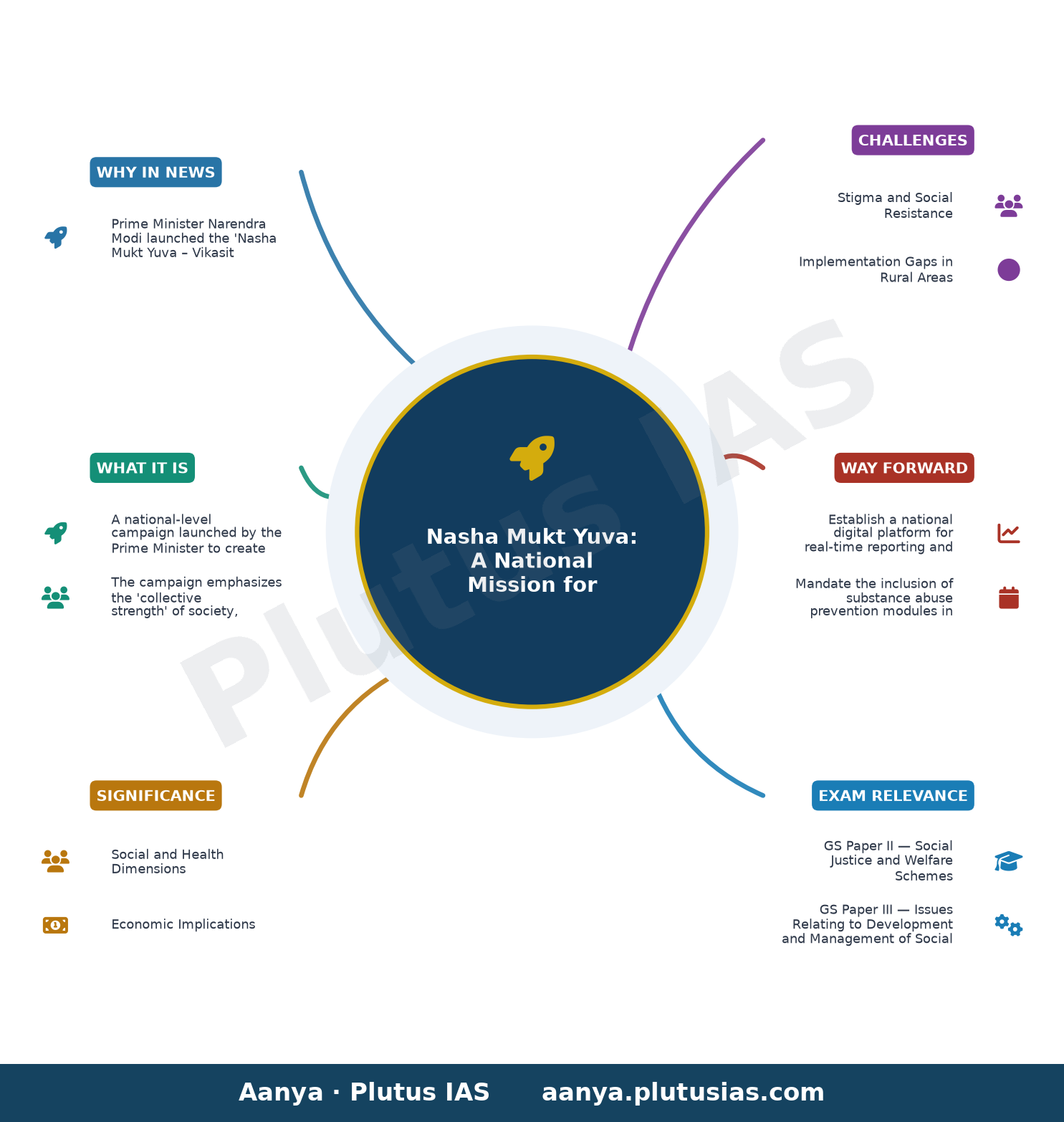
- GS Paper II — Social Justice and Welfare Schemes | GS Paper III — Issues Relating to Development and Management of Social Sector/Services relating to Health
- Prelims: Nasha Mukt Bharat Abhiyaan, National Action Plan for Drug Demand Reduction (NAPDDR), Youth Empowerment, Substance Abuse Prevention, SAMHSA (Substance Abuse and Mental Health Services Administration), Narcotic Drugs and Psychotropic Substances Act, 1985
- Essay: Youth as the Catalyst for National Development, Balancing Individual Freedom and Collective Responsibility in Public Health
Quick Revision: The ‘Nasha Mukt Yuva – Vikasit Bharat Sankalp Abhiyaan’ is a national campaign to foster a drug-free youth population, leveraging educational institutions and community participation as key pillars for prevention, awareness, and rehabilitation.
Why is this in the news?
Prime Minister Narendra Modi launched the ‘Nasha Mukt Yuva – Vikasit Bharat Sankalp Abhiyaan’ via video conference on 2 August 2026, emphasizing the critical role of a drug-free youth in realizing the vision of a developed India. The campaign, rooted in the ethos of collective action, seeks to mobilize educational institutions, particularly colleges and universities, to foster awareness and preventive measures against substance abuse among young citizens. The initiative underscores the government’s commitment to leveraging grassroots movements, exemplified by the reference to ‘Kashi’s sacred soil’ as the origin of transformative ideas now scaled nationally.
Background
- Substance abuse among youth in India has emerged as a significant public health and socio-economic challenge, with the National Drug Dependence Treatment Centre (NDDTC) reporting that approximately 2.8% of the population aged 10–75 years uses opioids, cannabis, sedatives, or inhalants.
- The Government of India, through the Ministry of Social Justice and Empowerment, has implemented the ‘Nasha Mukt Bharat Abhiyaan’ (NMBA) as a comprehensive strategy to address drug demand reduction, focusing on prevention, awareness, and rehabilitation.
- The National Action Plan for Drug Demand Reduction (NAPDDR) 2018–2025 outlines a multi-stakeholder approach involving central ministries, state governments, and civil society organizations to combat substance abuse.
- Educational institutions, particularly higher education campuses, have been identified as critical sites for intervention due to their role in shaping youth behavior and attitudes toward substance use.
- The Narcotic Drugs and Psychotropic Substances (NDPS) Act, 1985, provides the legal framework for controlling and regulating narcotic drugs and psychotropic substances in India, with stringent penalties for trafficking and consumption.
- Global precedents, such as the United Nations Office on Drugs and Crime (UNODC) initiatives and the U.S. Substance Abuse and Mental Health Services Administration (SAMHSA), highlight the importance of community-based prevention programs in reducing youth substance abuse.
What is the ‘Nasha Mukt Yuva – Vikasit Bharat Sankalp Abhiyaan’?
- A national-level campaign launched by the Prime Minister to create a drug-free youth population, aligning with the broader ‘Vikasit Bharat’ (Developed India) vision by 2047.
- The campaign emphasizes the ‘collective strength’ of society, particularly educational institutions, in fostering awareness and preventive measures against substance abuse among young citizens.
- It seeks to mobilize colleges, universities, and academic institutions as hubs for sensitization programs, peer-led interventions, and capacity-building initiatives to deter youth from drug use.
- The initiative integrates the principles of ‘prevention is better than cure’ by targeting vulnerable youth groups, including those in higher education and rural communities, through grassroots engagement.
- It leverages digital platforms and social media to amplify reach, echoing the Prime Minister’s call to ‘touch every youth mind’ through relatable, impactful messaging.
- The campaign is rooted in the ethos of ‘Karma Yog’ (selfless action), where individuals, families, and communities are encouraged to adopt a proactive stance against substance abuse.
- It aligns with the National Action Plan for Drug Demand Reduction (NAPDDR) and the Nasha Mukt Bharat Abhiyaan, reinforcing the government’s multi-pronged strategy to address the socio-economic and health impacts of drug abuse.
- The initiative underscores the need for inter-ministerial coordination, involving the Ministries of Social Justice and Empowerment, Education, Health, and Home Affairs, to ensure a holistic and sustainable approach.
Key Features
| Feature | Significance |
|---|---|
| National-scale launch via video conference | Demonstrates the use of digital governance to ensure pan-India outreach and inclusivity in social welfare initiatives. |
| Focus on youth empowerment through abstinence from substance abuse | Aligns with demographic dividend utilisation and aligns with Sustainable Development Goal 3 (Good Health and Well-being). |
| Emphasis on collective social responsibility | Reflects the principle of ‘Sabka Saath, Sabka Vikas, Sabka Vishwas’ by involving communities, educational institutions, and families. |
| Integration with ‘Viksit Bharat Sankalp Abhiyan’ | Demonstrates a multi-sectoral convergence approach linking health, education, and national development goals. |
| Direct appeal to academia (professors and universities) | Leverages the role of educational institutions as nodal points for awareness, prevention, and rehabilitation in substance abuse control. |
Why it Matters
Social and Health Dimensions
- Substance abuse among youth poses a severe threat to physical and mental health, directly impacting human capital formation and labour productivity.
- The initiative targets prevention, aligning with the National Mental Health Policy (2014) and the National Drug Demand Reduction Policy (2018) to reduce the burden of substance use disorders.
- Promotes holistic well-being by addressing the social determinants of health, including peer pressure, familial neglect, and lack of awareness.
- Supports the achievement of SDG 3.5: Strengthen the prevention and treatment of substance abuse, including narcotic drug abuse and harmful use of alcohol.
Economic Implications
- Reducing youth substance abuse can enhance workforce participation and economic productivity, contributing to India’s demographic dividend.
- Prevents loss of human capital due to addiction-related absenteeism, reduced cognitive abilities, and long-term disability.
- Lowers healthcare costs associated with treating addiction-related diseases and mental health disorders.
Governance and Policy Integration
- Demonstrates the integration of social welfare initiatives with broader national development agendas such as ‘Viksit Bharat 2047’.
- Highlights the role of digital governance in scaling social impact interventions efficiently across geographies.
- Reinforces the principle of cooperative federalism by involving state governments, local bodies, and civil society in implementation.
Educational and Institutional Role
- Educational institutions are positioned as key stakeholders in prevention, awareness, and rehabilitation efforts.
- Promotes the inclusion of life-skills education and substance abuse prevention in academic curricula.
- Encourages peer-led interventions and mentorship programmes within universities and colleges.
Cultural and Societal Impact
- The invocation of ‘Kashi’s sacred soil’ underscores the cultural and spiritual dimension of welfare initiatives, fostering a sense of national pride and collective responsibility.
- Promotes societal norms that reject substance abuse as a pathway to success, thereby influencing behavioural change.
- Strengthens community-based approaches to health and social welfare, aligning with the ‘Jan Andolan’ model.
Challenges
1. Stigma and Social Resistance
- Substance abuse remains a stigmatised issue, leading to underreporting and reluctance in seeking help.
- Cultural taboos and societal denial may impede open discussions and community participation.
- Requires sustained awareness campaigns to normalise conversations around addiction and mental health.
UPSC Link: GS2: Social Justice
2. Implementation Gaps in Rural Areas
- Limited access to healthcare facilities and rehabilitation centres in rural and remote regions.
- Shortage of trained professionals in addiction medicine and counselling.
- Digital divide may exclude sections of the population from awareness programmes.
UPSC Link: GS1: Social Issues
3. Interstate Disparities in Policy Enforcement
- Variations in state-level legislation and enforcement mechanisms may lead to uneven implementation.
- Lack of standardised protocols for prevention, treatment, and rehabilitation across states.
- Coordination challenges between central and state governments in monitoring and evaluation.
UPSC Link: GS2: Federalism
4. Economic and Structural Barriers
- High cost of treatment and rehabilitation services limits accessibility for economically weaker sections.
- Lack of insurance coverage for mental health and substance abuse treatment.
- Informal markets for substances may persist despite legal restrictions.
UPSC Link: GS3: Economic Development
5. Youth Vulnerability to Peer Pressure and Media Influence
- Exposure to social media and digital platforms normalises substance use and glamorises addiction.
- Lack of life-skills education to resist peer pressure and make informed choices.
- Targeted marketing by substance dealers through digital and social channels.
UPSC Link: GS4: Ethics
6. Data Gaps and Monitoring Challenges
- Inadequate epidemiological data on substance abuse patterns and trends among youth.
- Lack of a unified national database for tracking cases and outcomes.
- Difficulty in measuring the impact of awareness programmes due to delayed behavioural changes.
UPSC Link: GS3: Science & Technology
Challenges — UPSC Perspective
| Issue | Concern |
|---|---|
| Stigma and Social Resistance | Undermines early intervention and community participation. |
| Implementation Gaps in Rural Areas | Excludes marginalised populations from welfare benefits. |
| Interstate Disparities in Policy Enforcement | Leads to uneven progress and resource allocation. |
| Economic and Structural Barriers | Limits accessibility to treatment and rehabilitation services. |
| Youth Vulnerability to Peer Pressure | Increases susceptibility to substance abuse despite awareness. |
| Data Gaps and Monitoring Challenges | Hampers evidence-based policymaking and programme evaluation. |
Way Forward
- Establish a national digital platform for real-time reporting and monitoring of substance abuse cases, integrated with Ayushman Bharat Health Accounts.
- Mandate the inclusion of substance abuse prevention modules in school and university curricula, with periodic assessments.
- Strengthen the National Drug Dependence Treatment Centre (NDDTC) and state-level de-addiction centres with adequate funding and human resources.
- Launch a mass media campaign leveraging digital platforms, regional languages, and cultural icons to destigmatise addiction and promote abstinence.
- Promote peer-led interventions in educational institutions through trained student volunteers and alumni networks.
- Enhance interstate coordination through a unified framework for data collection, policy enforcement, and best practices sharing.
- Incentivise private sector participation in rehabilitation and employment opportunities for recovered individuals.
- Conduct periodic national surveys to assess the prevalence of substance abuse and evaluate the impact of prevention programmes.
UPSC Value Addition
Keywords for Mains Answer-Writing
Nasha Mukt Yuva – Vikasit Bharat Sankalp Abhiyaan · Drug abuse among youth · Collective action for social change · Kashi Vishwanath Corridor initiative · Role of educational institutions in social welfare · National policy on substance abuse · Youth empowerment and nation-building · Prime Minister’s Office and social sector initiatives · Collective social responsibility · Substance abuse prevention strategies
Concept Flow
Youth substance abuse → Decline in human capital and productivity → National development goals at risk → Initiation of ‘Nasha Mukt Yuva’ campaign → Digital governance and collective responsibility mobilisation → Integration with ‘Viksit Bharat Sankalp Abhiyan’ → Multi-sectoral convergence for health and education → Involvement of academia and communities → Prevention, awareness, and rehabilitation at grassroots level → Behavioural change and societal norm shift → Reduction in substance abuse and improved youth well-being → Enhanced workforce participation and economic growth → Contribution to India’s demographic dividend and SDG targets
Prelims Practice Questions
Q1. Consider the following statements regarding the ‘Nasha Mukt Yuva – Vikasit Bharat Sankalp Abhiyaan’:
1. It is a national-level campaign launched by the Prime Minister via video conferencing.
2. The campaign was initiated from the holy city of Kashi (Varanasi).
3. The campaign specifically targets youth in higher educational institutions like colleges and universities.
4. The campaign aims to address issues related to drug abuse and promote a drug-free society.
How many of the above statements are correct?
- Only one
- Only two
- Only three
- All four
Answer: All four — Statements 1, 2, and 4 are correct as per the official launch details. Statement 3 is also correct as the PM specifically addressed college and university professors in his speech.
Q2. Assertion (A): The ‘Nasha Mukt Yuva – Vikasit Bharat Sankalp Abhiyaan’ is a continuation of the welfare initiatives conceptualized from the Kashi Vishwanath Corridor project.
Reason (R): The Prime Minister highlighted that the welfare thought emanating from Kashi has now been scaled to a national project.
In the context of the above two statements, which one of the following is correct?
- Both A and R are true, and R is the correct explanation of A
- Both A and R are true, but R is not the correct explanation of A
- A is true, but R is false
- A is false, but R is true
Answer: Both A and R are true, and R is the correct explanation of A — Both the assertion and reason are true, and the reason correctly explains the assertion as the PM explicitly stated that the welfare idea from Kashi has become a national project.
Q3. Match the following initiatives with their respective focus areas:
Column I (Initiative) | Column II (Focus Area)
—————————————————|—————————————-
A. Nasha Mukt Yuva – Vikasit Bharat Sankalp Abhiyaan | 1. Skill development for youth
B. Skill India Mission | 2. Drug abuse prevention
C. Ayushman Bharat | 3. Health insurance for the poor
D. Make in India | 4. Manufacturing sector growth
Choose the correct match:
- A-2, B-1, C-3, D-4
- A-1, B-2, C-3, D-4
- A-3, B-1, C-2, D-4
- A-2, B-3, C-1, D-4
Answer: A-2, B-1, C-3, D-4 — The correct matches are: A-2 (Nasha Mukt Yuva focuses on drug abuse prevention), B-1 (Skill India Mission focuses on skill development), C-3 (Ayushman Bharat focuses on health insurance), and D-4 (Make in India focuses on manufacturing growth).
Mains Practice Question
✍ Critically examine the role of collective social action in addressing the challenge of drug abuse among youth in India. How can educational institutions, particularly colleges and universities, contribute to the success of initiatives like the ‘Nasha Mukt Yuva – Vikasit Bharat Sankalp Abhiyaan’? (15 Marks)
Approach: MODEL-ANSWER SKELETON:
1. **Introduction (2 marks)**: Define collective social action and its relevance in addressing social issues like drug abuse. Briefly introduce the ‘Nasha Mukt Yuva – Vikasit Bharat Sankalp Abhiyaan’ and its objectives.
2. **Role of Collective Social Action (5 marks)**:
– Explain the concept of collective action with reference to social movements and public policy.
– Discuss how collective action can amplify the impact of government initiatives by fostering community participation and ownership.
– Cite examples of successful collective action models in India (e.g., Swachh Bharat Mission, Beti Bachao Beti Padhao).
– Highlight the role of leadership and symbolic gestures (e.g., PM’s launch from Kashi) in mobilizing public support.
3. **Role of Educational Institutions (5 marks)**:
– Discuss the role of colleges and universities as hubs for youth engagement and awareness.
– Explain how educational institutions can integrate drug abuse prevention into their curricula (e.g., life skills education, peer-led programs).
– Highlight the importance of faculty involvement (as emphasized by the PM) in mentoring and guiding students.
– Discuss the potential for institutional partnerships with NGOs, government agencies, and law enforcement for holistic interventions.
4. **Challenges and Way Forward (3 marks)**:
– Identify challenges such as stigma, lack of awareness, and resource constraints in implementing such initiatives.
– Suggest measures like digital campaigns, counseling services, and policy frameworks to strengthen the initiative.
– Conclude with a balanced view on the potential of collective action and educational institutions to create a drug-free society.
Source: PIB (Press Information Bureau)
Generated by AanyaAi for educational purpose.

- ओडिशा में 870 एकड़ में बनेगा ‘सिलिकॉन वैली’, जानिए क्या होगा फायदा - September 19, 2026
- Odisha’s 870-Acre Silicon Valley Hub: UPSC Exam Focus on Semiconductor Growth - September 19, 2026
- यूपीएससी तैयारी: आरबीआई द्वारा 91, 182 और 364 दिनों के ट्रेजरी बिलों की नीलामी - September 19, 2026

No Comments