


13 Sep PM Modi & Marcos Jr Advance India-Philippines Strategic Ties at BRICS 2026
✎ The India-Philippines Strategic Partnership, formalised in 2025, is a multi-sectoral framework aimed at deepening bilateral ties under India’s Act East Policy, with a focus on defence, trade, infrastructure, and disaster…
Subject Relevance — Where This Topic Fits
- GS Paper II — International Relations: Bilateral, Regional and Global Groupings and Agreements involving India and/or affecting India’s interests
- Prelims: Act East Policy, Strategic Partnership, Coalition for Disaster Resilient Infrastructure (CDRI), BRICS Summit 2026, ASEAN-India Comprehensive Strategic Partnership
- Essay: The evolving architecture of India’s foreign policy: From Non-Alignment to Multi-Alignment, The role of strategic partnerships in India’s quest for a multipolar world order
Quick Revision: The India-Philippines Strategic Partnership, formalised in 2025, is a multi-sectoral framework aimed at deepening bilateral ties under India’s Act East Policy, with a focus on defence, trade, infrastructure, and disaster resilience.
Why is this in the news?
The bilateral meeting between Prime Minister Narendra Modi and Philippines President Ferdinand R. Marcos Jr. on the sidelines of the 18th BRICS Summit in New Delhi (September 2026) underscores the strategic importance of India-Philippines relations. The meeting formalised commitments to deepen cooperation across defence, trade, infrastructure, and technology, while also marking the Philippines’ formal association with the Coalition for Disaster Resilient Infrastructure (CDRI), an initiative co-led by India. This development is significant for India’s Act East Policy and its engagement with ASEAN, particularly in the context of regional security and economic integration.
Background
- The India-Philippines Strategic Partnership was established during President Marcos Jr.’s State Visit to India in August 2025, providing a formal framework for bilateral cooperation.
- The Coalition for Disaster Resilient Infrastructure (CDRI), launched by India in 2019, aims to promote resilient infrastructure development globally, with the Philippines joining as a key partner.
- The 18th BRICS Summit in New Delhi (2026) serves as a platform for India to engage with global and regional leaders, including ASEAN partners, on issues of mutual interest such as resilience, innovation, and sustainability.
- India’s foreign policy has increasingly emphasised multi-alignment, balancing relations with major powers while strengthening ties with regional groupings like ASEAN.
What is the India-Philippines Strategic Partnership?
- A formalised framework for bilateral cooperation established in August 2025, aimed at deepening engagement across multiple sectors.
- Encompasses defence and security cooperation, including maritime security, counter-terrorism, and capacity-building initiatives.
- Promotes trade and investment ties, with a focus on sectors such as agriculture, IT, and renewable energy.
- Facilitates collaboration in space technology, railway infrastructure, fintech, education, and tourism, leveraging complementary strengths.
- Includes people-to-people ties through cultural exchanges, educational programmes, and diaspora engagement.
- The Philippines’ decision to join the CDRI aligns with India’s leadership in promoting resilient infrastructure development globally.
- The partnership is a key pillar of India’s Act East Policy, which seeks to enhance connectivity, trade, and strategic ties with Southeast Asia.
Key Features
| Feature | Significance |
|---|---|
| Strategic Partnership (2025) | Formalises a long-term framework for bilateral cooperation across defence, trade, and technology, institutionalising engagement beyond episodic diplomacy. |
| Coalition for Disaster Resilient Infrastructure (CDRI) | Enhances disaster risk reduction in infrastructure, aligning with India’s leadership in climate-resilient development and South-South cooperation. |
| Defence and Security Cooperation | Expands maritime security dialogue, joint exercises, and capacity-building, critical for regional stability in the Indo-Pacific. |
| Space and Science Collaboration | Facilitates technology transfer, satellite data sharing, and joint research, leveraging India’s cost-effective space capabilities. |
| Railway Infrastructure Development | Supports modernisation of Philippine rail networks, aligning with India’s expertise in railway engineering and public-private partnerships. |
Why it Matters
Geopolitical Implications
- Strengthens India’s strategic footprint in the Indo-Pacific by deepening ties with ASEAN, counterbalancing regional power asymmetries.
- Reinforces India’s ‘Act East’ policy through high-level engagement with ASEAN leadership, particularly during the Philippines’ chairmanship of ASEAN in 2026.
- Demonstrates India’s role as a non-aligned, inclusive multilateral partner, distinct from great-power rivalries in the region.
Economic Synergies
- Expands trade and investment corridors, particularly in IT, fintech, and infrastructure, where both nations possess complementary strengths.
- Enhances connectivity via maritime routes, reducing trade costs and fostering supply-chain resilience in East and Southeast Asia.
- Promotes people-to-people ties through educational exchanges and tourism, building long-term economic and cultural linkages.
Institutional Frameworks
- Leverages existing mechanisms like the CDRI and ASEAN-India Comprehensive Strategic Partnership to operationalise commitments.
- Institutionalises high-level dialogue through the Strategic Partnership, ensuring continuity beyond political transitions.
- Aligns with India’s BRICS chairmanship in 2026, using multilateral platforms to amplify bilateral initiatives.
Challenges
1. Geopolitical Constraints in the Indo-Pacific
- Navigating competing regional claims, particularly in the South China Sea, without aligning with any bloc, to avoid strategic missteps.
- Balancing engagement with ASEAN members while maintaining equidistance from great-power rivalries (e.g., US-China tensions).
- Addressing perceptions of India’s hedging strategy, which may limit the depth of partnerships with some ASEAN states.
UPSC Link: GS2: Bilateral, Regional and Global Groupings
2. Implementation Bottlenecks in Infrastructure Projects
- Overcoming bureaucratic delays and regulatory hurdles in cross-border railway and port projects due to differing legal frameworks.
- Managing public-private partnership (PPP) risks in infrastructure financing, particularly in politically sensitive projects.
- Ensuring technology transfer and skill development align with local capacity-building needs in the Philippines.
UPSC Link: GS3: Infrastructure Development
3. Asymmetric Economic Engagement
- Addressing trade imbalances by diversifying exports beyond traditional sectors (e.g., IT services) to include manufacturing and agriculture.
- Mitigating currency and payment risks in bilateral trade, given the Philippines’ reliance on the US dollar and India’s rupee trade initiatives.
- Overcoming non-tariff barriers in sectors like fintech and pharmaceuticals, which require harmonised regulatory standards.
UPSC Link: GS3: Effects of Liberalisation on the Economy
4. Climate and Disaster Resilience Gaps
- Ensuring that CDRI projects are adaptable to the Philippines’ high vulnerability to typhoons and seismic activity.
- Balancing infrastructure development with environmental sustainability, particularly in coastal and urban areas.
- Coordinating disaster response mechanisms to avoid duplication with existing ASEAN frameworks (e.g., AHA Centre).
UPSC Link: GS3: Conservation, Environmental Pollution and Degradation
Challenges — UPSC Perspective
| Issue | Concern |
|---|---|
| Maritime Security Dilemmas | Balancing freedom of navigation with ASEAN centrality without provoking regional tensions. |
| Regulatory Fragmentation | Divergent standards in railway safety, fintech regulation, and environmental compliance hinder project execution. |
| Public Perception Risks | Domestic scepticism in either country about the benefits of bilateral cooperation, particularly in defence. |
| Climate Adaptability | Ensuring infrastructure projects withstand extreme weather events in the Philippines. |
| Currency and Payment Systems | Limited use of local currencies in bilateral trade due to liquidity constraints. |
Way Forward
- Constitute a joint working group (JWG) under the Strategic Partnership to draft a 5-year action plan with measurable milestones for defence, trade, and infrastructure.
- Accelerate negotiations on a Bilateral Investment Treaty (BIT) to provide legal safeguards for investors and reduce trade barriers.
- Expand the CDRI’s Philippines-specific projects to include urban resilience and renewable energy integration in critical infrastructure.
- Launch a ‘Philippines-India Startup Exchange’ to foster fintech and IT collaboration, leveraging India’s digital public infrastructure (DPI) expertise.
- Institutionalise maritime security dialogues under the ASEAN-India framework, including joint patrols and capacity-building programmes.
- Develop a ‘Skills for Infrastructure’ programme to train Philippine engineers in Indian railway and port management technologies.
- Establish a dedicated fund for climate-resilient infrastructure, co-financed by multilateral agencies like ADB and World Bank.
- Enhance people-to-people ties through scholarships for Filipino students in Indian universities and vice versa, focusing on STEM and disaster management.
UPSC Value Addition
Keywords for Mains Answer-Writing
India-Philippines Strategic Partnership · Act East Policy · Coalition for Disaster Resilient Infrastructure (CDRI) · BRICS Summit 2026 · ASEAN-India Comprehensive Strategic Partnership · Bilateral defence and security cooperation · Maritime security in the Indo-Pacific · India’s foreign policy instruments · Strategic autonomy in Indian foreign policy · People-to-people ties in diplomacy
Concept Flow
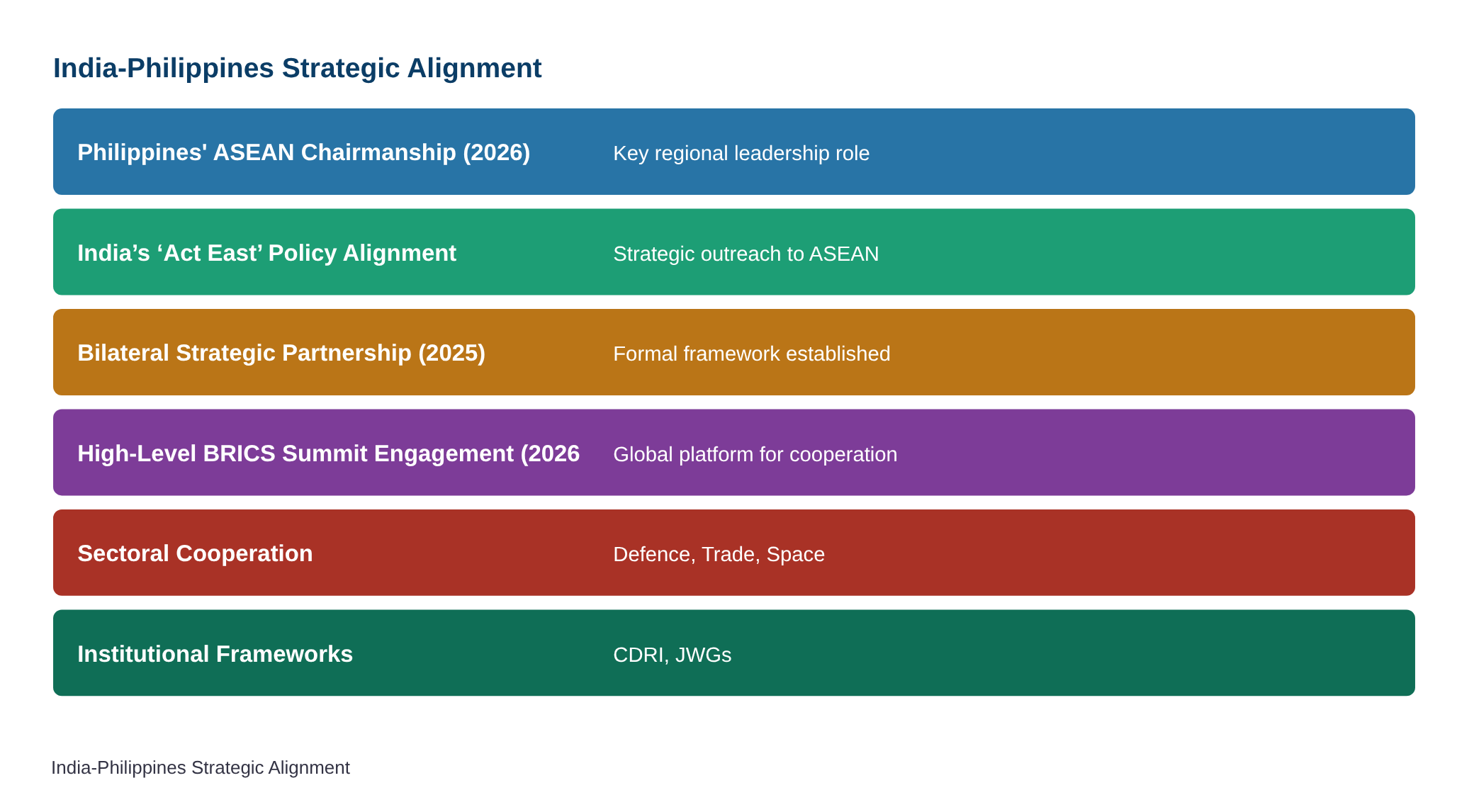
Philippines’ ASEAN Chairmanship (2026) → India’s ‘Act East’ Policy Alignment → Bilateral Strategic Partnership (2025) → High-Level BRICS Summit Engagement → Sectoral Cooperation (Defence, Trade, Space) → Institutional Frameworks (CDRI, JWGs) → Implementation and Monitoring → Long-Term Strategic Partnership.
Prelims Practice Questions
Q1. Consider the following statements regarding the Coalition for Disaster Resilient Infrastructure (CDRI):
1. It was launched by India at the UN Climate Action Summit in 2019.
2. The Philippines is a member of CDRI.
3. The primary objective of CDRI is to promote the resilience of new and existing infrastructure systems against climate and disaster risks.
4. CDRI is a UN-affiliated body.
How many of the above statements are correct?
- Only one
- Only two
- Only three
- All four
Answer: Only three — Statements 1, 2, and 3 are correct. CDRI was indeed launched by India at the UN Climate Action Summit in 2019, the Philippines is a member, and its objective is to enhance infrastructure resilience. Statement 4 is incorrect as CDRI is not a UN-affiliated body but an international coalition of countries, UN agencies, multilateral development banks, private sector, and knowledge institutions.
Q2. Assertion (A): The Act East Policy of India primarily focuses on strengthening economic and strategic ties with Southeast Asian countries.
Reason (R): The Act East Policy was launched in 2014 to replace the Look East Policy, with a renewed emphasis on connectivity, trade, and security partnerships.
Options:
A. Both A and R are true, and R is the correct explanation of A.
B. Both A and R are true, but R is not the correct explanation of A.
C. A is true, but R is false.
D. A is false, but R is true.
Answer: ? — Both Assertion (A) and Reason (R) are true. The Act East Policy, launched in 2014, indeed focuses on strengthening economic and strategic ties with Southeast Asian countries. The Reason (R) correctly explains the transition from the Look East Policy to the Act East Policy, which included a broader engagement with the Asia-Pacific region.
Q3. Match the following pairs related to India’s foreign policy initiatives:
Column I (Initiative) | Column II (Year of Launch)
—————————————————|—————————–
A. Look East Policy | 1. 2014
B. Act East Policy | 2. 1991
C. Coalition for Disaster Resilient Infrastructure | 3. 2019
D. BRICS Summit (India’s first chairmanship) | 4. 2009
Options:
A. A-2, B-1, C-3, D-4
B. A-1, B-2, C-3, D-4
C. A-2, B-1, C-4, D-3
D. A-4, B-3, C-1, D-2
Answer: ? — The correct matches are: A-2 (Look East Policy launched in 1991), B-1 (Act East Policy launched in 2014), C-3 (CDRI launched in 2019), and D-4 (India chaired its first BRICS Summit in 2009).
Mains Practice Question
✍ The India-Philippines Strategic Partnership, established in 2025, represents a significant evolution in India’s engagement with Southeast Asia. Critically analyse the strategic significance of this partnership for India’s foreign policy objectives, with particular reference to the Act East Policy and the broader Indo-Pacific geopolitical landscape. (15 Marks)
Approach: MODEL-ANSWER SKELETON:
1. **Introduction (2 marks)**:
– Define the India-Philippines Strategic Partnership (2025) and its key pillars (defence, trade, space, infrastructure, etc.).
– Briefly outline India’s Act East Policy and its objectives (economic integration, strategic partnerships, connectivity).
2. **Strategic Significance for India (6 marks)**:
– **Act East Policy Reinforcement**: Explain how the partnership aligns with the Act East Policy’s goals of deepening ties with ASEAN and the broader Indo-Pacific.
– **Maritime Security**: Discuss the role of the Philippines in India’s Indo-Pacific strategy, including maritime domain awareness, counter-terrorism, and disaster resilience (e.g., CDRI membership).
– **Counterbalancing China**: Analyse how the partnership contributes to India’s strategy of maintaining a balanced and rules-based order in the Indo-Pacific, particularly in the South China Sea context.
– **Economic and Technological Cooperation**: Highlight sectors like fintech, space, and railway infrastructure as areas of mutual benefit.
3. **Challenges and Limitations (4 marks)**:
– **Geopolitical Constraints**: Discuss the Philippines’ balancing act between India and China, given its economic dependence on the latter.
– **Implementation Gaps**: Address potential challenges in translating strategic intent into concrete outcomes (e.g., defence logistics, trade agreements).
– **ASEAN Centrality**: Critically assess whether the partnership risks diluting ASEAN’s central role in India’s regional engagement.
4. **Conclusion (3 marks)**:
– Summarise the partnership’s strategic value for India.
– Offer a balanced view on its long-term impact, considering both opportunities and constraints.
Key references to include:
– Act East Policy (2014) and its evolution.
– India’s Indo-Pacific Oceans Initiative (IPOI).
– Philippines’ role in ASEAN and its foreign policy priorities.
– Recent developments in India-Philippines defence cooperation (e.g., agreements on defence logistics, maritime security).
Source: orissapost.com
Generated by AanyaAi for educational purpose.
Related guides on our sites
- Best PSIR optional coaching for upsc
- Best PSIR optional teacher for upsc
- Best teacher of PSIR optional for upsc
- Best PSIR optional coaching in delhi for UPSC

- Exercise Tarang Shakti 2026: India’s Mega Multi-Nation Air Power Showcase - September 27, 2026
- रबी अभियान 2026: राष्ट्रीय सम्मेलन में केंद्र-राज्य तालमेल पर होगा जोर - September 27, 2026
- Himachal CM Sukhu: All Doctor Vacancies to be Filled by March - September 27, 2026

No Comments