


08 Aug PM Modi releases ₹4,597 crore tax devolution to Andhra Pradesh
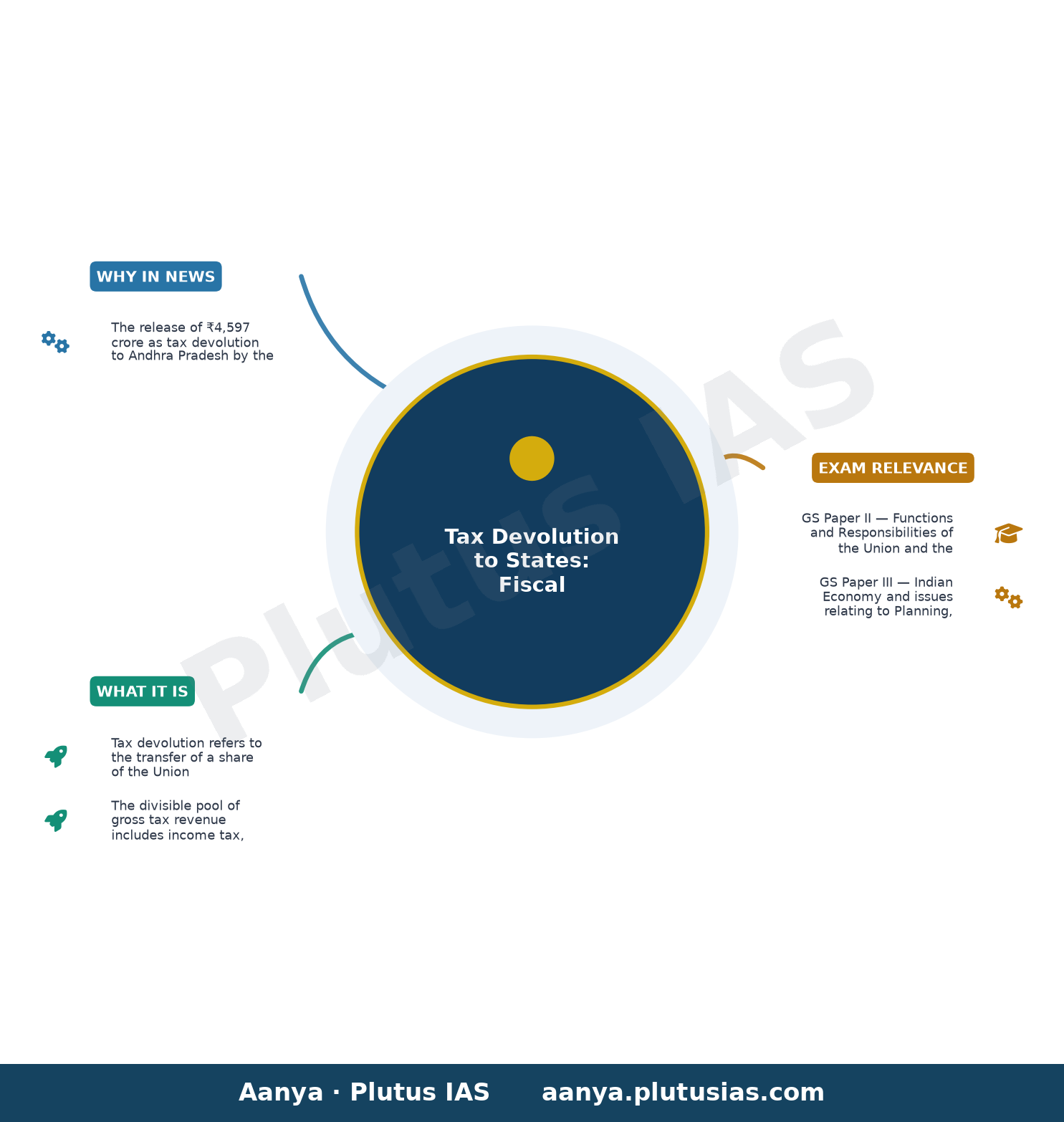
✎ Tax devolution is a constitutional mechanism under Article 270, where the Union Government shares a fixed percentage of its gross tax revenue with states, as recommended by the Finance Commission, to ensure fiscal federalism and…
Subject Relevance — Where This Topic Fits
- GS Paper II — Functions and Responsibilities of the Union and the States, Issues and Challenges Pertaining to the Federal Structure, Devolution of Powers and Finances up to Local Levels | GS Paper III — Indian Economy and issues relating to Planning, Mobilisation of Resources, Growth, Development and Employment
- Prelims: Tax Devolution, Finance Commission, Cooperative Federalism, Vertical and Horizontal Devolution, Gross Tax Revenue, Revenue Deficit Grants, Fiscal Federalism, 15th Finance Commission, Union Budget, State Development Expenditure
- Essay: The Role of Fiscal Federalism in India’s Development Trajectory, Cooperative Federalism: A Catalyst for Inclusive Growth
Quick Revision: Tax devolution is a constitutional mechanism under Article 270, where the Union Government shares a fixed percentage of its gross tax revenue with states, as recommended by the Finance Commission, to ensure fiscal federalism and balanced regional development.
Why is this in the news?
The release of ₹4,597 crore as tax devolution to Andhra Pradesh by the Union Government, acknowledged by Deputy Chief Minister K. Pawan Kalyan, underscores the Centre’s proactive fiscal federalism measures, including advance tax devolution to states. This development is significant as it reflects the Union Government’s commitment to enhancing state-level financial autonomy, accelerating infrastructure development, and promoting cooperative governance, particularly in the context of India’s Viksit Bharat 2047 vision.
Background
- The Constitution of India (Article 270 and 275) empowers the Union Government to share tax revenues with states through the Finance Commission, ensuring fiscal federalism.
- The 15th Finance Commission (2021-22 to 2025-26) recommended a total devolution of 41% of the divisible pool of gross tax revenue to states, with additional grants for local bodies and specific purposes.
- Andhra Pradesh, post-bifurcation in 2014, has faced fiscal challenges, including revenue deficits and developmental gaps, necessitating higher central support for balanced growth.
- The Union Government’s decision to release ₹1,09,019 crore as advance tax devolution to states aligns with the broader objective of accelerating India’s economic growth and reducing inter-state disparities.
- The concept of cooperative federalism, as articulated in the NITI Aayog’s agenda, emphasizes collaborative governance between the Centre and states to achieve national developmental goals.
Tax Devolution: Concept, Mechanism, and Significance
- Tax devolution refers to the transfer of a share of the Union Government’s tax revenue to state governments, as mandated by the Constitution and the Finance Commission.
- The divisible pool of gross tax revenue includes income tax, corporation tax, central excise duties, and service tax (excluding cess and surcharges), which are shared with states based on the Finance Commission’s recommendations.
- The Finance Commission, a constitutional body, determines the vertical devolution (share of states in the divisible pool) and horizontal devolution (distribution among states) based on criteria such as population, income distance, and fiscal capacity.
- Vertical devolution ensures that states receive a fixed percentage of the divisible pool, while horizontal devolution accounts for inter-state disparities, with larger shares allocated to poorer states.
- Tax devolution is a non-discretionary transfer, distinct from grants-in-aid (Article 275) or centrally sponsored schemes, which are conditional and tied to specific developmental objectives.
- Advance tax devolution, introduced in recent Union Budgets, allows states to access funds earlier in the financial year, enabling timely execution of infrastructure and welfare projects.
- Tax devolution plays a pivotal role in India’s fiscal federalism, ensuring that states have the financial autonomy to address local developmental needs while contributing to national economic objectives.
UPSC Value Addition
Keywords for Mains Answer-Writing
Tax Devolution to States · Finance Commission · Cooperative Federalism · Fiscal Federalism in India · Union-State Financial Relations · 15th Finance Commission · Viksit Bharat · Fiscal Consolidation · Devolution of Taxes · Union Budget 2026-27 · Andhra Pradesh State Finances · Advance Tax Devolution · Fiscal Federalism Challenges · Centre-State Financial Relations
Prelims Practice Questions
Q1. Consider the following statements regarding the Finance Commission of India:
1. The Finance Commission is a constitutional body established under Article 280 of the Constitution.
2. The Finance Commission recommends the distribution of net proceeds of taxes between the Union and the States.
3. The Finance Commission is constituted every five years.
4. The recommendations of the Finance Commission are binding on the Union and the States.
How many of the above statements are correct?
- Only one
- Only two
- Only three
- All four
Answer: Only three — Statements 1, 2, and 3 are correct. Statement 4 is incorrect as the recommendations of the Finance Commission are advisory in nature and not binding.
Q2. Assertion (A): The Union Government can release tax devolution to States in advance of the usual schedule.
Reason (R): The Constitution of India mandates that tax devolution to States must occur strictly as per the Finance Commission’s schedule.
Options:
A. Both A and R are true, and R is the correct explanation of A.
B. Both A and R are true, but R is not the correct explanation of A.
C. A is true, but R is false.
D. A is false, but R is true.
- A
- B
- C
- D
Answer: C — The Union Government can release tax devolution in advance, as seen in the news. However, the Constitution does not mandate a strict schedule; it is based on the Finance Commission’s recommendations, which are advisory. Hence, A is true, but R is false.
Q3. Match the following Finance Commissions with their respective Chairpersons:
Column I (Finance Commission) | Column II (Chairperson)
1. 14th Finance Commission | A. Dr. Y.V. Reddy
2. 15th Finance Commission | B. N.K. Singh
3. 13th Finance Commission | C. Vijay Kelkar
4. 12th Finance Commission | D. C. Rangarajan
Options:
A. 1-A, 2-B, 3-C, 4-D
B. 1-B, 2-A, 3-D, 4-C
C. 1-D, 2-C, 3-A, 4-B
D. 1-C, 2-B, 3-A, 4-D
- A
- B
- C
- D
Answer: A — 14th Finance Commission was chaired by Dr. Y.V. Reddy (A), 15th by N.K. Singh (B), 13th by Vijay Kelkar (C), and 12th by C. Rangarajan (D).
Mains Practice Question
✍ The release of tax devolution to States in advance of the usual schedule, as recently announced by the Union Government, represents a significant shift in fiscal federalism in India. Critically examine the implications of this decision for Centre-State financial relations, cooperative federalism, and the fiscal autonomy of States. Also, analyse the potential challenges this may pose to fiscal consolidation and macroeconomic stability. (15 Marks)
Approach: MODEL-ANSWER SKELETON:
1. **Context and Background**: Define tax devolution under Article 270 and the role of the Finance Commission (15th FC recommendations). Mention the usual schedule of devolution and the recent advance release of ₹1,09,019 crore.
2. **Implications for Centre-State Relations**:
– **Cooperative Federalism**: Evaluate how advance devolution aligns with the principle of cooperative federalism (e.g., NITI Aayog’s cooperative federalism reports, PM’s emphasis on ‘Team India’).
– **Fiscal Autonomy of States**: Discuss whether advance devolution enhances or undermines fiscal autonomy (cite Article 275, 282, and 15th FC’s horizontal devolution formula).
– **State-Specific Needs**: Reference Andhra Pradesh’s case (₹4,597 crore) to illustrate how advance funds can address critical gaps in infrastructure, healthcare, and agriculture.
3. **Potential Challenges**:
– **Fiscal Consolidation**: Explain the risk of increased revenue expenditure by States, leading to higher fiscal deficits (cite FRBM Act, 2003, and 15th FC’s fiscal roadmap).
– **Macroeconomic Stability**: Discuss the impact on inflation, interest rates, and the Union Government’s borrowing limits (mention RBI’s role in managing liquidity).
– **Inequity in Distribution**: Highlight concerns over whether advance devolution is equitable across States (reference 15th FC’s criteria: income distance, demographic performance, forest cover).
4. **Balancing Views**:
– **Pro-Advance Devolution**: Argue that it accelerates development, reduces delays, and aligns with the ‘Viksit Bharat’ vision (cite PM’s Independence Day speech 2026).
– **Con-Advance Devolution**: Counter-argue that it may lead to profligacy, undermine long-term planning, and create dependency on Centre (cite examples of States misusing devolution funds).
5. **Way Forward**: Suggest measures such as conditional grants, performance-based devolution, and strengthening State Finance Commissions to balance flexibility with accountability.
Source: The Hindu
Generated by AanyaAi for educational purpose.

- विधायकों की चुप्पी को न्यायालय कैसे मान सकता है शून्य? मद्रास हाईकोर्ट का महत्वपूर्ण फैसला - September 23, 2026
- वायुसेना को मिला बड़ा हथियार: ₹811 करोड़ के 160 स्मार्ट एंटी-एयरफील्ड वेपन समझौता - September 23, 2026
- UPSC Exam Alert: Defence Ministry signs ₹811 Crore SAT-SAAW deal for IAF - September 23, 2026

No Comments