


01 Aug PM Modi to Launch ‘Nasha Mukt Yuva’ Campaign on August 2 for Drug-Free India
✎ The 'Nasha Mukt Yuva – Vikasit Bharat Sankalp Abhiyan' is a 100-week mass mobilisation campaign launched on 2 August 2026 to combat youth substance abuse through community-led, weekly activities and multi-stakeholder…
Subject Relevance — Where This Topic Fits
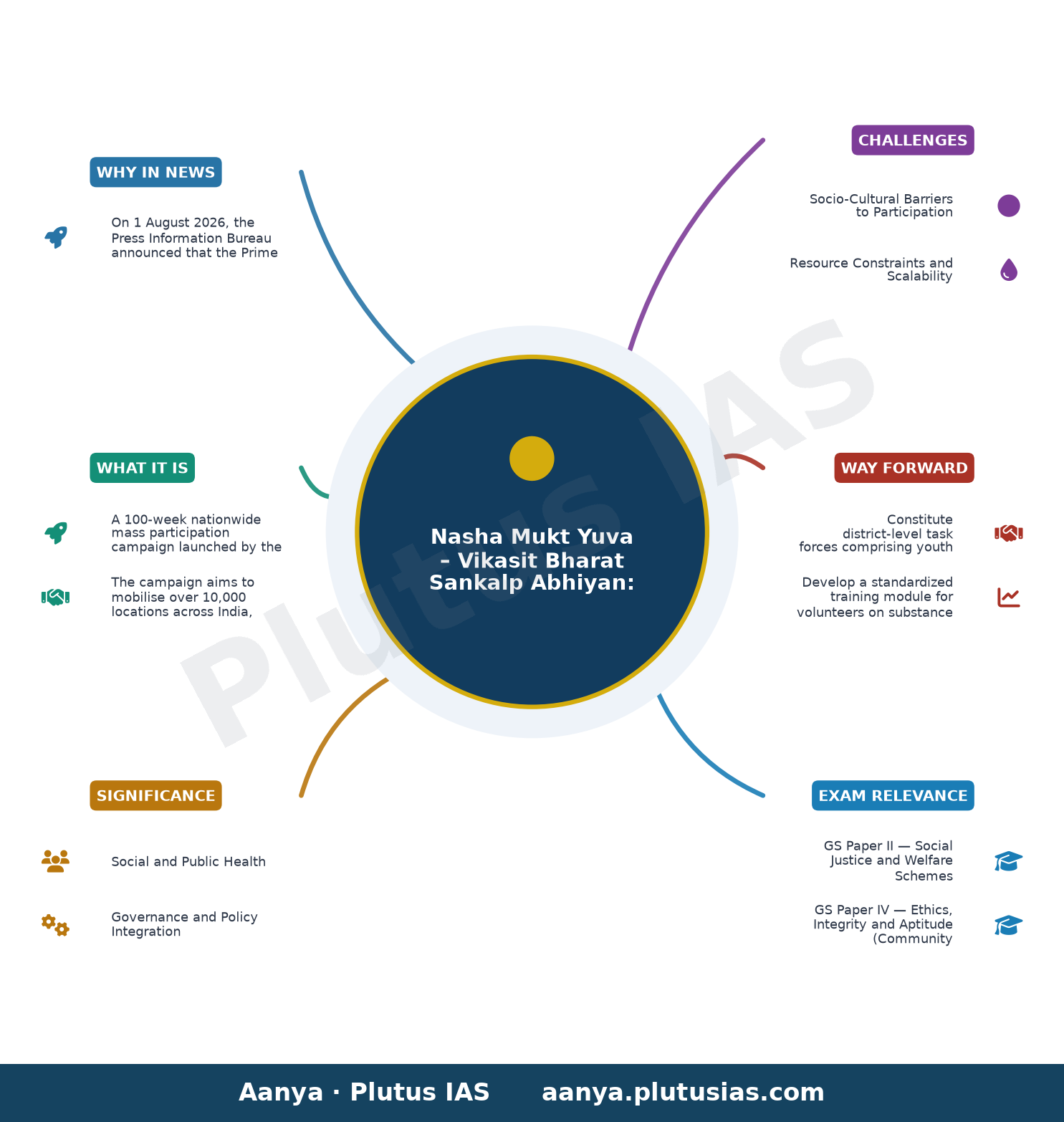
- GS Paper II — Social Justice and Welfare Schemes | GS Paper IV — Ethics, Integrity and Aptitude (Community Participation, Moral Responsibility)
- Prelims: Nasha Mukt Bharat Abhiyaan, National Service Scheme (NSS), My Bharat Volunteers, Substance Abuse Prevention, Community Mobilisation, Youth Empowerment
- Essay: The Role of Youth in Nation-Building: From Awareness to Action, Ethical Governance and Social Transformation: The Case of Substance Abuse Prevention
Quick Revision: The ‘Nasha Mukt Yuva – Vikasit Bharat Sankalp Abhiyan’ is a 100-week mass mobilisation campaign launched on 2 August 2026 to combat youth substance abuse through community-led, weekly activities and multi-stakeholder collaboration, building on the ‘Nasha Mukt Bharat Abhiyan’ framework.
Why is this in the news?
On 1 August 2026, the Press Information Bureau announced that the Prime Minister will inaugurate the ‘Nasha Mukt Yuva – Vikasit Bharat Sankalp Abhiyan’ on 2 August 2026 via video conference. This initiative marks the launch of a 100-week nationwide mass participation campaign aimed at raising awareness and fostering collective action against substance abuse among youth, integrating diverse stakeholders including educational institutions, civil society, industry bodies, and spiritual organisations.
Background
- Substance abuse among youth remains a critical public health and social challenge in India, with the National Drug Dependence Treatment Centre (NDDTC) reporting significant prevalence of opioid, cannabis, and alcohol use disorders among adolescents and young adults.
- The Government of India has previously launched the ‘Nasha Mukt Bharat Abhiyan’ (NMBA) in 2020, a seven-phase programme targeting 272 vulnerable districts to reduce substance abuse through awareness, treatment, and rehabilitation.
- The NMBA operates under the aegis of the Ministry of Social Justice and Empowerment, with a focus on demand reduction and community engagement, aligning with the United Nations Sustainable Development Goal 3.5 (Strengthen the prevention and treatment of substance abuse).
- The campaign recognises the role of youth as agents of social change, leveraging their energy and connectivity to drive grassroots mobilisation against substance abuse.
- India’s demographic dividend, with over 68% of the population below 35 years, necessitates targeted interventions to harness youth potential while mitigating risks associated with substance misuse.
- The initiative builds on the success of programmes like the National Service Scheme (NSS) and ‘My Bharat Volunteers’, which have demonstrated the efficacy of youth-led community engagement in social welfare.
What is the ‘Nasha Mukt Yuva – Vikasit Bharat Sankalp Abhiyan’?
- A 100-week nationwide mass participation campaign launched by the Prime Minister on 2 August 2026 to combat substance abuse among youth and foster a drug-free society.
- The campaign aims to mobilise over 10,000 locations across India, engaging youth through weekly activities every Sunday, including sports, walkathons, meditation sessions, cultural programmes, awareness drives, street plays, discussion forums, art competitions, and community participation events.
- It seeks to create a collective movement by integrating stakeholders such as educational institutions (schools, colleges, universities), youth clubs, NGOs, industry associations, and spiritual organisations into a unified platform for awareness and action.
- The initiative leverages digital tools and virtual participation, with over 125 spiritual organisations and programmes like ‘My Bharat Volunteers’ and ‘My Bharat National Service Scheme Volunteers’ joining the effort remotely.
- The campaign is structured to align with the broader objectives of the ‘Nasha Mukt Bharat Abhiyan’ (NMBA), reinforcing demand reduction strategies through community-led interventions and peer-to-peer advocacy.
- It emphasises the role of youth as ‘change agents’ (‘sankalp duts’) in their communities, promoting ethical values, resilience, and social responsibility as antidotes to substance abuse.
- The 100-week duration is designed to sustain momentum, allowing for phased implementation, periodic assessments, and adaptive strategies based on grassroots feedback and emerging trends in substance use.
- The campaign integrates awareness with actionable outcomes, including the establishment of peer support networks, referral systems for treatment, and community-based monitoring of substance use patterns.
Key Features
| Feature | Significance |
|---|---|
| 100-Week Nationwide Campaign | Ensures sustained, long-term engagement against substance abuse, aligning with the National Youth Policy 2021’s emphasis on youth-led social transformation. |
| Multi-Stakeholder Participation | Integrates educational institutions, youth clubs, NGOs, industry bodies, and spiritual organizations, fostering a holistic societal response to drug abuse prevention. |
| Weekly Sunday Activities | Creates regular, community-driven platforms for awareness, cultural expression, and collective action, leveraging the social capital of local communities. |
| Virtual and Physical Participation | Expands reach across 10,000+ locations, including virtual engagement by My Bharat volunteers and National Service Scheme participants, ensuring inclusivity. |
| Focus on Youth Leadership | Empowers young individuals as ‘agents of change’ in their communities, resonating with the Sustainable Development Goal 4 (Quality Education) and Goal 16 (Peace, Justice, and Strong Institutions). |
Why it Matters
Social and Public Health
- Substance abuse among youth is a critical public health challenge, with long-term implications for mental health, crime rates, and economic productivity, as highlighted in the WHO’s Global Strategy to Reduce the Harmful Use of Alcohol and Drugs.
- The campaign addresses the ‘silent epidemic’ of drug abuse, which disproportionately affects adolescents and young adults, aligning with India’s National Action Plan for Drug Demand Reduction (NAPDDR) 2018-2025.
- Promotes a preventive approach over punitive measures, emphasizing community-based interventions that reduce stigma and encourage early intervention.
Governance and Policy Integration
- Complements existing national initiatives such as the Nasha Mukt Bharat Abhiyaan (NMBA) under the Ministry of Social Justice and Empowerment, which targets 272 vulnerable districts.
- Demonstrates a whole-of-government approach, integrating youth welfare, education, and social justice policies into a unified campaign framework.
- Strengthens India’s compliance with international commitments, including the UN Sustainable Development Goals and the UNODC’s Global Action Plan on Drug Demand Reduction.
Community Mobilization and Social Capital
- Leverages India’s rich tradition of community-driven social movements, such as the Chipko Movement and the Swachh Bharat Mission, to foster collective responsibility.
- Encourages intergenerational dialogue, where youth engage with elders, spiritual leaders, and local institutions to build resilient communities.
- Utilizes cultural and sports activities as non-formal education tools, aligning with UNESCO’s emphasis on youth engagement through arts and sports.
Challenges
1. Socio-Cultural Barriers to Participation
- Deep-rooted stigma associated with substance abuse may deter individuals from seeking help or participating in awareness activities.
- Regional variations in cultural attitudes toward youth autonomy and community roles may limit uniform engagement across states.
UPSC Link: GS Paper 1: Social Issues
2. Resource Constraints and Scalability
- Ensuring equitable access to campaign resources across rural and urban areas, particularly in remote districts with limited infrastructure.
- Balancing the scale of participation (10,000+ locations) with the quality of implementation, including training of volunteers and monitoring of activities.
UPSC Link: GS Paper 2: Governance Issues
3. Behavioral Change Sustainability
- Sustaining long-term behavioral change requires consistent reinforcement, as short-term campaigns often fail to alter entrenched habits.
- Addressing peer pressure and the normalization of substance use in social settings, particularly among adolescents.
UPSC Link: GS Paper 4: Ethics and Human Values
4. Inter-Agency Coordination
- Coordinating between diverse stakeholders—government, NGOs, spiritual organizations, and private sector—presents logistical and administrative challenges.
- Ensuring alignment of campaign objectives with existing state-level initiatives to avoid duplication or conflict.
UPSC Link: GS Paper 2: Federalism
5. Data Gaps and Monitoring
- Limited granular data on substance abuse patterns among youth in specific regions may hinder targeted interventions.
- Developing a robust monitoring and evaluation framework to assess the campaign’s impact on awareness, behavior change, and reduction in substance use.
UPSC Link: GS Paper 3: Technology and Data
Challenges — UPSC Perspective
| Issue | Concern |
|---|---|
| Stigma and Silence | Social taboos around substance abuse may prevent open discussion and participation in campaign activities. |
| Urban-Rural Divide | Limited access to campaign resources in rural areas may exacerbate disparities in awareness and intervention. |
| Behavioral Inertia | Long-standing habits and social norms may resist change despite campaign efforts. |
| Volunteer Fatigue | Sustained engagement over 100 weeks requires continuous motivation and support for volunteers. |
| Policy-Implementation Gap | Existing policies like NAPDDR may face challenges in ground-level execution due to resource constraints. |
| Digital Divide | Virtual participation may exclude individuals without internet access or digital literacy. |
Government Initiatives — Must-Memorise for Prelims
- Nasha Mukt Bharat Abhiyaan (NMBA)
- My Bharat National Service Scheme (NSS)
Way Forward
- Constitute district-level task forces comprising youth leaders, NGOs, and local administration to oversee weekly activities and ensure grassroots participation.
- Develop a standardized training module for volunteers on substance abuse prevention, mental health first aid, and community engagement strategies.
- Leverage digital platforms to create a centralized dashboard for tracking participation, feedback, and impact metrics across locations.
- Integrate the campaign with existing school and college curricula to institutionalize awareness programs on substance abuse and healthy lifestyle choices.
- Partner with cultural and sports federations to design year-long programs that align with the campaign’s objectives, such as ‘Youth Against Drugs’ sports tournaments.
- Establish a helpline and mobile app for anonymous reporting and counseling, in collaboration with the Ministry of Social Justice and Empowerment.
- Conduct periodic impact assessments in collaboration with academic institutions to evaluate changes in awareness levels and substance use patterns among youth.
- Expand the campaign’s reach by involving local self-help groups, women’s collectives, and senior citizen associations to foster intergenerational support.
UPSC Value Addition
Keywords for Mains Answer-Writing
Nasha Mukt Yuva Abhiyaan · Substance abuse prevention · Youth empowerment · Community participation · Narcotic Drugs and Psychotropic Substances Act (NDPS Act) · National Service Scheme (NSS) · Social transformation · Public health policy · Behavioral change communication · Holistic development of youth
Concept Flow
Rising youth substance abuse rates → Recognition of public health crisis → Launch of ‘Nasha Mukt Yuva’ campaign → 100-week nationwide mobilization → Multi-stakeholder participation (youth, NGOs, spiritual groups) → Weekly community activities (sports, arts, awareness) → Behavioral change and stigma reduction → Long-term societal resilience and reduced drug demand → Alignment with SDGs and national policies (NAPDDR, NYP 2021)
Prelims Practice Questions
Q1. Consider the following statements regarding the ‘Nasha Mukt Yuva – Vikasit Bharat Sankalp Abhiyaan’:
1. The campaign is a 100-week nationwide initiative to promote awareness against substance abuse.
2. It is launched by the Ministry of Social Justice and Empowerment.
3. The campaign involves weekly activities such as sports, cultural programs, and community participation.
4. The initiative is exclusively targeted at school-going children.
How many of the above statements are correct?
- Only one
- Only two
- Only three
- All four
Answer: Only three — Statements 1 and 3 are correct. Statement 2 is incorrect as the campaign is launched by the Prime Minister’s Office. Statement 4 is incorrect as the initiative targets youth broadly, not exclusively school-going children.
Q2. Assertion (A): The ‘Nasha Mukt Yuva – Vikasit Bharat Sankalp Abhiyaan’ aims to create a collective movement against substance abuse by involving diverse stakeholders.
Reason (R): The campaign seeks to leverage the role of educational institutions, youth organizations, and spiritual bodies to foster community participation.
In the context of the above two statements, which one of the following is correct?
- Both A and R are true, and R is the correct explanation of A.
- Both A and R are true, but R is not the correct explanation of A.
- A is true, but R is false.
- A is false, but R is true.
Answer: Both A and R are true, and R is the correct explanation of A. — Both Assertion (A) and Reason (R) are true, and R correctly explains A. The campaign’s design explicitly includes diverse stakeholders to build a collective movement against substance abuse.
Q3. Which of the following activities is NOT explicitly mentioned as part of the weekly initiatives under the ‘Nasha Mukt Yuva – Vikasit Bharat Sankalp Abhiyaan’?
- Yoga and meditation sessions
- Cultural programs and street plays
- Financial literacy workshops
- Sports and walkathons
Answer: Financial literacy workshops — Financial literacy workshops are not mentioned in the list of weekly activities under the campaign. The campaign includes yoga, meditation, cultural programs, street plays, sports, and walkathons.
Mains Practice Question
✍ ‘Substance abuse among youth is a multifaceted challenge that requires a holistic approach integrating public health, education, and community participation.’ Critically examine the role of the ‘Nasha Mukt Yuva – Vikasit Bharat Sankalp Abhiyaan’ in addressing this issue. Also, assess how the campaign aligns with India’s existing legal and policy framework on substance abuse. (15 Marks)
Approach: MODEL-ANSWER SKELETON:
1. **Introduction (2 Marks)**
– Define substance abuse and its socio-economic impact on youth.
– Highlight the need for a holistic approach combining public health, education, and community engagement.
2. **Role of ‘Nasha Mukt Yuva – Vikasit Bharat Sankalp Abhiyaan’ (6 Marks)**
– **Awareness and Education**: Examine the campaign’s focus on weekly activities (yoga, sports, cultural programs, street plays) to raise awareness and foster behavioral change.
– **Community Participation**: Analyze the inclusion of diverse stakeholders (educational institutions, youth clubs, NGOs, spiritual organizations) to create a collective movement.
– **Youth Empowerment**: Discuss how the campaign positions youth as agents of social change, aligning with the National Youth Policy 2021.
– **Limitations**: Critique the campaign’s scalability, sustainability, and potential challenges in reaching marginalized sections.
3. **Alignment with Legal and Policy Framework (5 Marks)**
– **NDPS Act, 1985**: Discuss how the campaign complements the Narcotic Drugs and Psychotropic Substances Act in preventing drug abuse.
– **National Action Plan for Drug Demand Reduction (NAPDDR)**: Evaluate the campaign’s alignment with the NAPDDR’s objectives, such as prevention, treatment, and rehabilitation.
– **National Service Scheme (NSS) and National Cadet Corps (NCC)**: Examine the role of NSS volunteers and NCC cadets in the campaign.
– **Gaps**: Identify any gaps, such as the lack of a specific legal mandate or enforcement mechanism within the campaign.
4. **Conclusion (2 Marks)**
– Summarize the campaign’s strengths and weaknesses.
– Provide a balanced view on its potential to create long-term behavioral change and reduce substance abuse among youth.
Source: PIB (Press Information Bureau)
Generated by AanyaAi for educational purpose.

- मध्य प्रदेश में स्वास्थ्य सेवाओं का विस्तार: पीपीपी मॉडल और एमबीबीएस सीटों में वृद्धि - September 19, 2026
- MP’s Health Sector Progress Reviewed by Union Health Minister JP Nadda - September 19, 2026
- ओडिशा में 870 एकड़ में बनेगा ‘सिलिकॉन वैली’, जानिए क्या होगा फायदा - September 19, 2026

No Comments