


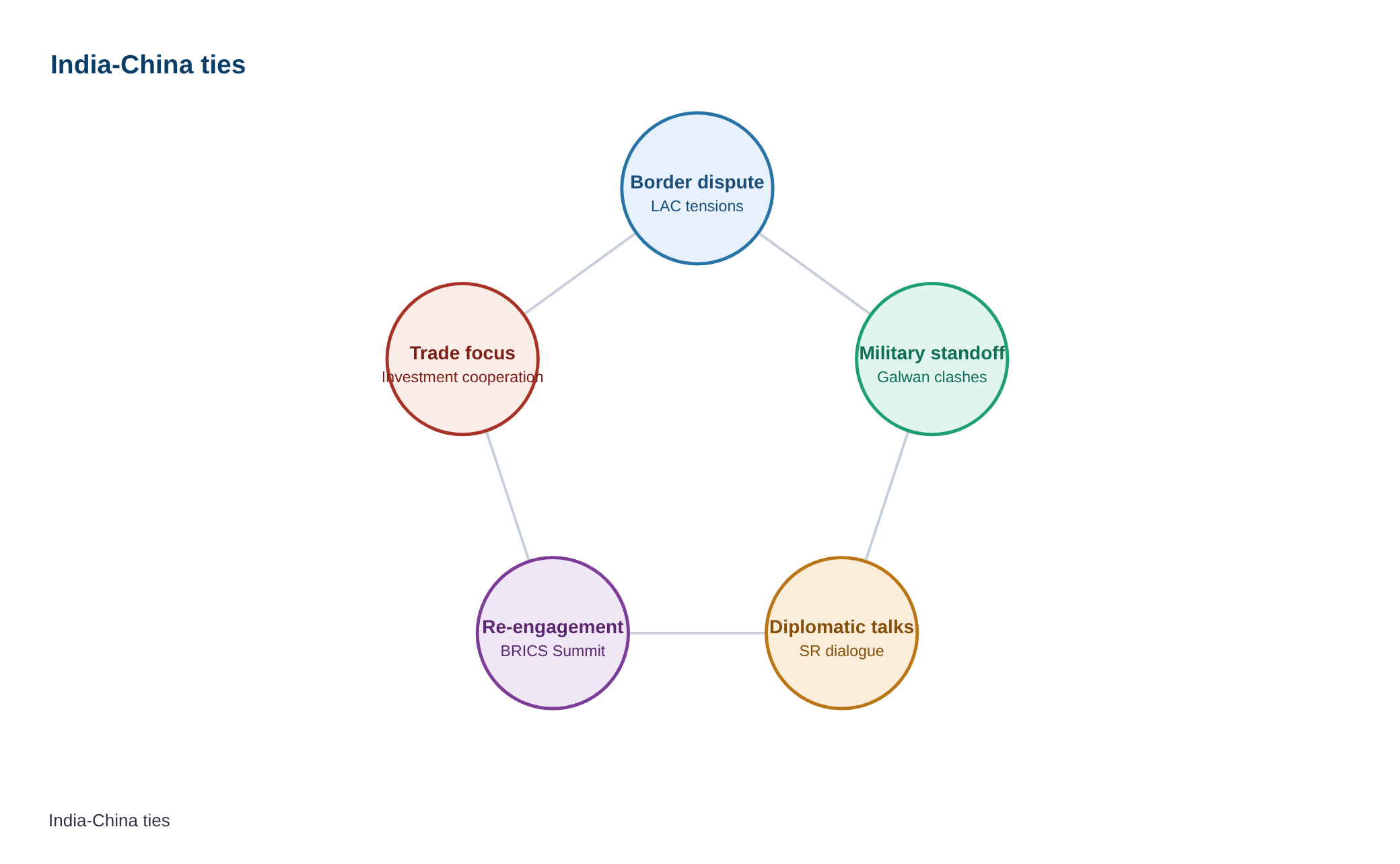
12 Sep PM Modi-Xi Jinping Talks: Key to Resolving India-China Border Disputes
✎ The India-China bilateral engagement is anchored in the Special Representative dialogue mechanism (2003), with trade and trans-boundary cooperation serving as key instruments for normalisation amid unresolved border disputes.
Subject Relevance — Where This Topic Fits
- GS Paper II — International Relations: India’s Foreign Policy, Bilateral and Multilateral Groupings and Agreements | GS Paper II — International Relations: India-China Relations, Border Disputes, and Diplomatic Strategies | GS Paper III — Economy: Trade and Investment Diplomacy, Economic Diplomacy in Foreign Policy
- Prelims: Line of Actual Control (LAC), Special Representative Mechanism, BRICS Summit, Eastern Ladakh standoff, Galwan Valley clashes, Trans-boundary cooperation, Delimitation of frontier, 3,488 km disputed border
- Essay: The Role of Diplomacy in Managing Asymmetric Power Relations: India-China Case Study, Economic Interdependence vs. Strategic Competition: The India-China Paradox
Quick Revision: The India-China bilateral engagement is anchored in the Special Representative dialogue mechanism (2003), with trade and trans-boundary cooperation serving as key instruments for normalisation amid unresolved border disputes.
Why is this in the news?
The bilateral meeting between Prime Minister Narendra Modi and Chinese President Xi Jinping on September 12, 2026, assumes significance as it follows a period of strained relations marked by military tensions along the Line of Actual Control (LAC) and seeks to normalise bilateral ties through enhanced trade and investment cooperation. The meeting, held on the sidelines of the BRICS Summit in New Delhi, represents a critical juncture in India-China diplomatic engagement, with both sides aiming to stabilise relations amid lingering border disputes and strategic mistrust.
Background
- The India-China relationship has historically been characterised by a complex interplay of cooperation and competition, with trade and investment serving as key pillars of engagement despite unresolved territorial disputes.
- The 2020 Galwan Valley clashes in Eastern Ladakh marked a significant deterioration in bilateral relations, leading to prolonged military standoffs and heightened strategic mistrust between the two nations.
- Following the Galwan incident, diplomatic channels were maintained through high-level engagements, including the Special Representative (SR) dialogue mechanism, which was established in 2003 to address the 3,488 km disputed border.
- Xi Jinping’s visit to India in 2026 is his first trip to the country in seven years, underscoring the importance of the BRICS Summit as a platform for re-engagement and confidence-building.
- Economic ties, including trade and investment, have been identified as critical areas for normalisation, with both sides seeking to leverage complementary economic strengths despite strategic divergences.
What is the India-China Bilateral Engagement Framework?
- The bilateral engagement framework between India and China encompasses diplomatic, economic, and strategic dimensions, with trade and investment serving as key instruments for normalisation.
- The Special Representative (SR) dialogue mechanism, established in 2003, is the primary institutionalised platform for addressing the unresolved border dispute, involving high-level officials from both countries.
- Bilateral trade, valued at over $100 billion annually, remains a critical component of the relationship, despite geopolitical tensions, with India seeking to reduce the trade deficit through targeted measures.
- Trans-boundary cooperation in areas such as climate change, disaster management, and cultural exchanges serves as confidence-building measures to mitigate strategic mistrust.
- The Line of Actual Control (LAC) remains a flashpoint, with both sides maintaining differing perceptions of the boundary, necessitating sustained diplomatic and military dialogue to prevent escalation.
- The BRICS platform provides an additional diplomatic avenue for engagement, enabling both countries to collaborate on global governance issues while managing bilateral tensions.
- Economic diplomacy, including investment facilitation and trade agreements, is being prioritised to rebuild trust and foster interdependence, despite strategic competition in the Indo-Pacific region.
Key Features
| Feature | Significance |
|---|---|
| Bilateral Talks Mechanism | Established in 2003 to address the 3,488 km disputed India-China border through structured dialogue, ensuring sustained engagement despite periodic strains. |
| Special Representative Dialogue | A high-level mechanism involving the National Security Advisor and Chinese Foreign Minister to maintain peace along the Line of Actual Control (LAC) and delimit the frontier. |
| BRICS Summit Context | Xi Jinping’s visit to India for the BRICS Summit provides a structured multilateral platform to complement bilateral efforts in normalising relations. |
| Trade and Investment Focus | The talks aim to expand bilateral economic ties, addressing trade imbalances and fostering mutual investment as confidence-building measures. |
| Military Posturing Concerns | Lingering issues over aggressive military posturing, particularly in the Arunachal Pradesh sector, remain a critical challenge in the normalisation process. |
Why it Matters
Strategic Diplomacy
- Reinforces the importance of structured bilateral mechanisms (e.g., Special Representative Dialogue) in managing territorial disputes without escalation to conflict.
- Demonstrates the role of multilateral forums (BRICS) in providing diplomatic space for bilateral engagement amid geopolitical tensions.
- Highlights the necessity of confidence-building measures (CBMs) in maintaining stability along disputed borders, particularly the LAC.
- Underscores the interplay between economic diplomacy and strategic stability in shaping India-China relations.
- Serves as a reminder of the 2005 Agreement on the Political Parameters and Guiding Principles for the Settlement of the India-China Boundary Question as a foundational framework.
Economic Implications
- Expansion of trade and investment ties can mitigate trade imbalances, which have historically favoured China, thereby reducing economic friction.
- Enhanced economic cooperation may facilitate joint ventures in sectors like manufacturing, technology, and infrastructure, benefiting both economies.
- Bilateral economic engagement can act as a stabilising factor in broader geopolitical relations, reducing the risk of trade wars or sanctions.
- Opportunities for collaboration in global supply chains, particularly in critical minerals and renewable energy technologies, may emerge from improved relations.
- The focus on economic ties aligns with India’s broader strategy of diversifying trade partners to reduce dependency on any single nation.
Geopolitical Context
- The visit occurs against the backdrop of shifting global power dynamics, including the rise of BRICS as a counterbalance to Western-led institutions.
- China’s engagement with India through BRICS and bilateral channels reflects its broader strategy of engaging with major developing economies.
- India’s participation in BRICS, despite tensions with China, underscores the pragmatic approach to multilateralism in an increasingly multipolar world.
- The normalisation efforts are influenced by regional security concerns, including China’s military posturing in the Indo-Pacific and India’s strategic partnerships with like-minded nations.
- The talks also reflect the broader trend of middle-power diplomacy, where India and China seek to balance their interests without being drawn into bloc politics.
Challenges
1. Border Dispute and LAC Management
- The unresolved border dispute spanning 3,488 km remains the core challenge, with periodic incidents of military posturing along the LAC.
- The lack of a clearly demarcated border increases the risk of miscalculation or unintended escalation, particularly in sensitive sectors like Arunachal Pradesh.
- The 2020 Galwan Valley clashes highlighted the fragility of peace along the LAC, necessitating robust confidence-building measures.
- Divergent perceptions of the LAC and differing historical narratives complicate negotiations, requiring sustained dialogue over decades.
- The absence of a final settlement means that any progress in normalisation is inherently fragile and reversible.
UPSC Link: GS II: India-China relations, LAC management
2. Economic Asymmetry and Trade Imbalance
- India’s trade deficit with China has persisted for years, creating structural economic tensions that complicate bilateral relations.
- China’s dominance in sectors like electronics, pharmaceuticals, and industrial goods poses challenges to India’s domestic industries and self-reliance goals.
- Non-tariff barriers and regulatory hurdles in China often limit market access for Indian goods, exacerbating the trade imbalance.
- The lack of reciprocal investment opportunities in China for Indian businesses further entrenches economic asymmetries.
- Addressing these imbalances requires not just trade negotiations but structural reforms in both economies to foster a level playing field.
UPSC Link: GS III: Trade policies, economic diplomacy
3. Trust Deficit and Historical Grievances
- Decades of unresolved border disputes, military standoffs, and perceived Chinese aggression have eroded mutual trust between the two nations.
- Historical grievances, including China’s support for Pakistan and its stance on issues like Tibet and Taiwan, continue to influence bilateral perceptions.
- The absence of high-level visits between 2019 and 2026 underscores the depth of the trust deficit and its impact on diplomatic engagement.
- Cultural and civilisational ties, while historically strong, have been overshadowed by geopolitical rivalries in recent decades.
- Rebuilding trust requires sustained people-to-people exchanges, track-II diplomacy, and consistent diplomatic engagement.
UPSC Link: GS II: Bilateral relations, soft power
4. Multilateral Constraints and Third-Party Influences
- India’s strategic partnerships with the United States, Japan, and Australia (Quad) introduce complexities in its engagement with China, particularly in the Indo-Pacific.
- China’s growing influence in South Asia and the Indian Ocean region through initiatives like the Belt and Road Initiative (BRI) poses strategic challenges for India.
- The BRICS grouping, while providing a diplomatic platform, also reflects the divergent interests of its members, limiting its effectiveness as a cohesive bloc.
- Global power rivalries, including US-China tensions, often spill over into regional dynamics, constraining India’s room for manoeuvre in its China policy.
- Balancing multilateral commitments with bilateral priorities requires careful navigation to avoid unintended consequences.
UPSC Link: GS II: Multilateralism, Indo-Pacific strategy
5. Domestic Political and Public Sentiment
- Public sentiment in India, shaped by historical grievances and recent military clashes, often views China with scepticism or hostility, constraining diplomatic flexibility.
- Domestic political narratives in both countries can influence foreign policy decisions, making long-term engagement vulnerable to short-term political pressures.
- Media narratives and public discourse in both nations often amplify tensions, complicating efforts to foster a conducive environment for dialogue.
- The role of opposition parties in both countries in shaping narratives around bilateral relations adds another layer of complexity to normalisation efforts.
- Sustained public diplomacy and transparent communication are essential to manage expectations and build a constituency for peace.
UPSC Link: GS II: Public diplomacy, domestic politics
Challenges — UPSC Perspective
| Issue | Concern |
|---|---|
| Border Dispute | Risk of military miscalculation or escalation due to unresolved territorial claims and differing perceptions of the LAC. |
| Trade Imbalance | Structural economic tensions arising from India’s persistent trade deficit with China, limiting the scope for economic cooperation. |
| Trust Deficit | Decades of historical grievances and military standoffs have eroded mutual trust, complicating diplomatic engagement. |
| Multilateral Constraints | Divergent interests within BRICS and strategic partnerships with third countries (e.g., Quad) constrain India-China bilateral dynamics. |
| Public Sentiment | Domestic political narratives and public perceptions in both countries often amplify tensions, limiting diplomatic flexibility. |
Way Forward
- Institutionalise the Special Representative Dialogue to ensure regular, structured engagement on border management and confidence-building measures.
- Accelerate negotiations under the 2005 Agreement on Political Parameters to delineate a framework for a final border settlement.
- Expand economic cooperation through targeted trade agreements, investment facilitation, and joint ventures in critical sectors like technology and green energy.
- Enhance people-to-people exchanges, including cultural, educational, and scientific collaborations, to rebuild mutual trust and understanding.
- Strengthen multilateral coordination within BRICS to address common challenges while managing bilateral tensions through pragmatic engagement.
- Develop a comprehensive risk assessment framework to anticipate and mitigate potential triggers for military posturing along the LAC.
- Promote track-II diplomacy and backchannel negotiations to explore creative solutions to long-standing disputes without public posturing.
- Establish a joint working group on cybersecurity and digital governance to address emerging challenges in the bilateral relationship.
UPSC Value Addition
Keywords for Mains Answer-Writing
India-China bilateral relations · Line of Actual Control (LAC) · Special Representative mechanism · BRICS Summit · trans-boundary cooperation · border delimitation · peace and tranquillity on borders · economic engagement · confidence-building measures (CBMs) · geopolitical stability · multilateral diplomacy · institutional mechanisms for dispute resolution
Concept Flow
Historical border disputes and military standoffs → Erosion of trust and confidence → Periodic diplomatic engagement through mechanisms like the Special Representative Dialogue → Efforts to normalise relations amid lingering concerns → Expansion of trade and investment ties as a confidence-building measure → Multilateral platforms (BRICS) providing diplomatic space for bilateral engagement → Challenges in sustaining progress due to structural issues like trade imbalance and public sentiment → Need for institutionalised dialogue and risk mitigation to ensure long-term stability.
Prelims Practice Questions
Q1. Consider the following statements regarding the India-China border dispute:
1. The India-China border dispute spans approximately 3,488 km.
2. The Special Representative mechanism for border talks was established in 2003.
3. The Line of Actual Control (LAC) is a clearly demarcated boundary between India and China.
4. The Galwan Valley clashes occurred in 2020.
How many of the above statements are correct?
- Only one
- Only two
- Only three
- All
Answer: All — Statements 1, 2, and 4 are correct. Statement 3 is incorrect as the LAC is not a clearly demarcated boundary; it is a de facto line subject to differing interpretations by both sides.
Q2. Assertion (A): The Special Representative mechanism for India-China border talks was established to comprehensively address the border dispute.
Reason (R): The mechanism was created to maintain peace and tranquillity along the Line of Actual Control (LAC).
- Both A and R are true, and R is the correct explanation of A.
- Both A and R are true, but R is not the correct explanation of A.
- A is true, but R is false.
- A is false, but R is true.
Answer: Both A and R are true, but R is not the correct explanation of A. — Both the Assertion and Reason are true. The Special Representative mechanism was established in 2003 to comprehensively address the border dispute, and one of its primary objectives is to maintain peace and tranquillity along the LAC.
Q3. Match the following institutions/mechanisms with their respective purposes in India-China relations:
Column I
A. Special Representative mechanism
B. Line of Actual Control (LAC)
C. BRICS Summit
D. Confidence-Building Measures (CBMs)
Column II
1. Multilateral platform for economic and political cooperation among emerging markets
2. Mechanism to address and resolve the border dispute through dialogue
3. De facto boundary line subject to differing interpretations
4. Measures to reduce military tensions and build trust along the border
- {‘A’: ‘2’, ‘B’: ‘3’, ‘C’: ‘1’, ‘D’: ‘4’}
- {‘A’: ‘1’, ‘B’: ‘2’, ‘C’: ‘3’, ‘D’: ‘4’}
- {‘A’: ‘2’, ‘B’: ‘4’, ‘C’: ‘1’, ‘D’: ‘3’}
- {‘A’: ‘3’, ‘B’: ‘1’, ‘C’: ‘4’, ‘D’: ‘2’}
Answer: {‘A’: ‘2’, ‘B’: ‘3’, ‘C’: ‘1’, ‘D’: ‘4’} — A matches with 2 (Special Representative mechanism for border talks), B matches with 3 (LAC as a de facto boundary line), C matches with 1 (BRICS as a multilateral platform), and D matches with 4 (CBMs to reduce military tensions).
Mains Practice Question
✍ The restoration of peace and tranquillity along the Line of Actual Control (LAC) is contingent upon sustained dialogue and institutional mechanisms. Critically examine the role of the Special Representative mechanism in India-China border dispute resolution, with reference to recent high-level engagements. Also, analyse the significance of confidence-building measures (CBMs) in maintaining stability along the LAC. (15 Marks)
Approach: MODEL-ANSWER SKELETON:
1. **Introduction (2 Marks)**
– Briefly define the India-China border dispute and its historical context, including the 2020 Galwan Valley clashes.
– State the importance of maintaining peace and tranquillity along the LAC for bilateral relations and regional stability.
2. **Role of the Special Representative Mechanism (6 Marks)**
– **Establishment and Purpose**: Explain the establishment of the Special Representative mechanism in 2003 to comprehensively address the border dispute.
– **Recent Engagements**: Highlight recent high-level exchanges, including the Special Representative dialogue between NSA Ajit Doval and Chinese Foreign Minister Wang Yi.
– **Functions**: Discuss its role in delimiting the frontier, sustaining trans-boundary cooperation, and maintaining peace along the LAC.
– **Limitations**: Acknowledge challenges such as differing interpretations of the LAC and the absence of a clearly demarcated boundary.
3. **Confidence-Building Measures (CBMs) (5 Marks)**
– **Definition and Objectives**: Define CBMs and their role in reducing military tensions and building trust.
– **Examples**: Provide examples of recent CBMs, such as the disengagement agreements post-2020 clashes.
– **Significance**: Explain how CBMs contribute to stability and prevent escalation of disputes.
4. **Conclusion (2 Marks)**
– Summarise the importance of sustained dialogue and institutional mechanisms in maintaining peace.
– Emphasise the need for a balanced approach combining diplomacy, economic engagement, and military restraint.
Source: orissapost.com
Generated by AanyaAi for educational purpose.
Related guides on our sites
- Anthropology VS PSIR
- Best PSIR optional coaching
- Best PSIR optional coaching online
- Best PSIR optional teacher

- कर्नाटक हाईकोर्ट ने शराब पीकर गाड़ी चलाने वालों पर कसा शिकंजा, मुआवजा 30% घटाया - September 14, 2026
- Karnataka HC Slashes Compensation by 30% for Drunk Driver: Key Polity Insight for UPSC - September 14, 2026
- अगस्त 2026 में थोक मूल्य सूचकांक मुद्रास्फीति 9.92%: प्रमुख समूहों का विश्लेषण - September 14, 2026

No Comments