


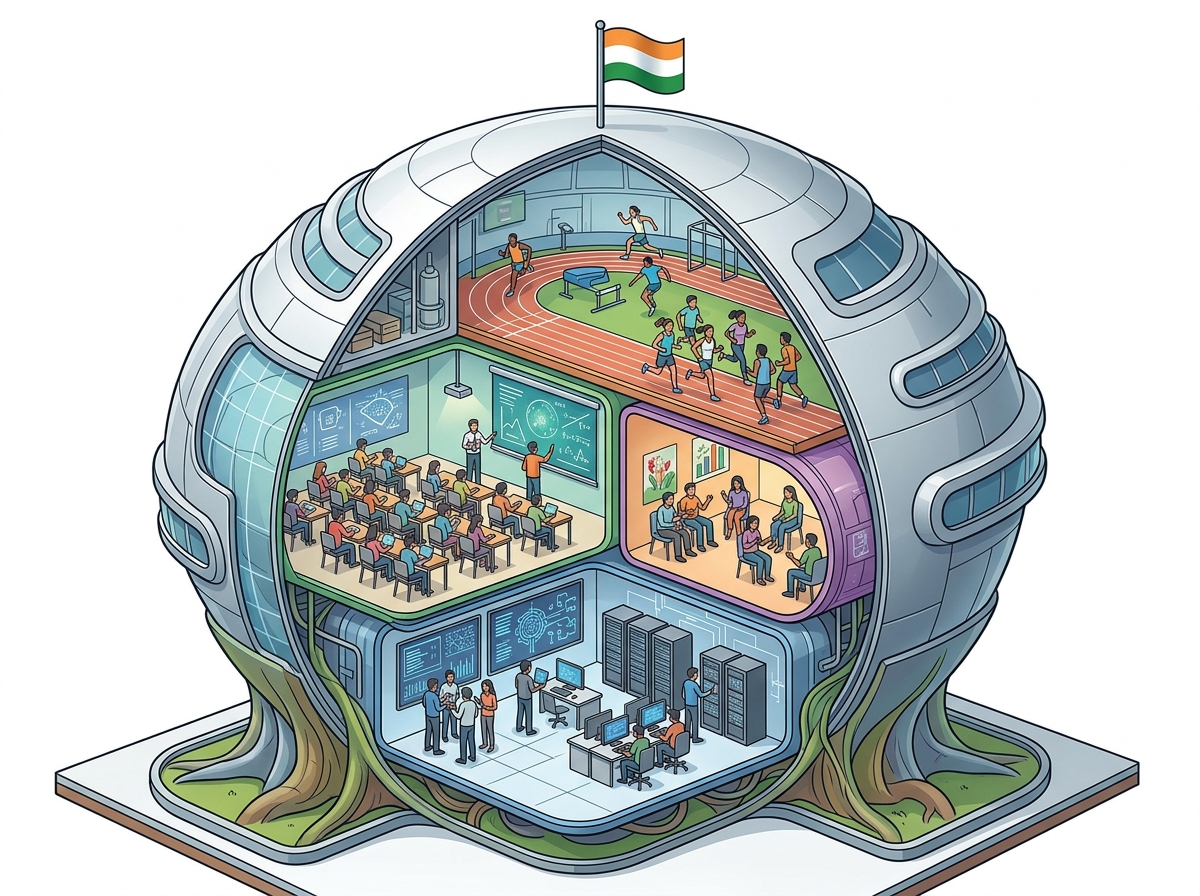
15 Aug PM Modi’s 5 Key Youth Initiatives for Viksit Bharat 2026
AI skill trainingFree digital coachingNasha Mukt Yuva AbhiyanTalent hunt 2036 OlympicsYouth empowermentViksit Bharat vision✎ The Prime Minister’s Independence Day announcements for youth empowerment—AI skill training, free digital coaching, Nasha Mukt Yuva Abhiyan, and the Olympics talent hunt—reflect a multi-dimensional strategy to harness India’s…
Subject Relevance — Where This Topic Fits
- GS Paper II — Governance, Social Justice and Welfare | GS Paper III — Science and Technology, Skill Development | GS Paper IV — Human Values and Aptitude
- Prelims: Artificial Intelligence (AI), Skill India Mission, Nasha Mukt Bharat Abhiyan, Digital India, Khelo India Programme, TOPS (Target Olympic Podium Scheme), National Education Policy 2020, National Digital Library, National Skill Development Corporation
- Essay: The Role of Technology in Transforming India’s Youth, Balancing Development and Social Responsibility: A Case for Drug-Free India
Quick Revision: The Prime Minister’s Independence Day announcements for youth empowerment—AI skill training, free digital coaching, Nasha Mukt Yuva Abhiyan, and the Olympics talent hunt—reflect a multi-dimensional strategy to harness India’s demographic dividend through technology, education, health, and sports.
Why is this in the news?
The Prime Minister of India announced several new initiatives for youth empowerment during the 80th Independence Day address from the Red Fort on 15 August 2026. These initiatives include AI skill training for one crore youth, free digital coaching for competitive examinations, a nationwide campaign against drug abuse (Nasha Mukt Yuva Abhiyan), and a talent hunt for the 2036 Olympics. The announcements underscore the government’s focus on leveraging technology, education, and social welfare to foster a skilled and responsible youth demographic as part of the vision for a ‘Viksit Bharat’ (Developed India).
Background
- The Union Government has consistently prioritised youth empowerment through skill development, education, and social welfare programmes, aligning with constitutional directives such as Article 21A (Right to Education) and Directive Principles of State Policy (Articles 38, 39, 41, 45, and 47) that emphasise education, health, and social justice.
- India’s demographic dividend, with over 65% of the population below 35 years, necessitates targeted interventions to enhance employability, reduce substance abuse, and promote holistic development.
- The National Education Policy (NEP) 2020 advocates for integrating technology in education and skill development, including AI and digital literacy, to prepare youth for future job markets.
- The Skill India Mission (launched in 2015) and initiatives like Khelo India (2018) aim to enhance vocational training and sports infrastructure, reflecting long-standing policy commitments to youth development.
- Substance abuse among youth has been identified as a critical public health challenge by the World Health Organization (WHO) and the United Nations Office on Drugs and Crime (UNODC), necessitating multi-stakeholder interventions.
- The Target Olympic Podium Scheme (TOPS), launched in 2014, supports elite athletes and has contributed to India’s improved performance in international sports events, including the Olympics.
Key Initiatives Announced for Youth Empowerment
- **AI Skill Training Programme**: A national initiative to train one crore youth in artificial intelligence (AI) and related technologies, aimed at enhancing employability in the rapidly evolving tech-driven job market. This aligns with the National Strategy for Artificial Intelligence (2018) and the Digital India initiative, which emphasise AI integration across sectors.
- AI training will be delivered through partnerships with industry, academia, and government institutions, leveraging platforms such as the National Digital Library and SWAYAM (Study Webs of Active-Learning for Young Aspiring Minds) for scalable and accessible learning.
- The programme targets both technical and non-technical youth, with a focus on foundational AI literacy, machine learning, and generative AI applications, thereby bridging the digital divide and fostering innovation.
- **Free Digital Coaching for Competitive Examinations**: A scheme to provide free online coaching to youth preparing for competitive examinations, including civil services, engineering, medical, and other professional entrance tests. This initiative complements existing programmes like the National Scholarship Portal and the National Testing Agency (NTA) to democratise access to quality education.
- The coaching will be delivered through digital platforms, including the National Digital Library and SWAYAM, ensuring scalability and accessibility across rural and urban areas. This aligns with the Right to Education (RTE) Act’s emphasis on equitable educational opportunities.
- **Nasha Mukt Yuva Abhiyan (NMYA)**: A 100-week nationwide campaign to combat drug abuse among youth, with a focus on prevention, awareness, and rehabilitation. The campaign encourages participation from families, NGOs, social organisations, and spiritual leaders, reflecting a multi-stakeholder approach to public health.
- NMYA builds on the Nasha Mukt Bharat Abhiyan (launched in 2020), which was a 100-day campaign targeting substance abuse among youth and adolescents. The extended duration and broader participation aim to address the root causes of addiction, including peer pressure and socio-economic factors.
- The campaign includes community-based interventions, school programmes, and awareness drives, with a focus on de-stigmatising addiction and promoting mental health. This aligns with the National Drug Dependence Treatment Centre (NDDTC) and the Ministry of Social Justice and Empowerment’s guidelines on substance abuse prevention.
- **Talent Hunt for 2036 Olympics**: A nationwide initiative to identify and nurture young sporting talent aged 5–15 years, with the goal of preparing athletes to represent India in at least three-fourths of Olympic events by 2036. This initiative is part of the broader Khelo India Programme and the Target Olympic Podium Scheme (TOPS).
- The talent hunt will utilise a decentralised scouting system, leveraging schools, sports academies, and local communities to identify potential athletes. Specialised training camps and mentorship programmes will be established to nurture identified talent.
- The initiative aligns with India’s ambition to host the 2036 Olympics, as articulated by the Prime Minister, and reflects the government’s commitment to sports as a tool for national pride and youth engagement.
- **Civil Defence Initiative**: A call for youth participation in civil defence networks to enhance preparedness for contemporary challenges, including disasters, cyber threats, and national security. This aligns with the National Disaster Management Authority (NDMA) guidelines and the Civil Defence Act, 1968.
- The initiative aims to sensitise youth to their roles in disaster resilience, community safety, and national security, fostering a culture of civic responsibility. Participation will be voluntary and structured through local government bodies and educational institutions.
Key Features
| Feature | Significance |
|---|---|
| AI Skill Courses for One Crore Youth | Equips a significant youth cohort with future-ready technical competencies in artificial intelligence, addressing skill gaps in India’s digital economy and enhancing employability in high-growth sectors. |
| Free Digital Coaching for Competitive Examinations | Provides accessible, high-quality preparatory resources for competitive examinations, democratising access to coaching and reducing socio-economic barriers to public service careers. |
| Nasha Mukt Yuva Abhiyan (100-Week Campaign) | Aims to combat substance abuse among youth through multi-stakeholder collaboration, aligning with public health priorities and social development goals. |
| Nationwide Talent Hunt for 2036 Olympics | Identifies and nurtures sporting talent at an early stage, supporting India’s long-term ambition to host and excel in the Olympic Games while promoting grassroots sports development. |
| Civil Defence Initiative for Youth | Engages youth in preparedness for contemporary threats, fostering civic responsibility and resilience in the face of emerging security challenges. |
Why it Matters
Economic
- AI skill courses directly contribute to India’s digital transformation agenda by creating a skilled workforce capable of participating in the global AI economy, thereby enhancing productivity and innovation.
- Free digital coaching for competitive examinations expands human capital formation, supporting the government’s goal of inclusive growth by enabling broader participation in high-skill employment sectors.
- Investment in youth sports talent development can yield long-term economic returns through tourism, sponsorships, and the commercialisation of sports, while reducing healthcare costs associated with sedentary lifestyles.
Social
- The Nasha Mukt Yuva Abhiyan addresses a critical public health challenge by targeting youth substance abuse, which has cascading effects on education, employment, and family stability.
- Civil defence initiatives foster a culture of civic engagement among youth, reinforcing social cohesion and community resilience in the face of disasters or security threats.
- Early talent identification in sports promotes inclusivity by providing opportunities to children from diverse socio-economic backgrounds, thereby reducing disparities in access to sporting excellence.
Governance
- The announcement reflects a multi-sectoral governance approach, integrating education, health, sports, and security into a cohesive youth development strategy aligned with the ‘Viksit Bharat’ vision.
- The 100-week duration of the Nasha Mukt Yuva Abhiyan indicates a sustained, long-term commitment to addressing substance abuse, contrasting with episodic or short-term interventions.
- The civil defence initiative underscores the need for proactive governance in preparing for contemporary threats, including cybersecurity, pandemics, and climate-related disasters.
Strategic
- AI skill development positions India as a global leader in emerging technologies, aligning with national strategies to reduce dependence on imported technology and enhance self-reliance.
- The 2036 Olympics talent hunt is a strategic investment in India’s soft power, leveraging sports diplomacy to enhance global standing and foster international collaborations.
Challenges
1. Implementation and Scalability of AI Skill Courses
- Ensuring equitable access to AI training across rural and urban areas, particularly for marginalised communities, requires robust digital infrastructure and last-mile connectivity.
- Maintaining the quality and relevance of AI curricula in the face of rapid technological advancements necessitates continuous updates and industry partnerships.
- Addressing the digital divide, including disparities in device ownership and internet access, is critical to prevent exclusion of economically disadvantaged youth.
UPSC Link: GS Paper 3: Science and Tech
2. Effectiveness of Nasha Mukt Yuva Abhiyan
- Sustaining community engagement over 100 weeks demands strong institutional mechanisms, including monitoring and evaluation frameworks to track progress and outcomes.
- Combating substance abuse requires a multi-pronged approach, integrating law enforcement, healthcare, education, and social welfare to address root causes such as poverty and mental health issues.
- Ensuring the campaign reaches vulnerable populations, including street children and marginalised groups, poses logistical and ethical challenges.
UPSC Link: GS Paper 2: Social Justice
3. Talent Identification and Development in Sports
- Balancing early talent identification with the need for holistic development, including education and mental well-being, is essential to avoid burnout or exploitation of young athletes.
- Lack of standardised infrastructure and coaching facilities across states may result in uneven opportunities for identified talent, exacerbating regional disparities.
- Ensuring transparency and fairness in the selection process to prevent biases based on socio-economic status or regional representation.
UPSC Link: GS Paper 3: Sports and Youth Affairs
4. Civil Defence and Youth Engagement
- Designing civil defence initiatives that resonate with youth aspirations and do not become mere tokenistic participation requires careful programme design and youth-centric approaches.
- Ensuring the relevance of civil defence training to contemporary threats, such as cyberattacks or climate-induced disasters, necessitates periodic curriculum reviews.
- Addressing potential resistance or apathy among youth towards civil defence roles, which may be perceived as burdensome or unrelated to personal goals.
UPSC Link: GS Paper 3: Disaster Management
5. Monitoring and Evaluation of Initiatives
- Establishing clear metrics for success across all initiatives is essential to measure impact and justify public investment.
- Ensuring data-driven governance through real-time monitoring systems to identify bottlenecks and course-correct interventions.
- Avoiding duplication of efforts with existing schemes, such as the Khelo India programme, to ensure optimal resource utilisation.
UPSC Link: GS Paper 4: Ethics and Governance
Challenges — UPSC Perspective
| Issue | Concern |
|---|---|
| Digital Divide in AI Training | Limited internet access and device ownership in rural areas may exclude marginalised youth from AI skill development programmes. |
| Substance Abuse Prevalence | High rates of drug addiction among youth, particularly in urban slums and border regions, pose a significant public health challenge. |
| Regional Disparities in Sports Infrastructure | Uneven distribution of training facilities and coaching expertise across states may hinder talent development. |
| Youth Apathy Towards Civil Defence | Perception of civil defence as irrelevant or burdensome may reduce participation and engagement. |
| Sustainability of Campaigns | Maintaining momentum and community involvement over extended durations (e.g., 100 weeks) is challenging without robust institutional support. |
Government Initiatives — Must-Memorise for Prelims
- AI Skill Courses for One Crore Youth
- Free Digital Coaching for Competitive Examinations
- Nasha Mukt Yuva Abhiyan (100-Week Campaign)
- Nationwide Talent Hunt for 2036 Olympics
- Civil Defence Initiative for Youth
Way Forward
- Establish a multi-stakeholder governance structure, including central ministries, state governments, industry partners, and civil society, to oversee the implementation of all initiatives with clear accountability mechanisms.
- Develop a phased rollout plan for AI skill courses, prioritising districts with high youth unemployment and limited digital infrastructure, while ensuring equitable access through public-private partnerships.
- Integrate the Nasha Mukt Yuva Abhiyan with existing national health programmes, such as the National Mental Health Programme, to leverage existing resources and expertise in substance abuse prevention and treatment.
- Create a standardised framework for talent identification in sports, including transparent selection criteria, psychological support, and academic flexibility to balance sports and education.
- Design civil defence initiatives as voluntary, skill-based programmes that align with youth aspirations, such as cybersecurity, emergency response, or climate adaptation, to enhance participation and relevance.
- Invest in digital public infrastructure, including broadband expansion and device distribution schemes, to bridge the digital divide and ensure inclusive access to AI training and digital coaching.
- Establish a robust monitoring and evaluation system with real-time dashboards to track progress, identify bottlenecks, and enable timely course corrections across all initiatives.
UPSC Value Addition
Keywords for Mains Answer-Writing
Viksit Bharat 2047 · AI skill development for youth · Nasha Mukt Yuva Abhiyan · National Digital Education Architecture · National Sports Talent Search Scheme · Skill India Mission · Pradhan Mantri Kaushal Vikas Yojana · Digital India initiative · Youth empowerment through technology · Substance abuse prevention in India · Competitive examination coaching · Olympic preparation strategy for 2036 · Civil Defence Volunteer Scheme · National Education Policy 2020 · Youth-centric governance · Digital public infrastructure for education
Concept Flow
National Vision (Viksit Bharat) → Youth-Centric Policy Focus → Announcement of Multi-Sectoral Initiatives → Skill Development (AI Training) → Employment and Economic Growth → National Vision → Youth-Centric Policy Focus → Announcement of Multi-Sectoral Initiatives → Public Health (Nasha Mukt Yuva Abhiyan) → Social Development and Community Resilience → National Vision → Youth-Centric Policy Focus → Announcement of Multi-Sectoral Initiatives → Sports Development (Talent Hunt) → National Pride and Soft Power → National Vision → Youth-Centric Policy Focus → Announcement of Multi-Sectoral Initiatives → Civil Defence → Disaster Preparedness and Civic Engagement → Implementation Challenges → Digital Divide → Equitable Access → Policy Adjustments → Inclusive Growth → Implementation Challenges → Substance Abuse → Multi-Sectoral Collaboration → Health and Social Outcomes → Community Well-being → Implementation Challenges → Regional Disparities → Infrastructure Development → Standardisation → Talent Nurturing
Prelims Practice Questions
Q1. Consider the following statements regarding the Nasha Mukt Yuva Abhiyan announced by the Prime Minister:
1. It is a 100-day nationwide campaign aimed at creating a drug-free India.
2. The campaign encourages participation from families, NGOs, and spiritual leaders.
3. It is mandated under the Narcotic Drugs and Psychotropic Substances Act, 1985.
How many of the above statements are correct?
- Only one
- Only two
- All three
- None
Answer: Only two — Statement 1 is incorrect: the campaign is a 100-week initiative, not 100 days. Statement 2 is correct: the PM explicitly urged families, NGOs, and spiritual leaders to participate. Statement 3 is incorrect: the NDPS Act provides the legal framework for drug control but does not mandate the campaign.
Q2. Assertion (A): The National Digital Education Architecture (NDEAR) is designed to provide free digital coaching for competitive examinations.
Reason (R): The NDEAR is a framework for integrating digital technologies in education, including online learning platforms and skill development initiatives.
Options:
A. Both A and R are true, and R is the correct explanation of A.
B. Both A and R are true, but R is NOT the correct explanation of A.
C. A is true, but R is false.
D. A is false, but R is true.
Answer: ? — Assertion (A) is true: the PM announced free digital coaching classes for competitive examinations. Reason (R) is also true: NDEAR is a framework for digital education integration. However, R does not directly explain A, as NDEAR is a broader initiative, not solely focused on competitive exam coaching.
Q3. Match the following initiatives announced by the Prime Minister with their respective objectives:
Column I (Initiative) Column II (Objective)
A. Nasha Mukt Yuva Abhiyan 1. Training one crore youth in artificial intelligence
B. National Sports Talent Search Scheme 2. Identifying and nurturing young sports talent for 2036 Olympics
C. AI Skill Courses 3. Creating a drug-free India through a nationwide campaign
D. Free Digital Coaching Classes 4. Providing free online coaching for competitive examinations
Options:
A-3, B-2, C-1, D-4
A-2, B-3, C-1, D-4
A-3, B-1, C-2, D-4
A-1, B-2, C-3, D-4
Answer: ? — A matches with 3 (Nasha Mukt Yuva Abhiyan aims to create a drug-free India). B matches with 2 (National Sports Talent Search Scheme identifies young talent for the 2036 Olympics). C matches with 1 (AI Skill Courses train one crore youth in AI). D matches with 4 (Free Digital Coaching Classes provide coaching for competitive examinations).
Mains Practice Question
✍ The Prime Minister’s Independence Day announcements reflect a multi-dimensional strategy to harness the demographic dividend through technology, education, and social welfare. Critically examine the constitutional and policy frameworks that underpin these initiatives, with special reference to the National Education Policy 2020 and the Digital India initiative. Also, assess the potential challenges in their implementation. (15 Marks)
Approach: MODEL-ANSWER SKELETON:
1. **Constitutional and Policy Frameworks**:
– **National Education Policy 2020**: Highlight key provisions such as equitable access to quality education (Article 21A, Right to Education), integration of technology in education (Digital India initiative), and skill development (Skill India Mission).
– **Digital India Initiative**: Emphasise the role of the National Digital Education Architecture (NDEAR) in providing digital infrastructure, online learning platforms, and skill development.
– **Constitutional Provisions**: Reference Article 41 (Right to Work and Education), Article 45 (Early Childhood Care and Education), and Article 46 (Promotion of Educational and Economic Interests of Scheduled Castes, Scheduled Tribes, and weaker sections).
2. **Initiatives Announced**:
– **AI Skill Courses**: Link to the Skill India Mission and the need for upskilling youth in emerging technologies (e.g., AI, data science).
– **Free Digital Coaching Classes**: Examine how this aligns with the NDEP and the Digital India initiative to bridge the digital divide.
– **Nasha Mukt Yuva Abhiyan**: Discuss the role of Article 47 (Duty of the State to improve public health) and the NDPS Act, 1985, in substance abuse prevention.
– **National Sports Talent Search Scheme**: Reference the Khelo India Scheme and the need for a structured talent identification system.
3. **Challenges in Implementation**:
– **Digital Divide**: Unequal access to digital infrastructure across rural and urban areas.
– **Quality and Standardisation**: Ensuring uniformity in AI training and digital coaching content.
– **Monitoring and Evaluation**: Lack of robust mechanisms to track progress and outcomes.
– **Social and Cultural Barriers**: Stigma associated with substance abuse and resistance to participation in civil defence initiatives.
– **Resource Allocation**: Adequate funding and human resources for sustained implementation.
4. **Conclusion**:
– Balance between technological advancement and inclusive growth.
– Need for inter-ministerial coordination (e.g., Ministry of Education, Ministry of Skill Development, Ministry of Youth Affairs and Sports).
– Emphasise the role of public-private partnerships and community participation.
Source: Mint
Generated by AanyaAi for educational purpose.

- मद्रास उच्च न्यायालय में ‘वेट्ट्री पयणम’ योजना को असंवैधानिक घोषित करने की मांग - October 4, 2026
- Gurugram’s groundwater extraction exceeds limit by 212%; HC seeks ban - October 4, 2026
- स्वतंत्रता सेनानी श्यामजी कृष्ण वर्मा की जन्म जयंती पर पीएम का श्रद्धांजलि - October 4, 2026

No Comments