


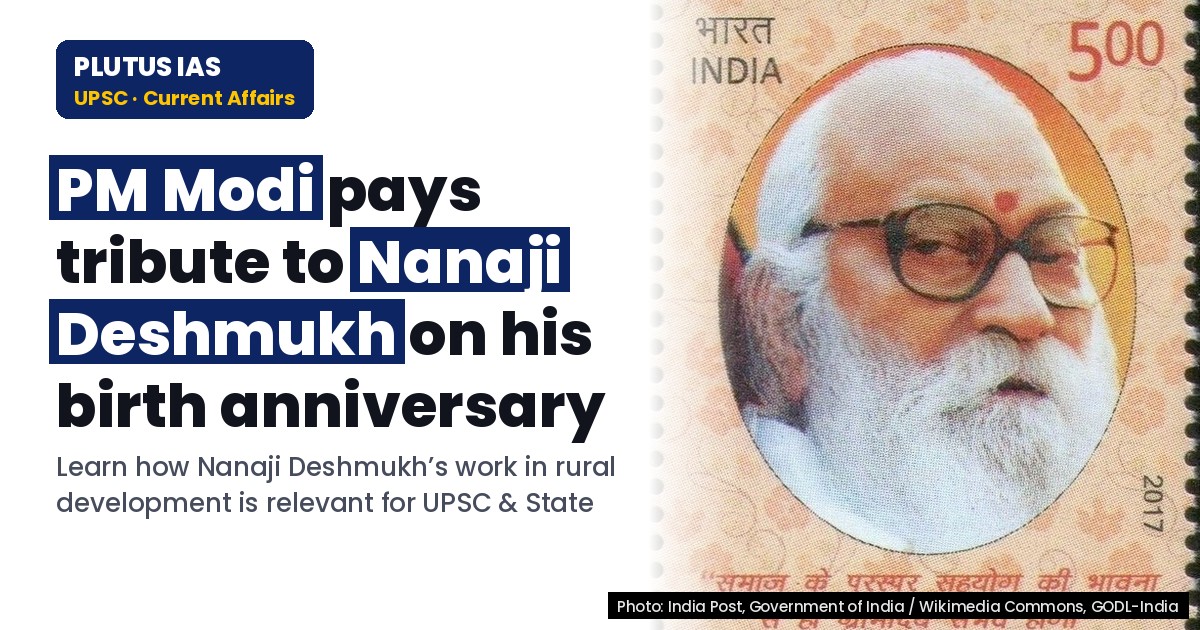
11 Oct PM pays tribute to Nanaji Deshmukh on his birth anniversary
✎ Nanaji Deshmukh’s legacy is encapsulated in the principles of *Gram Swaraj*, *Antyodaya*, and decentralised governance, which directly inform India’s rural development policies, including the 73rd Constitutional Amendment and the…
Subject Relevance — Where This Topic Fits
- GS Paper II — Governance, Constitution, Polity, Social Justice | GS Paper III — Agriculture, Rural Development, NITI Aayog
- Prelims: Deendayal Antyodaya Yojana – National Rural Livelihoods Mission (DAY-NRLM), Panchayati Raj Institutions (PRIs), Cooperative federalism, Rural employment schemes, Grassroots leadership in development
- Essay: The Role of Grassroots Leadership in India’s Development Trajectory, Decentralisation and Participatory Governance: Lessons from Post-Independence India
Quick Revision: Nanaji Deshmukh’s legacy is encapsulated in the principles of *Gram Swaraj*, *Antyodaya*, and decentralised governance, which directly inform India’s rural development policies, including the 73rd Constitutional Amendment and the DAY-NRLM.
Why is this in the news?
The Prime Minister of India paid homage to Nanaji Deshmukh on his birth anniversary, underscoring his seminal contributions to rural development and grassroots empowerment. This commemoration provides an opportunity to examine the institutional and policy frameworks that Deshmukh championed, particularly his emphasis on decentralised governance and self-reliance in rural India, which remain central to contemporary rural development strategies such as the DAY-NRLM and the 73rd Constitutional Amendment Act.
Background
- Nanaji Deshmukh (1916–2010) was a social reformer, politician, and thinker who played a pivotal role in India’s post-independence rural development discourse.
- He was associated with the Rashtriya Swayamsevak Sangh (RSS) and later became a key figure in the Jan Sangh and Bharatiya Janata Party (BJP), though his contributions transcend partisan affiliations.
- Deshmukh was instrumental in founding the Deendayal Research Institute (DRI) in 1972, which focused on rural upliftment through self-help, education, and cooperative models.
- His vision aligned with the principles of *Gram Swaraj* (village self-governance) and *Antyodaya* (uplift of the last person), which later influenced policies like the 73rd and 74th Constitutional Amendments.
- Deshmukh’s work in Chitrakoot, Uttar Pradesh, exemplified his model of integrated rural development, combining agriculture, education, and local governance.
- The Union Government has periodically commemorated his birth anniversary since 2018, reflecting his enduring influence on policy discourse.
Who was Nanaji Deshmukh and what were his key contributions to rural development?
- Nanaji Deshmukh was a social reformer and thinker whose work centred on the *Gram Swaraj* model, advocating for village-level self-governance as the foundation of national progress.
- He co-founded the Deendayal Research Institute (DRI) in 1972, which implemented grassroots development projects in education, healthcare, and agriculture, particularly in Chitrakoot, Uttar Pradesh.
- Deshmukh emphasised *Sarvodaya* (uplift of all) and *Antyodaya* (uplift of the marginalised), principles that underpin India’s contemporary rural development policies, including the DAY-NRLM and the National Rural Employment Guarantee Scheme (NREGS).
- His advocacy for decentralisation led to the inclusion of Panchayati Raj Institutions (PRIs) in the 73rd Constitutional Amendment Act (1992), which institutionalised local self-governance and empowered gram panchayats.
- Deshmukh was a proponent of *Swarajya* (self-rule) at the grassroots, arguing that true independence could only be achieved when villages were self-sufficient in resources and decision-making.
- He worked closely with leaders like Jayaprakash Narayan and Deendayal Upadhyaya, integrating their ideas of ethical governance and social justice into rural development frameworks.
- Deshmukh’s model of rural development was holistic, integrating vocational training, cooperative farming, and women’s empowerment, which aligns with modern schemes like the Pradhan Mantri Kaushal Vikas Yojana (PMKVY) and the National Rural Livelihood Mission (NRLM).
- His vision for rural India was rooted in cultural revivalism and self-reliance, rejecting top-down approaches in favour of community-led solutions.
UPSC Value Addition
Keywords for Mains Answer-Writing
Nanaji Deshmukh · Deendayal Upadhyaya · Integral Humanism · Rural Development · Panchayati Raj Institutions · Self-reliance · Social Entrepreneurship · Gramswaraj · Bharatiya Jana Sangh · Institutional Mechanisms for Rural Transformation · Policy Frameworks for Rural Development · Constitutional Provisions for Local Governance · Article 40 of the Indian Constitution · Deendayal Antyodaya Yojana – National Rural Livelihoods Mission (DAY-NRLM) · Socio-economic Empowerment of Rural Communities
Prelims Practice Questions
Q1. Consider the following statements regarding Nanaji Deshmukh’s contributions to rural development:
1. He was a key proponent of the philosophy of ‘Integral Humanism’ articulated by Deendayal Upadhyaya.
2. He played a pivotal role in the establishment of the first rural university in India, Chitrakoot Gramoday Vishwavidyalaya.
3. His work focused exclusively on agricultural productivity without addressing social empowerment.
4. He was instrumental in the formation of the Bharatiya Jana Sangh, a precursor to the Bharatiya Janata Party.
How many of the above statements are correct?
- Only one
- Only two
- Only three
- All four
Answer: Only three — Statements 1, 2, and 4 are correct. Statement 3 is incorrect as Nanaji Deshmukh’s work encompassed both agricultural productivity and social empowerment, including education and institution-building for rural communities.
Q2. Which of the following constitutional provisions is most directly related to the empowerment of rural local governance institutions as envisaged by Nanaji Deshmukh’s vision of ‘Gramswaraj’?
- Article 243 of the Constitution
- Article 40 of the Constitution
- Article 280 of the Constitution
- Article 324 of the Constitution
Answer: Article 40 of the Constitution — Article 40 of the Constitution, part of the Directive Principles of State Policy, mandates the organisation of village panchayats and endows them with such powers and authority as may be necessary to enable them to function as units of self-government. This aligns with Nanaji Deshmukh’s vision of ‘Gramswaraj’ (village self-rule).
Q3. Assertion (A): Nanaji Deshmukh’s philosophy of ‘Integral Humanism’ emphasised the holistic development of individuals, integrating material, social, and spiritual dimensions.
Reason (R): He believed that rural development must be pursued through self-reliance and community participation rather than external dependency.
In the context of the above statements, which of the following is correct?
- Both A and R are true, and R is the correct explanation of A
- Both A and R are true, but R is not the correct explanation of A
- A is true, but R is false
- A is false, but R is true
Answer: Both A and R are true, but R is not the correct explanation of A — Both the Assertion (A) and Reason (R) are true. Nanaji Deshmukh’s ‘Integral Humanism’ indeed advocated for a holistic development model, and he strongly believed in self-reliance and community-led rural development as the means to achieve it.
Mains Practice Question
✍ Nanaji Deshmukh’s vision of ‘Gramswaraj’ and ‘Integral Humanism’ continues to influence contemporary rural development policies in India. Critically examine the extent to which these philosophies have been operationalised in the policy frameworks and institutional mechanisms for rural transformation in India. (15 Marks)
Approach: 1. **Introduction**: Briefly outline Nanaji Deshmukh’s philosophy of ‘Integral Humanism’ and ‘Gramswaraj’, and its core tenets (holistic development, self-reliance, community participation, and decentralised governance).
2. **Policy Frameworks for Rural Development**:
– **Deendayal Antyodaya Yojana – National Rural Livelihoods Mission (DAY-NRLM)**: Highlight its objectives (e.g., mobilising rural poor into SHGs, enhancing livelihoods) and assess alignment with ‘Gramswaraj’.
– **Mahatma Gandhi National Rural Employment Guarantee Scheme (MGNREGS)**: Evaluate its role in promoting self-reliance and community participation as envisaged by Deshmukh.
– **Pradhan Mantri Gram Sadak Yojana (PMGSY)**: Discuss its contribution to rural connectivity and economic integration.
3. **Institutional Mechanisms**:
– **Panchayati Raj Institutions (PRIs)**: Analyse the constitutional mandate (Article 40, 73rd and 74th Amendments) and the extent to which PRIs function as self-governing units.
– **Chitrakoot Gramoday Vishwavidyalaya**: Examine its role in promoting rural education and entrepreneurship as a model for ‘Gramswaraj’.
4. **Challenges and Gaps**:
– **Top-down Approach**: Critique the dominance of centralised planning in rural development despite the emphasis on decentralisation.
– **Funding and Capacity**: Discuss issues of inadequate devolution of funds, administrative capacity, and political interference in PRIs.
– **Social Empowerment**: Assess whether policies have adequately addressed social empowerment (e.g., gender, caste) alongside economic development.
5. **Contemporary Relevance**:
– **Self-Help Groups (SHGs) and Farmer Producer Organisations (FPOs)**: Evaluate their role in promoting self-reliance and community-led development.
– **Digital and Financial Inclusion**: Discuss how initiatives like PM-KISAN, DBT, and e-NAM align with Deshmukh’s vision.
6. **Conclusion**: Summarise the extent to which Deshmukh’s vision has been realised, and suggest reforms (e.g., greater fiscal devolution, capacity-building, and participatory planning) to align policies more closely with ‘Gramswaraj’.
Source: PIB (Press Information Bureau)
Generated by AanyaAi for educational purpose.
Related guides on our sites
- Sociology vs History
- Best sociology optional coaching for upsc
- Which is best sociology optional coaching for upsc
- UPSC History optional


No Comments