


29 Jul PM-SEETU Scheme: UPSC Focus on ITI Upgradation for Skill & Employment
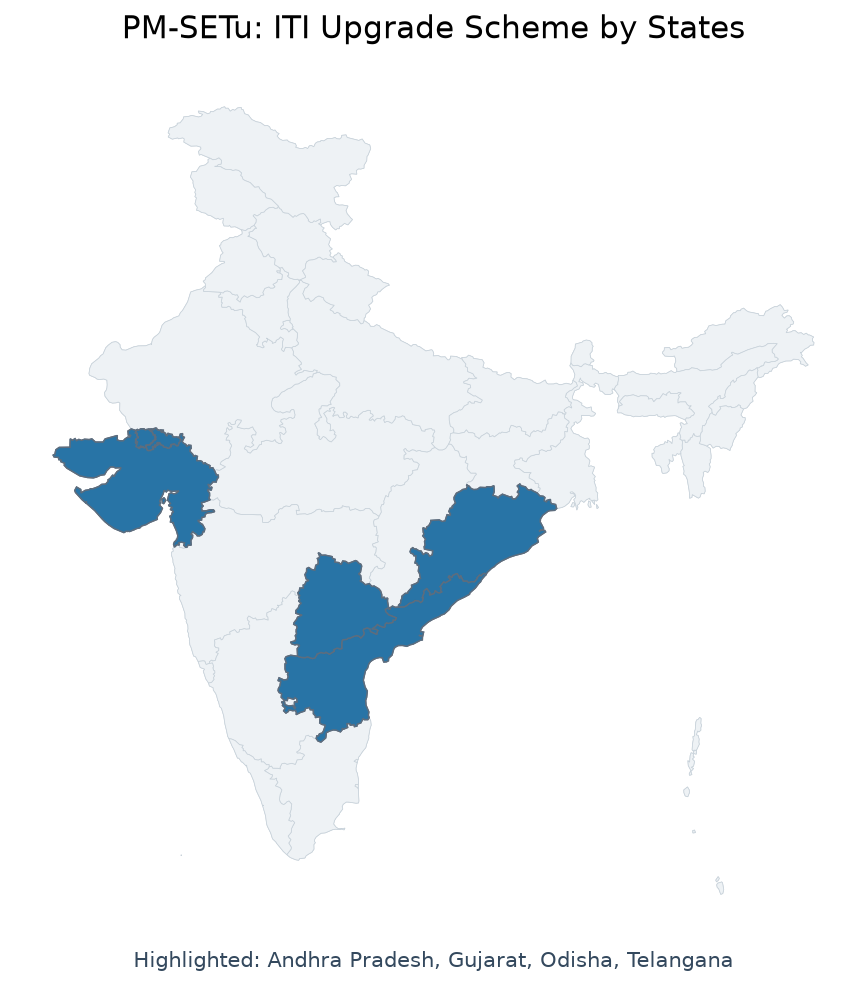
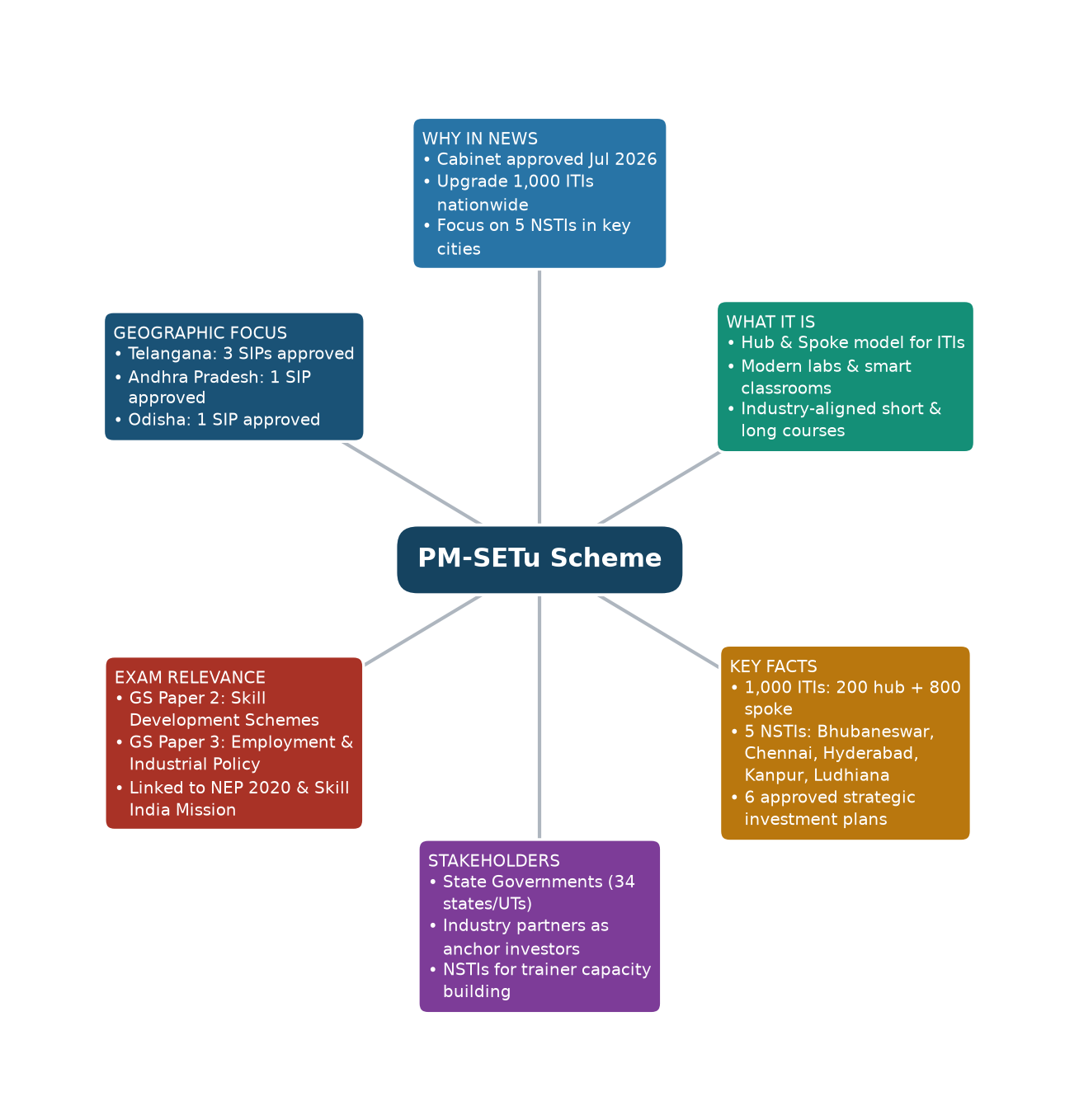
Map & concept mind-map: PM-SETu: ITI Upgrade Scheme by States
Subject Relevance — Where This Topic Fits
- GS Paper II — Social Justice (Skill Development & Employment) | GS Paper III — Economy (Human Resource Development, Labour Market Reforms)
- Prelims: Skill India Mission, National Skill Development Corporation (NSDC), Industrial Training Institutes (ITIs), National Skill Training Institutes (NSTIs), Pradhan Mantri Kaushal Vikas Yojana (PMKVY), Craftsman Training Scheme (CTS), Digital India, Make in India, Atmanirbhar Bharat, Skill Hubs
- Essay: Role of vocational education in India’s demographic dividend, Bridging the skill gap: A pathway to inclusive growth
Quick Revision: The scheme aims to bridge India’s skill gap by upgrading 1,000 ITIs and 5 NSTIs through industry-aligned infrastructure, demand-driven curricula, and global collaborations, ensuring employability in emerging sectors under a hub-and-spoke model.
Why is this in the news?
The scheme has been initiated to modernise India’s vocational training ecosystem by upgrading 1,000 government ITIs under a hub-and-spoke model and enhancing five National Skill Training Institutes (NSTIs) through global collaborations. Announced by the Ministry of Skill Development and Entrepreneurship, the scheme prioritises industry-aligned infrastructure, demand-driven curricula, and enhanced trainer capacity to improve employability outcomes, particularly in emerging sectors. Its structured governance through National and State Operation Committees underscores its strategic intent to align skilling with industrial demand and local economic priorities.
Background
- India faces a critical skill gap, with over 500 million workers projected to enter the labour force by 2030, necessitating scalable vocational training solutions to enhance employability and productivity.
- The Industrial Training Institutes (ITIs) and National Skill Training Institutes (NSTIs) form the backbone of India’s vocational education system, training over 2.5 million candidates annually across 15,000+ institutes.
- Previous initiatives like the Pradhan Mantri Kaushal Vikas Yojana (PMKVY) and Skill India Mission have expanded skilling coverage but highlighted gaps in infrastructure quality, curriculum relevance, and industry linkages.
- The National Education Policy (NEP) 2020 emphasises vocational integration at the school and higher education levels, mandating a 50% GER target in skill education by 2035.
- Global best practices, such as Germany’s dual education system and Singapore’s SkillsFuture initiative, demonstrate the efficacy of industry-driven vocational training models.
- The Atmanirbhar Bharat Abhiyan and Make in India campaigns underscore the need for locally relevant skills to reduce dependency on imports and boost domestic manufacturing.
What is the Scheme?
- The scheme is a centrally sponsored initiative aimed at transforming India’s ITI ecosystem by upgrading 1,000 government ITIs—comprising 200 hub ITIs and 800 spoke ITIs—under a hub-and-spoke model to enhance training quality and relevance.
- Component I focuses on modernising infrastructure, including smart classrooms, advanced laboratories, and digital learning resources, alongside introducing industry-aligned short-term and long-term courses in emerging sectors such as AI, robotics, green energy, and advanced manufacturing.
- Component II targets five National Skill Training Institutes (NSTIs) in Bhubaneswar, Chennai, Hyderabad, Kanpur, and Ludhiana, enhancing their capacity through global collaborations and establishing Centres of Excellence for trainer upskilling.
- The scheme adopts an industry-driven approach, with State Governments identifying ITIs in consultation with local industries to ensure alignment with regional economic needs and skill demands.
- A National Steering Committee (NSC) and State Operation Committees (SOCs), chaired by the Chief Secretary of each state/UT, oversee implementation, monitoring, and policy guidance, ensuring multi-stakeholder coordination.
- Industry partners, designated as Anchor Industry Partners (AIPs), play a pivotal role in curriculum design, infrastructure development, and trainer capacity building, with six strategic investment plans already approved across Telangana, Andhra Pradesh, Odisha, and Gujarat.
- The scheme integrates the Craftsman Training Scheme (CTS) under the Directorate General of Training (DGT), introducing 32 futuristic trades to cater to evolving industry requirements, such as drone technology, 3D printing, and renewable energy systems.
- Monitoring mechanisms include performance reviews, third-party impact assessments, and real-time data analytics to ensure accountability and continuous improvement in training outcomes.
Key Features
| Feature | Significance |
|---|---|
| Hub-and-Spoke Model for ITIs | Ensures focused upgradation of 200 hub ITIs and 800 spoke ITIs, enabling resource optimisation and standardised training delivery across clusters. |
| Modernisation of Infrastructure | Incorporates smart classrooms, advanced laboratories, and digital learning materials to align with Industry 4.0 requirements. |
| Industry-Anchored Curriculum | Introduces demand-driven courses in emerging sectors, ensuring relevance and employability of trainees. |
| Capacity Building of Trainers | Enhances training capabilities of instructors through advanced programmes at NSTIs, including global partnerships. |
| State-Level Governance Framework | Establishes State Operation Committees under Chief Secretaries to ensure local ownership and industry alignment. |
| Strategic Investment Plans (SIPs) | Approves industry-led SIPs for targeted skill clusters, fostering public-private collaboration in skill development. |
Why it Matters
Economic Growth and Employment
- Enhances the employability of 10 million youth annually by aligning vocational training with industry needs, reducing skill gaps in high-growth sectors.
- Supports the ‘Viksit Bharat 2047’ vision by creating a skilled workforce for global competitiveness in manufacturing, services, and green technologies.
- Promotes formalisation of the workforce, reducing informality and improving labour productivity in organised sectors.
- Facilitates integration of MSMEs into global supply chains through a trained and certified workforce.
Industrial and Technological Transformation
- Aligns vocational training with Industry 4.0 technologies such as AI, IoT, and automation, preparing the workforce for future-ready industries.
- Strengthens the ‘Make in India’ initiative by ensuring availability of skilled labour in critical sectors like electronics, automotive, and renewable energy.
- Enhances the ‘Atmanirbhar Bharat’ ecosystem by reducing dependency on imported skilled labour in strategic industries.
- Supports the transition to green jobs through training in renewable energy, waste management, and sustainable manufacturing.
Social Inclusion and Equity
- Expands access to quality vocational education in rural and semi-urban areas through upgraded ITIs, bridging urban-rural skill disparities.
- Promotes gender inclusivity by encouraging participation of women in non-traditional trades through targeted outreach and infrastructure support.
- Supports marginalised communities through reservation policies and scholarships for SC/ST/OBC candidates in ITI admissions.
- Enhances socio-economic mobility by providing certifications that are recognised by both domestic and international employers.
Governance and Institutional Strengthening
- Establishes a robust multi-level governance framework involving Centre, States, and industry partners for effective implementation.
- Introduces third-party impact assessments to ensure transparency, accountability, and continuous improvement in programme outcomes.
- Fosters public-private partnerships (PPPs) through Strategic Investment Plans, leveraging private sector expertise and resources.
- Enhances the role of NSTIs as centres of excellence for trainer capacity-building and curriculum innovation.
Challenges
1. Industry-Academia Mismatch
- Persistent disconnect between curriculum design and evolving industry requirements, particularly in emerging technologies like AI and robotics.
- Limited participation of industry in curriculum development and training delivery, despite formal partnerships.
- Variability in industry standards across regions, complicating the design of uniform, high-quality training programmes.
UPSC Link: GS3: Skill Development
2. Infrastructure and Resource Constraints
- Inadequate funding for large-scale modernisation of ITIs, especially in states with limited fiscal capacity.
- Shortage of qualified trainers, particularly in specialised trades like advanced manufacturing and green technologies.
- Delays in land acquisition and bureaucratic hurdles in establishing new ITI facilities or upgrading existing ones.
UPSC Link: GS2: Centre-State Relations
3. Geographical Disparities in Skill Development
- Concentration of upgraded ITIs in urban and semi-urban areas, leaving rural youth with limited access to quality vocational training.
- Lack of awareness among rural communities about available skill programmes and their benefits.
- Migration of skilled labour from rural to urban areas, exacerbating skill shortages in hinterland industries.
UPSC Link: GS1: Social Justice
4. Monitoring and Evaluation Gaps
- Inadequate real-time data systems to track the employment outcomes of ITI graduates across sectors and regions.
- Limited use of technology for monitoring training quality, attendance, and certification processes.
- Absence of a unified national database for skill development programmes, leading to duplication and inefficiencies.
UPSC Link: GS4: Governance
5. Cultural and Social Barriers
- Traditional perceptions of vocational education as inferior to academic streams, discouraging youth from enrolling in ITIs.
- Resistance from employers to hire ITI graduates due to perceived lack of practical skills, despite formal certifications.
- Low participation of women in non-traditional trades due to societal norms and inadequate safety infrastructure in ITIs.
UPSC Link: GS1: Social Justice
6. Regulatory and Compliance Issues
- Complexity in aligning state-level skill development policies with central schemes, leading to implementation delays.
- Lack of standardised accreditation mechanisms for ITIs, resulting in variability in training quality.
- Bureaucratic delays in approvals for industry-led training programmes and infrastructure upgradation.
UPSC Link: GS2: Federalism
Challenges — UPSC Perspective
| Issue | Concern |
|---|---|
| Curriculum Relevance | Rapid obsolescence of skills due to technological advancements, necessitating continuous curriculum updates. |
| Trainer Shortages | Insufficient number of qualified trainers, particularly in emerging sectors like AI, robotics, and green energy. |
| Regional Imbalances | Concentration of upgraded ITIs in select states, leaving hinterland regions with limited access to quality training. |
| Industry Engagement | Low participation of industry in curriculum design, training delivery, and certification processes. |
| Funding Gaps | Inadequate budgetary allocations for infrastructure modernisation and trainer capacity-building. |
| Monitoring Mechanisms | Lack of robust data systems to track employment outcomes and programme effectiveness. |
Government Initiatives — Must-Memorise for Prelims
- Pradhan Mantri Kaushal Vikas Yojana (PMKVY)
- Skill India Mission
- National Apprenticeship Promotion Scheme (NAPS)
- Atal Innovation Mission (AIM) – for fostering innovation in skill development
Way Forward
- Establish a National Skill Database to track employment outcomes of ITI graduates and identify skill gaps in real time.
- Strengthen industry-academia collaboration by mandating industry representation in State Operation Committees and curriculum design bodies.
- Introduce performance-linked funding for ITIs, with disbursements tied to employment outcomes and industry satisfaction ratings.
- Expand the hub-and-spoke model to cover aspirational districts and tribal areas, with targeted infrastructure and outreach programmes.
- Develop a standardised accreditation framework for ITIs, ensuring uniformity in training quality and certification standards.
- Leverage digital platforms for virtual training and upskilling, particularly in remote and underserved regions.
- Promote women’s participation in non-traditional trades through targeted scholarships, safety infrastructure, and awareness campaigns.
- Institutionalise third-party impact assessments to ensure transparency, accountability, and continuous improvement in programme outcomes.
UPSC Value Addition
Keywords for Mains Answer-Writing
PM-SETu Scheme · Skill Development and Entrepreneurship · Industrial Training Institutes (ITIs) · Hub and Spoke Model · National Skill Training Institutes (NSTIs) · Vocational Education · Demand-driven Skill Development · Industry-Academia Partnership · Skill Ecosystem Transformation · National Skill Development Mission
Concept Flow
Industry demand for skilled workforce → Government launches PM-SETu to upgrade ITIs → Hub-and-spoke model implemented → Modern infrastructure and industry-aligned curriculum introduced → Trainer capacity-building at NSTIs → State Operation Committees oversee implementation → Industry-led Strategic Investment Plans approved → Employment outcomes monitored → Feedback loop informs continuous improvement → Skilled workforce contributes to economic growth and industrial transformation.
Prelims Practice Questions
Q1. Consider the following statements regarding the PM-SETu Scheme:
1. It aims to upgrade 1,000 government ITIs under a hub-and-spoke model.
2. The scheme includes the establishment of National Centres of Excellence for trainer capacity building at five NSTIs.
3. The selection of ITIs is solely based on the recommendation of the Union Ministry of Skill Development and Entrepreneurship.
4. The scheme mandates the inclusion of emerging sectors like Artificial Intelligence and Robotics in the curriculum.
How many of the above statements are correct?
- Only one
- Only two
- Only three
- All four
Answer: Only three — Statements 1 and 2 are correct as per the scheme’s framework. Statement 3 is incorrect because ITI selection involves state governments and industry consultations. Statement 4 is incorrect as the scheme does not mandate specific sectors but focuses on industry-aligned courses.
Q2. Assertion (A): The PM-SETu Scheme aims to strengthen industry-academia linkages through the establishment of Industry-Anchored Partnerships (IAPs).
Reason (R): The scheme empowers ITIs to redesign curricula and infrastructure upgrades in alignment with local industrial needs.
In the context of the above two statements, which one of the following is correct?
- Both A and R are true, and R is the correct explanation of A.
- Both A and R are true, but R is not the correct explanation of A.
- A is true, but R is false.
- A is false, but R is true.
Answer: A is true, but R is false. — Assertion (A) is true as the scheme emphasizes industry-academia linkages. Reason (R) is also true but does not directly explain (A); instead, it describes a mechanism through which linkages are strengthened.
Q3. Match the following components of the PM-SETu Scheme with their respective descriptions:
Column I
A. Hub ITIs
B. Spoke ITIs
C. NSTIs
D. Industry-Anchored Partnerships (IAPs)
Column II
1. Centres of Excellence for trainer capacity building
2. Local ITIs linked to hub ITIs for resource sharing
3. ITIs designated as central nodes for skill delivery
4. Collaborative frameworks between ITIs and industries for curriculum design
Select the correct match:
- A-3, B-2, C-1, D-4
- A-2, B-3, C-1, D-4
- A-3, B-1, C-2, D-4
- A-4, B-2, C-1, D-3
Answer: A-3, B-2, C-1, D-4 — Hub ITIs (A) are central nodes (3), Spoke ITIs (B) are linked local ITIs (2), NSTIs (C) serve as Centres of Excellence (1), and IAPs (D) are industry-academia collaborations (4).
Mains Practice Question
✍ The PM-SETu Scheme represents a paradigm shift in India’s vocational education ecosystem by integrating industry demands with skill development infrastructure. Critically examine the scheme’s design and implementation framework, highlighting its potential to address the challenges of employability and skill gaps in the workforce. Also, analyse the role of State Operation Committees (SSCs) in ensuring localised and demand-driven skill development. (15 Marks)
Approach: MODEL-ANSWER SKELETON:
1. **Introduction (2 Marks)**
– Brief context: India’s demographic dividend and skill gap challenges (e.g., 2022-23 Periodic Labour Force Survey data on unemployment among skilled youth).
– Objective of PM-SETu: Transform ITIs/NSTIs into industry-aligned skill hubs via infrastructure modernisation, curriculum redesign, and trainer capacity building.
2. **Scheme Design and Key Components (4 Marks)**
– Hub-and-Spoke Model: Role of 200 Hub ITIs (central nodes) and 800 Spoke ITIs (local linkages) in resource sharing and outreach.
– Modernisation of Infrastructure: Smart classrooms, labs, and digital learning tools aligned with Industry 4.0 needs (e.g., IoT, AI, automation).
– Curriculum Reforms: Introduction of emerging sector courses (e.g., Renewable Energy, E-mobility) and industry-driven Special Purpose Vehicles (SPVs) for course redesign.
– Trainer Capacity Building: Upgradation of 5 NSTIs (Bhubaneswar, Chennai, Hyderabad, Kanpur, Ludhiana) as Centres of Excellence for trainer upskilling.
– Industry Partnerships: Anchor Industry Partners (AIPs) and Industry-Anchored Partnerships (IAPs) to ensure demand-driven skill mapping.
3. **Implementation Framework and Governance (4 Marks)**
– Multi-level Governance: Role of National Operation Committee (NSC) for policy oversight, State Operation Committees (SSCs) chaired by Chief Secretaries for state-level implementation, and District Skill Committees for local coordination.
– Selection of ITIs: Criteria involving state governments, industry consultations, and alignment with local industrial clusters (e.g., textiles in Tamil Nadu, automobile in Gujarat).
– Monitoring and Evaluation: Third-party impact assessments, performance reviews, and real-time data tracking via the Skill India Digital Hub.
4. **Potential Challenges and Critical Analysis (3 Marks)**
– **Challenges:**
– Fragmented state-level implementation due to varying industrial priorities and administrative capacities.
– Resistance from traditional ITI faculty accustomed to outdated curricula.
– Ensuring equitable access to upgraded facilities across urban-rural divides.
– Sustainability of industry partnerships post-scheme completion.
– **Critical Perspective:**
– The hub-and-spoke model risks creating disparities if Spoke ITIs remain under-resourced.
– Over-reliance on industry partners may lead to narrow, short-term skill training rather than holistic vocational education.
– Limited focus on soft skills and entrepreneurship, which are critical for self-employment.
5. **Role of State Operation Committees (SSCs) (2 Marks)**
– **Localised Skill Mapping:** SSCs, chaired by Chief Secretaries, facilitate collaboration between state governments, industries, and ITIs to identify skill gaps and prioritise sectors (e.g., healthcare in Kerala, manufacturing in Maharashtra).
– **Resource Mobilisation:** SSCs leverage state budgets, CSR funds, and industry contributions to upgrade ITI infrastructure (e.g., Gujarat’s textile cluster upgrades).
– **Monitoring and Accountability:** Regular reviews and grievance redressal mechanisms ensure timely implementation and address bottlenecks.
6. **Conclusion (2 Marks)**
– **Way Forward:**
– Strengthen SSCs with dedicated skill development cells and digital dashboards for real-time monitoring.
– Expand the scheme to cover more emerging sectors (e.g., green hydrogen, semiconductor manufacturing).
– Integrate PM-SETu with other schemes like PMKVY and NAPS for a seamless skill ecosystem.
– **Final Assessment:** PM-SETu is a transformative initiative but its success hinges on robust governance, industry alignment, and equitable implementation. The scheme’s design addresses core challenges but requires continuous adaptation to evolving industrial needs.
Source: PIB (Press Information Bureau)
Generated by AanyaAi for educational purpose.

- Tamil Nadu Expands Breakfast Scheme to Classes 6-8: 15.30 Lakh Students Benefit - September 22, 2026
- राज्यसभा उपचुनाव उत्तराखंड: 16 अक्तूबर को मतदान, जानें पूरा कार्यक्रम और महत्व - September 22, 2026
- राज्यसभा उपचुनाव उत्तराखंड: 16 अक्टूबर को मतदान, जानें प्रक्रिया और महत्व - September 22, 2026

No Comments