


29 Jul PM-SETU Scheme: Upgrading 1000 ITIs for Skill & Employment Transformation
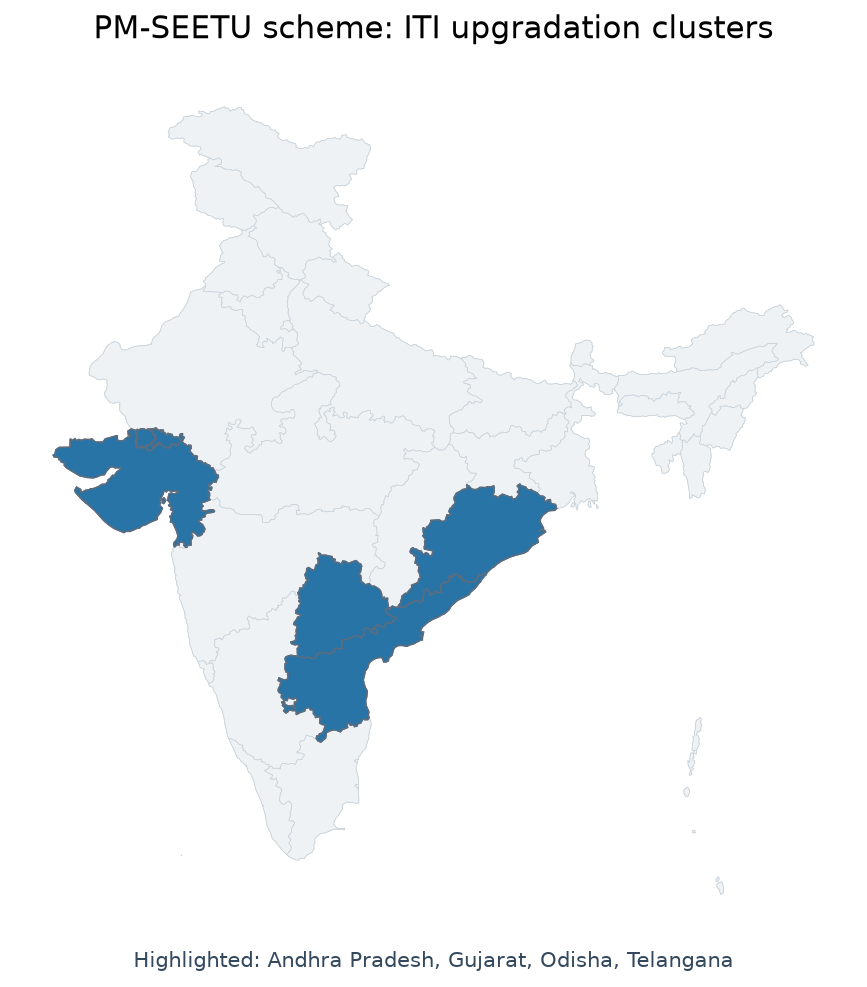
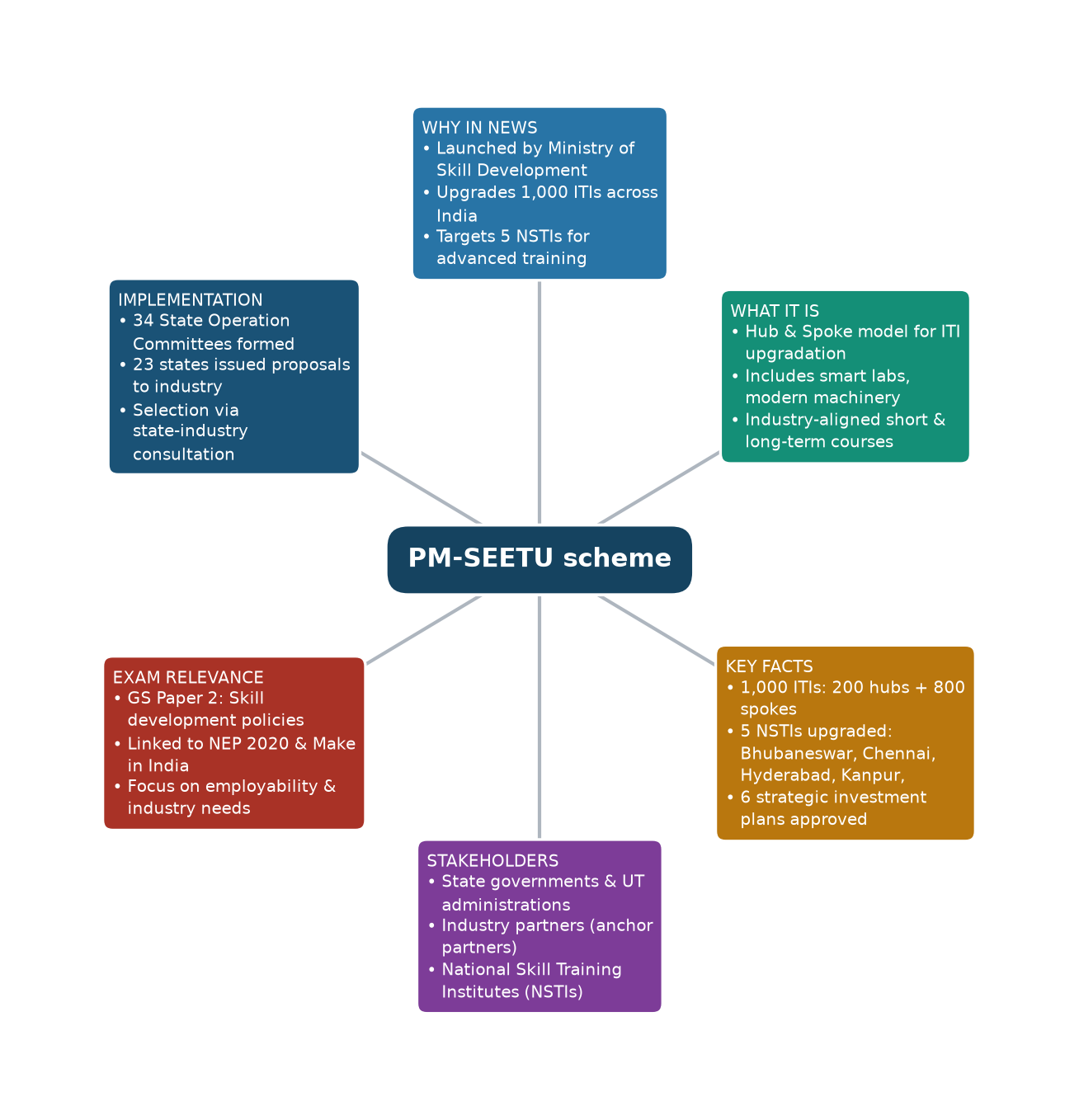
Map & concept mind-map: PM-SEETU scheme: ITI upgradation clusters
Subject Relevance — Where This Topic Fits
- GS Paper II — Governance, Administration and Challenges (Skill Development Initiatives) | GS Paper III — Employment, Human Resource Development and Industrial Policy
- Prelims: Skill India Mission, ITI Upgradation, National Skill Training Institutes (NSTIs), Hub and Spoke Model, Vocational Training, Employability, DGTE, CTS, State Skill Missions
- Essay: The Role of Vocational Education in India’s Demographic Dividend, Bridging the Skill Gap: A Pathway to Sustainable Employment
Quick Revision: PM-SEETU aims to modernise 1,000 ITIs and 5 NSTIs through industry-driven upgradation, introducing 32 futuristic trades and strengthening governance via hub-and-spoke models and multi-tiered committees.
Why is this in the news?
This initiative is significant as it aims to enhance the employability of youth by upgrading infrastructure, introducing demand-driven courses, and strengthening industry-academia linkages, thereby addressing the persistent challenge of skill mismatches in the labour market.
Background
- The Government of India has prioritised skill development as a key enabler for economic growth and employment generation, particularly in the context of India’s demographic dividend.
- The Skill India Mission, launched in 2015, seeks to train over 400 million people by 2022, with a focus on vocational education and training (VET).
- ITIs, established under the Craftsmen Training Scheme (CTS) by the Directorate General of Training (DGT), have historically played a critical role in providing skilled manpower to industries.
- Despite their contributions, ITIs have faced challenges such as outdated infrastructure, lack of industry-aligned curricula, and inadequate faculty training, leading to suboptimal employability outcomes.
- The PMKVY (Pradhan Mantri Kaushal Vikas Yojana) and other skilling schemes have highlighted the need for systemic reforms in vocational training institutions to meet evolving industry requirements.
- The hub-and-spoke model for ITI upgradation has been adopted in previous schemes, such as the World Bank-funded Skills Strengthening for Industrial Value Enhancement (STRIVE) project, to enhance reach and efficiency.
What is the PM-SEETU Scheme?
- The scheme operates under a dual-component framework: (i) Component-I focuses on upgrading 1,000 government ITIs (200 hub ITIs and 800 spoke ITIs) using a hub-and-spoke model, incorporating smart classrooms, modern labs, digital learning resources, and industry-aligned curricula.
- Component-II targets the capacity building of five NSTIs located in Bhubaneswar, Chennai, Hyderabad, Kanpur, and Ludhiana, including the establishment of Centres of Excellence for advanced faculty training through global partnerships.
- The selection of ITIs under the scheme is driven by state governments in consultation with industry partners, ensuring alignment with emerging skill demands and local industrial capacities.
- Industry partners, designated as Anchor Industry Partners (AIPs), play a pivotal role in shaping the upgradation plans, including curriculum redesign, infrastructure development, and practical training models.
- The scheme introduces 32 futuristic trades under the Craftsmen Training Scheme (CTS) to cater to evolving industry needs, such as green skills, Industry 4.0 technologies, and emerging sectors like renewable energy and artificial intelligence.
- Monitoring and implementation are overseen by a National Steering Committee (NSC) at the central level and State Steering Committees (SSCs) at the state level, ensuring multi-stakeholder coordination and accountability.
- The scheme emphasises outcome-based monitoring, including third-party impact assessments, to ensure the effectiveness of interventions and alignment with employment outcomes.
Key Features
| Feature | Significance |
|---|---|
| Hub & Spoke Model for ITIs | Ensures focused upgradation of 200 hub ITIs and 800 spoke ITIs, creating a tiered ecosystem for skill dissemination across regions. |
| Modern Infrastructure & Smart Classrooms | Upgrades physical and digital infrastructure to align with Industry 4.0 standards, enhancing learning outcomes. |
| Industry-Anchored Strategic Investment Plans (SIPs) | Six SIPs approved across four states, linking skill development directly to local industrial demand. |
| Special Purpose Vehicles (SPVs) | Empowers industry partners to co-design curricula, infrastructure upgrades, and training delivery models. |
| National Skill Training Institutes (NSTIs) Upgradation | Enhances capacity of five NSTIs with global partnerships and specialized centers of excellence. |
Why it Matters
Economic Growth & Employment
- Aligns vocational training with emerging sectors (e.g., AI, robotics, green energy) to bridge the skill-employment gap.
- Reduces structural unemployment by equipping youth with industry-relevant competencies in high-demand trades.
- Enhances productivity in MSMEs and large industries through a skilled workforce, boosting GDP contribution from manufacturing and services.
Strategic Workforce Development
- Supports India’s demographic dividend by creating a skilled labor pool for global supply chains and domestic industries.
- Facilitates regional industrial clusters (e.g., Hyderabad for IT, Ludhiana for textiles) through localized skill ecosystems.
- Promotes self-reliance in critical sectors by reducing dependency on imported skilled labor.
Institutional Capacity Building
- Strengthens governance of ITIs through State Operation Committees (SOCs) and National Operation Committee (NOC).
- Standardizes training quality via DGT’s Craftsman Training Scheme (CTS) with 32 futuristic trades.
- Fosters public-private partnerships (PPPs) to ensure sustainable skill development infrastructure.
Technological Integration
- Leverages digital tools (smart classrooms, e-learning) to modernize pedagogy and improve accessibility.
- Encourages adoption of Industry 4.0 technologies in training, preparing workers for smart manufacturing.
- Enables real-time industry feedback loops for curriculum refinement and upskilling pathways.
Challenges
1. Fragmented Implementation
- Variation in state-level execution due to differing administrative capacities and industry linkages.
- Risk of uneven skill development across states, exacerbating regional disparities.
UPSC Link: GS-II: Centre-State Relations
2. Industry Engagement Gaps
- Potential mismatch between industry needs and training content despite SIPs, due to rapid technological changes.
- Reluctance of industries to invest in long-term skill development without immediate returns.
UPSC Link: GS-III: Industrial Policy
3. Funding & Sustainability
- Dependence on central funds may strain state budgets, risking discontinuity post-implementation.
- Need for innovative financing models (e.g., skill bonds, CSR funds) to ensure long-term viability.
UPSC Link: GS-III: Resource Mobilisation
4. Quality Assurance
- Ensuring uniformity in training standards across 1,000 ITIs despite diverse local conditions.
- Addressing the shortage of qualified trainers and their periodic upskilling.
UPSC Link: GS-II: Governance
5. Monitoring & Evaluation
- Real-time tracking of employment outcomes to measure the scheme’s impact remains a challenge.
- Risk of data manipulation or underreporting in performance metrics.
UPSC Link: GS-IV: Ethics in Governance
Challenges — UPSC Perspective
| Issue | Concern |
|---|---|
| State-Level Coordination | Inconsistent execution due to varying administrative priorities and resource allocation. |
| Industry-Led Curriculum Design | Risk of curricula being skewed toward short-term industry needs, neglecting foundational skills. |
| Digital Divide | Unequal access to smart classrooms and e-learning tools in rural and remote ITIs. |
| Trainer Shortage | Lack of specialized trainers for emerging trades like AI, IoT, and renewable energy. |
| Placement Linkages | Weak post-training placement support, leading to underutilization of skilled labor. |
Government Initiatives — Must-Memorise for Prelims
- Pradhan Mantri Kaushal Vikas Yojana (PMKVY)
- Skill India Mission
- National Apprenticeship Promotion Scheme (NAPS)
Way Forward
- Establish a unified digital dashboard for real-time monitoring of ITI performance and employment outcomes.
- Mandate quarterly reviews by State Operation Committees with mandatory industry participation.
- Introduce performance-linked funding for states, incentivizing measurable outcomes in skill development.
- Expand the role of Sector Skill Councils (SSCs) to align training with global standards and certifications.
- Launch a national campaign to sensitize industries on the long-term benefits of investing in skill development.
- Develop a standardized trainer certification program with periodic re-certification requirements.
- Integrate PM-SEETU with existing schemes like PMKVY to avoid duplication and maximize outreach.
- Conduct third-party impact assessments every two years to identify gaps and recalibrate strategies.
UPSC Value Addition
Keywords for Mains Answer-Writing
PM-SEETU Scheme · ITI Upgradation · Skill Development in India · Hub and Spoke Model in Vocational Training · National Skill Training Institutes (NSTI) · Industry-Academia Collaboration · Vocational Education Quality Improvement · Directorate General of Training (DGT) · Craftsman Training Scheme (CTS) · State Skill Development Missions
Constitutional & Policy Linkages
- Article 29: Protection of interests of minorities in educational institutions (relevance to inclusive skill development).
- Article 41: Directive Principle of State Policy on securing right to work and education.
Concept Flow
Identification of skill gaps → Policy formulation (PM-SEETU) → State-level ITI upgradation → Industry partnership (SIPs/SPVs) → Modern infrastructure & curriculum design → Trainer upskilling → Trainee employment → Economic growth & demographic dividend realization.
Prelims Practice Questions
Q1. Consider the following statements regarding the PM-SEETU Scheme:
1. It aims to upgrade 1,000 government ITIs under a hub-and-spoke model.
2. The scheme includes the establishment of five National Skill Training Institutes (NSTIs) in Bhubaneswar, Chennai, Hyderabad, Kanpur, and Ludhiana.
3. The scheme mandates the involvement of industry partners in the selection and upgradation of ITIs.
4. The scheme is implemented solely by the central government without state participation.
How many of the above statements are correct?
- Only one
- Only two
- Only three
- All
Answer: Only three — Statements 1, 2, and 3 are correct. Statement 4 is incorrect as the scheme involves both central and state governments, with state governments playing a key role in implementation.
Q2. Assertion (A): The PM-SEETU Scheme focuses on modernizing infrastructure and curriculum in ITIs to align with industry demands.
Reason (R): The scheme includes provisions for smart classrooms, advanced laboratories, and industry-specific courses to enhance employability.
Options:
A. Both A and R are true, and R is the correct explanation of A.
B. Both A and R are true, but R is not the correct explanation of A.
C. A is true, but R is false.
D. A is false, but R is true.
Answer: ? — Both A and R are true, and R correctly explains A. The scheme’s primary objective is to modernize ITIs to meet industry standards, which includes upgrading infrastructure and curriculum.
Q3. Match the following components of the PM-SEETU Scheme with their respective descriptions:
Column I (Component) | Column II (Description)
1. Component-I | A. Upgradation of 5 National Skill Training Institutes (NSTIs) in select cities
2. Component-II | B. Modernization of 1,000 government ITIs under a hub-and-spoke model
3. Craftsman Training Scheme (CTS) | C. Introduction of 32 new-age trades under DGT
4. State Skill Development Missions | D. State-level implementation through industry partnerships
Options:
A. 1-B, 2-A, 3-C, 4-D
B. 1-A, 2-B, 3-D, 4-C
C. 1-D, 2-C, 3-B, 4-A
D. 1-C, 2-D, 3-A, 4-B
Answer: ? — The correct matches are: 1-B (Component-I involves upgrading 1,000 ITIs), 2-A (Component-II involves upgrading 5 NSTIs), 3-C (CTS introduces 32 new-age trades), and 4-D (State Skill Development Missions are implemented at the state level with industry partnerships).
Mains Practice Question
✍ Critically examine the institutional architecture of the PM-SEETU Scheme, with particular reference to the roles of the National Steering Committee (NSC), State Steering Committees (SSC), and industry partners. How does this multi-level governance structure enhance the scheme’s effectiveness in achieving its objectives? (15 Marks)
Approach: MODEL-ANSWER SKELETON:
1. **Institutional Architecture Overview**:
– Briefly describe the three-tier structure: NSC (central), SSC (state), and industry partners (local).
– Highlight the composition: NSC chaired by the Secretary, Skill Development; SSC chaired by the Chief Secretary of each state; industry partners as anchor entities.
2. **Role of NSC**:
– Policy guidance, approval of Strategic Investment Plans (SIPs), and monitoring of scheme progress.
– Ensure alignment with national skill development priorities and industry trends.
– Example: Approval of SIPs from Telangana, Andhra Pradesh, Odisha, and Gujarat.
3. **Role of SSC**:
– State-level implementation, selection of ITIs, and coordination with industry.
– Ensure local relevance by aligning ITI upgradation with regional industrial needs.
– Example: 23 states have issued tenders for industry partnerships.
4. **Role of Industry Partners**:
– Anchor Industry Partners (AIPs) drive curriculum redesign, infrastructure upgradation, and practical training.
– Ensure demand-driven skill development and employability outcomes.
– Example: AIPs from Telangana, Andhra Pradesh, Odisha, and Gujarat.
5. **Synergy and Effectiveness**:
– Multi-level governance ensures vertical and horizontal coordination, reducing implementation gaps.
– Industry involvement bridges the skill gap between training and market demands.
– Challenges: Potential delays in state-level coordination, varying state capacities, and ensuring equitable distribution of benefits.
6. **Critical Analysis**:
– Strengths: Decentralized decision-making, industry-driven relevance, and multi-stakeholder ownership.
– Weaknesses: Risk of bureaucratic delays, uneven state capacities, and over-reliance on industry for curriculum design.
– Suggestions: Strengthen SSC capacities, streamline approval processes, and ensure inclusive participation of MSMEs.
7. **Conclusion**:
– The multi-level governance structure of PM-SEETU enhances effectiveness by ensuring relevance, adaptability, and scalability. However, sustained monitoring and adaptive governance are essential for long-term success.
Source: PIB (Press Information Bureau)
Generated by AanyaAi for educational purpose.

- AI का वादा और खतरा: क्या मानवता के लिए खतरा है कृत्रिम बुद्धिमत्ता? - September 15, 2026
- AI’s Dual Role: Promise vs Peril in UPSC Mains 2026-27 - September 15, 2026
- दिल्ली में 99% पीजी में नहीं है फायर एनओसी, 30% को नहीं मिला लेआउट अप्रूवल: एमसीडी सर्वे - September 15, 2026

No Comments