


29 Jul PM Vidyalakshmi Scheme: Collateral-Free Education Loans for Meritorious Students
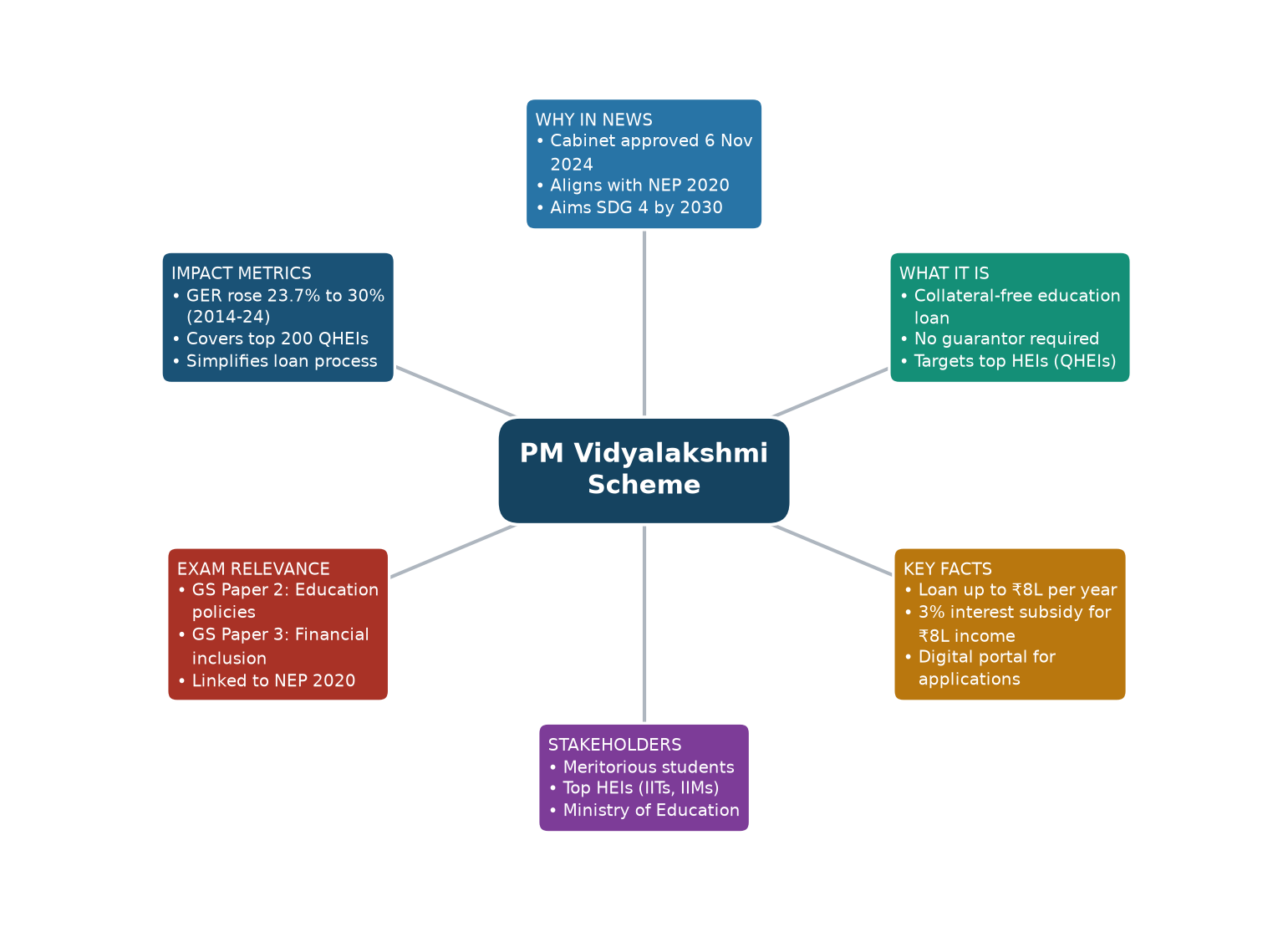
Map & concept mind-map: PM Vidyalakshmi Scheme overview
Subject Relevance — Where This Topic Fits
- GS Paper II — Governance, Administration and Policies | GS Paper III — Government Budgeting and Financial Inclusion | GS Paper IV — Ethical Governance and Social Justice
- Prelims: Pradhan Mantri Vidyalakshmi Yojana, Credit Guarantee for Education Loans, Gross Enrolment Ratio (GER) in Higher Education, Sustainable Development Goal (SDG) 4, National Education Policy (NEP) 2020
- Essay: The Role of Government Schemes in Bridging Educational Inequality, Financial Inclusion as a Catalyst for Human Capital Development
Quick Revision: Pradhan Mantri Vidyalakshmi Yojana provides collateral-free education loans with 3% interest subsidy for families earning up to ₹8 lakh annually, covering 1,425 top-tier institutions through a fully digital and transparent process.
Why is this in the news?
The Pradhan Mantri Vidyalakshmi Yojana (PMVY) has been approved by the Union Cabinet on 6 November 2024 and is now operational as a flagship scheme of the Ministry of Education to provide collateral-free education loans to meritorious students from economically weaker sections for admission to top-tier higher education institutions in India. This initiative directly addresses the persistent challenge of financial barriers in accessing quality higher education, aligning with the Sustainable Development Goal 4 (SDG 4) and the National Education Policy (NEP) 2020.
Background
- The Gross Enrolment Ratio (GER) in higher education in India increased from 23.7% in 2014-15 to 30.0% in 2023-24, reflecting significant progress in access to higher education.
- Despite rising enrolment, many meritorious students from economically disadvantaged backgrounds face financial constraints in pursuing education in premier institutions such as IITs, IIMs, and other top-ranked universities.
- Traditional education loan schemes often require collateral or third-party guarantees, and high interest rates deter many students from availing such loans, thereby limiting their educational aspirations.
- The National Education Policy (NEP) 2020 emphasises the need for financial assistance to meritorious students to ensure equitable access to quality higher education across public and private institutions.
- Sustainable Development Goal 4 (SDG 4) aims to ensure inclusive and equitable quality education and promote lifelong learning opportunities for all by 2030.
- The scheme is part of the government’s broader strategy to enhance human capital development and align India’s higher education system with global standards of accessibility and excellence.
What is the Pradhan Mantri Vidyalakshmi Yojana (PMVY)?
- A centrally sponsored scheme under the Ministry of Education, launched to provide collateral-free education loans to meritorious students from economically weaker sections for admission to top-tier higher education institutions in India.
- The scheme offers education loans without requiring any collateral or third-party guarantee, thereby reducing financial barriers for students pursuing higher education.
- Eligible students with an annual family income up to ₹8 lakh are entitled to a 3% interest subsidy.
- The scheme covers 1,425 designated Quality Higher Education Institutions (QHEIs), including both public and private institutions, but excludes admissions under management quota, NRI quota, and other non-merit-based categories.
- The entire loan application and disbursement process is digital, transparent, and student-friendly, facilitated through an integrated portal where students can apply, track applications, claim subsidies, and lodge grievances.
- The scheme is aligned with the objectives of the National Education Policy (NEP) 2020, which advocates for financial support to meritorious students to ensure no talented individual is deprived of quality education due to financial constraints.
- By promoting inclusive and equitable higher education, the scheme contributes to the achievement of Sustainable Development Goal 4 (SDG 4) and fosters lifelong learning opportunities.
Key Features
| Feature | Significance |
|---|---|
| Collateral-free and guarantee-free loans | Removes financial barriers for meritorious students by eliminating the need for collateral or third-party guarantees, thereby democratising access to top-tier higher education institutions. |
| Income-based interest subsidy (up to ₹8 lakh annual family income) | Provides a 3% interest subsidy on loans up to ₹10 lakh, reducing the cost burden and making education loans more affordable for economically weaker sections. |
| Integration with 1,425 designated Quality Higher Education Institutions (QHEIs) | Expands the reach of the scheme to include both public and private institutions ranked for academic excellence, ensuring quality education access. |
| 75% credit guarantee by Government of India for loans up to ₹7.5 lakh | Mitigates risk for lending institutions, encouraging broader participation of banks and financial entities in extending education loans under the scheme. |
| Fully digital and transparent application process via integrated portal | Ensures ease of access, real-time tracking of applications, and grievance redressal, reducing administrative delays and enhancing user experience. |
Why it Matters
Economic Empowerment
- Facilitates human capital formation by enabling meritorious students from economically disadvantaged backgrounds to pursue higher education in premier institutions, thereby enhancing their employability and future earnings potential.
- Reduces the financial burden on families, particularly those with annual incomes up to ₹8 lakh, by subsidising interest rates and eliminating collateral requirements.
- Promotes financial inclusion by providing structured credit access to students who may otherwise be excluded from formal banking channels due to lack of collateral.
Educational Equity and Inclusion
- Advances the objectives of Sustainable Development Goal (SDG) 4 by ensuring inclusive and equitable access to quality higher education, aligning with the global agenda for education by 2030.
- Bridges the gap between merit and opportunity by removing financial constraints, thereby fostering social mobility and reducing disparities in educational attainment.
- Supports the National Education Policy (NEP) 2020’s vision of equitable access to higher education through targeted financial interventions.
Institutional and Systemic Impact
- Strengthens the ecosystem of higher education by incentivising top institutions to admit meritorious students without financial constraints, thereby enhancing the overall quality and diversity of the student body.
- Encourages collaboration between government, financial institutions, and educational bodies to create a sustainable model for student financing.
- Sets a precedent for future policy interventions aimed at reducing financial barriers in education, thereby normalising inclusive practices in public policy.
Policy Coherence and Governance
- Demonstrates a coherent policy approach by integrating financial support with digital governance, ensuring transparency, accountability, and efficiency in implementation.
- Aligns with broader national priorities such as skill development, innovation, and sustainable growth by investing in human capital.
Challenges
1. Implementation Bottlenecks
- Risk of delays in disbursement due to bureaucratic processes or coordination gaps between banks, institutions, and government agencies.
- Potential underutilisation of the scheme if awareness among target beneficiaries remains low, particularly in rural and semi-urban areas.
- Challenges in maintaining a dynamic list of QHEIs, as rankings and institutional quality may fluctuate over time.
UPSC Link: GS2: Centre-State Relations
2. Financial Sustainability
- Long-term fiscal burden on the exchequer due to interest subsidies and credit guarantees, necessitating robust monitoring and cost-benefit analysis.
- Risk of moral hazard if beneficiaries default on loans due to lack of repayment discipline, particularly in the absence of collateral.
UPSC Link: GS3: Indian Economy
3. Inclusivity Gaps
- Exclusion of students admitted through management or NRI quotas, which may disproportionately affect certain socio-economic groups.
- Potential for urban-centric implementation, leaving marginalised communities in remote areas underserved due to limited access to digital infrastructure.
UPSC Link: GS1: Social Empowerment
4. Monitoring and Evaluation
- Difficulty in tracking the long-term impact of the scheme on student outcomes, such as employment rates, career progression, and societal contributions.
- Need for a robust grievance redressal mechanism to address discrepancies in loan disbursement, subsidy claims, or institutional admissions.
UPSC Link: GS4: Ethics in Governance
Challenges — UPSC Perspective
| Issue | Concern |
|---|---|
| Awareness and Outreach | Limited penetration in rural and tribal areas may lead to underutilisation of the scheme by eligible beneficiaries. |
| Institutional Capacity | Top-ranked institutions may face capacity constraints in accommodating additional students without compromising quality. |
| Repayment Discipline | Absence of collateral could lead to higher default rates, necessitating proactive measures like financial literacy programs. |
| Digital Divide | Students from economically weaker sections may lack access to digital tools required for seamless application and monitoring. |
| Policy Coordination | Inter-departmental coordination between education, finance, and banking sectors may face delays or misalignments. |
Way Forward
- Conduct large-scale awareness campaigns in regional languages through digital and traditional media to ensure maximum reach among target beneficiaries.
- Establish a dedicated grievance redressal cell with real-time tracking to address discrepancies in loan disbursement and subsidy claims.
- Introduce periodic reviews of the list of QHEIs to ensure alignment with evolving institutional rankings and quality benchmarks.
- Strengthen financial literacy programs to educate beneficiaries on loan repayment obligations and the importance of credit discipline.
- Explore public-private partnerships to expand the network of lending institutions and enhance last-mile delivery of loans.
- Develop a longitudinal impact assessment framework to evaluate the scheme’s effectiveness in improving educational and economic outcomes.
- Integrate the scheme with existing scholarship programs (e.g., PMKVY, NSP) to create a seamless financial support ecosystem for students.
UPSC Value Addition
Keywords for Mains Answer-Writing
PM Vidyalakshmi Yojana · Education Loan Scheme · Collateral-Free Loans · Interest Subsidy for Education · Gross Enrolment Ratio (GER) · Sustainable Development Goal 4 (SDG 4) · National Education Policy (NEP) 2020 · Quality Higher Education Institutions (QHEIs) · Credit Guarantee Mechanism · Digital Education Loan Portal · Inclusive Education · Merit-Based Financial Assistance
Concept Flow
Economic disparities → Limited access to quality higher education → Need for financial interventions → Policy formulation (NEP 2020, SDG 4) → Launch of PM Vidyalakshmi Yojana → Collateral-free loans and interest subsidies → Increased enrolment in QHEIs → Enhanced human capital formation → Socio-economic mobility.
Prelims Practice Questions
Q1. Consider the following statements regarding the PM Vidyalakshmi Yojana:
1. It provides collateral-free education loans to meritorious students for admission to top-ranked higher education institutions.
2. The scheme covers only public higher education institutions and excludes private institutions.
3. Students with an annual family income up to ₹8 lakh are eligible for a 3% interest subsidy on education loans.
4. The scheme is implemented through a digital portal that facilitates loan applications, subsidy claims, and grievance redressal.
How many of the above statements are correct?
- Only one
- Only two
- Only three
- All
Answer: Only three — Statements 1, 3, and 4 are correct. Statement 2 is incorrect as the scheme includes both public and private higher education institutions.
Q2. Assertion (A): The PM Vidyalakshmi Yojana aims to promote inclusive and equitable quality education by providing financial assistance to meritorious students.
Reason (R): The scheme aligns with the Sustainable Development Goal 4 (SDG 4) of the United Nations, which seeks to ensure inclusive and equitable quality education for all.
Options:
A. Both A and R are true, and R is the correct explanation of A.
B. Both A and R are true, but R is not the correct explanation of A.
C. A is true, but R is false.
D. A is false, but R is true.
- A
- B
- C
- D
Answer: A — Both A and R are true, and R correctly explains A as the scheme is designed to achieve SDG 4 objectives.
Q3. Match the following features of the PM Vidyalakshmi Yojana with their respective descriptions:
Column I (Feature) | Column II (Description)
— | —
1. Collateral-Free Loans | A. Provides 75% credit guarantee for loans up to ₹7.5 lakh
2. Interest Subsidy | B. Covers students with annual family income up to ₹8 lakh
3. Credit Guarantee Mechanism | C. Offers 3% interest subsidy on loans up to ₹10 lakh
4. Digital Portal | D. Facilitates loan applications, subsidy claims, and grievance redressal
Options:
A. 1-A, 2-C, 3-B, 4-D
B. 1-C, 2-B, 3-A, 4-D
C. 1-B, 2-C, 3-D, 4-A
D. 1-D, 2-A, 3-C, 4-B
- A
- B
- C
- D
Answer: B — 1-C (Collateral-free loans are provided to meritorious students), 2-B (Interest subsidy is available for students with income up to ₹8 lakh), 3-A (75% credit guarantee for loans up to ₹7.5 lakh), 4-D (Digital portal for loan processing).
Mains Practice Question
✍ The PM Vidyalakshmi Yojana represents a transformative step towards achieving inclusive and equitable quality education in India. Critically examine the scheme’s design, its alignment with the National Education Policy (NEP) 2020, and its potential to address financial barriers in higher education. Also, assess the challenges in its implementation and suggest measures to enhance its effectiveness. (15 Marks)
Approach: MODEL-ANSWER SKELETON:
1. Introduction (2 marks):
– Define PM Vidyalakshmi Yojana and its core objectives (collateral-free loans, interest subsidy, digital portal).
– Contextualise with India’s Gross Enrolment Ratio (GER) growth and financial barriers in higher education.
– Link to NEP 2020’s emphasis on equitable access and financial assistance.
2. Design and Features (4 marks):
– Eligibility criteria: merit-based admission to QHEIs, income thresholds (₹8 lakh for interest subsidy).
– Loan provisions: collateral-free loans up to ₹10 lakh, 3% interest subsidy, 75% credit guarantee for banks.
– Digital infrastructure: integrated portal for applications, subsidy claims, and grievance redressal.
– Coverage: inclusion of both public and private QHEIs (1,425 institutions).
3. Alignment with NEP 2020 (3 marks):
– NEP 2020’s recommendation for financial support to meritorious students in public and private HEIs.
– Focus on reducing financial barriers to access top-ranked institutions (e.g., IITs, IIMs).
– Contribution to SDG 4 (inclusive, equitable, quality education and lifelong learning).
4. Potential and Challenges (4 marks):
– Potential: Empowering economically disadvantaged meritorious students, reducing dropout rates due to financial constraints, enhancing GER in top institutions.
– Challenges: Awareness gaps among target beneficiaries, bureaucratic delays in subsidy disbursement, limited coverage of institutions, risk of loan defaults due to economic volatility.
5. Recommendations (2 marks):
– Strengthen outreach programs to ensure wider awareness.
– Streamline subsidy disbursement through faster digital verification.
– Expand institutional coverage to include more QHEIs.
– Introduce mentorship programs to support loan repayment.
Source: PIB (Press Information Bureau)
Generated by AanyaAi for educational purpose.

- Six New Species Discovered in Periyar Tiger Reserve: UPSC & PCS Key Biodiversity Insights - September 22, 2026
- तमिलनाडु में बस किराए में संशोधन: सरकार को चार सप्ताह और समय मिला, उच्च न्यायालय का फैसला - September 22, 2026
- Madras HC gives Tamil Nadu 4 weeks to revise bus fares amid diesel price surge - September 22, 2026

No Comments