


21 Jul PMJDY Success: 58.63 Crore Accounts, ₹3.08 Lakh Crore Deposits by July 2026
Subject Relevance — Where This Topic Fits
- GS Paper II — Governance, Social Justice and Welfare | GS Paper III — Indian Economy and Issues relating to Planning, Mobilisation of Resources, Growth, Development and Employment
- Prelims: Pradhan Mantri Jan Dhan Yojana (PMJDY), Pradhan Mantri Jeevan Jyoti Bima Yojana (PMJJBY), Pradhan Mantri Suraksha Bima Yojana (PMSBY), Atal Pension Yojana (APY), Pradhan Mantri Mudra Yojana (PMMY), Stand-Up India Scheme, Financial Inclusion, Jan Dhan-Aadhaar-Mobile (JAM) Trinity, Direct Benefit Transfer (DBT), Microfinance
- Essay: Financial Inclusion as a Catalyst for Inclusive Growth and Sustainable Development, Role of Government Schemes in Bridging Socio-Economic Disparities
Quick Revision: NMFI’s success is anchored in the JAM Trinity, which has enabled direct benefit transfers (DBT), reducing leakages and enhancing financial inclusion for marginalised communities.
Why is this in the news?
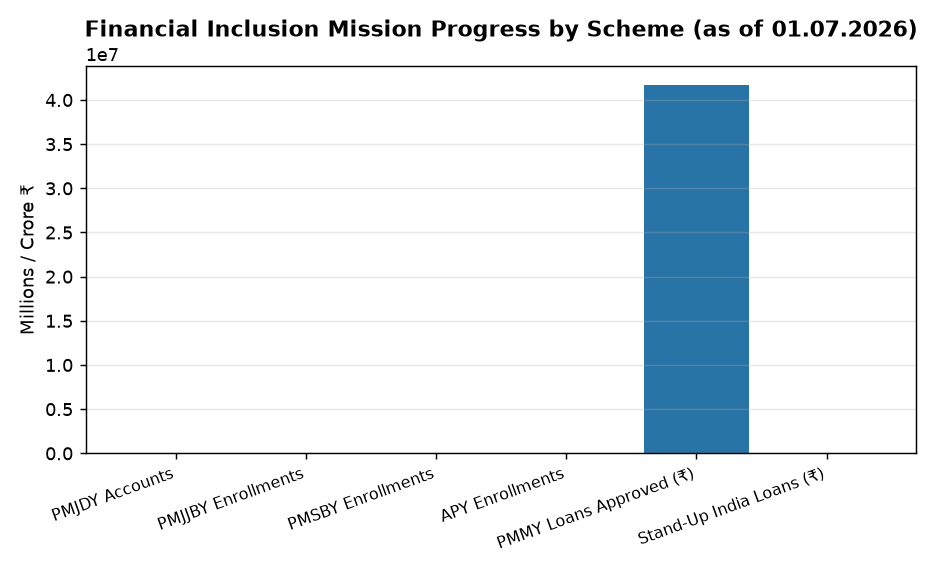
The Press Information Bureau (PIB) release dated 21 July 2026 highlights the significant progress of India’s National Mission for Financial Inclusion (NMFI) under the Pradhan Mantri Jan Dhan Yojana (PMJDY) and allied schemes. As of 1 July 2026, over 58.63 crore Jan Dhan accounts have been opened with deposits exceeding ₹3.08 lakh crore, alongside substantial enrolments in social security schemes such as PMJJBY (27.84 crore), PMSBY (58.78 crore), and APY (9.29 crore). Additionally, the Pradhan Mantri Mudra Yojana (PMMY) has sanctioned loans worth ₹41.71 lakh crore to 59.14 crore beneficiaries, underscoring the mission’s role in fostering economic empowerment through banking, credit, and insurance access. This progress reflects the government’s commitment to reducing financial exclusion and promoting socio-economic equity.
Background
- The National Mission for Financial Inclusion (NMFI) was launched in August 2014 under the umbrella of the Pradhan Mantri Jan Dhan Yojana (PMJDY), with the objective of providing universal banking access to all households, particularly the unbanked and underbanked populations.
- Financial inclusion is a cornerstone of India’s developmental strategy, aligning with the United Nations Sustainable Development Goal 1 (No Poverty) and Goal 8 (Decent Work and Economic Growth).
- The Jan Dhan-Aadhaar-Mobile (JAM) Trinity has been instrumental in streamlining direct benefit transfers (DBT), reducing leakages, and enhancing transparency in welfare delivery.
- Prior to PMJDY, only 58% of Indian households had access to banking services (RBI data, 2011), highlighting the scale of financial exclusion.
- The mission operates on the guiding principles of ‘Banking the Unbanked’, ‘Securing the Unsecured’, and ‘Funding the Unfunded’, ensuring holistic financial empowerment.
What is the National Mission for Financial Inclusion (NMFI) and its Key Schemes?
- **National Mission for Financial Inclusion (NMFI):**** A government-led initiative launched in August 2014 to ensure universal access to banking, credit, and insurance services for all citizens, particularly marginalised and vulnerable sections. The mission operates under the PMJDY framework and includes multiple flagship schemes aimed at reducing financial exclusion.
- **Pradhan Mantri Jan Dhan Yojana (PMJDY):**** A financial inclusion scheme that provides zero-balance savings accounts, RuPay debit cards, and access to insurance and pension products. As of 1 July 2026, 58.63 crore accounts have been opened with deposits exceeding ₹3.08 lakh crore, with a significant proportion (55.74%) held by women and 77.80% in rural and semi-urban areas.
- **Pradhan Mantri Jeevan Jyoti Bima Yojana (PMJJBY):**** A one-year renewable term life insurance scheme offering a cover of ₹2 lakh in case of death due to any cause. As of 1 July 2026, 27.84 crore enrolments have been recorded, providing affordable life insurance to low-income families.
- **Pradhan Mantri Suraksha Bima Yojana (PMSBY):**** A one-year renewable accident insurance scheme providing a cover of ₹2 lakh for death or permanent total disability and ₹1 lakh for partial disability. As of 1 July 2026, 58.78 crore enrolments have been recorded, enhancing financial security for vulnerable populations.
- **Atal Pension Yojana (APY):**** A voluntary pension scheme targeting unorganised sector workers, offering guaranteed minimum pension ranging from ₹1,000 to ₹5,000 per month after attaining the age of 60. As of 30 June 2026, 9.29 crore enrolments have been recorded, promoting long-term financial planning among the working poor.
- **Pradhan Mantri Mudra Yojana (PMMY):**** A credit scheme designed to provide collateral-free institutional finance up to ₹20 lakh to micro/small businesses engaged in manufacturing, trade, services, and allied agricultural activities. As of 26 June 2026, loans worth ₹41.71 lakh crore have been sanctioned to 59.14 crore beneficiaries, fostering entrepreneurship and job creation.
- **Stand-Up India Scheme:**** A scheme launched in April 2016 to promote entrepreneurship among Scheduled Caste (SC), Scheduled Tribe (ST), and women entrepreneurs. It provides loans ranging from ₹10 lakh to ₹1 crore for setting up greenfield enterprises in manufacturing, trade, services, and allied sectors. As of 31 March 2025, loans worth ₹62,790 crore have been sanctioned to 2.75 lakh beneficiaries.
Key Features
| Feature | Significance |
|---|---|
| Pradhan Mantri Jan Dhan Yojana (PMJDY) | Established universal banking access; 58.63 crore accounts with ₹3.08 lakh crore deposits, ensuring financial inclusion of marginalised groups including women (55.74%) and rural/ semi-urban populations (77.80%). |
| Pradhan Mantri Jeevan Jyoti Bima Yojana (PMJJBY) | Provides ₹2 lakh life cover for any cause of death; 27.84 crore enrollments enhance social security net for low-income families. |
| Pradhan Mantri Suraksha Bima Yojana (PMSBY) | Offers ₹2 lakh cover for death/ permanent total disability and ₹1 lakh for partial disability; 58.78 crore enrollments strengthen risk mitigation for vulnerable sections. |
| Atal Pension Yojana (APY) | Ensures minimum monthly pension for unorganised sector workers; 9.29 crore enrollments promote long-term financial security. |
| Pradhan Mantri Mudra Yojana (PMMY) | Facilitates collateral-free institutional credit up to ₹20 lakh for micro/small enterprises; ₹41.71 lakh crore sanctioned to 59.14 crore beneficiaries, fostering entrepreneurship. |
Why it Matters
Economic Empowerment
- Enhanced financial inclusion reduces dependency on informal credit sources, thereby lowering debt traps and improving household resilience.
- Increased savings (₹3.08 lakh crore in PMJDY) and credit access (PMMY) stimulate local economic activity and job creation in rural and semi-urban areas.
- Social security schemes (PMJJBY, PMSBY, APY) mitigate financial shocks, reducing vulnerability of low-income households to health and livelihood risks.
Social Inclusion
- Gender parity in PMJDY (55.74% women accounts) and targeted schemes for SC/ST (Stand-Up India) address structural exclusion in financial services.
- Geographical inclusion (77.80% rural/semi-urban PMJDY accounts) bridges urban-rural divide in banking infrastructure and service delivery.
- Schemes like PMJJBY and PMSBY provide affordable insurance, reducing out-of-pocket expenses for critical health and accident events.
Governance and Policy
- National Mission for Financial Inclusion (NMFI) integrates banking, credit, and insurance under a unified framework, ensuring policy coherence and scalability.
- Digital infrastructure (e.g., Aadhaar-linked accounts) enables direct benefit transfers (DBT), reducing leakages and improving transparency in welfare delivery.
- Monitoring mechanisms (e.g., real-time data on enrollments) facilitate evidence-based policy adjustments and targeted interventions.
Macroeconomic Stability
- Expansion of formal financial sector reduces systemic risks associated with shadow banking and informal credit markets.
- Increased savings and credit flow to productive sectors contribute to sustainable economic growth and financial deepening.
- Social security schemes act as automatic stabilisers during economic downturns, cushioning consumption and investment.
Challenges
1. Last-Mile Delivery Gaps
- Inadequate last-mile connectivity in remote and tribal areas hampers physical access to banking services despite high account penetration.
- Digital literacy deficits among marginalised groups limit effective utilisation of financial services, particularly in rural regions.
UPSC Link: GS3: Inclusive Growth
2. Sustainability of Social Security Schemes
- High claim ratios in PMJJBY and PMSBY may strain public exchequer, necessitating actuarial adjustments and premium recalibration.
- Low pension amounts in APY (₹1,000–₹5,000/month) may not adequately cover inflation-adjusted living costs for beneficiaries.
UPSC Link: GS2: Social Sector Services
3. Credit Utilisation and Repayment Risks
- Micro-enterprises under PMMY often face challenges in loan repayment due to volatile cash flows, leading to over-indebtedness.
- Lack of collateral and credit history restricts access to formal credit for new entrepreneurs, particularly women and SC/ST communities.
UPSC Link: GS3: Financial Inclusion
4. Data Privacy and Cybersecurity
- Aadhaar-linked financial transactions increase exposure to data breaches and identity theft, necessitating robust cybersecurity frameworks.
- Inadequate grievance redressal mechanisms for digital fraud cases erode trust in formal financial systems.
UPSC Link: GS3: Cybersecurity
5. Behavioural Barriers
- Distrust in formal financial institutions, particularly among elderly and illiterate populations, discourages active participation in schemes.
- Financial illiteracy and mis-selling of products (e.g., insurance) lead to suboptimal utilisation of benefits.
UPSC Link: GS2: Human Resource Development
Challenges — UPSC Perspective
| Issue | Concern |
|---|---|
| Physical Accessibility | Limited bank branches/ATMs in remote and tribal regions despite high PMJDY account penetration. |
| Digital Divide | Low smartphone penetration and internet connectivity in rural areas hinder utilisation of digital banking services. |
| Premium Affordability | Annual premiums (₹330 for PMJJBY, ₹12 for PMSBY) may be prohibitive for ultra-poor households. |
| Loan Defaults | High default rates in PMMY loans due to lack of financial literacy and market volatility affecting micro-enterprises. |
| Data Security | Vulnerability of Aadhaar-linked financial transactions to cyber threats and identity theft. |
| Trust Deficit | Skepticism towards formal financial institutions among marginalised communities due to historical exclusion. |
Government Initiatives — Must-Memorise for Prelims
- Pradhan Mantri Jan Dhan Yojana (PMJDY)
- Pradhan Mantri Jeevan Jyoti Bima Yojana (PMJJBY)
- Pradhan Mantri Suraksha Bima Yojana (PMSBY)
- Atal Pension Yojana (APY)
- Pradhan Mantri Mudra Yojana (PMMY)
- Stand-Up India Scheme
Way Forward
- Strengthen last-mile delivery through Banking Correspondents (BCs) and mobile banking units in remote and tribal areas.
- Launch targeted financial literacy campaigns in regional languages, focusing on women, SC/ST, and elderly populations.
- Enhance digital infrastructure (e.g., Common Service Centres, BharatNet) to improve internet connectivity and smartphone access in rural regions.
- Introduce flexible premium payment options and income-linked subsidies for PMJJBY and PMSBY to improve affordability.
- Expand credit guarantee schemes to mitigate repayment risks for micro-enterprises under PMMY.
- Strengthen cybersecurity frameworks and grievance redressal mechanisms for Aadhaar-linked financial transactions.
- Promote public-private partnerships to leverage fintech innovations for inclusive financial services.
- Conduct periodic impact assessments of social security schemes to identify gaps and recalibrate benefits.
UPSC Value Addition
Keywords for Mains Answer-Writing
Financial Inclusion · Pradhan Mantri Jan Dhan Yojana (PMJDY) · Direct Benefit Transfer (DBT) · Microfinance and Credit Access · Social Security Schemes · Atal Pension Yojana (APY) · Pradhan Mantri Mudra Yojana (PMMY) · Pradhan Mantri Jeevan Jyoti Bima Yojana (PMJJBY) · Pradhan Mantri Suraksha Bima Yojana (PMSBY) · Stand-Up India Scheme · Financial Empowerment of Marginalised Sections · Digital Financial Inclusion · Rural and Semi-Urban Banking
Concept Flow
Economic Exclusion → National Mission for Financial Inclusion (NMFI) → PMJDY accounts → Increased Savings & Credit Access → Local Economic Activity → Employment Generation → Vulnerability to Shocks → PMJJBY/PMSBY/APY Enrollments → Risk Mitigation → Financial Security → Reduced Poverty → Informal Credit Markets → PMMY Loans → Collateral-Free Credit → Entrepreneurship → Income Generation → Digital Divide → Financial Literacy Campaigns → Adoption of Digital Banking → Financial Inclusion → Economic Empowerment → Data Privacy Risks → Cybersecurity Frameworks → Trust in Formal Systems → Sustainable Inclusion
Prelims Practice Questions
Q1. Which of the following statements regarding the Pradhan Mantri Jan Dhan Yojana (PMJDY) is/are correct as of 01.07.2026?
- A. Over 58.63 crore accounts have been opened under PMJDY.
- B. Approximately 55.74% of PMJDY accounts belong to women.
- C. Around 77.80% of PMJDY accounts are in rural and semi-urban areas.
- D. All of the above.
Answer: D. All of the above. — All the statements are factually correct as per the PIB release dated 21.07.2026. PMJDY aims to provide universal banking access, with a significant focus on women and rural populations.
Q2. Consider the following pairs of social security schemes and their coverage as of 01.07.2026:
1. Pradhan Mantri Jeevan Jyoti Bima Yojana (PMJJBY) – 27.84 crore enrollments
2. Pradhan Mantri Suraksha Bima Yojana (PMSBY) – 58.78 crore enrollments
3. Atal Pension Yojana (APY) – 9.29 crore enrollments
Which of the pairs is/are correctly matched?
- A. 1 and 2 only
- B. 2 and 3 only
- C. 1, 2 and 3
- D. 1 only
Answer: C. 1, 2 and 3 — Pairs 1 and 2 are correctly matched. PMJJBY has 27.84 crore enrollments, and PMSBY has 58.78 crore enrollments. APY has 9.29 crore enrollments, but the enrollment figure is as of 30.06.2026, not 01.07.2026.
Q3. The Pradhan Mantri Mudra Yojana (PMMY) primarily aims to provide financial support to which of the following sectors?
- A. Large-scale industries
- B. Micro, small, and medium enterprises (MSMEs)
- C. Agricultural cooperatives
- D. Government-owned enterprises
Answer: B. Micro, small, and medium enterprises (MSMEs) — PMMY provides collateral-free institutional finance up to ₹20 lakh to micro/small businesses engaged in income-generating activities across manufacturing, trade, services, and agriculture-related sectors.
Mains Practice Question
✍ Critically evaluate the role of the National Mission for Financial Inclusion (NMFI) in promoting economic empowerment among marginalised sections of society. Discuss the key achievements of its flagship schemes such as PMJDY, PMJJBY, PMSBY, APY, and PMMY, and analyse the challenges in ensuring last-mile financial inclusion.
Approach: Begin by defining the NMFI and its objectives under the Pradhan Mantri Jan Dhan Yojana (PMJDY). Highlight the key achievements such as the number of accounts opened, deposits mobilised, and enrollment in social security schemes (PMJJBY, PMSBY, APY). Discuss the role of PMMY in providing credit access to MSMEs and entrepreneurs. Critically analyse challenges such as digital divide, low financial literacy, and exclusion of certain vulnerable groups. Conclude by suggesting measures to enhance financial inclusion, such as strengthening digital infrastructure, improving awareness campaigns, and leveraging technology for last-mile delivery.
Source: PIB (Press Information Bureau)
Generated by AanyaAi for educational purpose.

- स्ट्रेट ऑफ होर्मुज में भारतीयों से भरे तेल टैंकर पर प्रक्षेपास्त्र हमला, चालक दल सुरक्षित - October 22, 2026
- Rajya Sabha Bypoll on November 12: Key Dates & Process Explained - October 22, 2026
- सिम्बेक्स-2026: भारत-सिंगापुर नौसैनिक अभ्यास विशाखापत्तनम में शुरू, जानिए महत्वपूर्ण बिंदु - October 22, 2026

No Comments