


21 Jul PMKSY: Key Components & Implementation for UPSC State PCS 2026
Subject Relevance — Where This Topic Fits
- GS Paper III — Agriculture, Water Resources, and Rural Development
- Prelims: PMKSY, Accelerated Irrigation Benefits Programme (AIBP), Har Khet Ko Pani (HKKP), Watershed Development Component (WDC), Command Area Development, On-farm development, Central assistance to states, Competitive tendering in irrigation projects
- Essay: Water management as a critical enabler of agricultural productivity and rural prosperity, The role of public-private partnerships in India’s irrigation infrastructure: opportunities and constraints
Quick Revision: PMKSY integrates AIBP, HKKP, and WDC to enhance irrigation coverage and water-use efficiency in agriculture, with central assistance provided to states for irrigation potential creation and command area development, implemented primarily through state-led competitive tendering.
Why is this in the news?
The Press Information Bureau (PIB) released a statement on 21 July 2026 detailing the operational structure, implementation mechanisms, and challenges of the Pradhan Mantri Krishi Sinchayee Yojana (PMKSY), particularly highlighting its three components, funding mechanisms, and the absence of a centralised database for capacity-building activities. This clarification assumes significance in the context of India’s ongoing efforts to enhance irrigation coverage and agricultural productivity while addressing data gaps in monitoring and evaluation.
Background
- India’s agriculture sector, which employs approximately 42% of the workforce, is heavily dependent on monsoon rainfall, making irrigation a critical determinant of productivity and food security.
- The National Commission on Farmers (2006) and the National Water Policy (2012) underscored the need for a holistic approach to irrigation development, leading to the conceptualisation of PMKSY.
- The scheme aligns with the Sustainable Development Goals (SDG 2: Zero Hunger and SDG 6: Clean Water and Sanitation) and the government’s goal of doubling farmer incomes by 2022.
- Despite significant investments, India’s irrigation coverage remains uneven, with only about 50% of net sown area under irrigation, necessitating targeted interventions under PMKSY.
- The scheme operates within the broader framework of the National Mission for Sustainable Agriculture (NMSA) and the Pradhan Mantri Fasal Bima Yojana (PMFBY).
What is the Pradhan Mantri Krishi Sinchayee Yojana (PMKSY)?
- PMKSY is a centrally sponsored scheme launched by the Government of India in 2015 to enhance physical access to irrigation and improve water-use efficiency in agriculture.
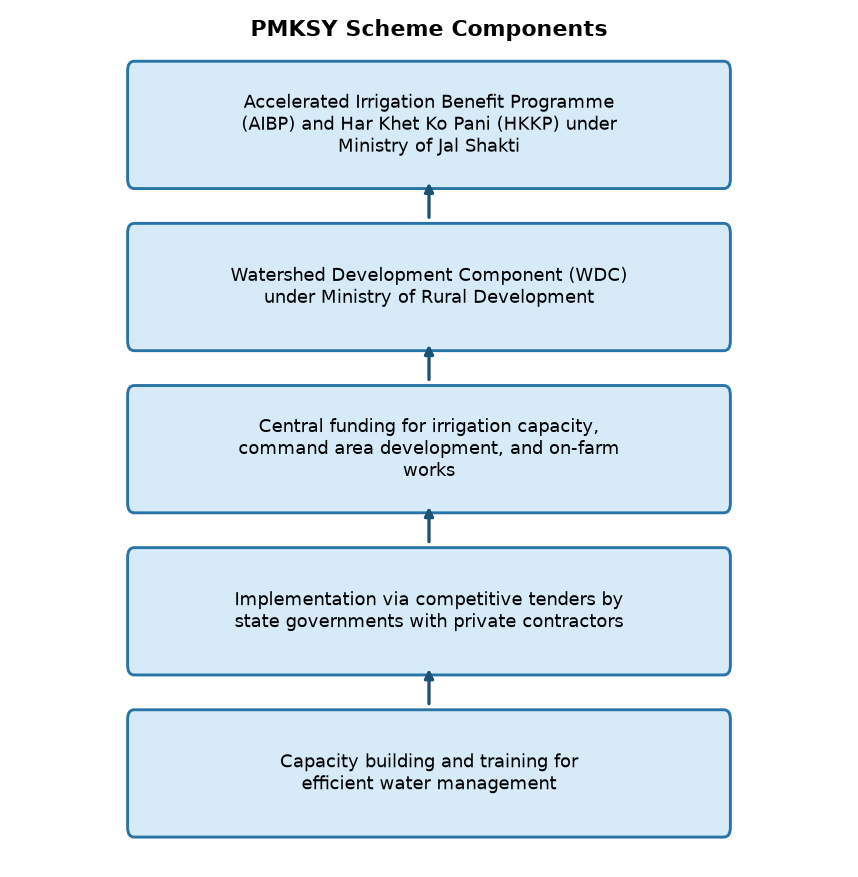
- The scheme is implemented through three major components: Accelerated Irrigation Benefits Programme (AIBP) and Har Khet Ko Pani (HKKP) under the Department of Water Resources, River Development and Ganga Rejuvenation under the Ministry of Jal Shakti, and the Watershed Development Component (WDC) under the Department of Land Resources under the Ministry of Rural Development.
- The scheme provides central financial assistance to states for creating irrigation potential, developing command areas, and on-farm water management.
- Implementation is primarily through state governments, which execute projects via competitive tendering processes, adhering to their respective procurement regulations.
- PMKSY emphasises capacity building and training for farmers, field-level officials, and stakeholders to promote efficient water management practices, though centralised monitoring of such activities remains limited.
- The scheme does not include specific provisions for private sector investment, relying instead on public funding and state-led execution.
Key Features
| Feature | Significance |
|---|---|
| Three-component structure | Integrates irrigation infrastructure (AIBP & HKKP) with watershed development (WDC), ensuring a holistic approach to water resource management. |
| Central financial assistance to States | Provides funding for irrigation capacity creation, command area development, and on-farm activities, reducing fiscal burden on States. |
| Competitive tendering mechanism | Projects are executed via State-conducted tenders, ensuring transparency and adherence to State procurement norms. |
| Capacity-building and training | Focuses on efficient water management through training of farmers and field-level staff, though centralised data maintenance is lacking. |
| State-specific implementation | Execution follows State regulations, ensuring contextual relevance but potentially leading to variability in outcomes. |
Why it Matters
Agricultural Productivity
- Enhances irrigation coverage, reducing dependency on monsoons and stabilising crop yields.
- Supports command area development, improving water-use efficiency and agricultural output.
- Facilitates on-farm interventions, promoting precision agriculture and sustainable practices.
Economic Growth
- Boosts rural incomes by increasing agricultural productivity and reducing crop losses due to water scarcity.
- Generates employment in rural areas through irrigation infrastructure projects and allied activities.
- Reduces food inflation by ensuring consistent agricultural supply, benefiting the broader economy.
Resource Sustainability
- Promotes efficient water management, aligning with the National Water Policy and sustainable development goals.
- Integrates watershed development, mitigating soil erosion and improving groundwater recharge.
- Supports climate-resilient agriculture by reducing vulnerability to droughts and erratic rainfall.
Governance and Transparency
- Leverages competitive tendering to ensure cost-effective project execution and minimise corruption risks.
- Encourages State-level ownership, fostering accountability in irrigation project implementation.
- Promotes participatory approaches through farmer training and community engagement.
Challenges
1. Implementation Delays
- Bureaucratic hurdles and procedural complexities in State-level tendering and approval processes.
- Delays in land acquisition and environmental clearances for irrigation projects.
- Inadequate inter-departmental coordination between Water Resources, Rural Development, and Agriculture ministries.
UPSC Link: GS III: Infrastructure
2. Financial Constraints
- Insufficient central funding to meet the scale of irrigation needs across States.
- Underutilisation of funds due to delays in project approvals and disbursements.
- Lack of incentives for private sector investment in irrigation infrastructure.
UPSC Link: GS III: Government Budgeting
3. Technological and Capacity Gaps
- Limited adoption of modern irrigation techniques (e.g., drip/sprinkler systems) due to lack of awareness.
- Inadequate training infrastructure for farmers and field staff on efficient water management.
- Absence of a centralised database for tracking training outcomes and beneficiary engagement.
UPSC Link: GS III: Science & Technology
4. Environmental and Social Concerns
- Over-extraction of groundwater leading to depletion in water-scarce regions.
- Potential displacement of communities due to large-scale irrigation projects.
- Ecological impacts of large dams and reservoirs on river ecosystems and biodiversity.
UPSC Link: GS III: Environment & Ecology
5. Monitoring and Evaluation Deficiencies
- Lack of real-time monitoring systems for irrigation project progress and outcomes.
- Inadequate post-implementation assessment of irrigation infrastructure performance.
- No centralised tracking of farmers trained under capacity-building initiatives.
UPSC Link: GS II: Governance
Challenges — UPSC Perspective
| Issue | Concern |
|---|---|
| Bureaucratic delays | Procedural inefficiencies in State-level approvals and tendering. |
| Fund underutilisation | Delays in fund disbursement and project execution. |
| Groundwater depletion | Over-reliance on groundwater without sustainable recharge mechanisms. |
| Farmer awareness gaps | Low adoption of modern irrigation techniques due to lack of training. |
| Ecological impacts | Potential harm to river ecosystems from large-scale irrigation projects. |
Way Forward
- Strengthen inter-ministerial coordination to expedite project approvals and clearances.
- Enhance centralised monitoring systems for real-time tracking of irrigation project progress.
- Expand capacity-building initiatives with measurable outcomes and centralised data maintenance.
- Promote public-private partnerships (PPPs) to attract investment in irrigation infrastructure.
- Integrate climate-resilient practices, such as micro-irrigation and watershed management, into project design.
- Conduct periodic evaluations of irrigation schemes to assess impact and identify bottlenecks.
- Incentivise States to adopt innovative irrigation technologies through performance-linked funding.
- Address groundwater depletion by promoting recharge projects and rainwater harvesting.
UPSC Value Addition
Keywords for Mains Answer-Writing
Pradhan Mantri Krishi Sinchayee Yojana (PMKSY) · Accelerated Irrigation Benefits Programme (AIBP) · Har Khet Ko Pani (HKKP) · Watershed Development Component (WDC) · Irrigation infrastructure · Command Area Development · On-farm development · Central assistance to states · Competitive tendering in irrigation projects · Capacity building in water management · Agrarian productivity · Sustainable agriculture · Drought mitigation · Micro-irrigation · Water-use efficiency · Agricultural productivity enhancement
Concept Flow
Water scarcity and monsoon dependency → PMKSY launched to enhance irrigation coverage → AIBP and HKKP components focus on major and minor irrigation projects → WDC component addresses watershed degradation and soil erosion → Central funding and State-level implementation → Project execution via competitive tenders → Capacity-building and training → Improved water-use efficiency and farmer livelihoods → Monitoring gaps and environmental concerns → Need for sustainable and inclusive implementation
Prelims Practice Questions
Q1. Which of the following is NOT a component of the Pradhan Mantri Krishi Sinchayee Yojana (PMKSY)?
- Accelerated Irrigation Benefits Programme (AIBP)
- Har Khet Ko Pani (HKKP)
- Micro Irrigation Fund (MIF)
- Watershed Development Component (WDC)
Answer: Micro Irrigation Fund (MIF) — The Micro Irrigation Fund (MIF) is a separate scheme under NABARD, whereas PMKSY comprises AIBP, HKKP, and WDC as its three core components.
Q2. Under the PMKSY, the implementation of irrigation projects is primarily governed by:
- Central procurement rules
- State-specific procurement regulations
- NITI Aayog guidelines
- Ministry of Finance directives
Answer: State-specific procurement regulations — PMKSY projects are executed through competitive tendering processes as per the procurement rules applicable to the respective state governments.
Q3. The Watershed Development Component (WDC) under PMKSY is implemented by which ministry?
- Ministry of Jal Shakti
- Ministry of Rural Development
- Ministry of Agriculture and Farmers’ Welfare
- Ministry of Environment, Forest and Climate Change
Answer: Ministry of Rural Development — The WDC is a component of PMKSY implemented by the Department of Land Resources under the Ministry of Rural Development.
Q4. Which of the following objectives is NOT directly addressed by the PMKSY?
- Creation of irrigation capacity
- Command Area Development
- On-farm development activities
- Direct cash transfers to farmers
Answer: Direct cash transfers to farmers — PMKSY focuses on irrigation infrastructure, command area development, and on-farm activities; it does not provide direct cash transfers to farmers.
Mains Practice Question
✍ Examine the significance of the Pradhan Mantri Krishi Sinchayee Yojana (PMKSY) in addressing the challenges of agricultural water security and productivity in India. Critically analyse the implementation challenges and suggest measures to enhance its efficacy.
Approach: The answer should begin by outlining the three components of PMKSY—AIBP, HKKP, and WDC—and their roles in enhancing irrigation infrastructure, command area development, and watershed management. Highlight the scheme’s contribution to agricultural productivity, drought mitigation, and water-use efficiency. Critically analyse implementation challenges such as delays in project execution, inadequate state-level capacity, lack of integrated data management for capacity-building activities, and limited private sector participation. Conclude with actionable suggestions, including strengthening inter-ministerial coordination, leveraging technology for real-time monitoring, incentivizing private investment through public-private partnerships, and ensuring robust data collection and analysis for evidence-based policymaking.
Source: PIB (Press Information Bureau)
Generated by AanyaAi for educational purpose.


No Comments