


21 Jul PMAY-G Achieves Targets: 5-Year Progress & Key Highlights for UPSC 2026
Subject Relevance — Where This Topic Fits
- GS Paper II — Welfare Schemes for Vulnerable Sections of the population by the Centre and States and the Performance of these Schemes | GS Paper III — Development, Inclusion and Associated Challenges / Land Reforms in India
- Prelims: PMAY-G, Land Titles in Rural Areas, Convergence with MGNREGS, Swachh Bharat Mission-Gramin, Jal Jeevan Mission, PM Ujjwala Yojana, Self-Help Groups (SHGs), Housing for All Mission, Land Ceiling and Holding
- Essay: Rural Transformation through Inclusive Policies: The Case of Pradhan Mantri Awaas Yojana-Gramin, Balancing Development and Equity: Lessons from India’s Housing Schemes
Quick Revision: PMAY-G is a demand-driven, beneficiary-led housing scheme that integrates convergence with SBM-G, MGNREGS, Jal Jeevan Mission, and PM Ujjwala Yojana to provide holistic rural development.
Why is this in the news?
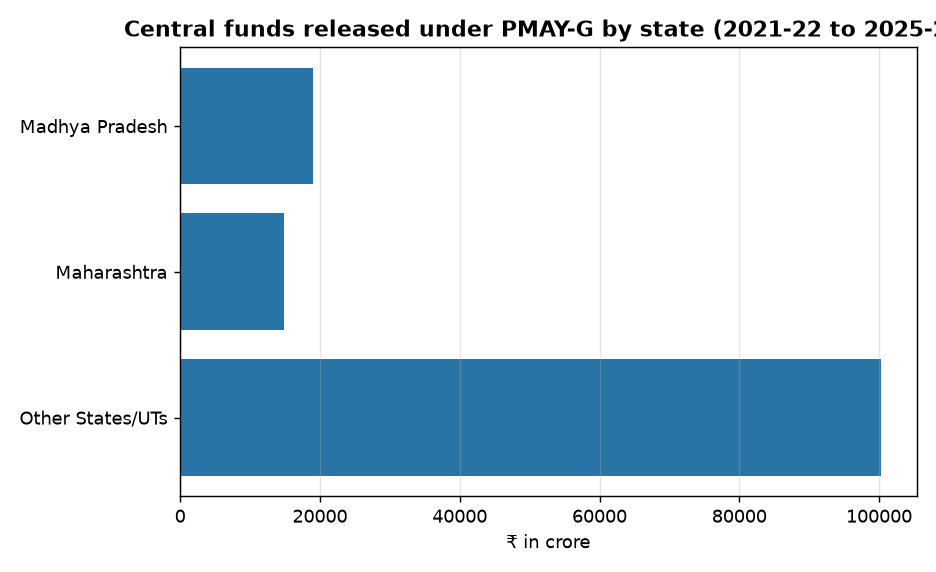
The Press Information Bureau (PIB) of the Ministry of Rural Development released a comprehensive progress report on 21 July 2026, highlighting the achievement of targets under the Pradhan Mantri Awaas Yojana-Gramin (PMAY-G) over the five-year period from 2021-22 to 2025-26. The report underscores the allocation of ₹1,34,242.45 crore in central funds, the integration of PMAY-G with other welfare schemes, and the positive socio-economic impacts documented by independent evaluations.
Background
- The scheme is a restructured version of the erstwhile Indira Awaas Yojana (IAY), incorporating beneficiary-led construction, convergence with other welfare programmes, and technology-driven monitoring.
- PMAY-G is implemented through a demand-driven approach, where eligible rural households are identified using the Socio-Economic Caste Census (SECC) 2011 data.
- The scheme mandates the use of eco-friendly and disaster-resilient materials, with a minimum size of 25 sq. mt. for each house.
- Convergence with Swachh Bharat Mission-Gramin (SBM-G) ensures the provision of Individual Household Latrines (IHHL) under PMAY-G.
- The scheme is a critical component of the government’s broader agenda to address rural poverty, enhance living standards, and promote sustainable development.
What is Pradhan Mantri Awaas Yojana-Gramin (PMAY-G)?
- PMAY-G is implemented by the Ministry of Rural Development, aimed at providing pucca houses with basic amenities to all eligible rural households.
- The scheme operates on a demand-driven model, where eligible households are identified through the SECC 2011 data, and the selection is validated by Gram Sabhas.
- Financial assistance is provided to beneficiaries for house construction, with an additional ₹12,000 for toilet construction under SBM-G convergence.
- The scheme mandates the use of eco-friendly materials and disaster-resilient designs, ensuring sustainability and safety against natural calamities.
- PMAY-G integrates with multiple welfare schemes, including MGNREGS for unskilled wage employment, Jal Jeevan Mission for piped water supply, and PM Ujjwala Yojana for LPG connections, enhancing the overall quality of life.
- Monitoring and evaluation are facilitated through a digital dashboard, enabling real-time tracking of progress and addressing bottlenecks in implementation.
- The scheme prioritises the inclusion of marginalised groups, including Scheduled Castes (SCs), Scheduled Tribes (STs), and women-headed households, ensuring equitable distribution of benefits.
- Independent evaluations by institutions such as IIM-Ahmedabad, NIPFP, and NIRD&PR have consistently highlighted the scheme’s positive impact on housing security, health outcomes, and socio-economic empowerment.
Key Features
| Feature | Significance |
|---|---|
| Central Financial Assistance (CFA) | Provides ₹1,34,242.45 crore over five years (2021-22 to 2025-26) to states/UTs, ensuring fiscal support for housing construction under PMAY-G. |
| State-wise Target Allocation | Ensures equitable distribution of housing targets and funds, with states like Madhya Pradesh (₹19,013.72 crore) and Maharashtra (₹14,898.43 crore) receiving significant allocations. |
| Monitoring via Dashboards | Real-time tracking of progress through digital dashboards enables transparency, accountability, and timely intervention in lagging regions. |
| Integration with Other Schemes | Links with Swachh Bharat Mission-Gramin (SBM-G), MGNREGS, Jal Jeevan Mission (JJM), and PMUY to provide sanitation, employment, water, and energy access alongside housing. |
| Women Empowerment through SHGs | Mandates linking women beneficiaries to Self-Help Groups (SHGs) to enhance social and economic empowerment, fostering gender-inclusive development. |
Why it Matters
Socio-Economic Impact
- Enhances housing security, reducing homelessness and improving living conditions for rural households.
- Improves health outcomes by integrating sanitation (SBM-G) and clean cooking (PMUY) facilities.
- Boosts rural employment through MGNREGS linkages, providing unskilled wage labor for housing construction.
- Increases household savings and income by reducing expenditure on housing repairs and healthcare (due to better sanitation and housing quality).
- Promotes gender equity by prioritizing women as primary beneficiaries and linking them to SHGs.
Policy and Governance
- Demonstrates effective Centre-State coordination in implementing flagship schemes with measurable outcomes.
- Highlights the role of digital governance in tracking and accelerating development projects.
- Serves as a model for convergence of welfare schemes to maximize multi-dimensional benefits for beneficiaries.
Sustainable Development Goals (SDGs)
- Contributes to SDG 1 (No Poverty) by providing secure housing and reducing vulnerability.
- Supports SDG 3 (Good Health and Well-being) through improved sanitation and housing quality.
- Advances SDG 5 (Gender Equality) by empowering women beneficiaries.
- Aligns with SDG 6 (Clean Water and Sanitation) via JJM integration and SDG 7 (Affordable and Clean Energy) through PMUY linkages.
Challenges
1. Regional Disparities in Implementation
- States like Madhya Pradesh and Maharashtra receive higher allocations, while smaller or less developed states may face delays in fund utilization.
- Geographical challenges (e.g., hilly or tribal areas) may hinder construction timelines and accessibility.
UPSC Link: GS-II: Centre-State Relations
2. Convergence Gaps in Scheme Integration
- Despite formal linkages, on-ground coordination between PMAY-G, SBM-G, JJM, and MGNREGS may suffer due to administrative silos.
- Delays in beneficiary identification and fund disbursement across schemes can reduce overall impact.
UPSC Link: GS-II: Governance
3. Quality and Durability of Constructed Houses
- Reports of substandard construction materials or designs in some regions, leading to poor durability and maintenance issues.
- Lack of post-construction monitoring to ensure long-term habitability and safety.
UPSC Link: GS-III: Rural Development
4. Financial Leakages and Corruption
- Risk of diversion of funds or ghost beneficiaries due to weak grievance redressal mechanisms in some states.
- Need for robust auditing and social audits to prevent misuse of allocated resources.
UPSC Link: GS-IV: Ethics
5. Climate Resilience and Adaptation
- Limited focus on climate-resilient housing designs (e.g., flood-resistant, earthquake-proof structures) despite vulnerability to extreme weather events.
- Need for integrating green building practices to align with sustainable development goals.
UPSC Link: GS-III: Environment
Challenges — UPSC Perspective
| Issue | Concern |
|---|---|
| Fund Utilization Delays | Underutilization of allocated funds in certain states due to administrative bottlenecks or lack of capacity. |
| Beneficiary Identification Errors | Incorrect targeting of beneficiaries, leading to exclusion of eligible households or inclusion of ineligible ones. |
| Post-Construction Support | Absence of mechanisms for addressing structural defects or maintenance issues after house completion. |
| Monitoring and Evaluation Gaps | Inadequate real-time data on construction progress, leading to delayed interventions. |
| Climate Vulnerability Ignored | Housing designs do not account for local climate risks, compromising long-term sustainability. |
Government Initiatives — Must-Memorise for Prelims
- Pradhan Mantri Awas Yojana-Gramin (PMAY-G)
- Swachh Bharat Mission-Gramin (SBM-G)
- Mahatma Gandhi National Rural Employment Guarantee Scheme (MGNREGS)
- Jal Jeevan Mission (JJM)
- Pradhan Mantri Ujjwala Yojana (PMUY)
Way Forward
- Strengthen inter-departmental convergence mechanisms to ensure seamless integration of PMAY-G with SBM-G, MGNREGS, JJM, and PMUY at the grassroots level.
- Enhance digital monitoring systems with AI-driven predictive analytics to identify and address implementation bottlenecks in real time.
- Introduce mandatory climate-resilient housing standards in PMAY-G guidelines to mitigate risks from extreme weather events.
- Expand post-construction support mechanisms, including grievance redressal cells and maintenance funds, to ensure long-term durability of houses.
- Conduct regular social audits and third-party evaluations to detect financial leakages and beneficiary inclusion errors.
- Prioritize states with lower fund utilization rates by deploying dedicated task forces to accelerate project implementation.
- Promote women-led self-help groups (SHGs) as nodal agencies for housing construction and maintenance to enhance local ownership and sustainability.
- Integrate skill development programs for rural masons and artisans under MGNREGS to improve construction quality and employability.
UPSC Value Addition
Keywords for Mains Answer-Writing
Pradhan Mantri Awas Yojana-Gramin (PMAY-G) · Housing for All in Rural Areas · Convergence with other schemes · Financial Allocation and Utilisation · Rural Housing Policy · Women Empowerment through SHGs · Impact Assessment Studies · Convergence with Swachh Bharat Mission-Gramin · MGNREGA Integration · Jal Jeevan Mission · PM Ujjwala Yojana · Socio-economic Empowerment of Rural Households
Concept Flow
Identification of housing deficit and beneficiary eligibility under PMAY-G → Allocation of Central Financial Assistance (CFA) to states/UTs → State-level planning and target setting → Integration with SBM-G, MGNREGS, JJM, and PMUY for multi-sectoral benefits → Construction of houses with climate-resilient designs → Post-construction monitoring and maintenance → Socio-economic empowerment of women beneficiaries → Long-term impact on health, income, and gender equity
Prelims Practice Questions
Q1. Which of the following is NOT a component of the convergence strategy under Pradhan Mantri Awas Yojana-Gramin (PMAY-G)?
- A. Integration with Swachh Bharat Mission-Gramin for toilet construction
- B. Provision of piped water supply under Jal Jeevan Mission
- C. Direct cash transfer to beneficiaries for land acquisition
- D. Provision of LPG connections under PM Ujjwala Yojana
Answer: C. Direct cash transfer to beneficiaries for land acquisition — Convergence under PMAY-G does not include direct cash transfers for land acquisition; it focuses on in-kind benefits like toilets, water, electricity, and LPG connections.
Q2. As per the latest data (16.07.2026), which of the following statements is correct regarding the linkages under PMAY-G?
- A. All 3.08 crore houses have received LPG connections
- B. 2.43 crore houses have received piped water connections under Jal Jeevan Mission
- C. 1.35 crore SHG members are exclusively from urban areas
- D. MGNREGA provides skilled wage employment for all beneficiaries
Answer: B. 2.43 crore houses have received piped water connections under Jal Jeevan Mission — As per the PIB release, 2.43 crore houses have received piped water connections under Jal Jeevan Mission, while the other statements are incorrect or partially incorrect.
Q3. Which of the following institutions conducted the latest impact assessment study of PMAY-G in 2026?
- A. National Institute of Rural Development and Panchayati Raj (NIRD & PR)
- B. Indian Institute of Management, Ahmedabad (IIM-A)
- C. NITI Aayog
- D. National Council of Applied Economic Research (NCAER)
Answer: B. Indian Institute of Management, Ahmedabad (IIM-A) — The latest impact assessment study of PMAY-G in 2026 was conducted by the Indian Institute of Management, Ahmedabad (IIM-A).
Q4. Under PMAY-G, the financial assistance for toilet construction is provided through which scheme?
- A. MGNREGA
- B. Swachh Bharat Mission-Gramin (SBM-G)
- C. Deendayal Antyodaya Yojana-National Rural Livelihoods Mission (DAY-NRLM)
- D. National Rural Health Mission (NRHM)
Answer: B. Swachh Bharat Mission-Gramin (SBM-G) — The financial assistance of ₹12,000 for toilet construction under PMAY-G is provided through the Swachh Bharat Mission-Gramin (SBM-G).
Mains Practice Question
✍ Critically examine the role of convergence in enhancing the effectiveness of Pradhan Mantri Awas Yojana-Gramin (PMAY-G). How does this strategy contribute to the socio-economic empowerment of rural households? (250 words)
Approach: The answer should first define convergence in the context of PMAY-G and its significance in addressing multi-dimensional deprivations in rural areas. Highlight the key schemes integrated, such as Swachh Bharat Mission-Gramin (toilet construction), Jal Jeevan Mission (water supply), MGNREGA (unskilled wage employment), PM Ujjwala Yojana (LPG connections), and SHG linkages. Discuss the benefits of convergence, including improved health outcomes, enhanced dignity, and economic empowerment, supported by data from impact assessment studies. Critically analyse challenges such as implementation gaps, regional disparities, and the need for sustained monitoring. Conclude with the broader implications for rural development and inclusive growth.
Source: PIB (Press Information Bureau)
Generated by AanyaAi for educational purpose.

- कर्नाटक सरकार ने पूर्ण रूप से लागू करेगी अनुच्छेद 371(जे), जानिए क्या है इसका महत्व - September 16, 2026
- Karnataka to Fully Implement Article 371(J) for Kalyana Karnataka Development - September 16, 2026
- एल नीनो से प्रभावित केरल की चाय उत्पादन में 2% की गिरावट, जानें कारण और प्रभाव - September 16, 2026

No Comments