


30 Jul PMKSY Progress: 4.09 Lakh Ha Sown Under AIBP in Last 3 Years
Subject Relevance — Where This Topic Fits
- GS Paper II — Government Policies and Interventions for Development in various sectors | GS Paper III — Agriculture, Water Resources, and Irrigation Management
- Prelims: PMKSY, AIBP, HKKP, CADWM, SMIP, RRR, Micro-irrigation, Watershed Development, Water-use efficiency, Pradhan Mantri Kisan Urja Suraksha evam Utthaan Mahabhiyaan (PM-KUSUM)
- Essay: Water conservation and sustainable agriculture: Balancing productivity with resource efficiency, Government schemes and their role in transforming rural economies
Quick Revision: PMKSY, launched in 2015-16, is India’s flagship scheme to enhance irrigation coverage and water-use efficiency through AIBP (large projects), HKKP (last-mile connectivity), WDC (watershed development), and micro-irrigation, with a focus on ‘more crop per drop’.
Why is this in the news?
The Press Information Bureau (PIB) released a progress report on 30 July 2026 detailing the achievements of the Pradhan Mantri Krishi Sinchayee Yojana (PMKSY) under its various components, including the Accelerated Irrigation Benefits Programme (AIBP) and Har Khet Ko Pani (HKKP). The report highlights incremental gains in irrigation coverage, central financial assistance disbursed, and state-wise project completions, with a focus on Telangana and specific Parliamentary constituencies such as Dahod. This update is significant for UPSC aspirants as it reflects the government’s ongoing efforts to enhance agricultural productivity through improved irrigation infrastructure and water management.
Background
- PMKSY was launched in 2015-16 as an umbrella scheme to address the critical issue of low irrigation coverage in India, where only 48% of net sown area is irrigated.
- The scheme aims to bridge the irrigation gap by focusing on ‘more crop per drop’ through efficient water use and last-mile connectivity.
- PMKSY is implemented by multiple ministries: the Department of Water Resources, River Development and Ganga Rejuvenation (under the Ministry of Jal Shakti) for AIBP and HKKP, the Department of Land Resources for the Watershed Development Component (WDC), and the Department of Agriculture and Farmers’ Welfare for micro-irrigation under the erstwhile ‘Per Drop More Crop’ (PDMC) scheme.
- The scheme is aligned with the National Mission for Sustainable Agriculture (NMSA) and the National Water Mission (NWM).
- PMKSY integrates various sub-schemes to ensure holistic water resource management, including command area development, surface minor irrigation, and revival of water bodies.
- The scheme is a key pillar of India’s strategy to double farmer incomes by 2022-23, as outlined in the Union Budget 2016-17.
What is the Pradhan Mantri Krishi Sinchayee Yojana (PMKSY)?
- PMKSY is a centrally sponsored umbrella scheme launched in 2015-16 to enhance physical access to irrigation and improve water-use efficiency in agriculture.
- The scheme is implemented through two primary components: the Accelerated Irrigation Benefits Programme (AIBP) and Har Khet Ko Pani (HKKP).
- AIBP focuses on the creation of irrigation potential through large and medium irrigation projects, including major and medium dams, canals, and command area development.
- HKKP aims to provide assured irrigation to every farm (‘Har Khet Ko Pani’) through sub-components such as Command Area Development and Water Management (CADWM), Surface Minor Irrigation (SMI), and Repair, Renovation, and Restoration (RRR) of water bodies.
- The Watershed Development Component (WDC) of PMKSY, implemented by the Department of Land Resources, promotes rainwater harvesting, soil conservation, and groundwater recharge in rainfed areas.
- PMKSY also includes pilot initiatives such as the Modernisation of Command Area Development and Water Management (M-CADWM) to integrate pressurized irrigation systems with micro-irrigation infrastructure.
- The scheme is guided by the principle of ‘Jal Sanchay’ (water conservation) and ‘Jal Prabandhan’ (water management) to ensure sustainable agricultural growth.
Key Features
| Feature | Significance |
|---|---|
| Accelerated Irrigation Benefits Programme (AIBP) | Direct augmentation of irrigation capacity through large and medium irrigation projects, enhancing command area development and last-mile connectivity for agricultural productivity. |
| Har Khet Ko Pani (HKKP) – Command Area Development & Water Management (CAD & WM) | Improves water-use efficiency by modernising irrigation infrastructure, reducing conveyance losses, and strengthening farm-level water management systems. |
| Har Khet Ko Pani (HKKP) – Surface Minor Irrigation (SMI) | Expands irrigation coverage in rainfed and water-scarce regions through small-scale surface irrigation projects, promoting decentralised water resource utilisation. |
| Har Khet Ko Pani (HKKP) – Repair, Renovation & Restoration (RRR) of Water Bodies | Revives traditional water storage systems, enhancing groundwater recharge and providing supplementary irrigation in drought-prone areas. |
| Micro-Irrigation under PMKSY (via PDMC) | Promotes precision irrigation techniques such as drip and sprinkler systems, reducing water consumption, increasing yields, and mitigating soil salinity. |
| Watershed Development Component (WDC) | Integrates soil and water conservation measures, enhancing drought resilience, reducing soil erosion, and improving rural livelihoods through sustainable land management. |
Why it Matters
Economic Impact
- Enhances agricultural productivity by expanding irrigation coverage, thereby increasing cropping intensity and farm incomes in water-deficient regions.
- Reduces input costs through water-use efficiency improvements, particularly in micro-irrigation adoption, leading to higher net returns for farmers.
- Stimulates rural employment through construction and maintenance of irrigation infrastructure, including last-mile connectivity projects.
- Contributes to food security by stabilising crop production in rainfed and drought-prone areas through supplementary irrigation.
Environmental Sustainability
- Promotes judicious water use by reducing conveyance and field-level losses, aligning with Sustainable Development Goal 6 (Clean Water and Sanitation).
- Revives traditional water bodies, enhancing groundwater recharge and mitigating the impacts of groundwater depletion in overexploited regions.
- Encourages adoption of micro-irrigation, which reduces water consumption by 30-60% compared to conventional methods, thereby conserving scarce water resources.
- Mitigates soil degradation through watershed development, reducing erosion and improving soil health in fragile ecosystems.
Institutional & Governance
- Strengthens inter-departmental coordination between the Ministry of Jal Shakti, Ministry of Agriculture, and state governments for integrated water resource management.
- Enhances decentralised planning and implementation through state-level agencies, ensuring last-mile connectivity and project-specific customisation.
- Promotes participatory irrigation management (PIM) by involving Water User Associations (WUAs) in operation and maintenance of irrigation systems.
- Improves transparency and accountability in fund utilisation through digital monitoring of project progress and financial disbursements.
Social Equity
- Prioritises water-scarce and drought-prone regions, ensuring equitable access to irrigation facilities across states and districts.
- Supports small and marginal farmers by facilitating micro-irrigation adoption, which is cost-effective and scalable for small landholdings.
- Enhances resilience of tribal and marginalised communities by integrating watershed development with livelihood diversification strategies.
- Reduces migration pressure from rural areas by improving agricultural productivity and rural incomes.
Challenges
1. Inter-State Water Disputes
- AIBP projects often span multiple states, leading to delays due to unresolved inter-state water-sharing agreements (e.g., Krishna, Godavari basins).
- Lack of a unified national water policy framework exacerbates conflicts over water allocation and project implementation timelines.
UPSC Link: GS Paper 2: Inter-State Relations
2. Last-Mile Connectivity Gaps
- Despite progress, 30-40% of irrigation potential remains unutilised due to incomplete field channels and farm-level distribution networks.
- Poor maintenance of tertiary canals and field channels leads to waterlogging and salinity issues, reducing efficiency gains.
UPSC Link: GS Paper 3: Agricultural Infrastructure
3. Financial Constraints & Cost Overruns
- Underutilisation of allocated funds due to procedural delays, land acquisition hurdles, and inadequate state-level capacity for project execution.
- Cost escalations in large irrigation projects (e.g., Polavaram) strain central and state budgets, leading to funding gaps.
UPSC Link: GS Paper 3: Resource Mobilisation
4. Technological & Capacity Gaps
- Limited adoption of modern irrigation technologies (e.g., IoT-based soil moisture sensors) due to high initial costs and lack of technical expertise among farmers.
- Inadequate training and extension services for farmers on micro-irrigation and precision agriculture techniques.
UPSC Link: GS Paper 3: Science & Technology in Agriculture
5. Climate Change & Water Scarcity
- Increasing frequency of droughts and erratic rainfall patterns reduce the reliability of surface water sources, impacting project viability.
- Groundwater depletion in states like Punjab and Haryana threatens the sustainability of irrigation systems reliant on aquifers.
UPSC Link: GS Paper 3: Climate Change & Agriculture
6. Institutional Fragmentation
- Overlapping mandates between central ministries (Jal Shakti, Agriculture) and state agencies lead to coordination failures and duplication of efforts.
- Weak enforcement of water-use regulations and lack of penalties for over-extraction of groundwater undermine conservation efforts.
UPSC Link: GS Paper 2: Centre-State Relations
Challenges — UPSC Perspective
| Issue | Concern |
|---|---|
| Land Acquisition Delays | Legal disputes and compensation disputes stall project execution, particularly in densely populated or tribal areas. |
| Poor Maintenance of Irrigation Infrastructure | Neglect of tertiary canals and field channels leads to siltation, waterlogging, and reduced efficiency over time. |
| Low Farmer Awareness on Micro-Irrigation | Limited knowledge of subsidies and technical benefits discourages adoption, especially among smallholders. |
| Inadequate Monitoring & Evaluation | Lack of real-time data on water-use efficiency and project outcomes hampers evidence-based policymaking. |
| Climate-Resilient Infrastructure Gaps | Traditional irrigation systems are not designed to withstand extreme weather events, increasing vulnerability. |
| Fragmented Watershed Development | Poor integration with other rural development schemes (e.g., MGNREGS) reduces the multiplier effect of watershed interventions. |
Government Initiatives — Must-Memorise for Prelims
- Pradhan Mantri Krishi Sinchayee Yojana (PMKSY)
- Accelerated Irrigation Benefits Programme (AIBP)
- Har Khet Ko Pani (HKKP)
- Command Area Development & Water Management (CAD & WM)
- Surface Minor Irrigation (SMI)
- Repair, Renovation & Restoration (RRR) of Water Bodies
- Watershed Development Component (WDC) of PMKSY
Way Forward
- Accelerate completion of on-going AIBP projects by resolving inter-state water disputes through the Inter-State Water Disputes Act, 1956, and setting up dedicated tribunals for time-bound resolutions.
- Strengthen last-mile connectivity by mandating state governments to allocate 10% of PMKSY funds exclusively for tertiary canal construction and farm-level distribution networks.
- Enhance micro-irrigation adoption through targeted awareness campaigns, simplified subsidy disbursement processes, and clustering of farmers for bulk procurement of equipment.
- Integrate climate-resilient design principles into all new irrigation projects, including flood-resistant structures and drought-proofing measures, in alignment with the National Mission for Sustainable Agriculture.
- Establish a National Irrigation Efficiency Index to monitor progress across states and districts, with performance-linked funding for lagging regions.
- Promote public-private partnerships (PPPs) for the maintenance of irrigation infrastructure, leveraging corporate social responsibility (CSR) funds and farmer cooperatives.
- Expand the scope of the Watershed Development Component to include afforestation, soil health mapping, and livelihood diversification, in convergence with MGNREGS and other rural schemes.
- Develop a unified national water data repository to enable real-time monitoring of water availability, usage, and conservation outcomes across river basins.
UPSC Value Addition
Keywords for Mains Answer-Writing
Pradhan Mantri Krishi Sinchai Yojana (PMKSY) · Har Khet Ko Pani (HKKP) · Accelerated Irrigation Benefits Programme (AIBP) · Command Area Development and Water Management (CAD&WM) · Surface Minor Irrigation (SMI) · Repair, Renovation and Restoration (RRR) of water bodies · Micro-irrigation under ‘Per Drop More Crop (PDMC)’ · Water-shed development under PMKSY-WDC · Irrigation efficiency and water-use optimisation · Last-mile connectivity in irrigation infrastructure
Constitutional & Policy Linkages
- {‘Article 262’: ‘Inter-State Water Disputes’}
- {‘Article 246’: ‘Union List – Water Resources’}
- {‘Seventh Schedule’: ‘State List – Water Supply & Irrigation’}
Concept Flow
Inadequate irrigation infrastructure → Low agricultural productivity and farmer distress → Launch of PMKSY (2015) as umbrella scheme → Implementation of AIBP and HKKP components → Expansion of irrigation coverage and efficiency → Increased cropping intensity and farm incomes → Enhanced food security and rural employment → Positive feedback loop for economic growth and poverty reduction → Long-term sustainability challenges due to climate change and groundwater depletion → Need for climate-resilient and participatory irrigation management → Policy reforms in inter-state cooperation, financial allocation, and technological adoption.
Prelims Practice Questions
Q1. Consider the following statements regarding the Pradhan Mantri Krishi Sinchai Yojana (PMKSY):
1. PMKSY is an umbrella scheme launched in 2015-16 to enhance irrigation coverage and efficiency.
2. The ‘Har Khet Ko Pani’ component includes sub-schemes such as Surface Minor Irrigation (SMI) and Repair, Renovation and Restoration (RRR) of water bodies.
3. The ‘Per Drop More Crop’ (PDMC) scheme is now implemented under the Pradhan Mantri Krishi Vikas Yojana (PM-KVY) instead of PMKSY.
4. The Accelerated Irrigation Benefits Programme (AIBP) is exclusively implemented by the Ministry of Agriculture and Farmers’ Welfare.
How many of the above statements are correct?
- Only one
- Only two
- Only three
- All four
Answer: Only three — Statements 1, 2, and 3 are correct. Statement 4 is incorrect as AIBP is implemented by the Department of Water Resources, River Development and Ganga Rejuvenation under the Ministry of Jal Shakti.
Q2. Assertion (A): The ‘Har Khet Ko Pani’ (HKKP) component of PMKSY aims to provide last-mile connectivity to irrigation infrastructure.
Reason (R): HKKP includes the Command Area Development and Water Management (CAD&WM) sub-component to improve irrigation efficiency and reduce water losses.
In the context of the above two statements, which of the following is correct?
- Both A and R are true, and R is the correct explanation of A
- Both A and R are true, but R is not the correct explanation of A
- A is true, but R is false
- A is false, but R is true
Answer: Both A and R are true, but R is not the correct explanation of A — Both the Assertion (A) and Reason (R) are true. HKKP indeed aims to provide last-mile connectivity to irrigation infrastructure, and CAD&WM is a sub-component under HKKP that works to improve irrigation efficiency and reduce water losses, thereby directly supporting the objective of A.
Q3. Match the following components of the Pradhan Mantri Krishi Sinchai Yojana (PMKSY) with their implementing agencies:
Column I (Component) | Column II (Implementing Agency)
———————|—————————
A. Accelerated Irrigation Benefits Programme (AIBP) | 1. Department of Land Resources
B. Surface Minor Irrigation (SMI) | 2. Department of Water Resources, River Development and Ganga Rejuvenation
C. Water-shed Development (WDC) | 3. Ministry of Agriculture and Farmers’ Welfare
D. Per Drop More Crop (PDMC) | 4. Ministry of Jal Shakti
Select the correct match:
- A-4, B-2, C-1, D-3
- A-2, B-4, C-3, D-1
- A-1, B-3, C-4, D-2
- A-3, B-1, C-2, D-4
Answer: A-4, B-2, C-1, D-3 — A. AIBP is implemented by the Department of Water Resources, River Development and Ganga Rejuvenation (Ministry of Jal Shakti) — 4.
B. SMI is also implemented by the same department — 2.
C. Water-shed Development (WDC) is implemented by the Department of Land Resources — 1.
D. PDMC is now implemented under PM-KVY by the Ministry of Agriculture and Farmers’ Welfare — 3.
Mains Practice Question
✍ Critically examine the role of the Pradhan Mantri Krishi Sinchai Yojana (PMKSY) in addressing India’s irrigation challenges. How far has it succeeded in enhancing irrigation coverage, efficiency, and water-use optimisation? Also, analyse the challenges in the implementation of its sub-schemes such as ‘Har Khet Ko Pani’ (HKKP) and ‘Per Drop More Crop’ (PDMC). (15 Marks)
Approach: MODEL-ANSWER SKELETON:
1. Introduction (2 marks)
– Brief background of PMKSY: launched in 2015-16 as an umbrella scheme to enhance irrigation coverage and efficiency.
– Objectives: ‘More crop per drop’, last-mile connectivity, convergence of schemes, and promotion of micro-irrigation.
2. Role of PMKSY in addressing irrigation challenges (5 marks)
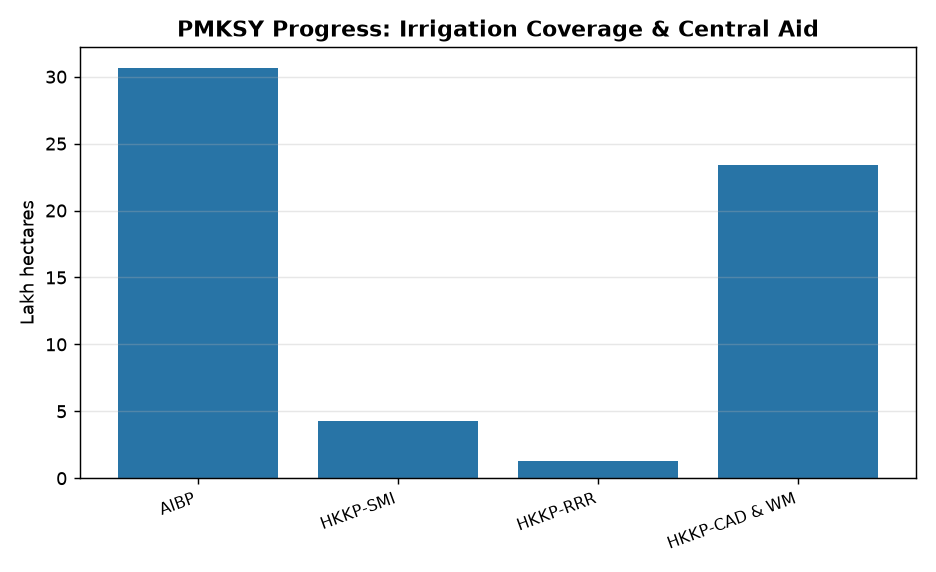
– Expansion of irrigation coverage: Data from the PIB release (April 2016 to 2025-26) on sown irrigation capacity under AIBP (30.66 lakh ha) and HKKP-SMI (4.29 lakh ha).
– Enhancing irrigation efficiency: CAD&WM sub-component under HKKP focuses on command area development and water management to reduce conveyance losses.
– Water-use optimisation: Micro-irrigation under PDMC (114.60 lakh ha covered since 2015-16) and its integration with PM-KVY.
– Revival of traditional water bodies: RRR component under HKKP (1.27 lakh ha restored; 0.41 lakh ha in last 3 years).
– Watershed development: PMKSY-WDC (9,434 projects) to address rainfed areas and soil conservation.
3. Successes and achievements (4 marks)
– Quantitative progress: Cite specific data from the PIB release (e.g., AIBP in Telangana: 204.74 thousand ha; HKKP-RRR: 25.55 thousand ha).
– Convergence and institutional mechanisms: Integration with other schemes (e.g., PM-KVY for PDMC) and multi-departmental implementation.
– Impact on agricultural productivity and water conservation: Reduced water losses, improved soil health, and higher crop yields in command areas.
4. Challenges in implementation (3 marks)
– Last-mile connectivity: Delays in project completion due to land acquisition, inter-state disputes, and bureaucratic hurdles.
– Fragmented implementation: Overlapping roles of multiple agencies (e.g., Department of Water Resources, Ministry of Agriculture) leading to coordination gaps.
– Financial constraints: Inadequate budgetary allocations and delays in fund disbursement.
– Technological and capacity gaps: Limited adoption of micro-irrigation due to high initial costs and lack of farmer awareness.
– Environmental concerns: Over-extraction of groundwater despite micro-irrigation efforts; need for sustainable water management practices.
5. Conclusion (1 mark)
– PMKSY has made significant strides in expanding irrigation coverage and promoting efficient water use, but challenges remain in ensuring last-mile connectivity, inter-agency coordination, and sustainable implementation. A holistic approach integrating technological innovation, farmer participation, and policy support is essential for realising its full potential.
Source: PIB (Press Information Bureau)
Generated by AanyaAi for educational purpose.

- उत्तराखंड राज्यपाल के 5 वर्ष: पांच मिशन और AI क्रांति का लेखा-जोखा - September 15, 2026
- UPSC Focus: Uttarakhand Governor’s 5-Year Journey & 5 Key Missions Explained - September 15, 2026
- AI का वादा और खतरा: क्या मानवता के लिए खतरा है कृत्रिम बुद्धिमत्ता? - September 15, 2026

No Comments