


09 Aug Policy Support Crucial to Save India’s Traditional Livelihoods: Expert Insights
✎ Traditional occupations are not merely economic activities but vital components of India’s cultural heritage and social fabric, requiring urgent policy interventions to ensure their survival in the face of economic transformation.
Subject Relevance — Where This Topic Fits
- GS Paper II — Social Justice and Governance (Inclusive Development, Constitutional Safeguards for Marginalised Groups) | GS Paper III — Indian Economy (Informal Sector, Livelihood Security, Employment Challenges)
- Prelims: Artisan communities, Middlemen exploitation, Constitutional provisions (Article 46, Directive Principles of State Policy), Informal sector employment, Social inclusion, Livelihood diversification, Market access barriers, Traditional knowledge systems
- Essay: The interplay between economic modernisation and cultural preservation: Can India’s traditional occupations survive in a globalised economy?, Sustainable livelihoods for marginalised communities: The role of state intervention in a market-driven world
Quick Revision: Traditional occupations are not merely economic activities but vital components of India’s cultural heritage and social fabric, requiring urgent policy interventions to ensure their survival in the face of economic transformation.
Why is this in the news?
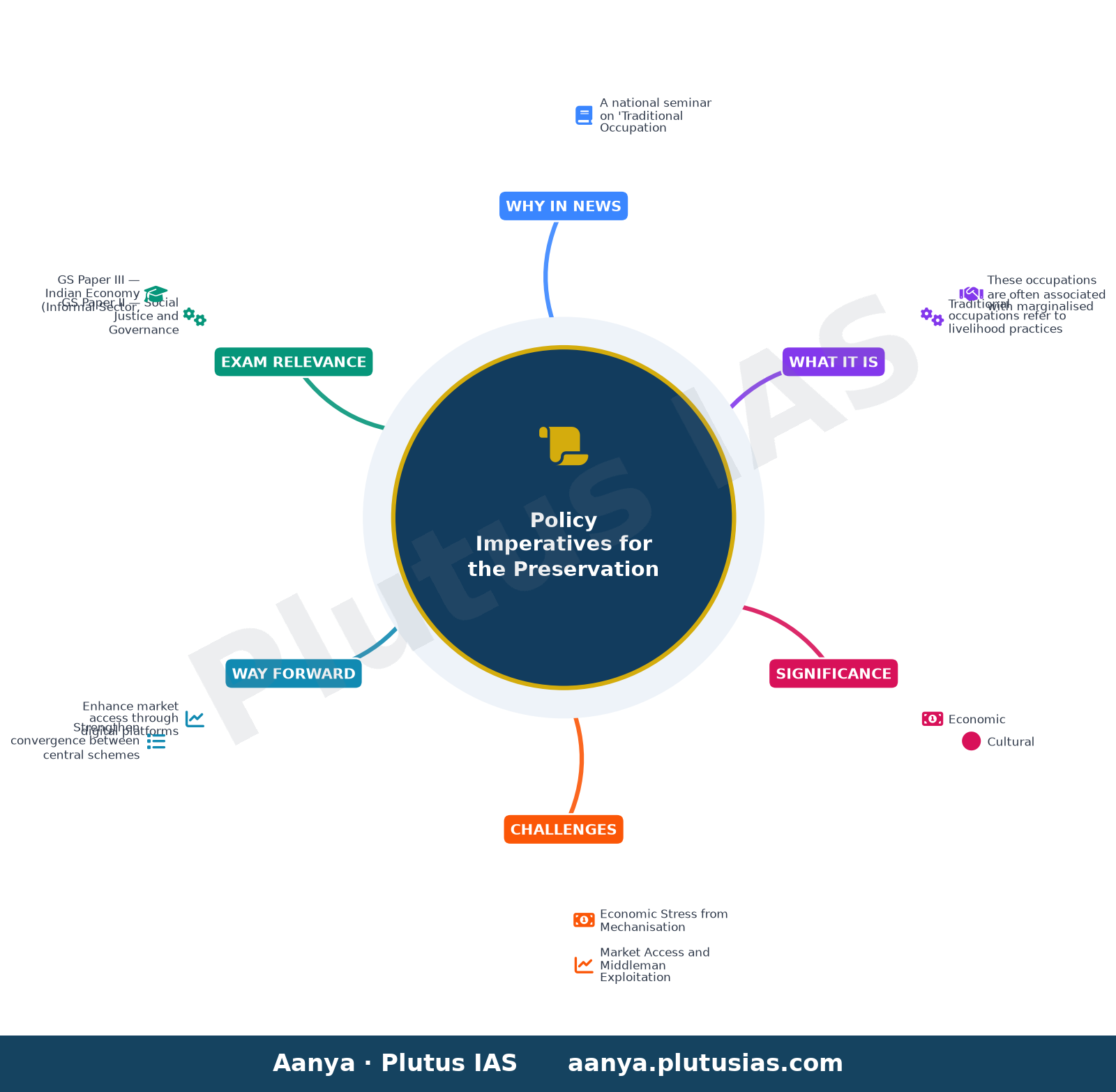
A national seminar on ‘Traditional Occupation Communities in a Changing Economy’ highlighted the severe economic stress faced by artisans and traditional occupational communities due to mechanisation, factory-made products, and inadequate market access. Speakers underscored the urgent need for stronger policy support to preserve these livelihoods, citing data that nearly 30% of artisans have exited their traditional occupations. The event, organised by the Centre for Study of Social Inclusion (CSSI), also discussed constitutional safeguards and the role of government in ensuring dignified livelihoods for these communities.
Background
- Traditional occupations in India, such as handloom weaving, pottery, blacksmithing, and carpentry, have been integral to the country’s cultural and economic fabric for centuries.
- Mechanisation and industrialisation have led to a decline in demand for handcrafted goods, reducing the economic viability of traditional occupations.
- Middlemen and lack of direct market access have further exacerbated the economic vulnerability of artisans, leading to reduced earnings and exploitation.
- Government schemes such as the National Handloom Development Programme (NHDP), Deendayal Antyodaya Yojana – National Urban Livelihoods Mission (DAY-NULM), and PM Vishwakarma Yojana aim to support traditional artisans, but implementation gaps persist.
- The Constitution of India, through Articles 46 and 38, directs the state to promote the welfare of weaker sections and ensure social and economic justice.
What are Traditional Occupations and Why Are They Significant?
- Traditional occupations refer to livelihood practices rooted in indigenous knowledge, cultural heritage, and community-based production systems, such as handloom weaving, pottery, and traditional metalwork.
- These occupations are often associated with marginalised communities, including Scheduled Castes (SCs), Scheduled Tribes (STs), and Other Backward Classes (OBCs), who have historically relied on them for sustenance.
- Traditional occupations contribute to India’s cultural diversity, preserving intangible heritage and fostering social cohesion through intergenerational knowledge transfer.
- The economic contribution of traditional occupations includes employment generation, rural development, and export earnings (e.g., handloom and handicrafts contribute significantly to India’s export basket).
- Despite their cultural and economic value, traditional occupations face existential threats due to market competition, lack of innovation, and inadequate policy support.
- The informal nature of these occupations often excludes workers from formal social security nets, making them highly vulnerable to economic shocks.
- Sustainable preservation of traditional occupations requires a multi-pronged approach, including skill upgradation, market linkages, and policy interventions to enhance competitiveness.
- Constitutional safeguards, such as Article 46, mandate the state to protect and promote the interests of weaker sections engaged in traditional livelihoods.
Key Features
| Feature | Significance |
|---|---|
| Policy support for traditional occupations | Ensures livelihood security and cultural preservation for marginalised artisan communities |
| Market access and middleman regulation | Reduces exploitation and enhances earnings for artisans by enabling direct trade |
| Constitutional safeguards for occupational freedom | Upholds Articles 19(1)(g) and 21, ensuring dignified livelihoods |
| Social inclusion mechanisms | Mitigates discrimination and promotes equitable participation in economic activities |
| Welfare measures integration | Aligns government schemes with ground realities to sustain traditional livelihoods |
Why it Matters
Economic
- Traditional occupations contribute significantly to India’s GDP through handicrafts, handlooms, and artisanal products, estimated at ₹3,000 crore annually (NITI Aayog, 2023).
- Preservation of these sectors supports rural economies and reduces migration to urban centres.
- Artisanal products, such as Khadi and handloom textiles, have high export potential, enhancing foreign exchange earnings.
Cultural
- Traditional occupations are repositories of indigenous knowledge, craftsmanship, and cultural heritage.
- They foster intergenerational transmission of skills, preserving India’s diverse cultural identity.
- UNESCO-recognised intangible cultural heritage, such as Madhubani painting and Pattachitra, relies on these occupations.
Social
- Traditional occupational communities, such as weavers, potters, and blacksmiths, form part of India’s socio-economic fabric.
- Empowerment of these communities aligns with the Sustainable Development Goals (SDG 8: Decent Work and Economic Growth).
- Inclusive development ensures equitable access to resources and opportunities for marginalised groups.
Strategic
- Traditional occupations act as bulwarks against homogenisation of global markets, promoting indigenous innovation.
- They contribute to India’s soft power through globally recognised artisanal products.
- Sustainable livelihoods reduce pressure on natural resources by promoting eco-friendly production methods.
Challenges
1. Economic Stress from Mechanisation
- Mechanisation and factory-produced goods have eroded demand for handmade products, leading to reduced incomes for artisans.
- Lack of economies of scale makes traditional products uncompetitive against mass-produced alternatives.
- Irregular income flows due to seasonal demand and market volatility exacerbate financial insecurity.
UPSC Link: GS-III: Industrial Policy
2. Market Access and Middleman Exploitation
- Artisans often rely on middlemen for market access, who exploit them through low procurement prices and delayed payments.
- Inadequate infrastructure, such as poor transportation and storage facilities, limits reach to urban and international markets.
- Dependence on localised markets increases vulnerability to economic shocks and policy changes.
UPSC Link: GS-III: Agriculture and Rural Development
3. Social Discrimination and Marginalisation
- Traditional occupational communities, such as Dalit artisans and tribal craftsmen, face systemic discrimination in access to resources and opportunities.
- Social stigma associated with certain occupations, such as manual scavenging, perpetuates exclusion and poverty.
- Lack of representation in policy-making bodies further marginalises these communities.
UPSC Link: GS-II: Social Justice
4. Inadequate Policy Implementation
- Despite numerous welfare schemes, poor implementation and lack of convergence between central and state policies hinder effective support.
- Bureaucratic delays and corruption in fund disbursal reduce the impact of government interventions.
- Lack of data on artisan demographics and economic contributions limits evidence-based policymaking.
UPSC Link: GS-II: Governance
5. Skill Erosion and Intergenerational Gaps
- Declining interest among youth in traditional occupations due to perceived lack of prestige and financial instability.
- Inadequate skill upgradation programmes fail to modernise traditional crafts to meet contemporary market demands.
- Loss of master artisans and traditional knowledge systems threatens the continuity of these occupations.
UPSC Link: GS-III: Skill Development
Challenges — UPSC Perspective
| Issue | Concern |
|---|---|
| Mechanisation | Erosion of demand for handmade products reduces artisan incomes |
| Middlemen exploitation | Low procurement prices and delayed payments exploit artisans |
| Social discrimination | Marginalisation of traditional communities limits access to opportunities |
| Policy implementation gaps | Poor convergence and corruption reduce scheme effectiveness |
| Skill erosion | Youth disinterest and inadequate training threaten traditional crafts |
Way Forward
- Enhance market access through digital platforms (e.g., e-NAM, GeM) to connect artisans directly with consumers and reduce middleman dependency.
- Strengthen convergence between central schemes (e.g., PM Vishwakarma, Stand-Up India) and state-level initiatives to ensure holistic support.
- Implement skill upgradation programmes in collaboration with institutions like NIFT and IITs to modernise traditional crafts.
- Establish artisan cooperatives and self-help groups (SHGs) to improve bargaining power and collective marketing.
- Promote research and development in traditional crafts to enhance product quality, design innovation, and export potential.
- Enforce anti-discrimination laws and sensitise communities to eliminate social stigma associated with traditional occupations.
- Develop robust data collection mechanisms to track artisan demographics, economic contributions, and welfare scheme utilisation.
- Encourage corporate social responsibility (CSR) funding for traditional occupations through tax incentives and recognition programmes.
UPSC Value Addition
Keywords for Mains Answer-Writing
Traditional occupations · Inclusive development · Social inclusion · Artisan communities · Policy support for livelihoods · Constitutional safeguards · Economic stress on traditional sectors · Market access for artisans · Middlemen exploitation · Dignified livelihoods · Social discrimination · Centre for Study of Social Inclusion (CSSI) · Constitutional provisions for marginalised groups · Mechanisation and traditional occupations · GST and occupational freedom
Constitutional & Policy Linkages
- Article 19(1)(g): Right to practise any profession, occupation, trade, or business
- Article 21: Right to livelihood and dignified life
- Article 46: Promotion of educational and economic interests of weaker sections
- Fifth Schedule: Protection of tribal communities and their traditional rights
- Seventh Schedule: Concurrent List (Entry 20: Economic and social planning)
Concept Flow
Changing market dynamics → Mechanisation and factory production → Reduced demand for handmade goods → Economic stress on artisans → Need for policy intervention → Middleman dependency → Exploitation and low earnings → Limited market access → Social and economic marginalisation → Requires regulatory and institutional reforms → Social discrimination → Exclusion from opportunities → Loss of cultural identity → Policy neglect → Need for inclusive development frameworks → Declining youth interest → Skill erosion → Loss of traditional knowledge → Threat to cultural heritage → Requires skill upgradation and awareness campaigns → Policy gaps → Poor implementation → Ineffective welfare measures → Unsustainable livelihoods → Need for convergence and data-driven governance
Prelims Practice Questions
Q1. Consider the following statements regarding traditional occupations in India:
1. Mechanisation and factory-made products have reduced the economic viability of traditional occupations.
2. The Central University of Sikkim has been instrumental in preserving traditional occupations through constitutional safeguards.
3. GST has been a major impediment to the growth of traditional artisans.
How many of the above statements are correct?
- Only one
- Only two
- All three
- None
Answer: Only two — Statement 1 is correct as mechanisation has placed traditional occupational communities under severe economic stress. Statement 2 is incorrect as the Central University of Sikkim discussed constitutional safeguards but was not instrumental in preserving traditional occupations. Statement 3 is incorrect as GST was discussed in the context of occupational freedom, not as an impediment.
Q2. Assertion (A): Traditional occupations contribute significantly to India’s cultural and economic fabric.
Reason (R): Policy support and market access are crucial for the survival of traditional occupational communities.
Options:
A. Both A and R are true, and R is the correct explanation of A.
B. Both A and R are true, but R is not the correct explanation of A.
C. A is true, but R is false.
D. A is false, but R is true.
Answer: ? — Both the assertion and reason are true. Traditional occupations are vital to India’s cultural and economic heritage (A). Policy support and market access are essential for their survival (R), making R the correct explanation for A.
Q3. Which of the following is NOT a challenge faced by traditional artisans as discussed in the seminar on Traditional Occupation Communities in a Changing Economy?
A. Dependence on middlemen
B. Irregular incomes
C. Lack of constitutional recognition
D. Inadequate market access
- A
- B
- C
- D
Answer: C — The seminar highlighted dependence on middlemen, irregular incomes, and inadequate market access as challenges. Constitutional recognition was not mentioned as a challenge; instead, constitutional safeguards were discussed as a means of empowerment.
Mains Practice Question
✍ Traditional occupations are not merely economic activities but are vital to India’s cultural heritage and social cohesion. Critically examine the role of policy support in preserving these occupations in the context of changing market conditions and social dynamics. (15 Marks)
Approach: MODEL-ANSWER SKELETON:
1. **Introduction**: Define traditional occupations and their significance in India’s socio-cultural and economic landscape, citing the CSSI seminar’s emphasis on their contribution to inclusive development.
2. **Challenges**:
– **Economic Stress**: Mechanisation, factory-made products, and irregular incomes (as highlighted by VIT-AP Dean Benarji Chakka).
– **Market Access**: Dependence on middlemen and lack of direct market linkages reducing artisans’ earnings.
– **Social Discrimination**: Continued marginalisation of certain communities affecting their livelihoods.
3. **Policy Support**:
– **Constitutional Safeguards**: Reference to constitutional provisions empowering marginalised groups (discussed by K.R. Rama Mohan).
– **Inclusive Development**: Role of the Centre for Study of Social Inclusion (CSSI) in advocating for policy measures.
– **Occupational Freedom**: Importance of dignified livelihoods and GST’s role in facilitating occupational freedom (as noted by G.V.V.S.V.L. Narasimha Rao).
4. **Critique**:
– **Gaps in Implementation**: Despite welfare measures, 30% of artisans have exited traditional occupations due to inadequate policy support.
– **Need for Holistic Approach**: Policies must address market access, financial inclusion, and social empowerment simultaneously.
5. **Conclusion**: Policy support must be multi-dimensional, integrating economic, social, and constitutional dimensions to ensure the survival and flourishing of traditional occupations.
Source: The Hindu
Generated by AanyaAi for educational purpose.


No Comments