


08 Aug Policy Support Crucial to Save India’s Traditional Livelihoods: Expert Insights
✎ Traditional occupations in India are protected under constitutional principles of social justice (Article 46) and cultural preservation (Article 29), but their survival requires integrated policy support addressing market access…
Subject Relevance — Where This Topic Fits
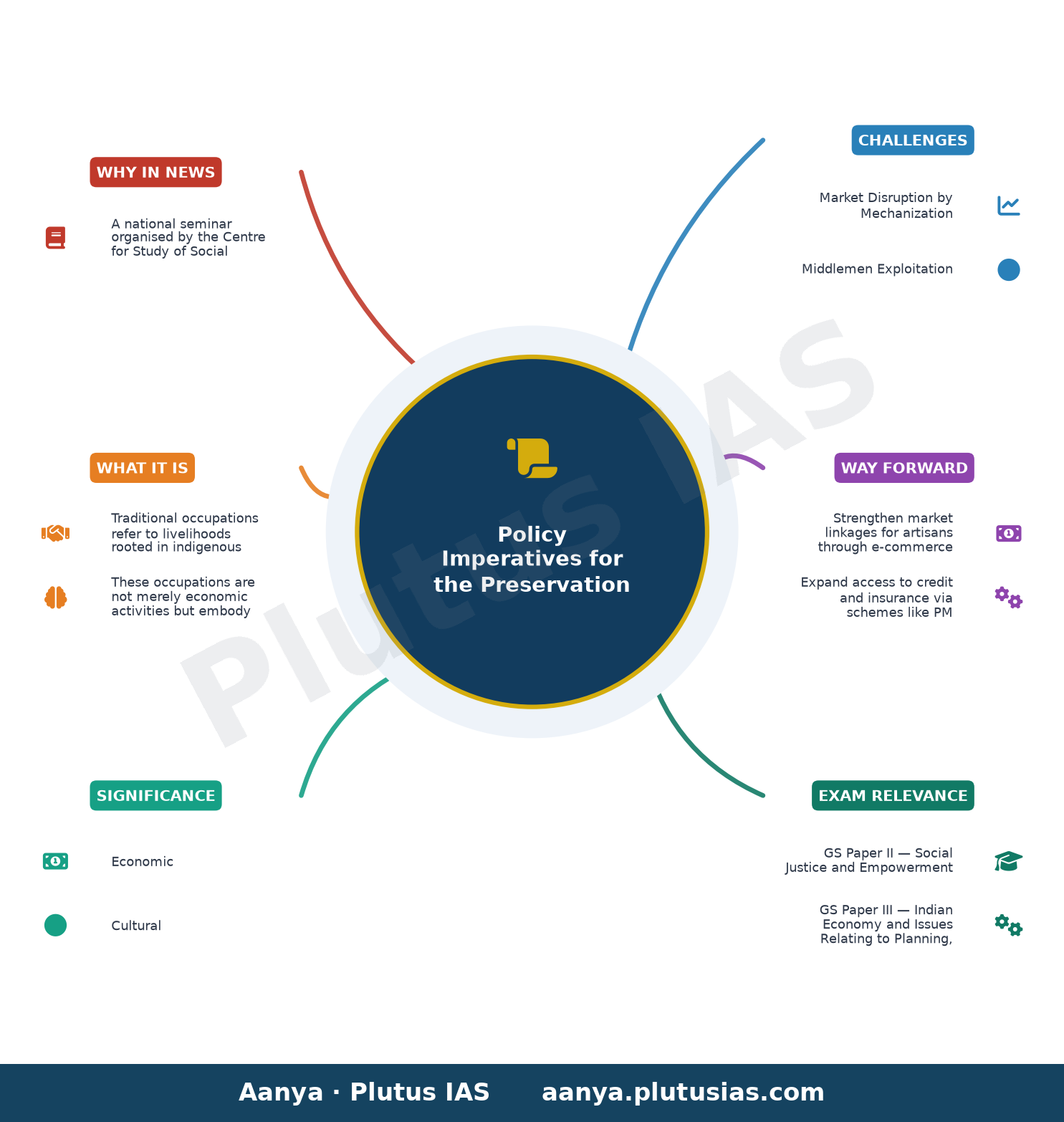
- GS Paper II — Social Justice and Empowerment | GS Paper III — Indian Economy and Issues Relating to Planning, Mobilisation of Resources, Growth, Development and Employment | GS Paper IV — Ethics, Integrity and Aptitude — Human Values
- Prelims: Artisan communities, Constitutional provisions for marginalised groups (Article 46, Article 29, Article 30), MSMEs and traditional industries, GST and customs implications for artisans, Social inclusion and exclusion, Mechanisation and deindustrialisation
- Essay: The erosion of traditional livelihoods in a globalised economy: A paradox of progress, Constitutional morality and the state’s duty to protect cultural heritage
Quick Revision: Traditional occupations in India are protected under constitutional principles of social justice (Article 46) and cultural preservation (Article 29), but their survival requires integrated policy support addressing market access, credit availability, and social inclusion.
Why is this in the news?
A national seminar organised by the Centre for Study of Social Inclusion (CSSI) at Andhra University highlighted the economic precarity of traditional occupational communities, attributing their decline to mechanisation, market distortions, and inadequate policy support. The event underscored the urgency of integrating constitutional safeguards, market reforms, and welfare measures to ensure their social inclusion and sustainable livelihoods.
Background
- Traditional occupations in India encompass a wide array of artisanal, agricultural, and craft-based livelihoods, including handloom weaving, pottery, blacksmithing, and folk arts, which have sustained communities for generations.
- The Indian economy, despite its rapid industrialisation and service-sector growth, continues to rely on traditional sectors for employment, cultural preservation, and rural livelihoods, with over 100 million artisans contributing significantly to GDP.
- Mechanisation, mass production, and globalisation have eroded the market competitiveness of traditional goods, leading to reduced earnings and the abandonment of ancestral professions by younger generations.
- Government schemes such as the National Handloom Development Programme, PM Vishwakarma Yojana, and the Scheme for Promotion of Innovation, Rural Industry and Entrepreneurship (ASPIRE) aim to support artisans, but implementation gaps persist.
- Social exclusion and caste-based discrimination further marginalise traditional occupational communities, limiting their access to credit, markets, and dignified livelihoods.
- The Constitution of India enshrines principles of social justice (Article 46), cultural preservation (Article 29), and non-discrimination (Article 15), providing a legal framework for state intervention in protecting traditional livelihoods.
What are Traditional Occupations and Why Do They Matter?
- Traditional occupations refer to livelihoods rooted in indigenous knowledge, artisanal skills, and cultural practices, often passed down through generations within specific communities.
- These occupations are not merely economic activities but embody India’s intangible cultural heritage, including techniques like Banarasi weaving, Dhokra metal casting, and Warli painting.
- The economic contribution of traditional sectors is substantial, with the handloom sector alone employing over 4.3 million people and contributing approximately ₹36,000 crore to the national economy annually.
- Traditional occupations play a critical role in rural and tribal economies, providing supplementary income and reducing migration pressures, particularly in regions with limited industrial development.
- The decline of these occupations threatens not only livelihoods but also the loss of indigenous knowledge systems, biodiversity conservation (e.g., natural dye techniques), and community cohesion.
- Artisans and traditional workers face structural vulnerabilities, including lack of access to formal credit, inadequate infrastructure, and exploitative middlemen who control pricing and distribution.
- Constitutional provisions such as Article 46 (promotion of educational and economic interests of weaker sections) and Article 29 (protection of cultural and educational rights of minorities) mandate state intervention to safeguard these livelihoods.
Key Features
| Feature | Significance |
|---|---|
| National Seminar on Traditional Occupations | Highlighted systemic challenges faced by traditional occupational communities, emphasizing policy gaps in preserving livelihoods. |
| Economic Stress on Artisans | Nearly 30% of artisans displaced due to mechanization, factory-made products, and irregular incomes, despite welfare measures. |
| Market Access and Middlemen Dependence | Inadequate market access and reliance on middlemen reduce artisans’ earnings, exacerbating economic vulnerability. |
| Social Discrimination | Continued marginalization of traditional communities affects their social inclusion and economic participation. |
| Policy Support and Dignified Livelihoods | Emphasized the role of government in providing occupational freedom and safeguarding traditional occupations. |
Why it Matters
Economic
- Traditional occupations contribute significantly to India’s GDP, particularly in rural and semi-urban economies.
- Preservation of these occupations ensures livelihood security for millions, reducing unemployment in informal sectors.
- Artisan communities act as custodians of indigenous knowledge systems, adding value to cultural heritage and economic diversity.
Cultural
- Traditional occupations are intrinsic to India’s socio-cultural fabric, reflecting regional identities and heritage.
- Loss of these occupations erodes intangible cultural capital, including craftsmanship, oral traditions, and community practices.
- Government intervention can revitalize dying art forms, fostering intergenerational transmission of skills.
Social
- Traditional occupational communities often face social exclusion, necessitating inclusive policies to bridge divides.
- Empowerment through dignified livelihoods can mitigate caste-based occupational discrimination.
- Inclusive development ensures equitable access to resources and opportunities for marginalized groups.
Policy
- Current welfare measures are insufficient without targeted policy support for market access and skill preservation.
- Constitutional provisions (e.g., Article 46) mandate state intervention to protect economically weaker sections.
- Inter-ministerial coordination (e.g., MSME, Culture, Rural Development) is essential for holistic solutions.
Challenges
1. Market Disruption by Mechanization
- Factory-made products and automation reduce demand for handcrafted goods, displacing artisans.
- Lack of access to modern technology limits artisans’ ability to compete in global markets.
- Government must incentivize adoption of hybrid production models (e.g., handloom + digital platforms).
UPSC Link: GS Paper 3: Employment & Industrialization
2. Middlemen Exploitation
- Intermediaries control pricing, distribution, and profits, leaving artisans with minimal earnings.
- Absence of direct market linkages prevents artisans from realizing fair value for their products.
- Policy measures like cooperative societies and e-commerce integration can bypass exploitative chains.
UPSC Link: GS Paper 3: Agricultural & Rural Development
3. Social Discrimination and Stigma
- Caste-based occupational hierarchies persist, limiting upward mobility for traditional artisans.
- Lack of social recognition reduces bargaining power and access to education/skilling programs.
- Awareness campaigns and affirmative action can challenge deep-rooted prejudices.
UPSC Link: GS Paper 1: Indian Society
4. Inadequate Policy Implementation
- Welfare schemes (e.g., PM Vishwakarma, Hunar Haat) suffer from poor outreach and bureaucratic delays.
- Absence of a unified national policy framework for traditional occupations hampers coordination.
- Need for real-time monitoring and grievance redressal mechanisms to ensure accountability.
UPSC Link: GS Paper 2: Governance
5. Irregular Income and Financial Vulnerability
- Seasonal demand and lack of savings push artisans into debt cycles.
- Absence of formal credit access prevents investment in tools, raw materials, or diversification.
- Microfinance and insurance schemes tailored for artisans can mitigate financial risks.
UPSC Link: GS Paper 3: Inclusive Growth
Challenges — UPSC Perspective
| Issue | Concern |
|---|---|
| Mechanization | Displacement of artisans due to factory-made substitutes and automation. |
| Middlemen Dominance | Exploitation through unfair pricing and lack of direct market access. |
| Social Stigma | Perpetuation of caste-based occupational discrimination. |
| Policy Gaps | Inadequate implementation of welfare schemes and absence of a unified framework. |
| Financial Instability | Irregular incomes and lack of credit access leading to debt traps. |
Way Forward
- Strengthen market linkages for artisans through e-commerce platforms (e.g., GeM, Flipkart Samarth) and cooperative societies.
- Expand access to credit and insurance via schemes like PM Vishwakarma and Stand-Up India, with simplified application processes.
- Integrate traditional occupations into school curricula (e.g., NCERT’s ‘Crafts of India’ modules) to foster intergenerational skill transfer.
- Implement skill upgradation programs in collaboration with institutions like NIFT and IITs to blend traditional and modern techniques.
- Enforce minimum support prices (MSP) for handcrafted goods to ensure fair remuneration and reduce middlemen exploitation.
- Launch nationwide awareness campaigns to combat social stigma and promote dignity of labor in traditional occupations.
- Establish a dedicated nodal agency under the Ministry of Micro, Small and Medium Enterprises (MSME) to coordinate policy implementation.
- Incentivize corporate social responsibility (CSR) funding for artisan welfare projects through tax benefits.
UPSC Value Addition
Keywords for Mains Answer-Writing
Traditional occupations · Social inclusion · Inclusive development · Artisan communities · Policy support for livelihoods · Constitutional safeguards for marginalised groups · Economic stress on traditional sectors · Market access for artisans · Middlemen exploitation · Social discrimination against occupational groups · Centre for Study of Social Inclusion (CSSI) · Constitutional provisions for occupational freedom · Dignified livelihoods
Constitutional & Policy Linkages
- {‘Article 46’: ‘Directive Principle mandating state protection for weaker sections.’}
- {‘Article 29(1)’: ‘Cultural and educational rights of minorities, including traditional artisans.’}
- {‘Article 38’: ‘Directive Principle promoting social and economic justice.’}
- {‘Article 47’: ‘Directive Principle to improve public health and prohibit intoxicants, indirectly supporting rural livelihoods.’}
Concept Flow
Mechanization & globalized markets → Reduced demand for handcrafted goods → Displacement of artisans → Economic stress → Policy neglect → Social exclusion. → Middlemen dominance → Exploitation of artisans → Low earnings → Financial vulnerability → Lack of savings → Debt cycles. → Caste-based occupational stigma → Limited access to education/skilling → Perpetuation of marginalization → Reduced bargaining power. → Government welfare schemes → Poor implementation → Inadequate outreach → Continued neglect of traditional occupations. → Policy support (e.g., credit access, market linkages) → Empowerment of artisans → Sustainable livelihoods → Preservation of cultural heritage.
Prelims Practice Questions
Q1. Consider the following statements regarding traditional occupations in India:
1. Nearly 30% of artisans have been pushed out of their traditional occupations due to changing market conditions.
2. Mechanisation and factory-made products have placed traditional occupational communities under severe economic stress.
3. The Centre for Study of Social Inclusion (CSSI) was established under the Ministry of Labour and Employment.
How many of the above statements are correct?
- Only one
- Only two
- All three
- None
Answer: Only two — Statements 1 and 2 are correct as per the report. Statement 3 is incorrect because CSSI is not under the Ministry of Labour and Employment; its institutional affiliation is not specified in the report.
Q2. Assertion (A): The dependence on middlemen has reduced artisans’ earnings significantly.
Reason (R): Middlemen act as intermediaries between artisans and markets, often exploiting the lack of market access.
In the context of the above statements, which of the following is correct?
- Both A and R are true, and R is the correct explanation of A.
- Both A and R are true, but R is not the correct explanation of A.
- A is true, but R is false.
- A is false, but R is true.
Answer: Both A and R are true, and R is the correct explanation of A. — Both A and R are true, and R correctly explains A as middlemen exploit artisans’ limited market access, reducing their earnings.
Q3. Match the following pairs related to constitutional safeguards for traditional communities:
Column I (Constitutional Provision)
A. Article 14
B. Article 15(1)
C. Article 16(2)
D. Article 21
Column II (Safeguard)
1. Prohibition of discrimination on grounds of religion, race, caste, sex, or place of birth
2. Equality before law
3. Prohibition of discrimination in public employment
4. Protection of life and personal liberty
Select the correct match:
- A-2, B-1, C-3, D-4
- A-1, B-2, C-3, D-4
- A-4, B-1, C-2, D-3
- A-2, B-3, C-1, D-4
Answer: A-2, B-1, C-3, D-4 — The correct match is A-2 (Article 14: Equality before law), B-1 (Article 15(1): Prohibition of discrimination), C-3 (Article 16(2): Prohibition in public employment), and D-4 (Article 21: Protection of life and liberty).
Mains Practice Question
✍ Traditional occupations in India face existential threats from market forces, inadequate policy support, and social discrimination. Critically analyse the challenges confronting traditional occupational communities and evaluate the constitutional and policy measures required to preserve their livelihoods and cultural heritage. (15 Marks)
Approach: MODEL-ANSWER SKELETON:
1. **Introduction (2 Marks)**
– Define traditional occupations and their socio-economic significance (e.g., artisans, weavers, potters).
– Cite the report’s statistic: 30% artisans pushed out of occupations due to market changes.
2. **Challenges (5 Marks)**
– **Economic Stress**: Mechanisation, factory-made products, and irregular incomes (as highlighted in the report).
– **Market Access Deficit**: Dependence on middlemen and lack of direct market linkages.
– **Social Discrimination**: Marginalisation of specific communities (e.g., Dalits, tribals) in traditional sectors.
– **Policy Gaps**: Inadequate implementation of welfare measures and lack of targeted support.
3. **Constitutional and Policy Safeguards (5 Marks)**
– **Constitutional Provisions**:
– Article 14 (Equality before law), Article 15(1) (Prohibition of discrimination), Article 16(2) (Equality in public employment), Article 21 (Right to livelihood).
– Directive Principles (Articles 38, 39, 41, 43) promoting welfare and dignified livelihoods.
– **Policy Measures**:
– MGNREGA for alternative employment.
– Skill India Mission (e.g., PMKVY) for upskilling artisans.
– Geographical Indication (GI) tags for traditional products (e.g., Banarasi sarees, Pochampally ikat).
– Direct benefit transfers and minimum support prices for artisans.
4. **Way Forward (3 Marks)**
– Strengthening market linkages through e-commerce platforms (e.g., Government e-Marketplace).
– Legal reforms to curb middlemen exploitation (e.g., Prohibition of Employment as Manual Scavengers Act).
– Institutional support: Role of CSSI and other research bodies in documenting and advocating for traditional communities.
– Community empowerment: Formation of cooperatives and self-help groups.
**Balance of Views**:
– Acknowledge the tension between economic modernisation and cultural preservation.
– Highlight the role of state versus market in addressing these challenges.
Source: The Hindu
Generated by AanyaAi for educational purpose.

- UPSC Civil Services (Main) Examination 2026 — Mechanical Engineering Optional Paper I: Question Paper | Plutus IAS - September 24, 2026
- सुप्रीम कोर्ट ने टीएमसी नाम और चुनाव चिह्न विवाद पर चुनाव आयोग से समयसीमा मांगी, 28 सितंबर को सुनवाई - September 24, 2026
- UPSC Civil Services (Main) Examination 2026 — Chemistry Optional Paper I: Questions with Model Answers | Plutus IAS - September 24, 2026

No Comments