


08 Aug Policy Support Crucial to Save India’s Traditional Occupations: Expert Insights
✎ Traditional occupations in India face existential threats from mechanisation and market distortions, necessitating policy interventions that combine economic support, market access, and social inclusion to ensure their survival…
Subject Relevance — Where This Topic Fits
- GS Paper I — Indian Society: Social Empowerment, Communalism, Regionalism & Secularism | GS Paper III — Issues Relating to Development & Management of Social Sector/Services relating to Health, Education, Human Resources | GS Paper III — Indian Economy and issues relating to Planning, Mobilization of Resources, Growth, Development and Employment
- Prelims: Artisan communities, MSMEs, Constitutional provisions (Article 46, Directive Principles of State Policy), National Handloom Development Programme, Geographical Indications (GI) Tags, Self-Help Groups (SHGs), Middlemen exploitation, Social inclusion
- Essay: The interplay between economic modernity and cultural heritage: Can India afford to lose its traditional crafts?, Inclusive growth: The role of policy in bridging the rural-urban divide
Quick Revision: Traditional occupations in India face existential threats from mechanisation and market distortions, necessitating policy interventions that combine economic support, market access, and social inclusion to ensure their survival and dignity.
Why is this in the news?
A national seminar on ‘Traditional Occupation Communities in a Changing Economy’ highlighted the urgent need for policy interventions to safeguard traditional livelihoods, citing severe economic stress on artisans due to mechanisation, market distortions, and social discrimination. The event underscored the role of government in preserving cultural heritage while ensuring dignified livelihoods for marginalised occupational communities.
Background
- Traditional occupations in India, including handloom weaving, pottery, blacksmithy, and folk arts, have been integral to the socio-cultural fabric and rural economy for centuries.
- The advent of industrialisation and globalisation has led to the marginalisation of artisans, with mechanisation reducing demand for handcrafted goods and factory-made products undercutting traditional markets.
- Government schemes such as the National Handloom Development Programme, PM Vishwakarma Scheme, and Stand-Up India have been launched to support artisans, but implementation gaps persist.
- Social discrimination and exclusion continue to affect certain occupational communities, limiting their access to education, credit, and market opportunities.
- The Constitution of India, through Directive Principles of State Policy (Article 46) and other provisions, mandates the state to promote the educational and economic interests of weaker sections, including traditional occupational groups.
- Geographical Indications (GI) tags have been used to protect traditional products, but enforcement and market penetration remain challenges.
What are Traditional Occupations?
- Traditional occupations refer to livelihood practices rooted in indigenous knowledge, cultural heritage, and local resources, often passed down through generations.
- These include artisanal crafts (e.g., handloom weaving, pottery, metalwork), folk arts (e.g., Madhubani painting, Warli art), and indigenous trades (e.g., fishing, basket-weaving) practiced by specific communities.
- Such occupations are not merely economic activities but embody cultural identity, social cohesion, and intergenerational knowledge transfer.
- Traditional occupations are predominantly located in rural and semi-urban areas, contributing significantly to local economies and employment.
- The decline of these occupations is attributed to factors such as lack of market access, competition from mass-produced goods, inadequate skill upgradation, and financial constraints.
- The informal nature of these occupations often excludes artisans from formal social security nets, exacerbating their vulnerability to economic shocks.
- Preservation of traditional occupations is essential for maintaining biodiversity (e.g., natural dyes in textiles), cultural diversity, and rural livelihoods.
- Global demand for sustainable and ethically produced goods presents an opportunity to revive traditional occupations through niche markets and fair-trade models.
Key Features
| Feature | Significance |
|---|---|
| Mechanisation and factory production | Disrupts traditional markets by reducing demand for handcrafted goods, accelerating displacement of artisans from livelihoods. |
| Inadequate market access | Limits artisans’ ability to sell directly to consumers, forcing dependence on exploitative intermediaries and reducing earnings. |
| Irregular incomes | Creates financial instability for traditional occupational communities, undermining economic security and social well-being. |
| Social discrimination | Perpetuates exclusion of certain artisan communities from equitable economic participation and dignity of labour. |
| Policy support gaps | Lack of targeted interventions exacerbates vulnerabilities, requiring urgent institutional and legislative measures. |
Why it Matters
Economic
- Traditional occupations contribute to India’s GDP through handicrafts, handlooms, and indigenous industries, estimated at over ₹3 lakh crore annually.
- Preservation ensures livelihoods for millions, particularly in rural and tribal regions, reducing migration and urban pressure.
- Handicrafts and handlooms are major export earners, contributing ~2% to India’s total exports, with high growth potential in niche markets.
Cultural
- Traditional occupations are carriers of intangible cultural heritage, including skills, designs, and indigenous knowledge systems passed across generations.
- Safeguarding these occupations preserves India’s diverse cultural identity amid globalisation and homogenisation of production.
- Artisan communities are custodians of regional art forms, ensuring continuity of indigenous aesthetics and craftsmanship.
Social
- Traditional occupations provide dignified livelihoods, fostering community cohesion and reducing social stratification.
- Empowerment of marginalised artisan communities aligns with constitutional ideals of social justice and equality.
- Inclusive development of these sectors can bridge rural-urban divides and promote equitable growth.
Strategic
- Diversification of economic activities through traditional occupations enhances climate resilience in rural economies.
- Reduces dependence on volatile industrial sectors, providing stability in times of economic downturns.
- Promotes sustainable production models, aligning with global commitments to circular economy and sustainable development.
Challenges
1. Market Disruption by Mechanisation
- Factory-produced goods undercut prices of handcrafted items, leading to loss of market share for artisans.
- Reduces demand for skilled labour, pushing artisans into informal or low-wage sectors.
- Accelerates skill erosion as younger generations abandon traditional occupations for mechanised alternatives.
UPSC Link: GS3: Industrial Policy and Employment
2. Dependence on Middlemen and Exploitative Channels
- Middlemen control pricing, supply chains, and market access, leaving artisans with minimal profits.
- Lack of direct market linkages increases vulnerability to price fluctuations and supply chain disruptions.
- Exploitative practices, such as delayed payments and forced bulk sales, perpetuate poverty cycles.
UPSC Link: GS2: Role of Middlemen in Agricultural and Artisan Markets
3. Inadequate Policy Support and Institutional Gaps
- Schemes exist but suffer from poor implementation, lack of awareness, and bureaucratic delays.
- Absence of targeted credit facilities and insurance schemes for artisans increases financial risks.
- Fragmented governance across central, state, and local levels hampers cohesive policy execution.
UPSC Link: GS2: Government Schemes and their Implementation
4. Social Discrimination and Marginalisation
- Historical caste-based discrimination persists, limiting access to resources and opportunities for certain artisan communities.
- Stereotypes and stigma associated with traditional occupations discourage youth from pursuing them.
- Lack of representation in decision-making bodies reinforces exclusion from policy processes.
UPSC Link: GS1: Social Justice and Inclusive Development
5. Technological and Skill Gaps
- Inability to adopt modern tools and digital platforms reduces competitiveness in global markets.
- Declining interest in traditional skills among youth due to lack of incentives and recognition.
- Inadequate vocational training and upskilling programmes fail to bridge the innovation gap.
UPSC Link: GS3: Skill Development and Employment
Challenges — UPSC Perspective
| Issue | Concern |
|---|---|
| Mechanisation | Undermines traditional markets by reducing demand for handcrafted goods. |
| Middlemen dominance | Exploitative pricing and supply chain control reduce artisan earnings. |
| Policy implementation gaps | Poor execution of schemes leaves artisans without adequate support. |
| Social discrimination | Caste-based barriers limit access to resources and opportunities. |
| Technological lag | Inability to modernise reduces competitiveness and market reach. |
| Youth attrition | Lack of incentives drives younger generations away from traditional occupations. |
Government Initiatives — Must-Memorise for Prelims
- Scheme of Fund for Regeneration of Traditional Industries (SFURTI)
- Prime Minister’s Employment Generation Programme (PMEGP)
- Handloom Weaver’s Comprehensive Welfare Scheme
- National Handicrafts Development Programme (NHDP)
Way Forward
- Strengthen implementation of SFURTI and NHDP with enhanced funding and monitoring mechanisms to ensure direct benefits to artisans.
- Establish dedicated e-commerce platforms and digital marketplaces to provide artisans with direct access to national and global consumers.
- Introduce skill upgradation programmes in collaboration with IITs, NITs, and design institutes to modernise traditional techniques without diluting heritage.
- Enforce Minimum Support Price (MSP) mechanisms for key artisan products to stabilise incomes and reduce exploitation by middlemen.
- Expand credit linkages through MUDRA loans and Kisan Credit Cards tailored for artisans, with simplified application processes.
- Launch nationwide awareness campaigns to combat social stigma and promote dignity of traditional occupations among youth.
- Integrate traditional occupations into school curricula to foster pride and continuity of craftsmanship.
- Establish artisan cooperatives with legal and financial autonomy to empower communities in collective bargaining and market negotiations.
UPSC Value Addition
Keywords for Mains Answer-Writing
Traditional occupations · Social inclusion · Inclusive development · Artisan communities · Policy support for livelihoods · Constitutional safeguards · Economic stress on artisans · Market access for traditional crafts · Middlemen exploitation · Dignified livelihoods · Centre for Study of Social Inclusion (CSSI) · Occupational freedom · Social discrimination · Welfare measures for traditional communities · Cultural and economic contributions of traditional occupations
Constitutional & Policy Linkages
- Article 46: Promotion of educational and economic interests of weaker sections.
- Article 29: Protection of interests of minorities in matters of culture.
- Article 47: Duty of the State to raise the level of nutrition and standard of living.
- Seventh Schedule: Concurrent List (Entry 20: Economic and social planning; Entry 24: Industries).
Concept Flow
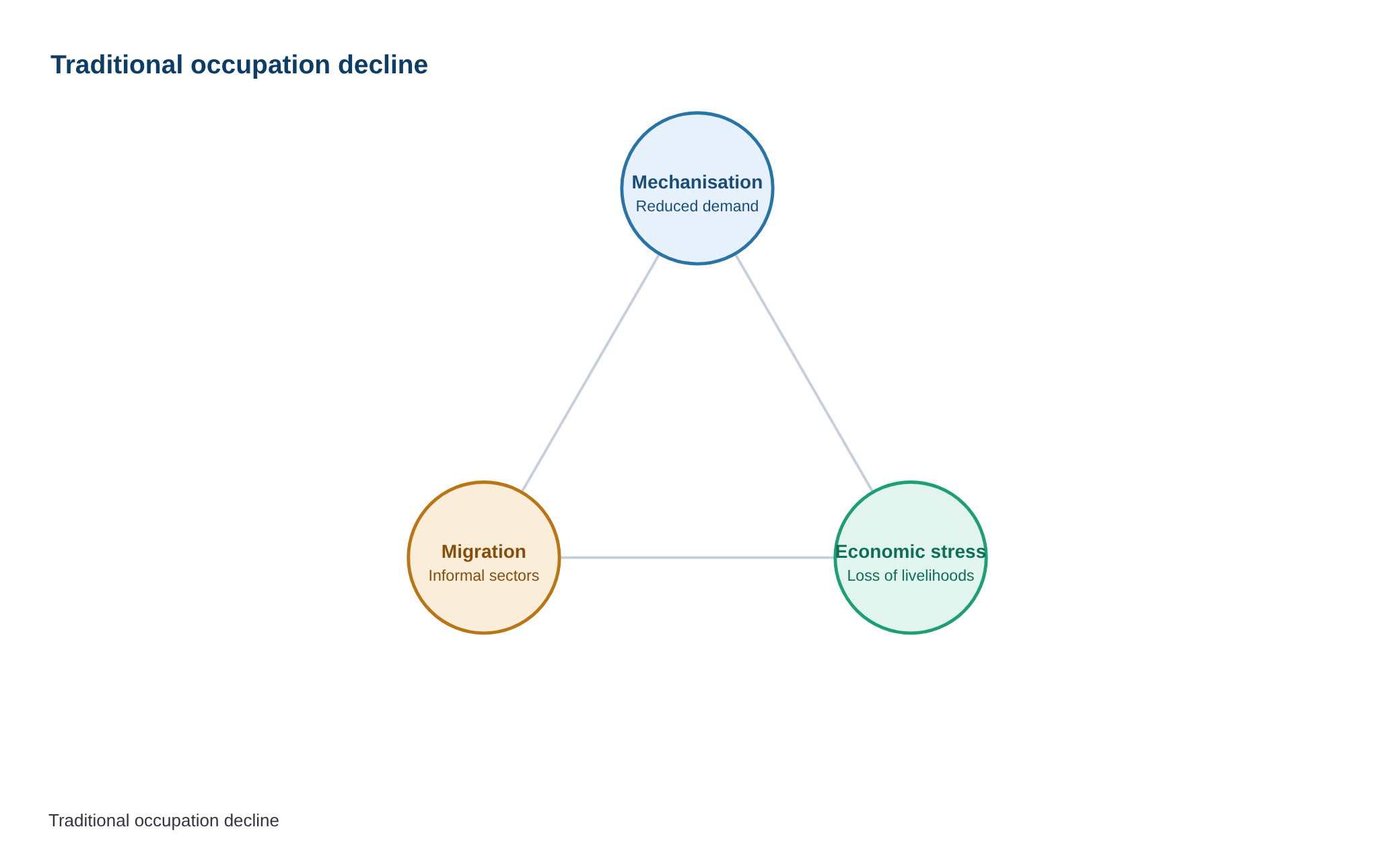
Mechanisation and factory production → Reduced demand for handcrafted goods → Economic stress on artisans → Loss of livelihoods → Migration to informal sectors. → Dependence on middlemen → Exploitative pricing and delayed payments → Reduced earnings → Financial instability → Social exclusion. → Lack of policy support → Inadequate credit and market access → Skill erosion → Youth attrition → Decline of traditional occupations. → Social discrimination → Caste-based barriers → Limited access to resources → Perpetuation of poverty cycles → Marginalisation of communities. → Technological lag → Inability to modernise → Reduced competitiveness → Loss of market share → Decline in exports and earnings. → Policy interventions (e.g., SFURTI, e-commerce) → Enhanced market access and credit → Improved earnings and dignity → Revival of traditional occupations.
Prelims Practice Questions
Q1. Consider the following statements regarding traditional occupations in India:
1. Nearly 30% of artisans have been pushed out of their traditional occupations due to changing market conditions.
2. Inadequate market access and dependence on middlemen have reduced artisans’ earnings.
3. The Centre for Study of Social Inclusion (CSSI) is a statutory body under the Ministry of Social Justice and Empowerment.
How many of the above statements are correct?
- Only one
- Only two
- All three
- None
Answer: Only two — Statements 1 and 2 are correct as per the seminar report. Statement 3 is incorrect; CSSI is not a statutory body but an academic/research centre.
Q2. Assertion (A): Traditional occupations in India face severe economic stress due to mechanisation and factory-made products.
Reason (R): Governments have failed to provide adequate policy support to safeguard these livelihoods.
In the context of the above statements, which of the following is correct?
- Both A and R are true, and R is the correct explanation of A.
- Both A and R are true, but R is not the correct explanation of A.
- A is true, but R is false.
- A is false, but R is true.
Answer: Both A and R are true, but R is not the correct explanation of A. — Both A and R are true, but R is not the sole or correct explanation of A, as other factors like market access and social discrimination also contribute.
Q3. Match the following traditional occupations with their associated challenges:
Column I (Traditional Occupation) | Column II (Associated Challenge)
1. Handloom weaving | A. Dependence on middlemen
2. Pottery | B. Mechanisation and factory-made substitutes
3. Blacksmithing | C. Irregular income and lack of market access
4. Leather tanning | D. Social discrimination and exclusion
Options:
A. 1-A, 2-B, 3-C, 4-D
B. 1-C, 2-A, 3-B, 4-D
C. 1-B, 2-C, 3-D, 4-A
D. 1-D, 2-A, 3-C, 4-B
- A
- B
- C
- D
Answer: B — 1-C (Handloom weavers face irregular income and lack of market access), 2-A (Potters often depend on middlemen), 3-B (Blacksmithing is threatened by mechanisation), 4-D (Leather tanners face social discrimination).
Mains Practice Question
✍ Traditional occupations are not merely economic activities but are vital to India’s cultural heritage and social fabric. Critically examine the challenges faced by traditional occupational communities in contemporary India, with reference to policy gaps and constitutional safeguards. Also, suggest measures to ensure their sustainable preservation and inclusive development. (15 Marks)
Approach: MODEL-ANSWER SKELETON:
1. **Introduction (2 marks)**: Define traditional occupations and their significance (economic, cultural, social) in India. Cite the contribution of traditional communities to GDP and cultural diversity (e.g., handloom sector contributes ~7% to India’s textile output).
2. **Challenges (5 marks)**:
– **Economic Stress**: Mechanisation, factory-made substitutes, and irregular incomes (cite the seminar’s 30% attrition rate among artisans).
– **Market Access**: Dependence on middlemen, lack of direct market linkages (e.g., weavers’ earnings reduced by 40-60% due to middlemen).
– **Social Discrimination**: Marginalisation of communities (e.g., Dalit artisans, tribal craftsmen facing exclusion).
– **Policy Gaps**: Inadequate implementation of schemes like PM Vishwakarma, lack of integration with formal economy.
3. **Constitutional Safeguards (3 marks)**:
– **Article 21**: Right to livelihood and dignified life (Olga Tellis vs. Bombay Municipal Corporation).
– **Article 19(1)(g)**: Right to practice any profession/occupation.
– **Directive Principles (Articles 38, 39, 41)**: State’s duty to promote welfare and protect livelihoods.
– **Constitutional Provisions for SCs/STs**: Reservation in education/employment to uplift artisan communities.
4. **Measures for Sustainable Preservation (5 marks)**:
– **Policy Interventions**: Strengthen PM Vishwakarma Yojana, integrate artisans with e-commerce (e.g., GeM portal), provide skill upgradation.
– **Market Reforms**: Direct procurement by government (e.g., Khadi and Village Industries Commission), elimination of middlemen.
– **Social Inclusion**: Awareness campaigns, reservation in government contracts, legal protection against discrimination.
– **Institutional Support**: Strengthen CSSI and similar bodies for research and advocacy.
– **Global Integration**: Promote GI tags for traditional crafts (e.g., Banarasi silk, Pochampally ikat) to enhance market value.
5. **Conclusion (1 mark)**: Reiterate the need for a multi-dimensional approach balancing economic viability, cultural preservation, and social justice.
Source: The Hindu
Generated by AanyaAi for educational purpose.

- UPSC Civil Services (Main) Examination 2026 — Mechanical Engineering Optional Paper I: Question Paper | Plutus IAS - September 24, 2026
- सुप्रीम कोर्ट ने टीएमसी नाम और चुनाव चिह्न विवाद पर चुनाव आयोग से समयसीमा मांगी, 28 सितंबर को सुनवाई - September 24, 2026
- UPSC Civil Services (Main) Examination 2026 — Chemistry Optional Paper I: Questions with Model Answers | Plutus IAS - September 24, 2026

No Comments