


08 Aug Policy Support Crucial to Save India’s Traditional Occupations: Expert Insights
✎ Traditional occupations in India are at risk due to mechanisation, market disruptions, and weak policy implementation, necessitating urgent institutional reforms to ensure social inclusion and economic sustainability.
Subject Relevance — Where This Topic Fits
- GS Paper II — Governance, Constitution, Polity, Social Justice and International Relations (Social Inclusion, Constitutional Safeguards) | GS Paper III — Economy (Employment, Labour, MSMEs, Informal Sector, Market Access)
- Prelims: Artisan communities, Constitutional provisions for weaker sections, MSMEs and informal sector, Social exclusion and discrimination, Mechanisation and deindustrialisation, Middlemen exploitation, Occupational freedom, Welfare measures for traditional occupations
- Essay: The interplay between economic growth and cultural preservation: Can India afford to lose its traditional occupations?, Inclusive development: The role of policy in bridging the gap between tradition and modernity
Quick Revision: Traditional occupations in India are at risk due to mechanisation, market disruptions, and weak policy implementation, necessitating urgent institutional reforms to ensure social inclusion and economic sustainability.
Why is this in the news?
A national seminar on ‘Traditional Occupation Communities in a Changing Economy’ highlighted the severe economic stress faced by traditional occupational communities due to mechanisation, market disruptions, and inadequate policy support, despite existing welfare measures. The event underscored the urgent need for stronger institutional frameworks to safeguard these livelihoods, which are integral to India’s cultural and economic fabric.
Background
- Traditional occupations in India encompass a wide array of livelihoods, including handloom weaving, pottery, blacksmithing, traditional medicine, and folk arts, which are often community-specific and passed down through generations.
- These occupations contribute significantly to India’s cultural heritage, employment generation (particularly in rural areas), and GDP, especially within the informal sector, which employs over 80% of the workforce.
- Mechanisation, industrialisation, and the proliferation of factory-made goods have eroded the market for traditional products, leading to reduced earnings and the abandonment of these occupations by younger generations.
- Middlemen and lack of direct market access further exacerbate the economic vulnerability of artisans, as they often receive only a fraction of the final product’s value.
- Constitutional provisions such as Directive Principles of State Policy (DPSP) under Articles 38, 39, and 46 mandate the state to promote the welfare of weaker sections, including traditional occupational communities.
- Existing welfare measures have had limited impact due to implementation gaps and lack of convergence.
What are Traditional Occupations and Why Do They Matter?
- Traditional occupations refer to livelihood practices rooted in indigenous knowledge, cultural heritage, and community-specific skills, often practised within the informal sector and transmitted intergenerationally.
- These occupations are not merely economic activities but embody India’s socio-cultural diversity, including artisanal crafts (e.g., Banarasi silk, Dhokra metalwork), indigenous agricultural practices, and folk performing arts.
- They play a critical role in rural employment, particularly for marginalised communities such as Scheduled Castes (SCs), Scheduled Tribes (STs), and Other Backward Classes (OBCs), who often lack access to formal education or capital.
- The informal nature of these occupations makes them vulnerable to exploitation, lack of social security, and inadequate policy protection, despite their contribution to India’s GDP (estimated at 50% of the non-agricultural workforce).
- Traditional occupations are also linked to ecological sustainability, as many practices (e.g., organic farming, handloom weaving) rely on low-energy, resource-efficient methods that align with sustainable development goals.
- The decline of these occupations threatens not only livelihoods but also the loss of intangible cultural heritage, as UNESCO recognises traditional knowledge systems as part of humanity’s shared legacy.
- Governments at central and state levels have implemented various schemes (e.g., PM Vishwakarma Yojana, Stand-Up India), but fragmentation, lack of awareness, and bureaucratic inefficiencies hinder their effectiveness.
- The seminar highlighted the need for a multi-pronged approach, including market linkage programmes, skill upgradation, financial inclusion, and legal safeguards to ensure dignified livelihoods for traditional workers.
Key Features
| Feature | Significance |
|---|---|
| Mechanisation and factory-made products | Disrupts demand for handmade goods, reducing market viability of traditional occupations. |
| Irregular incomes | Undermines financial stability of artisans, discouraging intergenerational transmission of skills. |
| Inadequate market access | Limits artisans’ reach to consumers, increasing dependence on exploitative intermediaries. |
| Social discrimination | Perpetuates exclusion of marginalised communities from equitable economic participation. |
| Policy support gaps | Lack of targeted interventions exacerbates vulnerability of traditional livelihoods to market forces. |
Why it Matters
Economic
- Traditional occupations contribute to GDP through handicrafts, handlooms, and artisanal products, forming a niche yet significant sector.
- Preservation ensures livelihoods for millions, particularly in rural and semi-urban areas, reducing migration pressures.
- Cultural economy thrives when traditional skills are sustained, enhancing India’s soft power and global brand recognition.
Social
- Traditional communities often belong to Scheduled Castes, Scheduled Tribes, and Other Backward Classes, necessitating inclusive development.
- Empowerment of artisans fosters social cohesion and reduces inter-community disparities.
- Skill transmission across generations preserves intangible cultural heritage and community identity.
Cultural
- Handicrafts and indigenous crafts are repositories of regional art, symbolism, and historical continuity.
- Sustainable tourism and cultural diplomacy rely on authentic, locally produced goods.
- Loss of traditional occupations erodes cultural diversity and collective memory.
Challenges
1. Market Disruption by Industrialisation
- Mass production undercuts prices of handmade goods, making traditional occupations economically unsustainable.
- Globalisation exposes artisans to competition from cheaper, machine-made alternatives.
- Lack of branding and marketing support limits artisans’ ability to compete in premium markets.
UPSC Link: GS Paper 3: Industrial Policy and MSMEs
2. Exploitative Intermediary Networks
- Middlemen control pricing, distribution, and access to raw materials, leaving artisans with minimal earnings.
- Credit dependency on intermediaries traps artisans in cycles of debt and exploitation.
- Absence of direct market linkages reduces artisans’ bargaining power.
UPSC Link: GS Paper 1: Marginalisation and Social Justice
3. Skill Erosion and Demographic Shifts
- Youth migration to urban centres for better incomes accelerates intergenerational skill loss.
- Lack of formal training infrastructure discourages new entrants into traditional occupations.
- Aging artisan populations threaten continuity of craftsmanship and innovation.
UPSC Link: GS Paper 3: Human Resource Development
4. Policy Implementation Gaps
- Schemes like PMKVY and SFURTI often suffer from poor outreach and bureaucratic delays.
- Absence of a unified policy framework for traditional occupations leads to fragmented support.
- Monitoring and evaluation mechanisms are weak, reducing accountability of implementing agencies.
UPSC Link: GS Paper 2: Governance and Policy Implementation
5. Social Stigma and Discrimination
- Caste-based occupational hierarchies perpetuate discrimination, limiting access to resources.
- Stereotypes about traditional occupations reduce their perceived value in modern economies.
- Lack of legal protections for artisans exacerbates vulnerability to exploitation.
UPSC Link: GS Paper 1: Social Empowerment and Inclusive Growth
Challenges — UPSC Perspective
| Issue | Concern |
|---|---|
| Price Undercutting | Handmade goods cannot compete with mass-produced alternatives due to higher production costs. |
| Middlemen Exploitation | Artisans receive only 10-30% of the final sale price, with intermediaries capturing the rest. |
| Lack of Market Linkages | Artisans lack access to e-commerce platforms, export markets, and urban consumers. |
| Skill Attrition | Declining interest among youth due to perceived low social status and income instability. |
| Policy Fragmentation | Multiple schemes operate in silos, leading to duplication or neglect of critical areas. |
| Cultural Erosion | Globalisation and urbanisation dilute traditional knowledge systems and craftsmanship. |
Way Forward
- Establish dedicated artisan cooperatives to aggregate production, negotiate fair prices, and access markets directly.
- Expand digital literacy programmes to enable artisans to leverage e-commerce platforms like GeM and Etsy.
- Strengthen the Geographical Indications (GI) registry to protect traditional products and enhance their market value.
- Integrate skill upgradation with formal education, such as through ITIs and polytechnics, to attract youth.
- Implement caste-based reservation in artisan training programmes and financial schemes to address historical marginalisation.
- Create a national database of artisans to streamline scheme implementation and monitor impact.
- Promote public-private partnerships to develop rural craft hubs with infrastructure for production, storage, and marketing.
- Enforce minimum support prices for traditional goods through government procurement, similar to agricultural MSPs.
UPSC Value Addition
Keywords for Mains Answer-Writing
Traditional occupations · Social inclusion · Inclusive development · Artisan communities · Economic stress · Policy support · Constitutional safeguards · Occupational freedom · Dignified livelihoods · Market access · Middlemen exploitation · Social discrimination · Centre for Study of Social Inclusion (CSSI) · Andhra University · Constitutional provisions for marginalised groups
Constitutional & Policy Linkages
- Article 46: Directive Principle promoting educational and economic interests of weaker sections.
- Article 38: Directive Principle of State policy to secure a social order for welfare of people.
Concept Flow
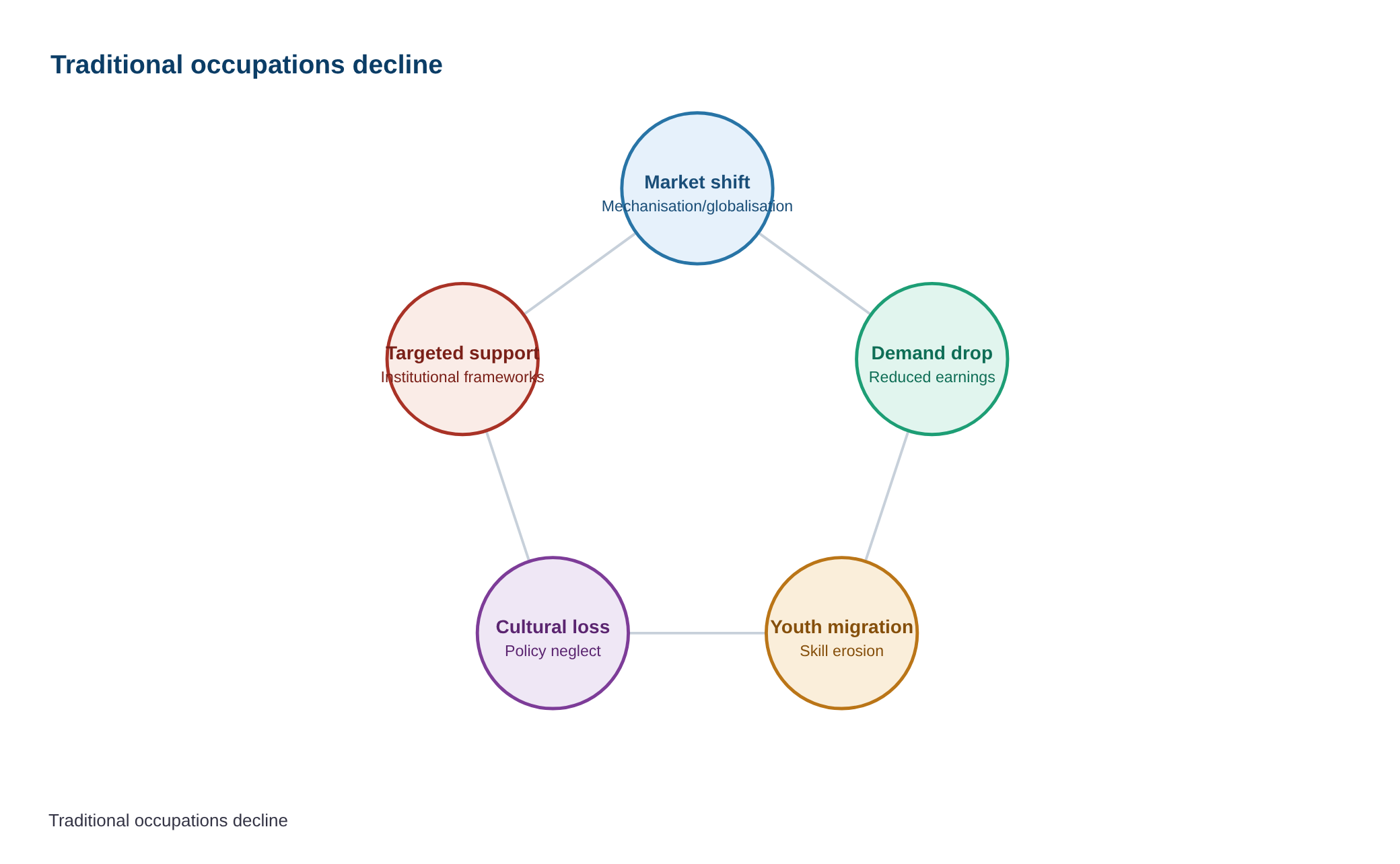
Changing market conditions (mechanisation, globalisation) → Reduced demand for traditional goods → Economic stress on artisans → Skill erosion and youth migration → Loss of cultural heritage → Policy neglect → Need for targeted interventions.
Prelims Practice Questions
Q1. Consider the following statements regarding traditional occupations in India:
1. Nearly 30% of artisans have been pushed out of their traditional occupations due to changing market conditions.
2. Inadequate market access and dependence on middlemen have reduced artisans’ earnings.
3. Social discrimination has no significant impact on traditional occupational communities.
How many of the above statements are correct?
- Only one
- Only two
- All three
- None
Answer: Only two — Statement 1 and 2 are correct as per the report, while statement 3 is incorrect as social discrimination is explicitly mentioned as affecting many communities.
Q2. Assertion (A): The Centre for Study of Social Inclusion (CSSI) at Andhra University organised a national seminar on traditional occupations.
Reason (R): The seminar aimed to address challenges of social inclusion and inclusive development for traditional occupational communities.
Options:
A. Both A and R are true, and R is the correct explanation of A.
B. Both A and R are true, but R is not the correct explanation of A.
C. A is true, but R is false.
D. A is false, but R is true.
Answer: ? — Both the assertion and reason are true, and the reason correctly explains the assertion as the seminar was indeed organised by CSSI to address social inclusion challenges.
Q3. Match the following traditional occupations with their associated challenges:
Column I (Traditional Occupation)
1. Handloom weaving
2. Pottery
3. Blacksmithing
Column II (Associated Challenge)
A. Dependence on middlemen for raw materials
B. Competition from factory-made products
C. Irregular income due to seasonal demand
Options:
A. 1-A, 2-B, 3-C
B. 1-B, 2-A, 3-C
C. 1-C, 2-B, 3-A
D. 1-A, 2-C, 3-B
- A
- B
- C
- D
Answer: B — Handloom weaving faces competition from factory-made products (1-B). Pottery often depends on middlemen for raw materials (2-A). Blacksmithing experiences irregular income due to seasonal demand (3-C).
Mains Practice Question
✍ Traditional occupational communities in India face severe economic stress despite various welfare measures. Critically analyse the role of policy support in preserving these occupations and ensuring social inclusion and dignified livelihoods. (15 Marks)
Approach: MODEL-ANSWER SKELETON:
1. **Introduction**: Define traditional occupations and their socio-economic and cultural significance (cite CSSI Director P. Subba Rao’s remarks).
2. **Challenges**: Mechanisation, factory-made products, irregular incomes, inadequate market access, middlemen exploitation, and social discrimination (use data from the seminar: 30% artisans pushed out).
3. **Policy Gaps**: Analyse existing schemes (e.g., PM Vishwakarma Yojana, Deendayal Antyodaya Yojana) and their limitations (e.g., poor implementation, lack of market linkages).
4. **Constitutional Safeguards**: Discuss Articles 21, 41, and 46; mention K.R. Rama Mohan’s reference to empowerment.
5. **Way Forward**: Suggest policy measures—direct market access, skill upgradation, financial inclusion, and legal protections against discrimination.
6. **Conclusion**: Balance between preservation and modernisation, emphasising dignified livelihoods as a constitutional obligation.
Source: The Hindu
Generated by AanyaAi for educational purpose.

- उत्तराखंड में मतदाता सूची मिलान: डीएसई-पीएसई अभियान शुरू, जानें प्रक्रिया - September 24, 2026
- EC Launches Voter List Verification Drive in Uttarakhand’s 5 Districts - September 24, 2026
- UPSC Civil Services (Main) Examination 2026 — Mechanical Engineering Optional Paper I: Question Paper | Plutus IAS - September 24, 2026

No Comments