


08 Aug Policy Support Crucial to Save India’s Traditional Occupations for UPSC
✎ Traditional occupations in India are at risk due to mechanisation, market distortions, and inadequate policy support, necessitating constitutional safeguards, institutional empowerment, and market integration to ensure their…
Subject Relevance — Where This Topic Fits
- GS Paper II — Governance, Constitution and Social Justice | GS Paper III — Indian Economy and Issues Relating to Planning, Mobilisation of Resources, Growth, Development and Employment
- Prelims: Traditional Knowledge Systems, Artisan Communities, MSMEs, Skill India Mission, Geographical Indications (GI), National Handloom Development Programme, Tribal Cooperative Marketing Development Federation (TRIFED), Mahatma Gandhi National Rural Employment Guarantee Scheme (MGNREGS)
- Essay: The erosion of traditional livelihoods: A critique of India’s development paradigm, Cultural heritage and economic justice: Balancing modernity with tradition
Quick Revision: Traditional occupations in India are at risk due to mechanisation, market distortions, and inadequate policy support, necessitating constitutional safeguards, institutional empowerment, and market integration to ensure their preservation and the dignity of artisans.
Why is this in the news?
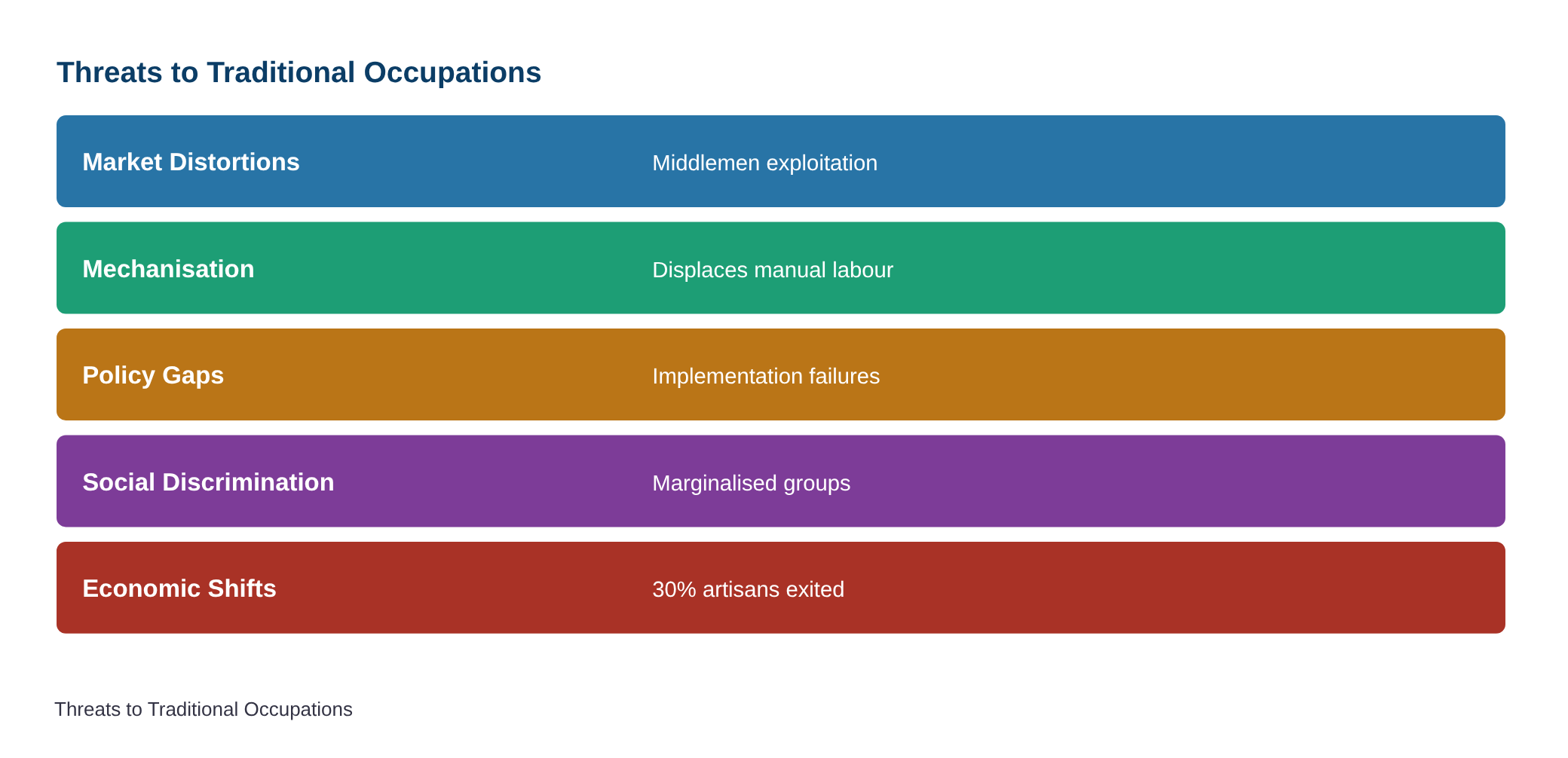
A two-day national seminar on ‘Traditional Occupation Communities in a Changing Economy: Challenges of Social Inclusion and Inclusive Development’ highlighted the critical need for robust policy interventions to preserve India’s traditional occupations, which face existential threats from mechanisation, market distortions, and inadequate institutional support despite existing welfare measures. The event underscored the systemic vulnerabilities of artisan communities, with empirical evidence suggesting that nearly 30% of artisans have exited traditional livelihoods due to shifting economic conditions, thereby necessitating urgent state intervention to ensure social inclusion and economic dignity.
Background
- Traditional occupations in India encompass a diverse array of livelihoods, including handloom weaving, pottery, metalwork, leather craft, and indigenous agricultural practices, which are deeply intertwined with cultural identity and local economies.
- Mechanisation and industrialisation have progressively displaced manual and artisanal labour, reducing the economic viability of traditional crafts and pushing artisans into informal or precarious employment sectors.
- Market access for traditional artisans remains constrained by dependence on middlemen, who often exploit their vulnerability by offering disproportionately low remuneration for finished goods.
- Social discrimination, particularly against marginalised communities such as Scheduled Castes, Scheduled Tribes, and Other Backward Classes, further exacerbates the marginalisation of traditional occupational groups, limiting their socio-economic mobility.
- India’s welfare architecture, while extensive, often suffers from implementation gaps, inadequate targeting, and insufficient integration with market mechanisms, thereby failing to provide sustainable livelihood support to traditional artisans.
- The Constitution of India, through Articles 21 (Right to Life and Personal Liberty), 41 (Right to Work), and 46 (Promotion of Educational and Economic Interests of Weaker Sections), provides a legal framework for the protection and promotion of traditional occupations and marginalised communities.
What are Traditional Occupations?
- Traditional occupations refer to livelihood practices that are rooted in indigenous knowledge systems, cultural heritage, and community-based production methods, often transmitted across generations through apprenticeship or familial training.
- These occupations include, but are not limited to, handloom weaving, pottery, blacksmithing, carpentry, leather tanning, basket weaving, and indigenous agricultural techniques, each of which contributes to India’s rich cultural tapestry and economic diversity.
- Traditional occupations are characterised by their reliance on manual skills, local raw materials, and community-specific techniques, which are often environmentally sustainable and culturally adaptive.
- The preservation of traditional occupations is not merely an economic imperative but also a cultural one, as these livelihoods embody the intangible heritage of communities, including folklore, rituals, and social structures.
- Despite their cultural and economic significance, traditional occupations face existential threats from globalisation, technological disruption, and policy neglect, necessitating proactive measures to ensure their continuity.
- The United Nations Sustainable Development Goals (SDGs), particularly SDG 8 (Decent Work and Economic Growth), SDG 10 (Reduced Inequalities), and SDG 12 (Responsible Consumption and Production), underscore the importance of safeguarding traditional livelihoods for inclusive and sustainable development.
- India’s policy framework for traditional occupations includes initiatives such as the National Handloom Development Programme, Geographical Indications (GI) registration, and the Skill India Mission, which aim to enhance market access, skill development, and institutional support for artisans.
- The erosion of traditional occupations has broader socio-economic implications, including the loss of indigenous knowledge systems, increased rural-urban migration, and the exacerbation of income inequalities within and between communities.
Key Features
| Feature | Significance |
|---|---|
| Mechanisation and factory-made products | Displace artisans by reducing demand for handcrafted goods and increasing production efficiency. |
| Irregular incomes | Undermine financial stability of traditional occupational communities, leading to livelihood insecurity. |
| Inadequate market access | Limit artisans’ ability to sell products directly, forcing reliance on exploitative middlemen. |
| Social discrimination | Perpetuate exclusion of marginalised communities from economic opportunities and dignity. |
| Policy support mechanisms | Essential to provide subsidies, market linkages, and skill preservation to sustain traditional occupations. |
Why it Matters
Economic
- Traditional occupations contribute significantly to India’s GDP through handicrafts, handlooms, and artisanal sectors, which are labour-intensive and generate rural employment.
- Preservation of these sectors ensures inclusive growth by sustaining livelihoods in rural and semi-urban areas, reducing migration to urban centres.
Cultural
- Traditional occupations are repositories of indigenous knowledge, art, and cultural heritage, safeguarding India’s diverse cultural identity.
- They foster intergenerational transmission of skills, maintaining continuity of traditional practices and craftsmanship.
Social
- Empowerment of traditional occupational communities enhances social inclusion, reducing marginalisation and discrimination.
- Dignified livelihoods contribute to community resilience, mental well-being, and social cohesion.
Strategic
- Sustainable traditional occupations reduce dependence on imports for artisanal goods, bolstering self-reliance (Atmanirbhar Bharat).
- They provide a buffer against economic shocks by diversifying livelihood options in vulnerable sectors.
Challenges
1. Market Displacement by Mechanisation
- Factory-made goods often undercut prices of handcrafted products, reducing demand and forcing artisans out of traditional occupations.
- Lack of access to modern technology limits artisans’ ability to compete in quality and scale.
UPSC Link: GS-III: Industrial Policy and MSMEs
2. Exploitative Middlemen and Market Access
- Artisans depend on middlemen for market access, often receiving a fraction of the final sale price due to exploitative pricing.
- Absence of direct market linkages prevents artisans from realising fair remuneration for their work.
UPSC Link: GS-II: Inclusive Growth and Poverty Alleviation
3. Irregular and Inadequate Income
- Seasonal and irregular income flows undermine financial stability, pushing artisans towards debt and poverty.
- Lack of social security nets exacerbates vulnerability to economic shocks.
UPSC Link: GS-II: Welfare Schemes for Vulnerable Sections
4. Social Discrimination and Marginalisation
- Historical social hierarchies and discrimination continue to exclude certain communities from accessing economic opportunities.
- Stigma associated with traditional occupations limits upward mobility and social acceptance.
UPSC Link: GS-II: Social Justice and Empowerment
5. Policy Implementation Gaps
- Despite existing welfare measures, inadequate implementation and lack of awareness among beneficiaries limit their effectiveness.
- Fragmented policy approaches fail to address the holistic needs of traditional occupational communities.
UPSC Link: GS-II: Government Policies and Interventions
Challenges — UPSC Perspective
| Issue | Concern |
|---|---|
| Mechanisation | Reduces demand for handcrafted goods, displacing artisans economically. |
| Middlemen Dominance | Exploits artisans by controlling market access and pricing, reducing earnings. |
| Irregular Income | Leads to financial instability, debt cycles, and poverty among artisans. |
| Social Discrimination | Perpetuates exclusion, limiting access to opportunities and dignity. |
| Policy Gaps | Lack of effective implementation and awareness undermines welfare measures. |
| Skill Erosion | Absence of intergenerational knowledge transfer threatens continuity of traditional occupations. |
Way Forward
- Strengthen direct market linkages for artisans through e-commerce platforms, craft fairs, and cooperative societies to eliminate middlemen exploitation.
- Provide financial literacy and credit access to artisans to mitigate irregular income challenges and reduce debt dependency.
- Implement targeted skill preservation programmes to ensure intergenerational transmission of traditional knowledge and techniques.
- Enhance social security nets, including health insurance and pension schemes, to protect artisans from economic shocks.
- Promote research and development in traditional crafts to improve product quality, design innovation, and market competitiveness.
- Conduct awareness campaigns to educate artisans about existing welfare schemes and their rights under constitutional safeguards.
- Encourage public-private partnerships to invest in infrastructure for traditional occupations, such as common facility centres and training hubs.
UPSC Value Addition
Keywords for Mains Answer-Writing
Traditional occupations · Social inclusion · Inclusive development · Artisan communities · Economic stress on artisans · Welfare measures for traditional occupations · Market access for artisans · Middlemen exploitation · Constitutional safeguards for marginalised communities · Occupational freedom · Dignified livelihoods · Policy support for traditional livelihoods · Social discrimination and economic marginalisation · Centre for Study of Social Inclusion (CSSI) · Andhra University
Constitutional & Policy Linkages
- [‘Article 21: Right to Livelihood’, ‘Guarantees dignified living through sustainable occupations.’]
- [‘Article 19(1)(g): Right to Practice Any Profession’, “Protects artisans’ freedom to engage in traditional occupations.”]
- [‘Article 46: Promotion of Educational and Economic Interests’, ‘Directs state to protect weaker sections, including traditional occupational communities.’]
Concept Flow
Mechanisation and factory production → Reduced demand for handcrafted goods → Economic displacement of artisans → Livelihood insecurity and poverty. → Inadequate market access → Dependence on middlemen → Exploitative pricing → Reduced earnings and financial instability. → Social discrimination → Marginalisation of traditional communities → Limited access to opportunities → Persistent poverty. → Policy gaps and lack of awareness → Ineffective implementation of welfare schemes → Continued vulnerability of artisans. → Irregular incomes → Debt cycles and financial distress → Erosion of traditional skills and knowledge. → Absence of dignified livelihoods → Social stigma and exclusion → Weakening of cultural heritage and community resilience.
Prelims Practice Questions
Q1. Consider the following statements regarding traditional occupations in India:
1. Mechanisation and factory-made products have significantly reduced the economic viability of traditional occupations.
2. Artisan communities face social discrimination but have adequate market access.
3. The Centre for Study of Social Inclusion (CSSI) is actively involved in preserving traditional livelihoods.
4. Constitutional safeguards exist to protect the rights of traditional occupational communities.
How many of the above statements are correct?
- Only one
- Only two
- Only three
- All four
Answer: All four — Statements 1, 3, and 4 are correct. Statement 2 is incorrect as artisans face inadequate market access and dependence on middlemen.
Q2. Assertion (A): The decline of traditional occupations is primarily due to inadequate policy support.
Reason (R): Governments have failed to provide adequate market access and reduce dependence on middlemen for artisans.
Options:
A. Both A and R are true, and R is the correct explanation of A.
B. Both A and R are true, but R is NOT the correct explanation of A.
C. A is true, but R is false.
D. A is false, but R is true.
Answer: ? — Both A and R are true, and R correctly explains A as the lack of market access and middlemen dependence exacerbates the decline of traditional occupations.
Q3. Match the following traditional occupations with their associated challenges:
Column I (Traditional Occupation)
1. Handloom weaving
2. Pottery
3. Blacksmithing
4. Leather tanning
Column II (Challenge)
A. Dependence on middlemen and lack of market access
B. Environmental degradation due to chemical use
C. Competition from power looms and synthetic fibres
D. Decline in demand due to modern alternatives
Options:
A. 1-A, 2-D, 3-C, 4-B
B. 1-C, 2-A, 3-D, 4-B
C. 1-C, 2-D, 3-A, 4-B
D. 1-A, 2-C, 3-D, 4-B
Answer: ? — 1-C (Handloom weaving faces competition from power looms and synthetic fibres), 2-A (Pottery faces dependence on middlemen and lack of market access), 3-D (Blacksmithing faces decline in demand due to modern alternatives), 4-B (Leather tanning faces environmental degradation due to chemical use).
Mains Practice Question
✍ Traditional occupational communities in India are facing severe economic stress despite various welfare measures. Critically analyse the role of policy support in preserving these livelihoods, with reference to constitutional safeguards and market access challenges. (15 Marks)
Approach: MODEL-ANSWER SKELETON:
1. **Introduction (2 marks)**: Define traditional occupations and their socio-economic significance in India. Mention the recent seminar findings (e.g., 30% artisans pushed out of traditional occupations, inadequate market access, dependence on middlemen).
2. **Economic Stress Factors (4 marks)**:
– Mechanisation and factory-made products reducing viability.
– Irregular incomes and lack of social security.
– Exploitation by middlemen and inadequate market access.
– Cite data from the seminar (e.g., 30% artisans displaced).
3. **Constitutional Safeguards (4 marks)**:
– Article 19(1)(g) (right to practice any profession/occupation).
– Directive Principles (Articles 38, 39, 41, 43) on livelihood and social justice.
– Scheduled Castes and Scheduled Tribes (Prevention of Atrocities) Act, 1989 for protection against discrimination.
– Recent judicial interventions (e.g., Right to Livelihood cases).
4. **Policy Support and Gaps (3 marks)**:
– Role of government in providing market access (e.g., e-commerce platforms, GeM portal).
– Welfare schemes (e.g., PM Vishwakarma Yojana, Deendayal Antyodaya Yojana).
– Challenges in implementation (bureaucratic delays, lack of awareness).
5. **Conclusion (2 marks)**: Balanced view—policy support is crucial but must be complemented by structural reforms (e.g., skill upgradation, financial inclusion). Emphasise the need for a multi-stakeholder approach involving government, civil society, and private sector.
Source: The Hindu
Generated by AanyaAi for educational purpose.

- केरल लोक सेवा आयोग ने उच्च न्यायालय में दायर किया मामला, सदस्यों के खिलाफ मामला रद्द करने की मांग - September 23, 2026
- KPSC Challenges Prosecution Sanction in Kerala High Court: Key UPSC Polity Insight - September 23, 2026
- केरल में एंटीमाइक्रोबियल रेजिस्टेंस: सरकारी रिपोर्ट में चौंकाने वाले आँकड़े सामने - September 23, 2026

No Comments