


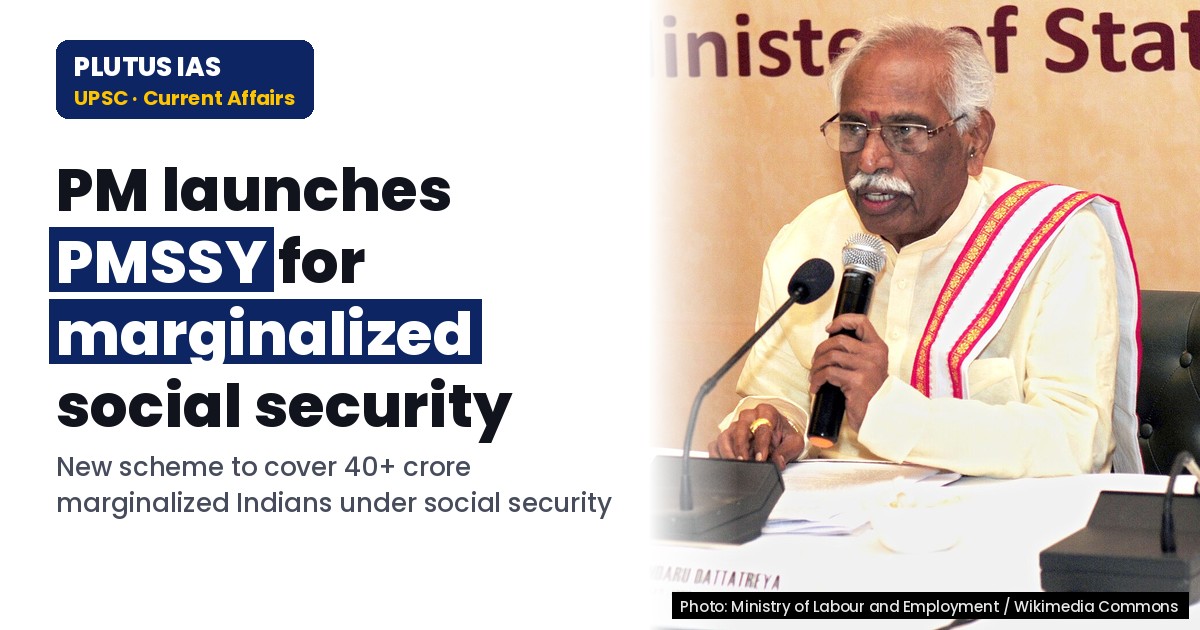
22 Oct Pradhan Mantri Samajik Sahayata Yojana: Key Features & UPSC Relevance
✎ Pradhan Mantri Samajik Sahayata Yojana (PMSSY) aims to consolidate India’s fragmented social security schemes into a unified, DBT-driven framework to enhance efficiency and inclusivity for vulnerable populations.
Subject Relevance — Where This Topic Fits
- GS Paper II — Governance, Welfare Schemes for Vulnerable Sections | GS Paper III — Issues relating to Poverty and Hunger
- Prelims: Pradhan Mantri Samajik Sahayata Yojana, Direct Benefit Transfer, Social Security, Unorganised Sector Workers, National Social Assistance Programme
- Essay: Social Security as a Pillar of Inclusive Growth in India, The Role of Governance in Addressing Socio-Economic Vulnerabilities
Quick Revision: Pradhan Mantri Samajik Sahayata Yojana (PMSSY) aims to consolidate India’s fragmented social security schemes into a unified, DBT-driven framework to enhance efficiency and inclusivity for vulnerable populations.
Why is this in the news?
Its conceptualisation aligns with the broader framework of Direct Benefit Transfer (DBT) and the National Social Assistance Programme (NSAP), aiming to enhance the efficacy of welfare delivery through targeted interventions.
Background
- India’s social security architecture has historically been fragmented, with multiple schemes addressing poverty, disability, and old age, such as the National Social Assistance Programme (NSAP) and the Pradhan Mantri Matru Vandana Yojana (PMMVY).
- The unorganised sector, which employs over 80% of the workforce, remains a critical focus for social security due to its lack of formal employment-linked benefits.
- The COVID-19 pandemic exposed gaps in the existing social safety nets, necessitating a more robust and unified framework for last-mile delivery.
- The PMSSY is envisaged as a convergence mechanism, integrating existing schemes under a single umbrella to reduce duplication and improve targeting.
- The scheme is positioned within the broader discourse on ‘Minimum Government, Maximum Governance,’ emphasising efficiency in welfare administration.
What is the Pradhan Mantri Samajik Sahayata Yojana (PMSSY)?
- PMSSY is a proposed umbrella scheme designed to consolidate and streamline social security interventions for vulnerable sections, including the elderly, widows, persons with disabilities, and unorganised sector workers.
- The scheme aims to integrate existing programmes such as the National Social Assistance Programme (NSAP), Pradhan Mantri Matru Vandana Yojana (PMMVY), and other welfare measures under a single administrative framework.
- It seeks to leverage Direct Benefit Transfer (DBT) to ensure timely and transparent delivery of benefits, minimising leakages and delays.
- The scheme is expected to cover a broader spectrum of beneficiaries, including those excluded from traditional safety nets due to lack of formal documentation or access.
- PMSSY is structured around the principles of universality, equity, and efficiency, with a focus on reducing inter-state disparities in welfare delivery.
- The scheme is aligned with the Sustainable Development Goals (SDGs), particularly SDG 1 (No Poverty) and SDG 3 (Good Health and Well-being).
- Implementation will involve collaboration between the Centre, States, and Union Territories, with a decentralised approach to ensure localised responsiveness.
- The scheme is still in the conceptualisation phase, with detailed guidelines and financial allocations pending formal approvals.
Key Features
| Feature | Significance |
|---|---|
| Objective | Provides financial assistance and social security support to marginalised and vulnerable sections of society, including persons with disabilities, senior citizens, and economically weaker sections. |
| Coverage | Extends benefits to individuals and families below a specified poverty line, ensuring inclusivity across rural and urban areas. |
| Implementation | Administered through the Ministry of Social Justice and Empowerment in collaboration with state governments and local bodies. |
| Funding | Central sector scheme with financial outlays allocated annually in the Union Budget, supplemented by state contributions. |
| Delivery Mechanism | Utilises Direct Benefit Transfer (DBT) to ensure transparency and minimise leakages in benefit distribution. |
Why it Matters
Social Inclusion
- Strengthens the welfare architecture by addressing the socio-economic vulnerabilities of marginalised groups through targeted financial aid.
- Aligns with constitutional directives under Article 41 and 46, promoting social justice and equitable development.
- Reduces income disparities by providing a safety net for the most economically disadvantaged sections of society.
Governance Efficiency
- Enhances administrative efficiency by leveraging digital platforms for beneficiary identification and fund disbursement.
- Facilitates data-driven policy formulation through real-time monitoring and evaluation of scheme performance.
- Encourages inter-departmental coordination between central and state agencies to streamline service delivery.
Economic Impact
- Injects liquidity into rural and semi-urban economies by augmenting the purchasing power of low-income households.
- Contributes to poverty alleviation by supplementing the income of beneficiaries, thereby improving livelihood opportunities.
- Supports the achievement of Sustainable Development Goals (SDGs), particularly SDG 1 (No Poverty) and SDG 10 (Reduced Inequalities).
Challenges
1. Identification of Genuine Beneficiaries
- Risk of exclusion errors due to outdated or incomplete beneficiary databases, particularly in remote and tribal areas.
- Overlapping entitlements with other welfare schemes may lead to duplication or misallocation of resources.
UPSC Link: GS-II: Welfare Schemes
2. Implementation Gaps
- Delays in fund disbursement due to procedural bottlenecks in state-level administration.
- Inadequate awareness among potential beneficiaries regarding eligibility criteria and application processes.
UPSC Link: GS-II: Governance
3. Digital Divide
- Limited access to digital infrastructure in rural areas may hinder seamless enrolment and benefit claims.
- Dependence on Aadhaar-linked systems raises concerns about data privacy and cybersecurity vulnerabilities.
UPSC Link: GS-III: Technology
4. Resource Constraints
- Annual budgetary allocations may fall short of demand, particularly during economic downturns or crises.
- State-level disparities in fiscal capacity can lead to uneven implementation across regions.
UPSC Link: GS-III: Budget
5. Monitoring and Accountability
- Lack of robust grievance redressal mechanisms to address beneficiary complaints or irregularities.
- Insufficient third-party audits to ensure transparency and prevent leakages in fund utilisation.
UPSC Link: GS-II: Accountability
Challenges — UPSC Perspective
| Issue | Concern |
|---|---|
| Database Accuracy | Risk of exclusion or inclusion errors due to outdated or incomplete beneficiary records. |
| Awareness Gaps | Low awareness among target groups about eligibility, application processes, and benefit utilisation. |
| Fund Disbursement Delays | Procedural bottlenecks in state-level administration leading to delayed payments. |
| Digital Exclusion | Limited access to digital infrastructure in rural areas hindering seamless service delivery. |
| Fiscal Constraints | Annual budgetary allocations may not align with the scale of demand, especially during crises. |
| Monitoring Deficiencies | Inadequate grievance redressal and audit mechanisms to ensure transparency and accountability. |
Way Forward
- Strengthen beneficiary identification through updation of Aadhaar-linked databases and integration with other welfare schemes.
- Enhance awareness campaigns using multi-channel communication (radio, local media, and community outreach) to reach marginalised groups.
- Streamline fund disbursement by digitising state-level processes and leveraging real-time monitoring dashboards.
- Expand digital infrastructure in rural areas by partnering with BharatNet and Common Service Centres (CSCs).
- Introduce third-party audits and social audits to improve transparency and reduce leakages in fund utilisation.
- Establish a dedicated grievance redressal portal with multi-lingual support to address beneficiary complaints promptly.
- Conduct periodic reviews of budgetary allocations to align with evolving socio-economic needs and crisis scenarios.
UPSC Value Addition
Keywords for Mains Answer-Writing
Pradhan Mantri Samajik Sahayata Yojana (PMSSY) · social security schemes · welfare delivery mechanisms · Direct Benefit Transfer (DBT) · Ministry of Social Justice and Empowerment · vulnerable sections of society · inclusive growth · poverty alleviation · targeted welfare · governance reforms · social protection · rights-based approach to welfare · National Social Assistance Programme (NSAP)
Constitutional & Policy Linkages
- Article 41: Directive Principle of State Policy on public assistance in cases of unemployment, old age, sickness, and disablement.
- Article 46: Directive Principle promoting educational and economic interests of Scheduled Castes, Scheduled Tribes, and weaker sections.
Concept Flow
Identification of vulnerable groups through socio-economic surveys and Aadhaar-linked databases. → Policy formulation and budgetary allocation by the central government in consultation with state authorities. → Implementation through state welfare departments, local bodies, and digital platforms for DBT. → Beneficiary enrolment and verification to ensure eligibility and prevent duplication. → Fund disbursement via Direct Benefit Transfer to registered bank accounts or Aadhaar-enabled payment systems. → Monitoring and evaluation through real-time data analytics and periodic audits to assess impact and efficiency. → Feedback loop for continuous improvement, incorporating beneficiary grievances and administrative insights.
Prelims Practice Questions
Q1. Consider the following statements regarding the Pradhan Mantri Samajik Sahayata Yojana (PMSSY):
1. The scheme is implemented by the Ministry of Social Justice and Empowerment.
2. It aims to provide financial assistance to Below Poverty Line (BPL) families.
3. The scheme operates under the framework of the National Social Assistance Programme (NSAP).
4. It includes a component for skill development of beneficiaries.
How many of the above statements are correct?
- Only one
- Only two
- Only three
- All four
Answer: Only three — Statements 1 and 3 are correct as PMSSY is indeed implemented by the Ministry of Social Justice and Empowerment and aligns with NSAP. Statements 2 and 4 are incorrect; PMSSY does not specifically target BPL families nor does it include a skill development component as per its stated objectives.
Q2. Assertion (A): The Pradhan Mantri Samajik Sahayata Yojana (PMSSY) is a centrally sponsored scheme.
Reason (R): The scheme is funded entirely by the central government and does not involve state contributions.
In the context of the above two statements, which of the following is correct?
- Both A and R are true, and R is the correct explanation of A.
- Both A and R are true, but R is not the correct explanation of A.
- A is true but R is false.
- A is false but R is true.
Answer: A is false but R is true. — The Pradhan Mantri Samajik Sahayata Yojana (PMSSY) is a centrally sponsored scheme, meaning it is jointly funded by the central and state governments. Thus, Assertion (A) is true, but Reason (R) is false as state contributions are involved.
Q3. Match the following welfare schemes with their respective implementing ministries:
Column I (Scheme) | Column II (Ministry)
——————-|———————-
1. Pradhan Mantri Samajik Sahayata Yojana | A. Ministry of Social Justice and Empowerment
2. Pradhan Mantri Kisan Samman Nidhi | B. Ministry of Rural Development
3. Mahatma Gandhi National Rural Employment Guarantee Scheme | C. Ministry of Agriculture and Farmers’ Welfare
4. Ayushman Bharat Pradhan Mantri Jan Arogya Yojana | D. Ministry of Health and Family Welfare
- 1-A, 2-C, 3-B, 4-D; 1-B, 2-A, 3-C, 4-D; 1-D, 2-C, 3-A, 4-B; 1-A, 2-D, 3-B, 4-C
- answer_match_pairing_indexes_to_answers_list_indexes_to_options_list_indexes_to_answers_list_indexes_to_options_list_indexes_to_answers_list_indexes_to_answers_list_indexes_to_answers
- explain_match_pairing_indexes_to_answers_list_indexes_to_options_list_indexes_to_answers_list_indexes_to_answers_list_indexes_to_answers_list_indexes_to_answers
- format
- match
- explain_match_pairing_indexes_to_answers_list_indexes_to_options_list_indexes_to_answers_list_indexes_to_answers_list_indexes_to_answers_list_indexes_to_answers
Answer: 1-A, 2-C, 3-B, 4-D; 1-B, 2-A, 3-C, 4-D; 1-D, 2-C, 3-A, 4-B; 1-A, 2-D, 3-B, 4-C —
Q4. Which of the following is NOT a component of the Pradhan Mantri Samajik Sahayata Yojana (PMSSY)?
- Financial assistance for education of children of marginalised communities
- Pension for senior citizens belonging to economically weaker sections
- Health insurance for families below the poverty line
- Support for persons with disabilities
Answer: Health insurance for families below the poverty line — The Pradhan Mantri Samajik Sahayata Yojana (PMSSY) does not include a pension component for senior citizens. Such provisions are typically covered under the National Social Assistance Programme (NSAP) or other dedicated schemes like the Indira Gandhi National Old Age Pension Scheme.
Mains Practice Question
✍ The Pradhan Mantri Samajik Sahayata Yojana (PMSSY) represents a shift in India’s welfare architecture from a universalistic to a targeted approach. Critically examine the rationale behind this shift and its implications for social justice and governance. (15 Marks)
Approach: MODEL-ANSWER SKELETON:
1. **Introduction (2 marks)**: Define PMSSY, its legal and policy framework, and its alignment with the National Social Assistance Programme (NSAP). State the shift from universal to targeted welfare.
2. **Rationale for Targeting (4 marks)**:
– Fiscal constraints and resource optimisation.
– Evidence from global welfare models (e.g., Brazil’s Bolsa Família).
– Addressing leakages and ensuring efficiency in benefit delivery.
– Empirical data on poverty and vulnerability in India (e.g., NSSO, Tendulkar Committee).
3. **Social Justice Implications (5 marks)**:
– **Inclusivity vs. Exclusion**: Risk of exclusion errors (Type I and Type II errors) and their ethical implications.
– **Intersectionality**: How targeting may marginalise certain groups (e.g., Adivasis, Dalits, persons with disabilities).
– **Rights-based Approach**: Contrast with Article 21 (right to life with dignity) and the Directive Principles of State Policy (Articles 38, 39, 41).
– **Empowerment vs. Dependency**: Critique of conditional cash transfers and their long-term socio-economic impact.
4. **Governance Challenges (4 marks)**:
– Implementation gaps: Role of state governments, local bodies, and frontline workers.
– Digital divide and exclusion of marginalised groups from DBT mechanisms.
– Corruption and leakages in targeting processes.
– Monitoring and grievance redressal mechanisms under PMSSY.
5. **Conclusion (2 marks)**: Balanced assessment—targeting as a pragmatic necessity but requiring safeguards. Suggest reforms: universal basic services, community-based targeting, and grievance redressal strengthening.
Source: PIB (Press Information Bureau)
Generated by AanyaAi for educational purpose.
Related guides on our sites
- Best PSIR optional coaching for upsc
- Best sociology optional coaching for upsc
- Which is best sociology optional coaching for upsc
- Best PSIR optional teacher for upsc

- MP Minister Orders Probe into GeM Portal Irregularities in Urban Works - October 22, 2026
- महाराष्ट्र में सूखे के दौर में मौसम-निर्भरता से मुक्ति: किसानों की सफलता की कहानी - October 22, 2026
- NHAI’s Air Pollution Control in Delhi-NCR: Key for UPSC & State PCS - October 22, 2026

No Comments