


11 Aug Premature Redemption of SGB 2018-19 Series VI: Key Details for UPSC Aspirants
✎ Premature redemption of Sovereign Gold Bonds is permitted after five years from the issue date, with the redemption price calculated as the simple average of the IBJA’s 999 purity gold closing prices for the three preceding…
Subject Relevance — Where This Topic Fits
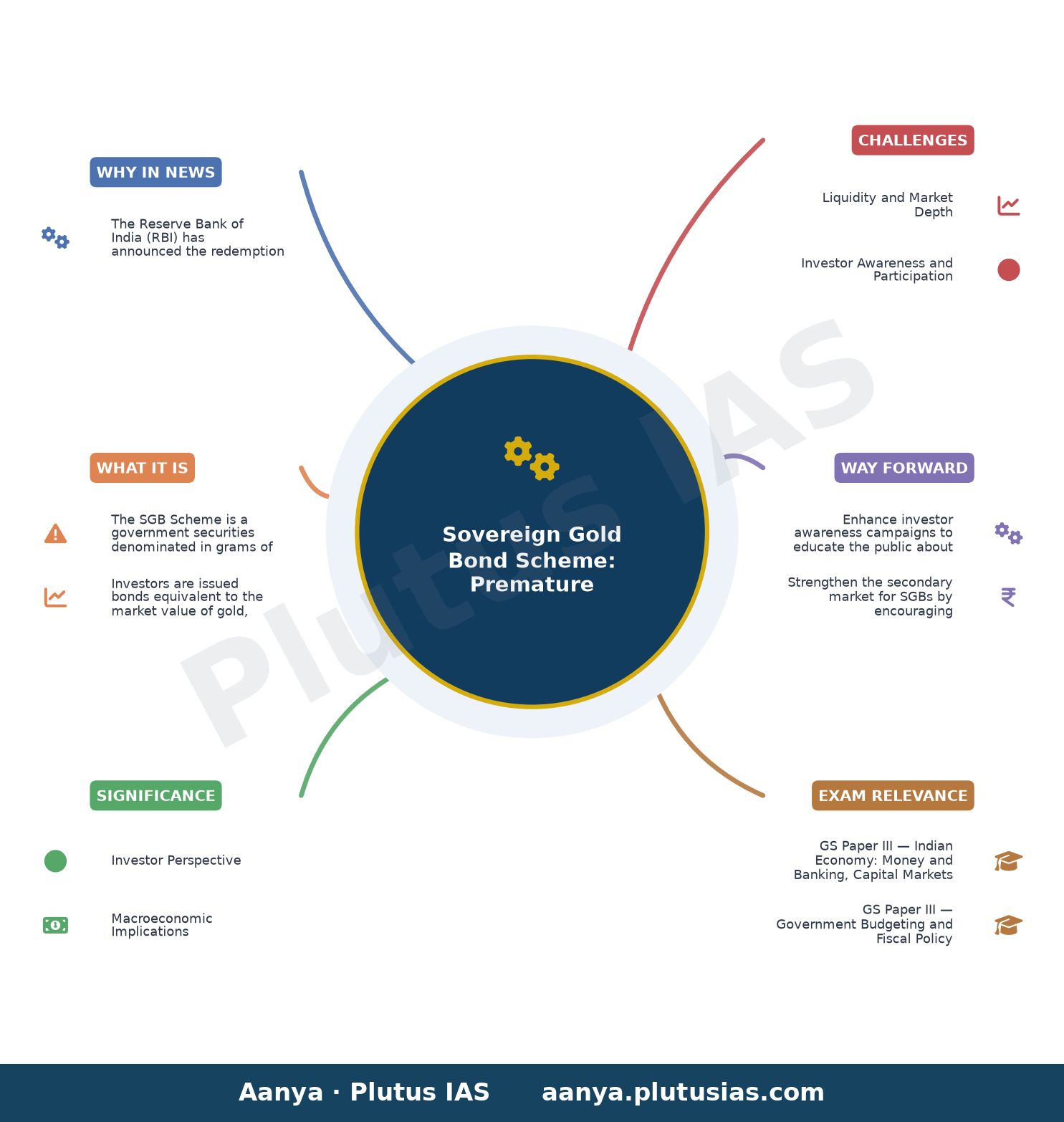
- GS Paper III — Indian Economy: Money and Banking, Capital Markets | GS Paper III — Government Budgeting and Fiscal Policy
- Prelims: Sovereign Gold Bond (SGB), premature redemption, IBJA gold price, RBI, GOI notification F.No.4(22)-B(W&M)/2018, 999 purity gold, simple average pricing, SEBI (Investment Advisers) Regulations, 2013 (for investment advisers), Financial Stability and Development Council (FSDC)
- Essay: Role of gold in India’s financial system and macroeconomic stability, Government’s strategy for reducing physical gold imports and promoting financial savings
Quick Revision: Premature redemption of Sovereign Gold Bonds is permitted after five years from the issue date, with the redemption price calculated as the simple average of the IBJA’s 999 purity gold closing prices for the three preceding business days.
Why is this in the news?
The Reserve Bank of India (RBI) has announced the redemption price of ₹15,102 per unit for the premature redemption of Sovereign Gold Bond (SGB) 2018-19 Series VI, scheduled for August 12, 2026. This announcement highlights the operational mechanism of premature redemption under the SGB scheme, including the pricing methodology based on the India Bullion and Jewellers Association Ltd (IBJA) gold price benchmark.
Background
- The Sovereign Gold Bond (SGB) Scheme was launched in 2015 by the Government of India (GOI) in collaboration with the RBI to reduce the demand for physical gold and shift savings towards financial assets.
- The scheme offers an alternative to holding physical gold, providing investors with a sovereign-backed instrument that earns interest and is denominated in grams of gold.
- Premature redemption of SGBs is permitted after the completion of the fifth year from the date of issue, subject to the terms specified in the GOI notification dated October 8, 2018.
- The SGB scheme is part of broader efforts to promote financial inclusion and reduce the country’s reliance on gold imports, which impact the current account deficit.
- The pricing of SGBs, including redemption, is linked to the market price of gold to ensure transparency and fairness for investors.
- The RBI acts as the implementing agency for the SGB scheme, while the GOI guarantees the principal and interest payments.
What is the Sovereign Gold Bond (SGB) Scheme?
- The SGB Scheme is a government securities denominated in grams of gold, issued by the RBI on behalf of the GOI, aimed at reducing physical gold demand and promoting financial savings.
- Investors are issued bonds equivalent to the market value of gold, with the denomination typically ranging from 1 gram to 4 kg per individual.
- The bonds carry a fixed annual interest rate of 2.5% (as per the latest GOI notifications), payable semi-annually, and are redeemable at maturity or prematurely under specified conditions.
- Premature redemption is allowed after the fifth year from the date of issue, subject to the terms of the GOI notification and RBI guidelines.
- The redemption price is determined based on the simple average of the closing price of 999 purity gold for the three business days preceding the redemption date, as published by the India Bullion and Jewellers Association Ltd (IBJA).
- The scheme is open to resident individuals, Hindu Undivided Families (HUFs), trusts, universities, and charitable institutions, with a maximum subscription limit of 4 kg per individual and 20 kg per entity per fiscal year.
- The bonds are listed on stock exchanges, providing liquidity to investors who wish to exit before maturity.
- The GOI guarantees the repayment of principal and interest, making SGBs a low-risk investment compared to physical gold or other gold-based financial instruments.
Key Features
| Feature | Significance |
|---|---|
| Premature Redemption Eligibility | Permits redemption after the fifth year from the issue date, providing liquidity flexibility to investors while maintaining the long-term nature of the instrument. |
| Redemption Price Calculation | Determined by the simple average of the closing price of 999 purity gold over the three business days preceding redemption, ensuring transparency and market-linked valuation. |
| Issue Date and Maturity | Series VI of SGB 2018-19 was issued on February 12, 2019, with premature redemption due on August 12, 2026, marking the first eligible redemption window. |
| Government Notification Basis | Premature redemption is permitted under GOI notification F.No.4(22)-B(W&M)/2018 dated October 08, 2018, which governs the operational framework of the SGB Scheme. |
| Price Benchmarking | Uses the India Bullion and Jewellers Association Ltd (IBJA) gold price benchmark, a widely accepted standard in India’s bullion market, ensuring credibility and consistency. |
Why it Matters
Investor Perspective
- Provides an exit option for investors requiring liquidity before the maturity period of 8 years, enhancing the attractiveness of SGBs as an investment instrument.
- Offers a market-linked redemption price, protecting investors from arbitrary valuation while ensuring fair compensation.
- Encourages participation in SGBs by addressing liquidity concerns, particularly for retail investors who may face unforeseen financial needs.
Macroeconomic Implications
- Reduces the burden on foreign exchange reserves by substituting gold imports with domestically issued gold bonds, aligning with India’s balance of payments management.
- Promotes financial savings by offering a sovereign-backed alternative to physical gold, contributing to the formalisation of the gold economy.
- Supports the government’s objective of reducing the current account deficit by curbing gold imports through increased subscription to SGBs.
Monetary Policy and RBI Role
- Demonstrates the RBI’s role in administering the SGB Scheme, ensuring adherence to the framework and maintaining investor confidence in sovereign instruments.
- Facilitates the transmission of gold price signals to the financial system, as redemption prices are directly linked to market benchmarks.
- Supports the RBI’s objective of diversifying the sources of gold demand, reducing reliance on physical imports and enhancing price discovery.
Fiscal Policy and Government Objectives
- Aligns with the government’s strategy to mobilise resources for public expenditure by offering a non-taxable, interest-bearing gold-linked instrument.
- Contributes to the reduction of the fiscal deficit by substituting costly external borrowings with domestic resource mobilisation through SGBs.
- Supports the ‘Make in India’ initiative indirectly by promoting domestic investment in gold, reducing the need for imports.
Challenges
1. Liquidity and Market Depth
- Limited secondary market liquidity for SGBs may pose challenges for investors seeking to exit before maturity, despite the premature redemption option.
- The redemption price is subject to gold price volatility, which may result in lower-than-expected returns for investors redeeming during periods of price decline.
UPSC Link: Economic Survey: Gold Market Dynamics
2. Investor Awareness and Participation
- Low awareness among retail investors about the premature redemption facility and its operational details may lead to underutilisation of the option.
- Complexity in understanding the redemption price calculation mechanism could deter small investors from participating in SGBs.
UPSC Link: SEBI Investor Education Initiatives
3. Regulatory and Operational Risks
- Ensuring timely and accurate calculation of the redemption price based on IBJA benchmarks requires robust data infrastructure and regulatory oversight.
- Potential delays or discrepancies in the redemption process could erode investor trust in sovereign instruments.
UPSC Link: RBI Payment and Settlement Systems
Challenges — UPSC Perspective
| Issue | Concern |
|---|---|
| Secondary Market Liquidity | Limited trading volumes may restrict investor exit options despite premature redemption eligibility. |
| Price Volatility Impact | Gold price fluctuations can lead to suboptimal redemption values for investors redeeming during downturns. |
| Investor Awareness Gaps | Lack of understanding about redemption mechanics may deter participation in SGBs. |
| Operational Delays | Potential bottlenecks in processing premature redemptions could affect investor confidence. |
| Benchmark Reliability | Dependence on IBJA prices introduces sensitivity to data accuracy and market manipulation risks. |
Government Initiatives — Must-Memorise for Prelims
- Sovereign Gold Bond (SGB) Scheme
Way Forward
- Enhance investor awareness campaigns to educate the public about the premature redemption facility and its operational details.
- Strengthen the secondary market for SGBs by encouraging participation from institutional investors and market makers.
- Improve data transparency and timeliness in the calculation and dissemination of redemption prices based on IBJA benchmarks.
- Conduct periodic reviews of the SGB Scheme to assess its effectiveness in achieving macroeconomic objectives, including gold import substitution.
- Explore the introduction of digital platforms for seamless redemption processes, reducing operational bottlenecks.
- Collaborate with financial literacy initiatives to simplify the understanding of SGB features, particularly for retail investors.
- Monitor gold price trends and market conditions to assess the impact of premature redemptions on investor sentiment and participation.
UPSC Value Addition
Keywords for Mains Answer-Writing
Sovereign Gold Bond Scheme (SGB) · Reserve Bank of India (RBI) · Premature redemption of SGB · SGB 2018-19 Series VI · Gold pricing mechanism · India Bullion and Jewellers Association Ltd (IBJA) · Financial instruments under Government Securities Act · Capital market instruments for retail investors · Inflation-hedging instruments · Fiscal policy and gold monetisation
Concept Flow
Issue of SGB 2018-19 Series VI on February 12, 2019 under GOI notification F.No.4(22)-B(W&M)/2018. → Investor subscription to SGBs as a sovereign-backed alternative to physical gold. → Eligibility for premature redemption after the fifth year from the issue date (August 12, 2026). → Calculation of redemption price based on the simple average of IBJA gold prices over three preceding business days. → Publication of redemption price (₹15,102 per unit) on August 11, 2026. → Investor decision to redeem or hold, influenced by gold price trends and liquidity needs. → Impact on macroeconomic indicators such as gold imports, fiscal deficit, and financial savings.
Prelims Practice Questions
Q1. Consider the following statements regarding the Sovereign Gold Bond (SGB) Scheme:
1. Premature redemption is permitted after the fifth year from the date of issue.
2. The redemption price is determined by the simple average of the closing price of gold of 999 purity over the previous three business days as published by the India Bullion and Jewellers Association Ltd (IBJA).
3. The SGB Scheme is issued by the Reserve Bank of India on behalf of the Government of India.
How many of the above statements are correct?
- Only one
- Only two
- All three
- None
Answer: All three — Statements 1, 2, and 3 are all correct. The SGB Scheme permits premature redemption after the fifth year, the redemption price is based on the IBJA’s three-day average gold price, and the RBI issues SGBs on behalf of the Government of India.
Q2. Assertion (A): The Sovereign Gold Bond Scheme is designed to reduce the demand for physical gold in the country.
Reason (R): The scheme offers an alternative investment avenue that provides returns linked to gold prices without the need to hold physical gold.
(a) Both A and R are true, and R is the correct explanation of A.
(b) Both A and R are true, but R is not the correct explanation of A.
(c) A is true, but R is false.
(d) A is false, but R is true.
- a
- b
- c
- d
Answer: a — Both A and R are true. The SGB Scheme aims to reduce physical gold demand by offering a financial instrument linked to gold prices, thereby monetising gold holdings.
Q3. Match the following columns related to the Sovereign Gold Bond Scheme:
Column I
1. Issuer of SGB
2. Authority determining redemption price
3. Minimum investment amount
4. Lock-in period for premature redemption
Column II
A. Reserve Bank of India
B. India Bullion and Jewellers Association Ltd (IBJA)
C. ₹1 gram of gold
D. After fifth year from the date of issue
Select the correct match:
- 1-A, 2-B, 3-C, 4-D
- 1-B, 2-A, 3-C, 4-D
- 1-A, 2-B, 3-D, 4-C
- 1-B, 2-A, 3-D, 4-C
Answer: 1-A, 2-B, 3-C, 4-D — The correct matches are: 1-A (RBI issues SGBs), 2-B (IBJA determines redemption price), 3-C (minimum investment is ₹1 gram of gold), and 4-D (premature redemption allowed after fifth year).
Mains Practice Question
✍ The Sovereign Gold Bond (SGB) Scheme represents a strategic initiative by the Government of India to monetise gold holdings and reduce the country’s reliance on imported gold. Critically examine the rationale, operational framework, and challenges associated with the SGB Scheme. Also, assess its effectiveness in achieving the stated objectives of reducing physical gold demand and providing a viable investment avenue for retail investors. (15 Marks)
Approach: MODEL-ANSWER SKELETON:
1. **Rationale for SGB Scheme**:
– Context: India’s high gold imports (approx. 800-1000 tonnes annually) and their impact on current account deficit.
– Objectives: Monetise gold holdings, reduce import dependency, provide a regulated investment avenue, and offer inflation-hedging benefits.
– Reference: Government of India’s Gold Monetisation Scheme (GMS) 2015 and subsequent initiatives.
2. **Operational Framework**:
– Issuer: Reserve Bank of India (RBI) on behalf of the Government of India.
– Eligibility: Resident individuals, HUFs, trusts, universities, and charitable institutions.
– Investment: Minimum ₹1 gram of gold; maximum limit of 4 kg per individual per fiscal year.
– Tenure: 8 years with an option for premature redemption after the fifth year.
– Redemption Price: Simple average of IBJA’s closing gold price for the previous three business days.
– Interest: Fixed rate of 2.5% per annum payable semi-annually.
3. **Challenges and Criticisms**:
– **Market Acceptance**: Limited awareness among retail investors; preference for physical gold due to cultural and emotional factors.
– **Liquidity**: Secondary market liquidity remains constrained despite RBI’s commitment to provide an exit option.
– **Interest Rate Differential**: Lower returns compared to other financial instruments like equities or debt funds.
– **Redemption Mechanism**: Complexity in determining redemption price based on IBJA’s average price.
– **Taxation**: Capital gains tax implications (long-term vs. short-term) may deter investors.
4. **Effectiveness in Achieving Objectives**:
– **Reduction in Physical Gold Demand**: Moderate success; SGBs have garnered significant subscription but physical gold demand remains high.
– **Investment Avenue**: Provides a regulated, safe, and tax-efficient alternative to physical gold.
– **Government Revenue**: Generates revenue through issuance and reduces forex outflows.
– **Data**: Cite RBI/GOI reports on SGB subscriptions and gold import trends (e.g., SGBs issued worth ₹3,738 crore in FY 2023-24).
5. **Way Forward**:
– Enhance awareness campaigns targeting rural and semi-urban populations.
– Improve secondary market liquidity through market-making initiatives.
– Rationalise tax structures to make SGBs more attractive.
– Integrate with digital platforms (e.g., UPI, mobile apps) for seamless subscription and redemption.
Balance of Views:
– Proponents argue SGBs are a step toward formalising gold holdings and reducing import dependency.
– Critics highlight structural challenges like cultural preferences, liquidity issues, and competition from other asset classes.
Source: RBI
Generated by AanyaAi for educational purpose.

- गुजरात ATS ने EEZ में 526 किलो नशीली दवाओं की जब्ती कर इतिहास रचा - September 30, 2026
- CAQM Reviews Stubble Burning & Emission Control Strategies for UPSC - September 30, 2026
- ग्रीन एनर्जी कॉरिडोर-III: बीईएसएस सहित इंट्रा-स्टेट ट्रांसमिशन प्रणाली को मजबूत करेगी सरकार - September 30, 2026

No Comments