


11 Aug Premature Redemption of SGB 2018-19 Series VI: Key Details for UPSC Aspirants
✎ The redemption price for premature redemption of Sovereign Gold Bonds is calculated as the simple average of the closing price of 999 purity gold over the three business days preceding the redemption date, as published by IBJA.
Subject Relevance — Where This Topic Fits
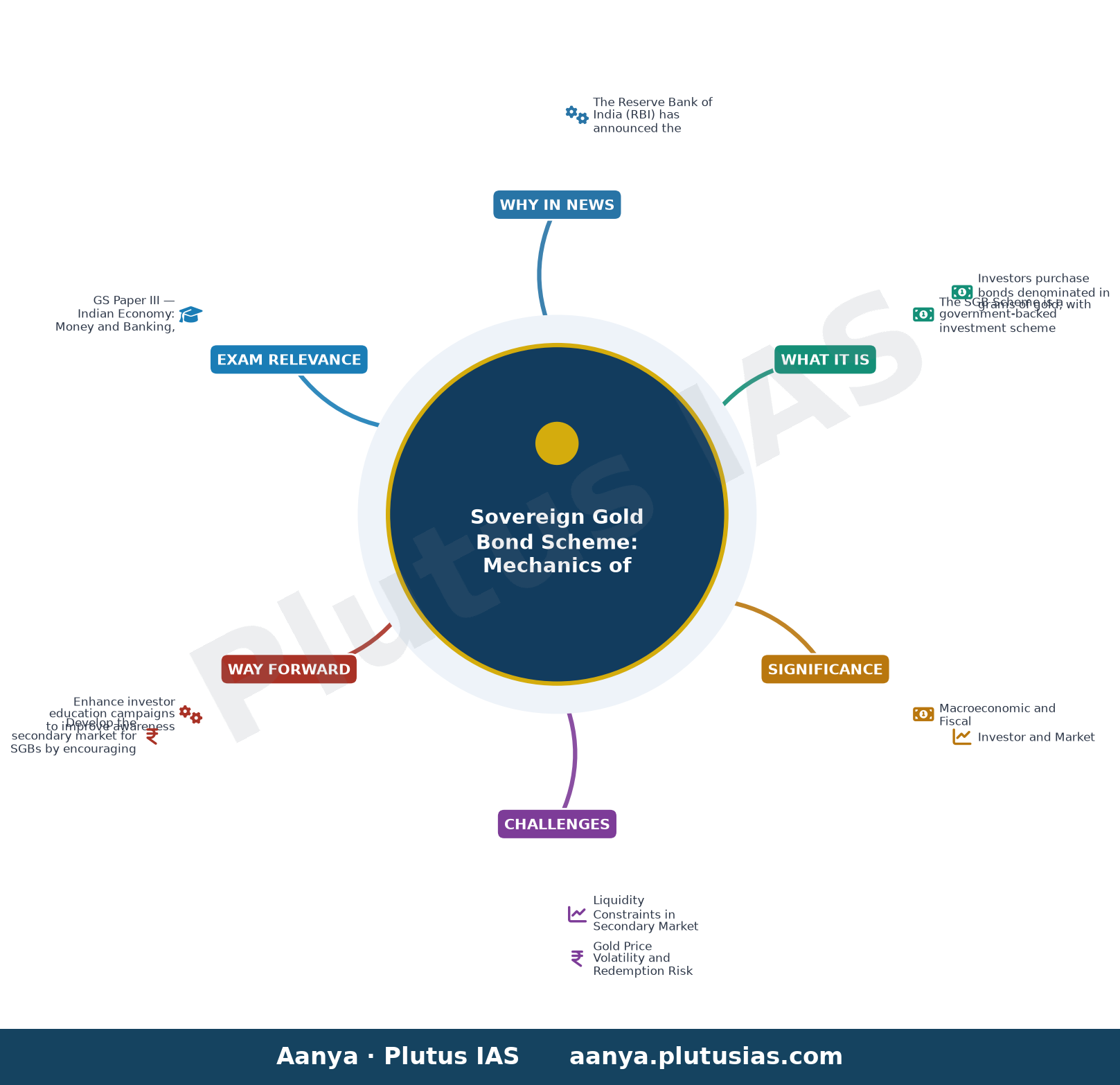
- GS Paper III — Indian Economy: Money and Banking, Capital Markets
- Prelims: Sovereign Gold Bond (SGB) Scheme, Premature redemption clause, IBJA gold price, Government securities, Gold monetisation, Fifth-year lock-in period, Redemption price calculation
- Essay: Financial inclusion through gold-backed instruments, Role of gold in India’s foreign exchange reserves and monetary policy
Quick Revision: The redemption price for premature redemption of Sovereign Gold Bonds is calculated as the simple average of the closing price of 999 purity gold over the three business days preceding the redemption date, as published by IBJA.
Why is this in the news?
The Reserve Bank of India (RBI) has announced the redemption price for the premature redemption of the Sovereign Gold Bond (SGB), scheduled for August 12, 2026. This development is significant as it highlights the operational aspects of the SGB Scheme, including eligibility for premature redemption, the pricing mechanism, and the role of benchmark gold prices in determining redemption value. It also underscores the financial prudence embedded in the scheme’s design, ensuring transparency and market-linked valuation for investors.
Background
- The Sovereign Gold Bond (SGB) Scheme was launched in November 2015 by the Government of India in collaboration with the Reserve Bank of India (RBI) to reduce the demand for physical gold and shift a portion of the domestic savings into financial savings.
- The scheme offers an alternative to holding physical gold, providing investors with an interest-bearing instrument linked to the market price of gold, thereby reducing storage risks and costs.
- SGBs are government securities denominated in grams of gold, with a fixed interest rate of 2.5% per annum payable semi-annually. The bonds have a maturity period of 8 years, but premature redemption is permitted after the fifth year from the date of issue.
- The scheme is part of broader efforts to monetise gold holdings in India, which holds one of the largest private gold reserves globally, estimated at over 25,000 tonnes.
- The pricing of SGBs is linked to the international gold price, ensuring market-linked returns for investors while providing the government with a cost-effective means to mobilise resources.
- The India Bullion and Jewellers Association Ltd (IBJA) serves as the benchmark for gold pricing in India, providing daily closing prices for 999 purity gold, which are used for various financial and regulatory purposes.
What is the Sovereign Gold Bond (SGB) Scheme?
- The SGB Scheme is a government-backed investment scheme introduced to reduce the country’s reliance on physical gold imports, thereby easing pressure on the current account deficit.
- Investors purchase bonds denominated in grams of gold, with the minimum investment typically set at 1 gram and multiples thereof, subject to a maximum limit per financial year.
- The bonds carry a fixed annual interest rate of 2.5%, payable semi-annually, making them attractive for investors seeking regular income alongside capital appreciation.
- The bonds have a maturity period of 8 years, but premature redemption is permitted after the fifth year from the date of issue, subject to specific conditions.
- The redemption price for premature redemption is determined as the simple average of the closing price of 999 purity gold over the three business days preceding the redemption date, as published by the India Bullion and Jewellers Association Ltd (IBJA).
- SGBs are issued in both demat and paper form, providing flexibility to investors in terms of holding and transferability.
- The scheme is open to resident individuals, Hindu Undivided Families (HUFs), trusts, universities, and charitable institutions, making it inclusive for a wide range of investors.
- The proceeds from the sale of SGBs are utilised by the government for various developmental purposes, including infrastructure and social sector initiatives.
Key Features
| Feature | Significance |
|---|---|
| Premature Redemption Eligibility | Permits investors to exit the Sovereign Gold Bond (SGB) after the fifth year from the issue date, subject to the redemption date aligning with an interest payment schedule. |
| Redemption Price Determination | Calculated as the simple average of the closing price of 999-purity gold over the three preceding business days, as published by the India Bullion and Jewellers Association Ltd (IBJA), ensuring transparency and market linkage. |
| Issue Date and Maturity | Series VI of SGB 2018-19 was issued on February 12, 2019, with premature redemption permitted from February 12, 2024, and the next eligible date being August 12, 2026. |
| Government Notification Basis | Premature redemption provisions are governed by the Government of India notification F.No.4(22)-B(W&M)/2018 dated October 08, 2018, which outlines the operational framework for the SGB Scheme. |
| Investor Protection Mechanism | The redemption price is benchmarked to a credible market indicator (IBJA gold price), reducing arbitrage risks and ensuring fair valuation for investors. |
Why it Matters
Macroeconomic and Fiscal
- Reduces fiscal burden by substituting physical gold imports with sovereign-backed instruments, thereby contributing to the reduction of the current account deficit (CAD) and import dependency.
- Enhances the depth of the domestic gold market by providing a risk-free, interest-bearing alternative to physical gold holdings.
- Supports the government’s objective of monetising gold holdings held by households, thereby improving the efficiency of financial savings and resource allocation.
Investor and Market
- Offers investors liquidity options post the mandatory five-year lock-in period, balancing long-term investment incentives with exit flexibility.
- Provides a hedge against gold price volatility through a transparent, market-linked redemption mechanism, enhancing investor confidence.
- Encourages financial inclusion by offering a sovereign-backed, low-risk investment avenue for retail investors seeking exposure to gold without physical storage risks.
Policy and Institutional
- Demonstrates the efficacy of the Sovereign Gold Bond Scheme as a tool for reducing the economy’s reliance on imported gold while simultaneously mobilising domestic savings.
- Highlights the role of the Reserve Bank of India (RBI) in administering the scheme, ensuring adherence to market benchmarks and regulatory oversight.
- Illustrates the government’s use of financial instruments to achieve strategic economic objectives, such as reducing the trade deficit and promoting formal financial channels.
Fiscal and Budgetary
- Contributes to the government’s revenue through interest payments on SGBs, which are taxable under the Income Tax Act, 1961, thereby broadening the tax base.
- Reduces the fiscal cost associated with gold imports by substituting them with domestically issued sovereign instruments, indirectly supporting fiscal consolidation efforts.
Challenges
1. Liquidity Constraints in Secondary Market
- Despite premature redemption eligibility, the secondary market for SGBs remains underdeveloped, limiting exit options for investors seeking liquidity before maturity.
- Low trading volumes in the secondary market may result in price discovery challenges, potentially disadvantaging investors during redemption.
UPSC Link: Economic Survey: Financial Market Depth
2. Gold Price Volatility and Redemption Risk
- Fluctuations in gold prices can lead to significant variations in redemption values, exposing investors to market risk despite the sovereign guarantee.
- The reliance on IBJA’s three-day average price may not fully capture short-term volatility, potentially leading to suboptimal redemption decisions for investors.
UPSC Link: Monetary Policy and Inflation
3. Investor Awareness and Participation Gaps
- Limited awareness among retail investors regarding the premature redemption facility and its operational nuances may result in underutilisation of the scheme.
- Complexity in understanding the redemption price calculation and eligibility criteria could deter potential investors from participating in the SGB Scheme.
UPSC Link: Financial Inclusion and Literacy
4. Fiscal Trade-offs and Opportunity Cost
- The interest paid on SGBs represents a fiscal cost to the government, which must be balanced against the macroeconomic benefits of reduced gold imports.
- Opportunity cost arises from the allocation of resources to interest payments on SGBs, which could otherwise be deployed in higher-return public investments.
UPSC Link: Fiscal Policy and Budgetary Management
5. Regulatory and Compliance Burdens
- Stringent Know Your Customer (KYC) and anti-money laundering (AML) norms, while necessary, may pose operational challenges for investors, particularly in rural and semi-urban areas.
- Compliance requirements for premature redemption, including documentation and verification, may deter small investors from utilising the facility.
UPSC Link: Regulatory Framework for Financial Markets
Challenges — UPSC Perspective
| Issue | Concern |
|---|---|
| Secondary Market Liquidity | Underdeveloped secondary market limits exit options and price discovery for investors. |
| Gold Price Volatility | Market-linked redemption exposes investors to price fluctuations despite sovereign backing. |
| Investor Awareness | Low participation due to lack of understanding of redemption mechanics and benefits. |
| Fiscal Cost | Interest payments on SGBs represent a recurring fiscal burden with long-term implications. |
| Regulatory Compliance | Complex KYC/AML norms and documentation requirements may deter small investors. |
Way Forward
- Enhance investor education campaigns to improve awareness of premature redemption facilities and their operational details among retail investors.
- Develop the secondary market for SGBs by encouraging participation from institutional investors and market makers to improve liquidity and price discovery.
- Explore the introduction of a fixed redemption premium or floor price mechanism to mitigate gold price volatility risks for investors.
- Simplify KYC and AML compliance processes for small investors, potentially leveraging digital identity solutions to reduce operational burdens.
- Conduct periodic reviews of the SGB Scheme to assess its impact on gold imports, fiscal costs, and investor participation, with a view to optimising its design.
- Strengthen collaboration between the RBI, Ministry of Finance, and financial intermediaries to streamline redemption processes and reduce turnaround times.
- Integrate SGBs with other financial inclusion initiatives, such as PMJDY or Atal Pension Yojana, to broaden their reach and utility among underserved populations.
UPSC Value Addition
Keywords for Mains Answer-Writing
Sovereign Gold Bonds (SGB) Scheme · premature redemption of SGB · reserve price calculation for SGB · India Bullion and Jewellers Association Ltd (IBJA) · gold pricing mechanism in India · Government of India notification on SGB · financial instruments for gold investment · monetary policy instruments · capital market instruments · commodity-linked securities · investment avenues for retail investors · gold as an asset class in India
Concept Flow
Government of India notification (October 2018) → Sovereign Gold Bond Scheme (SGB) 2018-19 Series VI issued (February 2019) → Investor subscription and holding period → Eligibility for premature redemption after fifth year (February 2024) → Next redemption date (August 12, 2026) → Redemption price calculation based on IBJA gold price average → Investor exit or continued holding → Impact on gold imports, fiscal revenue, and financial market depth.
Prelims Practice Questions
Q1. Consider the following statements regarding the Sovereign Gold Bond (SGB) Scheme:
1. Premature redemption of SGB is permitted after the fifth year from the date of issue.
2. The redemption price is determined by the average closing price of gold of 999 purity over the past three business days as published by the London Bullion Market Association (LBMA).
3. The SGB Scheme was notified by the Government of India in October 2018.
How many of the above statements are correct?
- Only one
- Only two
- All three
- None
Answer: Only two — Statement 1 is correct as premature redemption is permitted after the fifth year. Statement 2 is incorrect because the redemption price is based on the average closing price published by the India Bullion and Jewellers Association Ltd (IBJA), not LBMA. Statement 3 is correct as the scheme was notified by the Government of India on October 8, 2018.
Q2. Assertion (A): The Sovereign Gold Bond (SGB) Scheme allows investors to hold gold in a dematerialized form.
Reason (R): The SGB Scheme is designed to reduce the physical demand for gold and provide a secure alternative for investors.
Options:
A. Both A and R are true, and R is the correct explanation of A.
B. Both A and R are true, but R is not the correct explanation of A.
C. A is true, but R is false.
D. A is false, but R is true.
- A
- B
- C
- D
Answer: A — The Assertion (A) is true as SGBs are issued in a dematerialized form. The Reason (R) is also true and correctly explains why the scheme was introduced—to reduce physical demand for gold and provide a secure investment avenue. Hence, both A and R are true, and R is the correct explanation of A.
Q3. Match the following columns related to the Sovereign Gold Bond (SGB) Scheme:
Column I
1. Issue date of SGB 2018-19 Series VI
2. Authority determining redemption price
3. Minimum lock-in period for premature redemption
4. Government notification date for SGB Scheme
Column II
A. February 12, 2019
B. India Bullion and Jewellers Association Ltd (IBJA)
C. Fifth year from the date of issue
D. October 8, 2018
Answer: ? —
Mains Practice Question
✍ The Sovereign Gold Bond (SGB) Scheme represents a strategic shift in India’s approach to gold investment by transitioning from physical holdings to financial instruments. Critically examine the rationale, benefits, and challenges associated with the SGB Scheme, with particular reference to its redemption mechanism and the role of the India Bullion and Jewellers Association Ltd (IBJA). Also, assess how the scheme aligns with broader macroeconomic objectives such as reducing the current account deficit and curbing gold imports. (15 Marks)
Approach: MODEL-ANSWER SKELETON:
1. **Introduction (2 marks)**: Define the Sovereign Gold Bond (SGB) Scheme, its launch context (2015), and its objective to reduce physical gold demand and promote financial savings.
2. **Rationale and Benefits (4 marks)**:
– Reduction in physical gold imports and impact on current account deficit.
– Provides a safe, interest-bearing alternative to physical gold.
– Tax benefits (exemption from capital gains tax on redemption if held till maturity).
– Dematerialized form enhances liquidity and reduces storage risks.
3. **Redemption Mechanism (4 marks)**:
– Eligibility for premature redemption after the fifth year.
– Redemption price based on the simple average of the closing price of 999 purity gold over the last three business days as published by IBJA.
– Role of IBJA in ensuring transparency and market-linked pricing.
4. **Challenges (3 marks)**:
– Limited awareness among retail investors.
– Dependence on gold price volatility for returns.
– Potential mismatch between investor expectations and actual returns.
5. **Alignment with Macroeconomic Objectives (2 marks)**:
– Contribution to reducing the trade deficit by curbing gold imports.
– Encouraging financialization of savings and reducing household investment in unproductive assets.
6. **Conclusion (2 marks)**: Summarize the scheme’s significance and suggest measures to enhance its effectiveness, such as improving financial literacy and expanding distribution channels.
Source: RBI
Generated by AanyaAi for educational purpose.

- छत्तीसगढ़: एआई से बनी महिला की आपत्तिजनक तस्वीरें सोशल मीडिया पर डालना साइबर अपराध - August 12, 2026
- Chhattisgarh Warns: AI-Generated Obscene Images on Social Media is Cyber Crime - August 12, 2026
- अनुसूचित जाति के छात्रों को विदेशी शिक्षा: राष्ट्रीय विदेशी छात्रवृत्ति योजना में सुधार - August 12, 2026

No Comments