


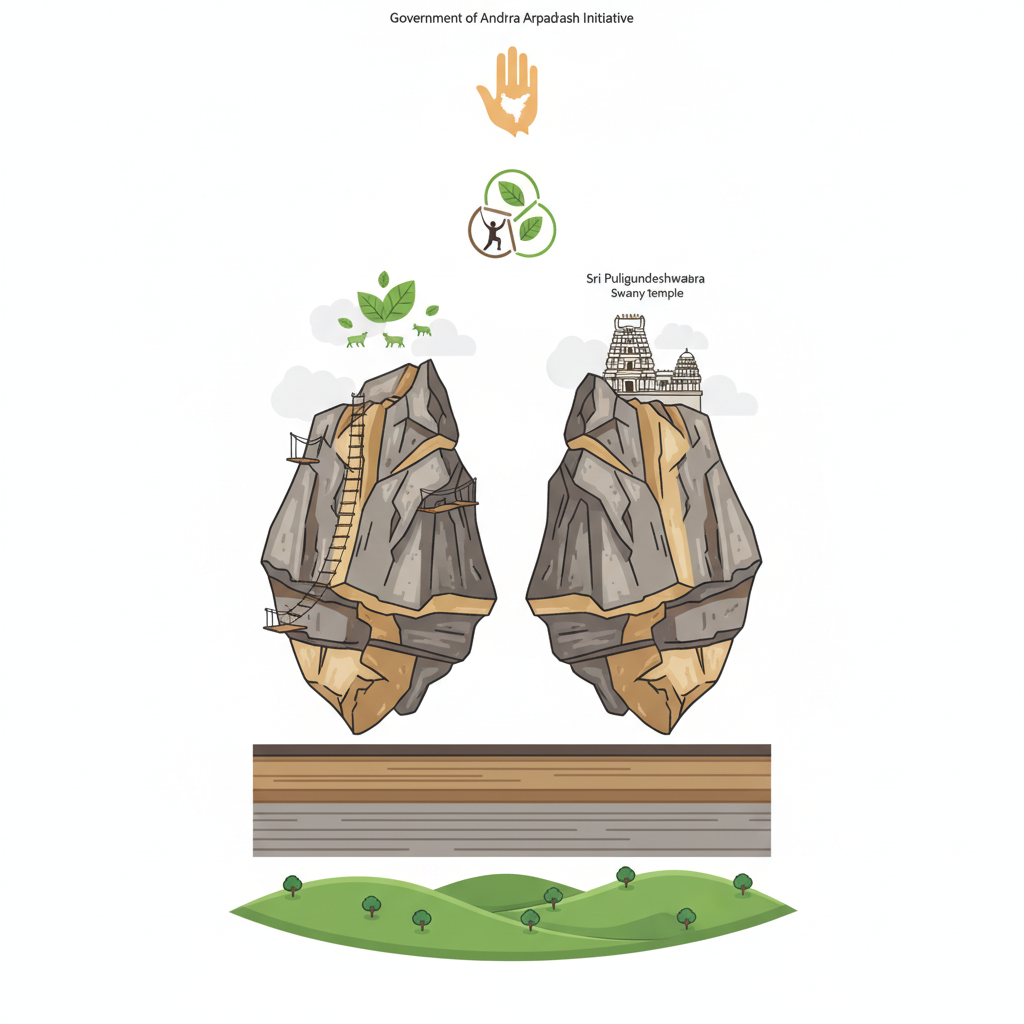
02 Sep Puligundu’s Twin Rock Peaks: UPSC Focus on Adventure & Eco-Tourism Development
✎ Puligundu’s integrated tourism plan exemplifies convergence of adventure, eco, and temple tourism leveraging geological heritage, cultural assets, and ecological sustainability for local economic development.
Subject Relevance — Where This Topic Fits
- GS Paper I — Geography (Tourism Geography, Ecotourism, Geological Heritage) | GS Paper III — Environment (Sustainable Tourism, Eco-sensitive Zones) | GS Paper III — Economy (Tourism as a Catalyst for Local Economic Development)
- Prelims: Puligundu rock peaks, Andhra Pradesh tourism policy, Eco-tourism, Adventure tourism infrastructure, Temple tourism, Geological heritage, Sustainable tourism, Circuit tourism
- Essay: Sustainable tourism as a tool for inclusive regional development, Balancing conservation and commercialisation in natural and cultural heritage
Quick Revision: Puligundu’s integrated tourism plan exemplifies convergence of adventure, eco, and temple tourism leveraging geological heritage, cultural assets, and ecological sustainability for local economic development.
Why is this in the news?
The Government of Andhra Pradesh has announced a phased development plan for the twin 1,000-foot rock peaks at Puligundu in Chittoor district to transform it into an integrated tourism destination combining adventure sports, eco-tourism, and temple pilgrimage. This initiative is significant as it exemplifies a multi-dimensional approach to leveraging natural geological formations, cultural heritage, and ecological assets for socio-economic upliftment while adhering to principles of sustainability and safety.
Background
- The twin rock peaks at Puligundu are natural geological formations rising approximately 1,000 feet in height, located in Penumur mandal, Chittoor district, Andhra Pradesh.
- The site is home to the 300-year-old Sri Puligundeshwara Swamy temple, a hilltop shrine of religious significance, which has historically attracted pilgrims and local devotees.
- Andhra Pradesh has been actively promoting tourism as a key sector for economic diversification, with a focus on niche segments such as adventure, eco, and temple tourism to reduce regional disparities.
- The state government has earmarked 79 acres of land for tourism development, indicating a commitment to integrated planning and resource optimisation.
- Existing infrastructure at Puligundu includes basic trekking trails, limited accommodation, and minimal facilities, which the new plan aims to upgrade comprehensively.
- The initiative aligns with national frameworks such as the National Tourism Policy 2022 and the Swadesh Darshan Scheme, which emphasise sustainable and experiential tourism.
What is the Puligundu Tourism Development Plan?
- A three-phase, multi-dimensional tourism development plan aimed at transforming Puligundu’s twin rock peaks into a premier integrated tourism destination.
- Adventure tourism components include graded trekking trails, rock climbing, bouldering, and exploration of a zip-line and rope course between the two peaks, leveraging the natural rock formations.
- Eco-tourism initiatives encompass the establishment of a nature park with native flora, eco-huts, wooden cottages, a butterfly garden, bird-watching zones, and rainwater harvesting systems to ensure sustainability.
- Temple tourism enhancements involve beautification of the Sri Puligundeshwara Swamy temple, repair of steps and pathways, improved lighting for darshan, resting facilities, and meditation spaces.
- Safety and security measures include installation of safety railings, warning boards, trained local guides, rescue teams, CCTV surveillance, and a dedicated police control room.
- Infrastructure development includes parking areas, accommodation blocks, a reception and information centre, food courts promoting local cuisine, drinking water facilities, toilets, and waste management systems.
- The plan prioritises local employment generation, promotion of regional handicrafts and cuisine, and digital integration for information dissemination and visitor management.
- The phased approach ensures phased funding, environmental impact assessment, and community consultation to align with principles of sustainable and inclusive tourism.
Key Features
| Feature | Significance |
|---|---|
| 1,000-foot twin rock peaks | Natural geological formations providing a unique adventure and eco-tourism backdrop with unparalleled verticality and scenic vistas. |
| Sri Puligundeshwara Swamy temple | Centuries-old hilltop temple offering spiritual tourism value and cultural heritage, enhancing the destination’s multi-dimensional appeal. |
| Graded trekking trails and rock climbing | Adventure tourism infrastructure leveraging natural rock formations for graded trails, bouldering, and climbing, ensuring accessibility and safety. |
| Zip-line between peaks | Proposed aerial connectivity enhancing adventure tourism by providing a novel, high-altitude experience between the twin peaks. |
| Eco-huts and wooden cottages | Sustainable accommodation options integrating with the natural environment, promoting eco-tourism and minimizing ecological footprint. |
| Nature park with native species | Conservation-focused initiative to preserve local biodiversity while providing educational and recreational value to visitors. |
Why it Matters
Economic Development
- Creation of local employment opportunities in hospitality, adventure tourism, guiding, and handicrafts, thereby augmenting rural livelihoods.
- Revenue generation through tourism taxes, entry fees, and commercial activities, contributing to district and state exchequer.
- Stimulation of ancillary sectors such as transportation, food processing, and handicrafts, fostering inclusive growth in Penumur mandal.
- Potential to position Chittoor district as a premier tourism hub in Andhra Pradesh, attracting domestic and international visitors.
Environmental Conservation
- Promotion of eco-tourism principles, including rainwater harvesting, waste management, and plastic-free zones, to ensure sustainable tourism practices.
- Establishment of a nature park with native species to preserve local flora and fauna, mitigating biodiversity loss.
- Implementation of regulated camping and trekking to prevent ecological degradation of the fragile rock formations and surrounding ecosystems.
Cultural Preservation
- Revitalization of the Sri Puligundeshwara Swamy temple through infrastructure upgrades, ensuring the preservation of its historical and architectural heritage.
- Integration of local cuisine and handicrafts in tourism infrastructure, fostering pride in cultural identity and providing market access for artisans.
- Enhancement of spiritual tourism by improving accessibility and safety for devotees, thereby sustaining religious practices and traditions.
Tourism Infrastructure
- Development of comprehensive tourism infrastructure, including parking, accommodation, food courts, and first-aid facilities, to enhance visitor experience.
- Improved lighting, signage, and digital information systems to facilitate navigation and accessibility for all categories of tourists.
- Establishment of a police control room and CCTV surveillance to ensure safety and security, particularly for night trekking and adventure activities.
Challenges
1. Ecological Vulnerability
- Risk of environmental degradation due to increased footfall, necessitating strict adherence to carrying capacity and sustainable tourism practices.
- Potential disruption to local wildlife and flora from construction activities and unregulated tourism, requiring robust environmental impact assessments.
- Need for continuous monitoring of natural resources such as water and soil to prevent depletion or contamination.
UPSC Link: Environmental Impact Assessment (EIA) Notification 2006
2. Safety and Security
- Ensuring the safety of visitors during high-risk activities such as rock climbing, zip-lining, and night trekking, which requires trained personnel and stringent protocols.
- Mitigating risks of accidents or mishaps in a terrain with steep rock faces and uneven surfaces, necessitating regular safety audits.
- Addressing concerns of theft or vandalism in a remote, less-policed area, requiring effective surveillance and community engagement.
UPSC Link: Disaster Management Act, 2005
3. Tourism Pressure and Overcrowding
- Balancing the influx of tourists to prevent overcrowding, which could degrade the natural and cultural assets of the destination.
- Managing seasonal fluctuations in tourism to ensure year-round viability without overburdening local resources or infrastructure.
- Implementing reservation systems or timed entry to regulate visitor numbers and maintain the quality of experience.
UPSC Link: National Tourism Policy 2022
4. Community Participation and Benefit Sharing
- Ensuring equitable distribution of tourism benefits among local communities, particularly marginalized groups, to prevent resentment or displacement.
- Addressing potential conflicts over land use or resource access between tourism development and traditional livelihoods such as agriculture.
- Building local capacity through training programs to ensure that residents are equipped to participate in and benefit from tourism activities.
UPSC Link: Panchayats (Extension to Scheduled Areas) Act, 1996
5. Regulatory and Bureaucratic Hurdles
- Navigating multiple approvals and clearances from forest, environment, and tourism departments for infrastructure development.
- Ensuring coordination among various stakeholders, including district administration, tourism department, and local bodies, to streamline implementation.
- Addressing delays in project execution due to procedural bottlenecks or resource constraints.
UPSC Link: Forest Conservation Act, 1980
Challenges — UPSC Perspective
| Issue | Concern |
|---|---|
| Environmental degradation | Risk of soil erosion, water pollution, and biodiversity loss due to unregulated tourism activities. |
| Safety risks for tourists | Potential for accidents during adventure activities or night trekking in rugged terrain. |
| Overcrowding and carrying capacity | Deterioration of visitor experience and ecological damage from excessive footfall. |
| Land-use conflicts | Tension between tourism infrastructure development and traditional agricultural or forest land uses. |
| Seasonal tourism fluctuations | Economic instability for local communities and businesses due to uneven tourist inflow. |
| Regulatory delays | Slow pace of project approvals and clearances hindering timely implementation of tourism plans. |
Government Initiatives — Must-Memorise for Prelims
- Swadesh Darshan Scheme
Way Forward
- Conduct a detailed Environmental Impact Assessment (EIA) to identify and mitigate ecological risks before scaling up infrastructure.
- Develop a phased tourism master plan with clear carrying capacity norms to prevent overcrowding and environmental stress.
- Establish a dedicated local governance body, such as a Special Purpose Vehicle (SPV), to oversee implementation, monitoring, and community engagement.
- Invest in capacity-building programs for local youth to serve as trained guides, rescue personnel, and hospitality staff, ensuring community ownership.
- Implement a robust waste management system, including plastic-free zones, recycling units, and regular clean-up drives to maintain ecological integrity.
- Introduce digital platforms for visitor registration, feedback, and real-time monitoring of tourism activities to enhance safety and experience.
- Promote homestays and local handicrafts through marketing initiatives to ensure equitable benefit-sharing and cultural preservation.
- Collaborate with educational institutions to conduct research on the geological, ecological, and cultural significance of Puligundu for academic and tourism purposes.
UPSC Value Addition
Keywords for Mains Answer-Writing
Tourism policy in India · Adventure tourism · Eco-tourism framework · Temple tourism development · District-level tourism planning · Sustainable tourism practices · Cultural tourism in Andhra Pradesh · Geotourism and geological heritage · Multi-modal tourism infrastructure · Community-based tourism · Tourism governance and safety regulations · Tourism as a tool for local economic development
Concept Flow
Identification of Puligundu’s twin rock peaks as a potential tourism hub due to their geological, ecological, and cultural significance. → Formulation of a three-phase action plan by the District Collector and Tourism Department to develop adventure, eco, and temple tourism infrastructure. → Implementation of graded trekking trails, rock climbing facilities, and a zip-line to attract adventure tourists while preserving natural assets. → Development of eco-tourism infrastructure such as nature parks, eco-huts, and butterfly gardens to promote sustainable tourism practices. → Upgradation of the Sri Puligundeshwara Swamy temple and surrounding facilities to enhance spiritual tourism and cultural preservation. → Establishment of safety protocols, including trained guides, CCTV surveillance, and rescue teams, to ensure visitor security. → Monitoring and evaluation of tourism activities to balance economic gains with environmental and cultural sustainability.
Prelims Practice Questions
Q1. Consider the following statements regarding the development of Puligundu in Andhra Pradesh as a tourism destination:
1. The development plan includes graded trekking trails and rock climbing using natural rocks.
2. A zip-line between the twin peaks is proposed as part of adventure tourism infrastructure.
3. The plan includes a butterfly garden and bird-watching zones under the eco-tourism component.
4. The Sri Puligundeshwara Swamy temple is a 200-year-old structure that adds spiritual value to the site.
How many of the above statements are correct?
- Only one
- Only two
- Only three
- All four
Answer: All four — Statements 1, 2, and 3 are correct as per the report. Statement 4 is incorrect; the temple is stated to be three centuries old, not two.
Q2. Which of the following is NOT a component of the eco-tourism plan proposed for Puligundu?
- Plastic-free environment
- Rainwater harvesting
- Solar-powered zip-line
- Nature park with native species
Answer: Solar-powered zip-line — The eco-tourism plan includes rainwater harvesting and a plastic-free environment, but a solar-powered zip-line is not mentioned. The zip-line is proposed as part of adventure tourism infrastructure.
Q3. Assertion (A): The development of Puligundu as a tourism destination is expected to generate local employment opportunities.
Reason (R): The action plan includes provisions for trained local youth as guides, accommodation blocks, and promotion of local food and handicrafts.
In the context of the above two statements, which one of the following is correct?
- Both A and R are true, and R is the correct explanation of A.
- Both A and R are true, but R is not the correct explanation of A.
- A is true, but R is false.
- A is false, but R is true.
Answer: Both A and R are true, and R is the correct explanation of A. — Both the assertion and reason are true. The reason correctly explains how local employment opportunities are expected to be generated through the development plan.
Mains Practice Question
✍ Tourism development in India often faces the challenge of balancing economic growth with environmental conservation and cultural preservation. Critically analyse the proposed three-phase action plan for Puligundu in Andhra Pradesh, highlighting its strengths and potential challenges in achieving sustainable tourism. Also, discuss the role of district-level authorities in implementing such plans. (15 Marks)
Approach: MODEL-ANSWER SKELETON:
1. **Introduction (2 marks)**: Define sustainable tourism and its significance for India’s tourism policy. Briefly outline the Puligundu plan’s objectives: adventure, eco, and temple tourism.
2. **Strengths of the Puligundu Plan (4 marks)**:
– Multi-modal tourism: Adventure (trekking, rock climbing, zip-line), eco (nature park, butterfly garden), and temple tourism (heritage conservation).
– Community involvement: Training local youth as guides, promoting local cuisine and handicrafts, and generating employment.
– Environmental sustainability: Plastic-free environment, rainwater harvesting, recharge pits, and native species-based nature park.
– Safety and infrastructure: Graded trails, safety railings, CCTV, rescue teams, and digital information centres.
3. **Potential Challenges (4 marks)**:
– Environmental impact: Risk of over-tourism degrading geological formations and green cover despite eco-measures.
– Cultural preservation: Balancing modern tourism infrastructure with the sanctity of the 300-year-old temple and local traditions.
– Implementation gaps: Ensuring timely execution of phases, funding, and coordination among multiple agencies (tourism, forest, local bodies).
– Safety concerns: Managing adventure activities like zip-lines and night trekking without compromising visitor safety.
4. **Role of District-Level Authorities (3 marks)**:
– Implementation: Overseeing graded trails, safety measures, and infrastructure development as per the plan.
– Coordination: Liaising with state tourism departments, forest officials, and local communities for integrated execution.
– Monitoring: Ensuring compliance with environmental norms, waste management, and sustainable practices.
– Local governance: Facilitating participatory decision-making and addressing grievances of stakeholders.
5. **Conclusion (2 marks)**: Emphasise the need for a balanced approach—leveraging Puligundu’s unique geological and cultural assets while adhering to sustainable tourism principles. Highlight the model’s replicability for other district-level tourism initiatives.
Source: The Hindu
Generated by AanyaAi for educational purpose.
Related guides on our sites
- Current affairs for upsc 2026
- How to prepare for GS paper 1 for UPSC CSE mains exam
- Best UPSC coaching for IFOS exam
- Best geography optional coaching

- मद्रास उच्च न्यायालय में ‘वेट्ट्री पयणम’ योजना को असंवैधानिक घोषित करने की मांग - October 4, 2026
- Gurugram’s groundwater extraction exceeds limit by 212%; HC seeks ban - October 4, 2026
- स्वतंत्रता सेनानी श्यामजी कृष्ण वर्मा की जन्म जयंती पर पीएम का श्रद्धांजलि - October 4, 2026

No Comments