


06 Sep Punjab Power Plants: Centre Ensures Adequate Coal Supply Amid PLF Concerns
✎ Captive coal mines in India are allocated to entities for exclusive use to ensure energy security, with Coal India Limited (CIL) playing a pivotal role in coal supply logistics, including to Punjab’s thermal power plants.
Subject Relevance — Where This Topic Fits
- GS Paper II — Government Policies and Interventions for Development in various sectors | GS Paper III — Infrastructure: Energy
- Prelims: Coal India Limited (CIL), Captive Coal Mines, Plant Load Factor (PLF), Independent Power Producers (IPPs), Ministry of Coal, Punjab State Power Corporation Limited (PSPCL)
- Essay: Energy security and sustainable development in India, Role of public sector enterprises in critical infrastructure
Quick Revision: Captive coal mines in India are allocated to entities for exclusive use to ensure energy security, with Coal India Limited (CIL) playing a pivotal role in coal supply logistics, including to Punjab’s thermal power plants.
Why is this in the news?
The Ministry of Coal, through a press release dated 06 September 2026, clarified that coal supply to Punjab’s thermal power plants has been adequate, with Coal India Limited (CIL) ensuring uninterrupted coal supply for power generation across the country. The clarification addressed media reports attributing power generation shortfalls in Punjab to insufficient coal supply, emphasizing instead operational and logistical factors as potential constraints.
Background
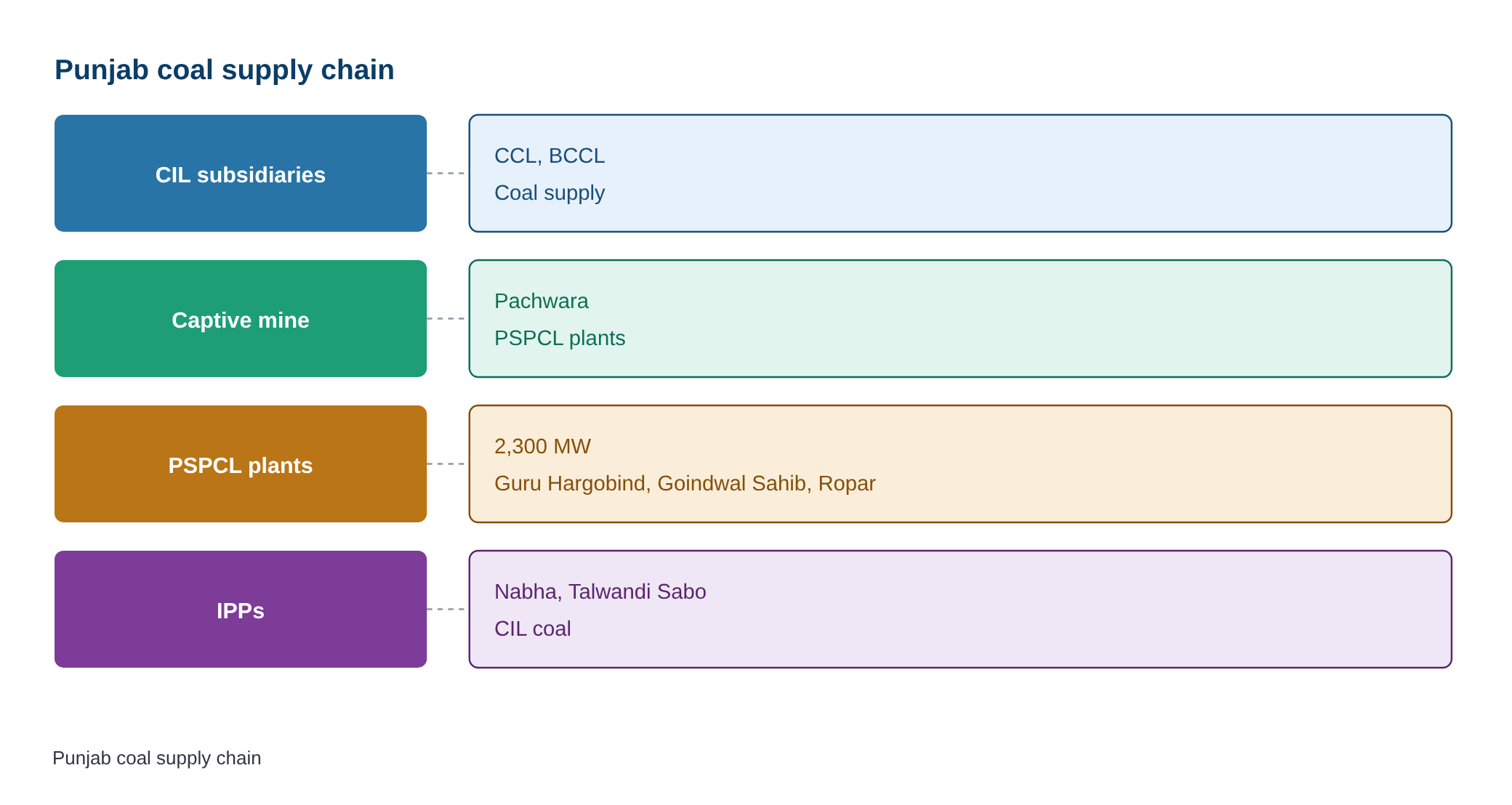
- India’s thermal power sector is heavily dependent on coal, with Coal India Limited (CIL) and its subsidiaries being the primary suppliers to both state-owned and independent power producers (IPPs).
- Punjab State Power Corporation Limited (PSPCL) operates three thermal power plants with a combined capacity of 2,300 MW: Guru Hargobind Thermal Power Plant (Lehra Mohabbat), Goindwal Sahib Thermal Power Plant, and Ropar Thermal Power Plant.
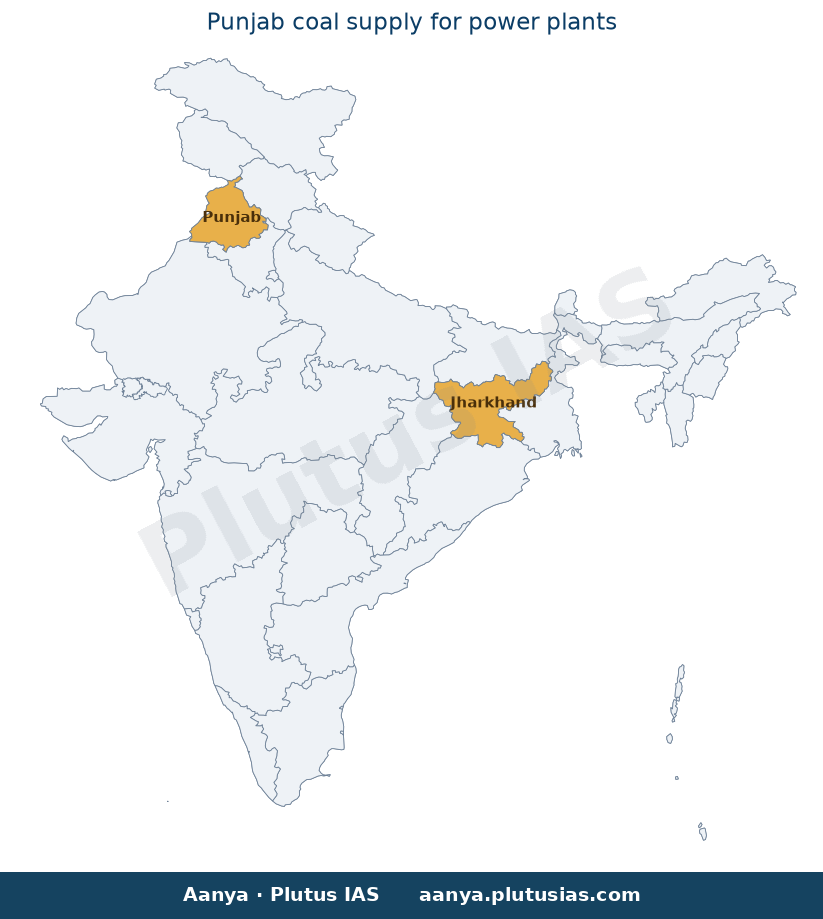
- PSPCL also operates the Pachwara Central Coal Mine, a captive mine, which supplies coal to its own plants and, under specified conditions, to IPPs.
- Independent Power Producers (IPPs) in Punjab, such as Nabha Power Limited (Rajpura) and Talwandi Sabo Power Limited (Mansa), rely on coal from CIL’s subsidiaries for power generation.
- The Plant Load Factor (PLF) of PSPCL’s plants was reported at approximately 42% in August 2026, despite coal stock levels being 117% of the standard requirement, indicating that supply adequacy was not the primary constraint.
- CIL’s subsidiaries, including Central Coalfields Limited (CCL) and Bharat Coking Coal Limited (BCCL), have offered coal to IPPs in Punjab, but logistical delays in booking and evacuation have been noted.
What are Captive Coal Mines and their Role in India’s Energy Sector?
- Captive coal mines are coal blocks allocated to public or private entities for their exclusive use, primarily to meet the coal requirements of their own industries or power plants, rather than for commercial sale.
- The allocation of captive coal mines in India is governed by the Coal Mines (Special Provisions) Act, 2015, and subsequent amendments, which aim to enhance coal production and reduce import dependence.
- Captive mines play a critical role in ensuring energy security by providing a stable and dedicated coal supply to power plants, reducing reliance on market-based procurement.
- In Punjab, PSPCL’s Pachwara Central Coal Mine is a captive mine that supplies coal to its own thermal power plants and, under regulatory conditions, to IPPs to optimize resource utilization.
- The Ministry of Coal, through Coal India Limited (CIL) and its subsidiaries, ensures the supply of coal to both state-owned utilities (like PSPCL) and IPPs across India, including Punjab.
- The supply chain for coal involves multiple stages: mining, transportation (via rail, road, or conveyor belts), and delivery to power plants, with logistical efficiency being a key determinant of supply adequacy.
- The Plant Load Factor (PLF) is a measure of a power plant’s operational efficiency, calculated as the ratio of actual power generated to the maximum possible output under ideal conditions. A low PLF may indicate operational constraints rather than fuel shortages.
- Regulatory frameworks, such as the Coal Distribution Policy, govern the allocation and supply of coal to different sectors, including power generation, to ensure equitable distribution and prevent shortages.
Key Features
| Feature | Significance |
|---|---|
| Captive coal mining by PSPCL (Pachwara Central Coal Mine) | Enables direct supply of coal to Independent Power Producers (IPPs) in Punjab, reducing dependency on external sources and ensuring energy security for state-owned and private thermal plants. |
| Coal India Limited’s (CIL) role in supply chain facilitation | Ensures uninterrupted coal supply to Punjab’s power plants through subsidiaries like CCL and BCCL, maintaining grid stability and meeting peak demand requirements. |
| Plant Load Factor (PLF) of PSPCL vs IPPs | PSPCL’s PLF of ~42% in August 2026 contrasts with IPPs like Nabha Power Limited achieving ~93%, highlighting operational inefficiencies rather than coal scarcity as the bottleneck. |
| Statutory payment obligations for coal dispatch | Punjab State Power Corporation Limited (PSPCL) must comply with statutory payments to Jharkhand for coal sourced from Pachwara Central Coal Mine, ensuring legal and financial alignment in inter-state coal transactions. |
| Annual production utilisation cap (50%) for IPPs | Regulatory limit on coal offtake from PSPCL’s captive mine by IPPs prevents over-exploitation while ensuring equitable distribution of coal resources among stakeholders. |
Why it Matters
Energy Security and Grid Stability
- Direct coal supply from captive mines to IPPs reduces transmission losses and enhances energy security for Punjab by ensuring localised fuel availability for thermal power generation.
- Uninterrupted coal supply by CIL supports baseload power requirements, critical for industrial and agricultural sectors in Punjab during peak demand periods.
- Diversification of coal sources (captive mines + CIL subsidiaries) mitigates risks associated with supply chain disruptions from distant coalfields.
Economic Implications
- Reduction in coal transportation costs for IPPs due to proximity of supply sources, improving their operational efficiency and profitability.
- Potential for reduced power purchase costs for PSPCL if coal is sourced from captive mines at lower landed costs compared to market-linked procurement.
- Enhanced competitiveness of Punjab’s power sector in attracting investments, given reliable fuel supply for thermal plants.
Regulatory and Governance Framework
- Compliance with statutory obligations (e.g., payments to Jharkhand) ensures fiscal discipline and inter-state cooperation in resource sharing.
- Regulatory caps on coal offtake (50% for IPPs) balance resource utilisation with conservation, aligning with sustainable mining practices.
- Transparent coal allocation mechanisms under CIL’s subsidiaries (CCL, BCCL) foster accountability in supply chain management.
Operational Efficiency in Power Sector
- Higher PLF in IPPs (~93%) compared to PSPCL (~42%) underscores the need for operational optimisation in state-owned plants to match private sector benchmarks.
- Timely coal dispatch and utilisation are critical for maintaining grid stability, especially during monsoon seasons or supply chain bottlenecks.
- Integration of captive mine output with IPPs’ operational schedules can enhance overall system efficiency and reduce idle capacity.
Challenges
1. Logistical Bottlenecks in Coal Dispatch
- Underutilisation of coal offered by CIL subsidiaries (e.g., only 3.1 LT dispatched out of 5 LT offered by CCL to Nabha Power Limited), indicating inefficiencies in booking and transportation.
- Delays in coal evacuation from mines to power plants due to administrative and infrastructural constraints, affecting PLF and grid reliability.
- Inter-state coordination challenges in coal movement, particularly between Jharkhand (mine source) and Punjab (end-use), requiring streamlined logistics.
UPSC Link: GS-III: Infrastructure – Energy
2. Operational Inefficiencies in State-Owned Plants
- PSPCL’s PLF of ~42% in August 2026 suggests underutilisation of installed capacity, despite adequate coal stockpiles, pointing to technical or managerial deficiencies.
- Lack of alignment between coal supply schedules and power generation planning in PSPCL plants, leading to suboptimal utilisation of resources.
- Need for capacity-building in state-owned utilities to adopt best practices from private IPPs in operational efficiency and maintenance.
UPSC Link: GS-III: Infrastructure – Energy
3. Regulatory and Compliance Constraints
- Statutory payment obligations to Jharkhand for coal sourced from Pachwara Central Coal Mine may impose financial burdens on PSPCL, affecting its liquidity.
- Regulatory caps on coal offtake (50% for IPPs) limit flexibility in resource utilisation, potentially constraining power generation capacity during high-demand periods.
- Complexity in inter-state coal transactions due to differing state policies and fiscal regimes, requiring harmonised regulatory frameworks.
UPSC Link: GS-II: Governance – Regulatory Bodies
4. Market and Supply Chain Vulnerabilities
- Dependence on a single captive mine (Pachwara Central Coal Mine) for coal supply exposes PSPCL to operational risks in case of mine disruptions or geological constraints.
- Fluctuations in coal prices and freight costs can impact the economic viability of coal-based power generation, necessitating hedging strategies.
- Climate change-induced disruptions (e.g., monsoon delays, extreme weather) may affect coal mining and transportation, requiring adaptive supply chain management.
UPSC Link: GS-III: Infrastructure – Energy
5. Technological and Infrastructure Gaps
- Limited adoption of modern coal handling and storage technologies in PSPCL plants may contribute to inefficiencies in coal utilisation and ash management.
- Inadequate rail and road infrastructure for coal transportation between mines and power plants, leading to delays and increased costs.
- Lack of real-time monitoring systems for coal stockpiles and dispatch schedules hinders proactive decision-making in power generation planning.
UPSC Link: GS-III: Infrastructure – Energy
Challenges — UPSC Perspective
| Issue | Concern |
|---|---|
| Underutilisation of coal offered by CIL | Only 62% of offered coal (5 LT) by CCL was booked, and 62% of booked coal was dispatched, indicating logistical and administrative inefficiencies. |
| Low PLF in PSPCL plants (~42%) | Despite sufficient coal stockpiles, PSPCL’s PLF remains suboptimal, suggesting operational or managerial deficiencies rather than fuel scarcity. |
| Statutory payment obligations to Jharkhand | Financial burden on PSPCL due to payments for coal sourced from Pachwara Central Coal Mine, impacting its fiscal health. |
| Regulatory cap on coal offtake (50% for IPPs) | Limits flexibility in coal utilisation, potentially constraining power generation during peak demand periods. |
| Delays in coal dispatch and evacuation | Administrative and infrastructural bottlenecks delay coal movement, affecting grid stability and power generation schedules. |
| Inter-state coordination challenges | Differing state policies and fiscal regimes complicate coal transactions between Jharkhand and Punjab, requiring harmonised frameworks. |
Way Forward
- Streamline coal booking and dispatch processes under CIL subsidiaries (CCL, BCCL) to ensure timely evacuation and utilisation of offered coal, aligning with IPPs’ operational schedules.
- Undertake capacity-building initiatives for PSPCL to enhance operational efficiency, including adoption of best practices from private IPPs in maintenance and generation planning.
- Invest in modern coal handling and storage infrastructure at PSPCL plants to reduce losses and improve utilisation of available coal stockpiles.
- Strengthen inter-state coordination mechanisms between Punjab and Jharkhand to facilitate seamless coal transactions, including harmonised regulatory and fiscal frameworks.
- Explore diversification of coal sources beyond captive mines (e.g., long-term supply agreements with other CIL subsidiaries) to mitigate operational risks.
- Implement real-time monitoring systems for coal stockpiles and dispatch schedules to enable proactive decision-making in power generation and supply chain management.
- Conduct periodic audits of coal utilisation and PLF in PSPCL plants to identify bottlenecks and implement corrective measures, ensuring optimal resource utilisation.
- Develop contingency plans for climate-induced disruptions (e.g., monsoon delays) to maintain uninterrupted coal supply and grid stability during critical periods.
UPSC Value Addition
Keywords for Mains Answer-Writing
Coal supply chain · Captive coal mines · Plant Load Factor (PLF) · Independent Power Producers (IPPs) · Coal India Limited (CIL) · Power sector reforms · Thermal power plants · Energy security · Coal logistics · Public sector undertakings in energy · Coal mining policy · Grid management · Energy transition · Coal linkage rationalisation · Electricity Act 2003 · Central Electricity Authority (CEA) · Ministry of Coal · State electricity boards · Energy mix diversification · Coal washing and beneficiation
Concept Flow
Coal scarcity concerns in Punjab’s thermal plants → Centre clarifies adequate coal availability via captive mines and CIL supply → PSPCL’s PLF (~42%) vs IPPs’ PLF (~93%) reveals operational inefficiencies → Logistical bottlenecks in coal dispatch (CCL, BCCL) identified → Regulatory caps and statutory obligations complicate resource utilisation → Way forward: streamline processes, enhance capacity, and diversify supply sources.
Prelims Practice Questions
Q1. Consider the following statements regarding the Plant Load Factor (PLF) of thermal power plants in India:
1. PLF is a measure of the actual output of a power plant compared to its maximum possible output.
2. A higher PLF indicates better utilisation of the plant’s capacity.
3. The PLF of thermal power plants in Punjab was approximately 42% in August 2026.
4. The PLF of independent power producers (IPPs) in Punjab was significantly higher than that of state-owned plants during the same period.
How many of the above statements are correct?
- Only one
- Only two
- Only three
- All
Answer: All — Statements 1, 2, and 3 are correct. Statement 4 is also correct as IPPs in Punjab achieved a PLF of ~93% in August 2026, compared to ~42% for state-owned plants. Thus, three statements are correct.
Q2. Assertion (A): Coal India Limited (CIL) is the sole supplier of coal to thermal power plants in India.
Reason (R): CIL operates captive coal mines exclusively for its own use and does not supply coal to other entities.
Options:
A. Both A and R are true, and R is the correct explanation of A.
B. Both A and R are true, but R is not the correct explanation of A.
C. A is true, but R is false.
D. A is false, but R is true.
Answer: ? — Assertion (A) is false because CIL supplies coal to multiple entities, including independent power producers (IPPs) and state electricity boards. Reason (R) is also false as CIL supplies coal to other entities beyond its captive mines.
Q3. Match the following entities with their respective functions in the coal supply chain for thermal power plants:
Column I
1. Coal India Limited (CIL)
2. Punjab State Power Corporation Limited (PSPCL)
3. Independent Power Producers (IPPs)
4. Ministry of Coal
Column II
A. Regulatory oversight and policy formulation
B. Coal mining, production, and supply
C. Ownership and operation of state-owned thermal power plants
D. Generation of electricity using coal as fuel
Options:
A. 1-B, 2-C, 3-D, 4-A
B. 1-A, 2-B, 3-C, 4-D
C. 1-D, 2-A, 3-B, 4-C
D. 1-C, 2-D, 3-A, 4-B
Answer: ? — 1-B (CIL is responsible for coal mining, production, and supply), 2-C (PSPCL owns and operates state-owned thermal power plants in Punjab), 3-D (IPPs generate electricity using coal as fuel), 4-A (Ministry of Coal provides regulatory oversight and policy formulation).
Mains Practice Question
✍ The adequacy of coal supply to thermal power plants is often cited as a main constraint on electricity generation in India. In this context, critically examine the role of captive coal mines and the Plant Load Factor (PLF) as indicators of the efficiency and reliability of the coal-based power sector. Substantiate your answer with reference to the recent developments in Punjab’s power sector. (15 Marks)
Approach: MODEL-ANSWER SKELETON:
1. **Introduction (2 marks)**
– Define captive coal mines and PLF.
– State the context: Punjab’s thermal power plants and recent data on coal supply and PLF.
– Clarify the directive: critical examination of the role of captive mines and PLF.
2. **Role of Captive Coal Mines (4 marks)**
– **Definition and purpose**: Captive mines are coal blocks allocated to end-use entities (e.g., power plants) for their exclusive use, ensuring supply security.
– **Legal framework**: Reference the Coal Mines (Special Provisions) Act, 2015, and subsequent auction mechanisms.
– **Advantages**: Supply security, reduced dependence on external sources, and cost efficiency for end-users.
– **Limitations**: Environmental concerns, land acquisition challenges, and operational inefficiencies.
– **Punjab’s case**: PSPCL’s captive mine (Pachwara Central Coal Mine) supplying coal to IPPs like Nabha Power Limited and Talwandi Sabo Power Limited.
3. **Plant Load Factor (PLF) as an Efficiency Indicator (4 marks)**
– **Definition**: PLF measures actual generation against maximum potential generation.
– **Importance**: Reflects operational efficiency, maintenance practices, and demand-supply alignment.
– **PLF in Punjab**: State-owned plants (~42% PLF in August 2026) vs. IPPs (~93% PLF).
– **Reasons for low PLF**: Logistical bottlenecks (e.g., coal evacuation delays), administrative hurdles, or demand-side factors.
– **Comparison with national standards**: Average PLF of thermal plants in India (historical data).
4. **Interrelation and Policy Implications (3 marks)**
– **Link between captive mines and PLF**: Adequate coal supply (from captive mines) does not guarantee high PLF if logistical or operational constraints persist.
– **Policy gaps**: Need for integrated coal logistics (e.g., dedicated freight corridors), streamlined clearances, and demand forecasting.
– **Recent reforms**: Coal linkage rationalisation, introduction of coal gasification, and emphasis on renewable energy integration.
5. **Way Forward (2 marks)**
– **Short-term**: Improve coal evacuation infrastructure, enhance coordination between CIL subsidiaries and IPPs.
– **Long-term**: Diversify energy mix (solar, hydro), invest in grid flexibility, and adopt advanced technologies (e.g., supercritical boilers).
– **Role of institutions**: Ministry of Coal, Central Electricity Authority (CEA), and state electricity boards.
6. **Conclusion (1 mark)**
– Summarise the critical role of captive mines in supply security and PLF as a performance metric.
– Emphasise the need for a holistic approach combining supply-side and demand-side reforms.
Source: PIB (Press Information Bureau)
Punjab PCS (PPSC) — State PCS Practice
Prelims: Which of the following captive coal mines of PSPCL (Punjab State Power Corporation Limited) has been enabled by the central government for coal supply to Punjab’s power plants after the commencement of captive mine production?
- A. Talcher captive mine
- B. Singareni captive mine
- C. Pachwara North captive mine
- D. Neyveli captive mine
Answer: C. Pachwara North captive mine — The central government enabled the supply from PSPCL’s Pachwara North captive mine in Jharkhand to Punjab’s power plants after the commencement of captive mine production.
Mains: Discuss the significance of the central government’s decision to enable coal supply from PSPCL’s captive mines for Punjab’s power plants. Analyze how this decision addresses the energy security challenges in Punjab and its impact on the state’s power generation capacity.
Generated by AanyaAi for educational purpose.
Related guides on our sites
- Current affairs for upsc 2026
- How to prepare for GS paper 1 for UPSC CSE mains exam
- Best UPSC coaching for IFOS exam
- Best mentorship programme for upsc

- यूएनजीए 2026: युद्ध, एआई और सुधार – दुनिया के नेता क्या करेंगे? (UPSC दृष्टिकोण) - September 22, 2026
- 40 दिन बाद भी संसद सत्र अनिर्णीत, महिला आरक्षण विधेयक पर सरकार की तैयारी - September 22, 2026
- Why Parliament Session Still Unprorogued After 40 Days? Women’s Quota Law Buzz Explained - September 22, 2026

No Comments