


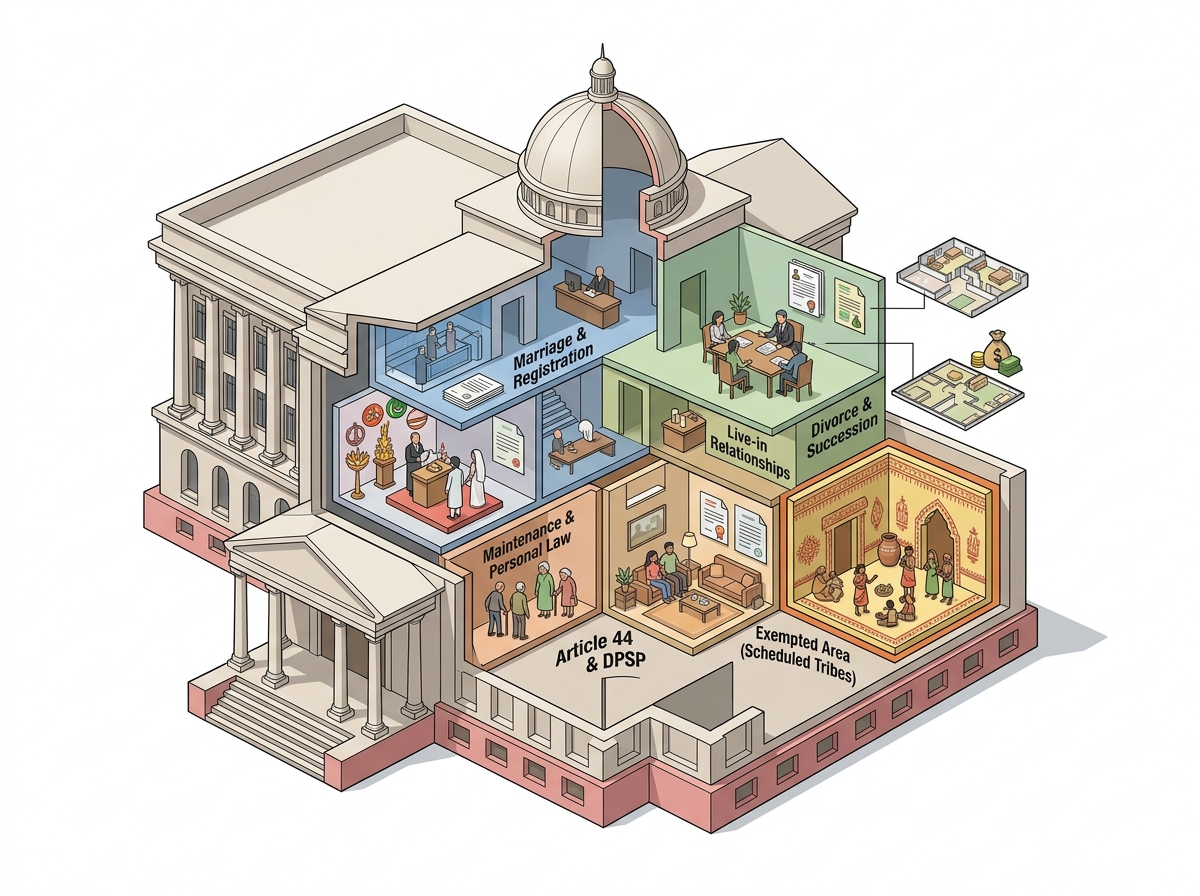
13 Aug Rajasthan Cabinet Approves UCC Draft: Key Provisions & Tribal Exemptions
Uniform Civil Code BillLegislative AssemblyScheduled TribesMarriage lawsDivorce provisionsSuccession rules✎ The Rajasthan UCC Bill 2026 proposes a uniform legal framework for marriage, divorce, succession, and live-in relationships, exempting Scheduled Tribes, and aligns with Article 44 of the Constitution and Supreme Court directives…
Subject Relevance — Where This Topic Fits
- GS Paper II — Polity and Governance | GS Paper III — Social Justice
- Prelims: Uniform Civil Code, Article 44, Personal Laws (Amendment) Act, 2024, Scheduled Tribes and Sixth Schedule, Liv-in Relationships (Registration)
- Essay: Uniform Civil Code: Balancing Uniformity and Pluralism in Indian Society
Quick Revision: The Rajasthan UCC Bill 2026 proposes a uniform legal framework for marriage, divorce, succession, and live-in relationships, exempting Scheduled Tribes, and aligns with Article 44 of the Constitution and Supreme Court directives on gender justice in personal laws.
Why is this in the news?
The Rajasthan Cabinet’s approval of the draft Uniform Civil Code (UCC) Bill 2026 marks a significant development in the state’s legislative agenda. The Bill, slated for introduction in the upcoming Legislative Assembly session, proposes a uniform legal framework for marriage, divorce, succession, maintenance, and registration of live-in relationships, while exempting Scheduled Tribes from its purview. This initiative aligns with ongoing national debates on the UCC and its implications for personal laws, gender justice, and constitutional uniformity.
Background
- The concept of a Uniform Civil Code (UCC) is enshrined in Article 44 of the Indian Constitution, which forms part of the Directive Principles of State Policy (DPSP) and directs the State to endeavour to secure a uniform civil code for all citizens.
- The Supreme Court of India has, in multiple judgments (e.g., *Shayara Bano v. Union of India*, 2017), emphasised the need for a UCC to address gender discrimination in personal laws, particularly in matters of polygamy, triple talaq, and maintenance rights.
- Several states, including Uttarakhand (2024) and Assam (2025), have initiated steps toward implementing a UCC, reflecting a growing state-level engagement with the issue.
- Personal laws in India are currently governed by religious texts and customary practices, leading to differential treatment across communities in matters such as marriage, inheritance, and divorce.
- The exemption of Scheduled Tribes from the UCC is rooted in the constitutional safeguards under the Fifth and Sixth Schedules, which protect tribal customary laws and practices.
What is the Rajasthan Uniform Civil Code Bill 2026?
- The Bill seeks to replace existing personal laws with a single, uniform legal framework applicable to all citizens of Rajasthan, irrespective of religion, except Scheduled Tribes.
- Key provisions include mandatory registration of marriages within 60 days of solemnisation to ensure legal recognition and prevent fraudulent practices.
- The Bill introduces a uniform framework for divorce, succession, and maintenance, replacing diverse religious and customary laws with a single set of rules to promote gender equality and legal parity.
- Written notification or registration of the start and end of live-in relationships is provided to ensure transparency and prevent exploitation.
- The Bill exempts Scheduled Tribes from its purview, recognising the constitutional protection of tribal customary laws and practices under the Fifth and Sixth Schedules.
- The proposed legal framework aims to address gender disparities in personal laws, such as unequal inheritance rights, lack of alimony provisions, and discriminatory divorce practices.
- The Bill is aligned with the Supreme Court’s observations in *Shayara Bano v. Union of India* (2017), which called for a UCC to eliminate gender discrimination in personal laws.
- The draft Bill is a state-level initiative and does not override the central government’s jurisdiction over personal laws, which remain under the Concurrent List (Entry 5 of the Concurrent List).
Key Features
| Feature | Significance |
|---|---|
| Uniform Civil Code (UCC) Draft Approval | Establishes a legal framework for uniform personal laws governing marriage, divorce, inheritance, and live-in relationships, replacing existing personal laws based on religion. |
| Mandatory Registration of Live-in Relationships | Introduces a formal registration system for live-in relationships, enhancing legal recognition and accountability in such arrangements. |
| Exemption for Scheduled Tribes (STs) | Provides constitutional protection to tribal communities by exempting them from the UCC, respecting customary practices and autonomy. |
| Tree Protection Bill, 2026 | Prohibits unauthorized tree felling and mandates compensatory afforestation for permitted cuts, ensuring ecological sustainability. |
| Six-Decade-Old Tree Species List | Identifies 29 ecologically and economically significant tree species (e.g., Khejri, Rohida, Banyan) for enhanced conservation measures. |
| Five-Tier Institutional Framework for Rural Water Supply | Creates a decentralized governance structure from Gram Panchayats to State level to ensure equitable and quality water supply in rural areas. |
Why it Matters
Legal and Constitutional
- Codifies personal laws into a single civil code, aligning with the constitutional directive under Article 44 (DPSP) for a Uniform Civil Code.
- Ensures gender justice by standardizing inheritance, divorce, and maintenance laws across religions, reducing discriminatory practices.
- Formalizes live-in relationships, addressing gaps in legal recognition and rights of cohabiting partners.
Administrative and Governance
- Introduces a structured registration system for live-in relationships, reducing ambiguity in legal disputes.
- Strengthens decentralized governance in rural water supply, improving service delivery and accountability.
- Enhances environmental governance through the Tree Protection Bill, balancing developmental needs with ecological preservation.
Social and Cultural
- Respects tribal autonomy by exempting Scheduled Tribes from the UCC, preserving customary practices and social structures.
- Promotes gender equality by ensuring uniform maintenance and inheritance rights, reducing patriarchal biases in personal laws.
- Encourages formalization of relationships, reducing informal and unregulated social arrangements.
Challenges
1. Implementation of Uniform Civil Code
- Potential resistance from religious and community groups due to perceived interference in personal laws.
- Need for extensive awareness campaigns to ensure public understanding and acceptance of the new legal framework.
- Challenges in harmonizing the UCC with existing personal laws and customary practices in tribal areas.
UPSC Link: GS-II: Fundamental Rights & DPSP
2. Enforcement of Tree Protection Measures
- Risk of illegal logging and deforestation due to weak enforcement mechanisms in rural areas.
- Balancing developmental projects with ecological conservation, particularly in tribal and forest-dependent communities.
- Ensuring compliance with compensatory afforestation mandates without creating administrative bottlenecks.
UPSC Link: GS-III: Environment & Ecology
3. Rural Water Supply Governance
- Ensuring equitable distribution of water resources in drought-prone and water-scarce regions of Rajasthan.
- Addressing funding and infrastructure gaps in the five-tier institutional framework.
- Preventing leakage and wastage in water supply systems through robust monitoring and maintenance.
UPSC Link: GS-II: Governance & Public Policy
Challenges — UPSC Perspective
| Issue | Concern |
|---|---|
| Religious and Community Resistance | Potential backlash from groups opposing uniform personal laws on grounds of religious freedom. |
| Tribal Exemptions and Customary Laws | Risk of conflicts between UCC provisions and tribal customary practices, requiring careful integration. |
| Enforcement of Live-in Relationship Registration | Challenges in tracking and registering live-in relationships, especially in rural and informal settlements. |
| Illegal Tree Felling and Deforestation | High likelihood of unauthorized logging due to weak enforcement and high demand for timber. |
| Rural Water Supply Infrastructure Gaps | Inadequate funding and technical capacity in rural areas to implement the five-tier governance model. |
| Public Awareness and Legal Literacy | Need for extensive outreach to ensure citizens understand the implications of the new laws. |
Way Forward
- Constitute a high-level committee to draft detailed rules and guidelines for implementing the UCC, ensuring clarity and uniformity across jurisdictions.
- Launch statewide awareness campaigns in collaboration with local bodies, NGOs, and educational institutions to educate citizens on the UCC and its provisions.
- Strengthen enforcement mechanisms for the Tree Protection Bill by training forest officials and empowering local communities in monitoring tree felling.
- Develop a robust monitoring framework for the five-tier rural water supply governance structure, with clear performance indicators and accountability measures.
- Conduct pilot projects in select districts to test the UCC’s implementation, addressing challenges before statewide rollout.
- Establish grievance redressal mechanisms for tribal communities to address concerns regarding the UCC’s exemptions and customary practices.
- Integrate environmental education in school curricula to foster a culture of conservation and sustainable resource management.
- Ensure adequate funding and capacity-building for Gram Panchayats to execute rural water supply policies effectively.
UPSC Value Addition
Keywords for Mains Answer-Writing
Uniform Civil Code (UCC) · Article 44 of the Constitution · personal laws · Scheduled Tribes (STs) · living-in relationships · marriage registration · inheritance rights · divorce laws · maintenance rights · Rajasthan Legislative Assembly · State List (7th Schedule) · Directive Principles of State Policy · right to equality (Article 14) · right to freedom of religion (Article 25)
Constitutional & Policy Linkages
- Article 44 (Directive Principle of State Policy) – Uniform Civil Code
- Article 14 (Right to Equality) – Ensuring uniformity in personal laws
- Article 21 (Right to Life and Personal Liberty) – Balancing individual rights with societal norms
- Fifth Schedule (Tribal Areas) – Exemptions for Scheduled Tribes
Concept Flow
State Cabinet approves draft of UCC and Tree Protection Bill → Bills introduced in State Assembly → Legislative debate and scrutiny → Passage and assent by Governor → Notification and implementation of provisions → Public awareness and capacity-building → Enforcement and monitoring → Periodic review and amendments based on feedback
Prelims Practice Questions
Q1. Consider the following statements regarding the Uniform Civil Code (UCC):
1. The UCC is explicitly mentioned in Part IV of the Constitution under Directive Principles of State Policy.
2. Article 44 of the Constitution directs the State to secure a Uniform Civil Code for the citizens of India.
3. The UCC, if implemented, would replace all personal laws in India.
4. The Supreme Court of India has, in several judgments, directed the Union Government to frame a UCC.
How many of the above statements are correct?
- Only one
- Only two
- Only three
- All four
Answer: All four — Statements 1, 2, and 4 are correct. Statement 3 is incorrect as the UCC, if implemented, would not necessarily replace all personal laws but would provide a common legal framework for civil matters.
Q2. Assertion (A): The Rajasthan Legislative Assembly has the legislative competence to introduce a Uniform Civil Code (UCC) Bill under the State List.
Reason (R): Personal laws fall under the Concurrent List of the Seventh Schedule of the Constitution of India.
- Both A and R are true, and R is the correct explanation of A
- Both A and R are true, but R is NOT the correct explanation of A
- A is true but R is false
- A is false but R is true
Answer: A is false but R is true — Assertion (A) is true as the State Legislature can legislate on matters not explicitly excluded from the State List. Reason (R) is false because personal laws fall under the Concurrent List (Entry 5), not the State List.
Q3. Which of the following provisions is NOT typically included under a Uniform Civil Code (UCC)?
- Mandatory registration of live-in relationships
- Uniform rules for inheritance and succession
- Compulsory conversion of all religious personal laws into civil laws
- Standardized procedures for divorce and maintenance
Answer: Compulsory conversion of all religious personal laws into civil laws — A Uniform Civil Code does not mandate the conversion of religious personal laws into civil laws; it aims to provide a common legal framework for civil matters such as marriage, divorce, inheritance, and maintenance.
Mains Practice Question
✍ The Rajasthan Cabinet has approved the draft of the Uniform Civil Code (UCC) Bill, 2026, proposing a common legal framework for marriage, divorce, inheritance, and maintenance while exempting Scheduled Tribes. Critically examine the constitutional validity and implications of the UCC in the context of India’s federal structure and fundamental rights. (15 Marks)
Approach: MODEL-ANSWER SKELETON:
1. **Constitutional Basis**:
– Article 44 of the Constitution (DPSP) directs the State to secure a Uniform Civil Code.
– The UCC is not enforceable as a fundamental right but is a directive principle.
– The Supreme Court has, in judgments like *Shayara Bano v. Union of India* (2017) and *Jose Paulo Coutinho v. Maria Luiza Valentina Pereira* (2019), reiterated the need for a UCC.
2. **Federal Structure and Legislative Competence**:
– Personal laws fall under the Concurrent List (Entry 5), allowing both Parliament and State Legislatures to legislate.
– Rajasthan’s competence to introduce a UCC Bill is derived from Entry 5 and the absence of any bar under the Constitution.
– The principle of federalism does not prevent State-level experimentation in governance.
3. **Fundamental Rights and Personal Laws**:
– The UCC aims to address inequalities arising from diverse personal laws under Articles 14 (right to equality) and 25 (right to freedom of religion).
– The exemption for Scheduled Tribes (STs) raises questions about the scope of Article 14 and the constitutional mandate under Article 44.
– The balance between uniformity and cultural rights must be examined.
4. **Implications and Challenges**:
– **Uniformity vs. Diversity**: The UCC could reduce discrimination but may also infringe upon religious freedoms guaranteed under Article 25.
– **Implementation**: Challenges include resistance from communities, enforcement mechanisms, and the need for consensus.
– **Judicial Review**: The Supreme Court’s role in interpreting the UCC’s validity and its alignment with fundamental rights.
5. **Comparative Perspective**:
– Reference to Goa’s UCC (1961) as a model, which applies uniformly to all citizens regardless of religion.
– Lessons from other countries with civil codes (e.g., France, Turkey) and their socio-cultural contexts.
6. **Conclusion**:
– The UCC is a progressive step toward gender justice and equality but must be balanced with constitutional safeguards.
– The Rajasthan initiative highlights the need for a broader national debate on the UCC’s feasibility and desirability.
Source: amarujala.com
Generated by AanyaAi for educational purpose.

- Gurugram’s groundwater extraction exceeds limit by 212%; HC seeks ban - October 4, 2026
- स्वतंत्रता सेनानी श्यामजी कृष्ण वर्मा की जन्म जयंती पर पीएम का श्रद्धांजलि - October 4, 2026
- KWML’s Feasibility Reports for Water Metro in 18 Cities: UPSC & PCS Insights - October 3, 2026

No Comments