


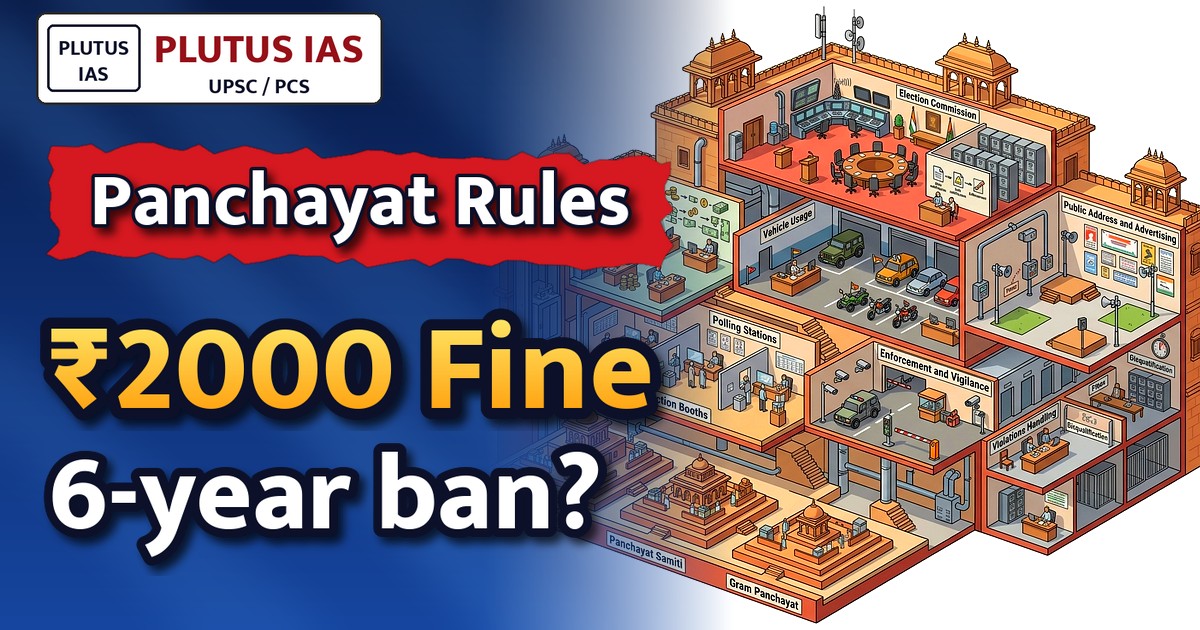
28 Sep Rajasthan Panchayati Raj Elections: New Rules, Fines & Disqualification
✎ State Election Commissions regulate local body elections under Article 243K; Rajasthan SEC has imposed expenditure limits, vehicle usage caps, loudspeaker time restrictions, and disqualification for violations in Panchayati Raj…
Subject Relevance — Where This Topic Fits
- GS Paper II — Constitutional, Statutory, Regulatory and various Quasi-judicial Bodies (State Election Commissions) | GS Paper II — Functions and Responsibilities of the Union and the States, Issues and Challenges Pertaining to the Federal Structure | GS Paper III — Government Budgeting and Expenditure Management
- Prelims: Panchayati Raj System, State Election Commission, Model Code of Conduct for Local Body Elections, Election Expenditure Limits, Disqualification Provisions under Representation of the People Act, Local Governance Reforms
Quick Revision: State Election Commissions regulate local body elections under Article 243K; Rajasthan SEC has imposed expenditure limits, vehicle usage caps, loudspeaker time restrictions, and disqualification for violations in Panchayati Raj polls.
Why is this in the news?
The Rajasthan State Election Commission has notified stringent regulations governing election expenditure, use of vehicles, loudspeakers, and display of posters for candidates contesting Panchayati Raj elections. These rules introduce expenditure ceilings, vehicle usage limits, time-bound restrictions on loudspeakers, and penal provisions including fines and disqualification for violations, aimed at ensuring fairness and curbing malpractices in grassroots democratic processes.
Background
- The Panchayati Raj system in India, established under the 73rd Constitutional Amendment Act, 1992, provides for a three-tier structure of local self-government in rural areas.
- State Election Commissions (SECs) are constitutional bodies under Article 243K, responsible for conducting elections to Panchayati Raj institutions.
- Expenditure regulation in local body elections is a critical governance tool to prevent undue influence of money power and ensure equitable electoral competition.
- Rajasthan, with a robust Panchayati Raj system, has historically been proactive in electoral reforms at the local level.
- The notified rules align with the broader objective of strengthening democratic decentralisation while maintaining fiscal discipline in local governance.
What are the notified regulations for Panchayati Raj elections in Rajasthan?
- The Rajasthan State Election Commission has prescribed maximum expenditure limits for candidates contesting Panchayati Raj elections: ₹3 lakh for Zila Parishad members, ₹1.5 lakh for Panchayat Samiti members, and ₹1 lakh for Sarpanches.
- Strict limits have been imposed on the number of vehicles that can be used for campaigning: up to 3 vehicles for Zila Parishad candidates, 2 for Panchayat Samiti candidates, and 1 for Sarpanch candidates.
- The use of buses, trucks, mini-buses, and animal-drawn vehicles for campaigning has been completely prohibited to prevent unnecessary display of power and crowd mobilisation.
- Loudspeakers are banned after 10 PM to minimise noise pollution and public disturbance.
- Unauthorised display of posters, banners, or hoardings is prohibited, and all campaign material must comply with the prescribed formats and locations.
- Violations of these rules attract a fine of ₹2,000 and disqualification from contesting elections for a period of six years.
- The regulations are intended to enhance transparency, reduce electoral malpractices, and ensure a level playing field for all candidates in Panchayati Raj elections.
- The State Election Commission has emphasised strict compliance, noting that candidates must adhere to these norms at every stage of the electoral process.
Key Features
| Feature | Significance |
|---|---|
| Expenditure Ceiling (₹1–3 lakh) | Prevents financial inequality and reduces the influence of money power in rural elections, aligning with the constitutional mandate of free and fair elections under Article 324. |
| Vehicle Usage Limits (1–3 vehicles) | Curbs ostentatious campaigning, reduces environmental pollution, and ensures equitable access to campaign platforms for all candidates. |
| Loudspeaker Ban (10 PM–6 AM) | Mitigates noise pollution, respects public tranquility, and ensures compliance with environmental and public order norms. |
| Prohibition Near Sensitive Areas (100m from hospitals/schools) | Balances electoral freedom with the right to public health and education, as recognised under Directive Principles of State Policy. |
| Disqualification & Fine (₹2,000 + 6 years) | Enforces strict compliance with expenditure and conduct norms, deterring malpractices and ensuring electoral integrity. |
Why it Matters
Electoral Integrity
- Strengthens the credibility of panchayati raj elections by institutionalising transparent expenditure norms, reducing the risk of undue influence by affluent candidates.
- Ensures a level playing field by capping campaign expenditures, thereby preventing the misuse of financial resources to sway voter behaviour.
- Enhances public trust in local governance institutions by demonstrating adherence to democratic principles of fairness and equity.
Constitutional Framework
- Operationalises the constitutional directive under Article 324 (Election Commission’s superintendence) to conduct elections in a manner that is free and fair, as envisaged in Part IX of the Constitution.
- Supports the Directive Principles of State Policy (Article 46) by promoting equitable resource distribution and preventing exploitation through excessive campaign spending.
Administrative Efficiency
- Streamlines the electoral process by standardising campaign conduct, reducing administrative arbitrariness in enforcement.
- Facilitates easier monitoring and auditing of campaign expenditures, thereby improving the State Election Commission’s oversight capabilities.
Environmental & Public Order
- Reduces vehicular congestion and air pollution during election campaigns by limiting the number of vehicles used.
- Minimises noise pollution and public disturbance through strict timings for loudspeaker use, aligning with environmental and public order regulations.
Challenges
1. Enforcement and Monitoring
- Risk of inadequate field-level monitoring by the State Election Commission, particularly in remote rural areas.
- Potential delays in adjudication of expenditure violations, undermining the deterrent effect of disqualification.
- Challenges in distinguishing between legitimate campaign expenses and violations, requiring robust documentation and auditing mechanisms.
UPSC Link: Election Commission of India
2. Cultural and Social Resistance
- Traditional campaign practices, such as large-scale rallies and vehicle processions, may face resistance from candidates accustomed to unrestricted campaigning.
- Local political dynamics may pressure enforcement agencies to overlook minor violations, compromising the uniformity of application of rules.
UPSC Link: Panchayati Raj System
3. Resource Constraints
- Limited administrative capacity of the State Election Commission to conduct real-time audits of campaign expenditures across all panchayati raj institutions.
- Insufficient digital infrastructure for tracking and verifying expenditure declarations, leading to potential loopholes.
UPSC Link: State Election Commissions
4. Legal and Procedural Hurdles
- Complexity in defining and quantifying
UPSC Link: Model Code of Conduct
5. Public Awareness Deficit
- Low awareness among voters and candidates about the new norms, leading to unintentional violations and disputes.
- Need for sustained voter education campaigns to ensure compliance and acceptance of the revised rules.
UPSC Link: Voter Education
Challenges — UPSC Perspective
| Issue | Concern |
|---|---|
| Monitoring Gaps | Inadequate field-level supervision may lead to undetected violations of expenditure or vehicle usage norms. |
| Cultural Resistance | Deep-rooted local campaign practices may clash with the new regulations, fostering non-compliance. |
| Resource Constraints | Limited administrative and technological capacity hampers real-time tracking of campaign expenditures. |
| Legal Ambiguity | Unclear definitions of |
| Public Awareness | Lack of awareness among candidates and voters may result in unintentional breaches of the rules. |
Way Forward
- Conduct pre-election workshops for candidates, Returning Officers, and enforcement agencies to clarify expenditure norms and reporting mechanisms.
- Develop a digital platform for real-time tracking of campaign expenditures, integrating with the State Election Commission’s existing systems.
- Strengthen the capacity of the State Election Commission by deploying additional audit teams and training officials on expenditure verification.
- Launch targeted voter education campaigns through local media, gram sabhas, and digital channels to disseminate the new rules.
- Establish a grievance redressal mechanism for candidates and the public to report violations, ensuring timely resolution.
- Collaborate with the State Pollution Control Board and local authorities to monitor noise pollution and vehicular restrictions during campaigns.
- Publish a quarterly report on the enforcement of expenditure norms, highlighting trends and areas for improvement.
- Incorporate feedback from stakeholders, including candidates and civil society, to refine the rules and address implementation challenges.
UPSC Value Addition
Keywords for Mains Answer-Writing
Panchayati Raj System · State Election Commission · Model Code of Conduct · Campaign Expenditure Limits · Electoral Disqualification · Election Rules and Regulations · Grama Sabha · Panchayat Samiti · Zila Parishad · Electoral Reforms in Local Governance · Constitutional Provisions for Panchayats (Article 243 to 243-O) · Electoral Accountability Mechanisms
Constitutional & Policy Linkages
- Article 324: Superintendence, direction and control of elections.
- Article 243: Provisions relating to Panchayats.
- Article 46: Promotion of educational and economic interests of weaker sections.
- Part IX: Panchayats in the Constitution.
Concept Flow
Declaration of panchayati raj elections by State Election Commission under Article 324 and Part IX of the Constitution. → Formulation of expenditure and conduct norms to ensure free and fair elections. → Imposition of ceilings on campaign expenditures and vehicle usage to curb money power and ostentatious campaigning. → Enforcement through disqualification and fines for violations, ensuring compliance with electoral integrity. → Monitoring and auditing of campaign expenditures by the State Election Commission. → Public awareness and stakeholder engagement to facilitate smooth implementation. → Continuous feedback and refinement of norms based on enforcement challenges.
Prelims Practice Questions
Q1. Consider the following statements regarding the Panchayati Raj System in India:
1. The State Election Commission is responsible for conducting elections to the Panchayati Raj institutions.
2. The expenditure limits for campaigning in Panchayat elections are uniform across all states.
3. The disqualification period for electoral malpractice in Panchayat elections is determined by the State Election Commission.
4. The Panchayati Raj Act, 1993, mandates the reservation of seats for women in Panchayati Raj institutions.
How many of the above statements are correct?
- Only one
- Only two
- Only three
- All
Answer: All — Statements 1, 3, and 4 are correct. Statement 2 is incorrect as expenditure limits for campaigning in Panchayat elections vary across states and are determined by the respective State Election Commissions or state governments.
Q2. Assertion (A): The State Election Commission in Rajasthan has recently revised the campaign expenditure limits for Panchayati Raj elections.
Reason (R): The revision aims to curb excessive campaign spending and promote electoral fairness.
Options:
A. Both A and R are true, and R is the correct explanation of A.
B. Both A and R are true, but R is not the correct explanation of A.
C. A is true, but R is false.
D. A is false, but R is true.
Answer: ? — Both the assertion and reason are true. The State Election Commission in Rajasthan has indeed revised campaign expenditure limits for Panchayati Raj elections to ensure fairness and curb excessive spending, making R the correct explanation of A.
Q3. Match the following columns related to Panchayati Raj institutions in India:
Column I (Institution) | Column II (Responsibility)
1. Gram Panchayat | A. Coordination between Gram Panchayats and Zila Parishad
2. Panchayat Samiti | B. Implementation of rural development schemes at the village level
3. Zila Parishad | C. Supervision of Panchayat Samitis within a district
4. State Election Commission | D. Conducting elections to Panchayati Raj institutions
Options:
A. 1-B, 2-A, 3-C, 4-D
B. 1-D, 2-C, 3-A, 4-B
C. 1-C, 2-B, 3-A, 4-D
D. 1-A, 2-D, 3-B, 4-C
Answer: ? — The correct match is: 1-B (Gram Panchayat: Implementation of rural development schemes at the village level), 2-A (Panchayat Samiti: Coordination between Gram Panchayats and Zila Parishad), 3-C (Zila Parishad: Supervision of Panchayat Samitis within a district), 4-D (State Election Commission: Conducting elections to Panchayati Raj institutions).
Mains Practice Question
✍ The State Election Commission of Rajasthan has recently notified stringent rules governing campaign expenditure, vehicle usage, and the use of loudspeakers during Panchayati Raj elections, including provisions for fines and disqualification for violations. Critically examine the significance of these measures in the context of electoral reforms in local governance. Also, analyse the constitutional framework governing the autonomy and accountability of State Election Commissions in India. (15 Marks)
Approach: MODEL-ANSWER SKELETON:
1. **Introduction (2 Marks)**
– Briefly define the Panchayati Raj System and its constitutional basis (Articles 243 to 243-O of the Constitution).
– Highlight the role of State Election Commissions in conducting free and fair elections to local bodies.
2. **Significance of the Measures (5 Marks)**
– **Curbing Electoral Expenditure**: Discuss how setting expenditure limits (₹1 lakh for Sarpanch, ₹1.5 lakh for Panchayat Samiti members, ₹3 lakh for Zila Parishad members) promotes electoral fairness and reduces the influence of money power.
– **Regulating Campaign Practices**: Explain the rationale behind restricting vehicle usage (1-3 vehicles) and banning loudspeakers post 10 PM to minimise noise pollution and ensure public order.
– **Disqualification Provisions**: Analyse how the six-year disqualification for violations strengthens electoral accountability and deters malpractices.
– **Comparative Perspective**: Contrast these measures with other states’ approaches to electoral reforms in local governance.
3. **Constitutional Framework for State Election Commissions (5 Marks)**
– **Autonomy**: Discuss Article 243-K, which empowers State Election Commissions to supervise, direct, and control the preparation of electoral rolls and the conduct of elections.
– **Accountability**: Examine the balance between autonomy and accountability, including the role of the judiciary in reviewing decisions of State Election Commissions.
– **Judicial Precedents**: Cite landmark judgments such as *T.N. Seshan v. Union of India* (1995) and *State of U.P. v. Raj Narain* (1975) to highlight the judiciary’s role in safeguarding electoral integrity.
4. **Challenges and Way Forward (3 Marks)**
– **Implementation Challenges**: Discuss potential challenges in enforcing these rules, such as monitoring expenditure and vehicle usage.
– **Suggestions for Reform**: Propose measures like digital tracking of campaign expenses, public awareness campaigns, and capacity-building for election officials to enhance compliance.
5. **Conclusion (2 Marks)**
– Summarise the importance of these measures in strengthening democratic decentralisation and local governance.
– Emphasise the need for continuous evaluation and adaptation of electoral rules to evolving challenges.
Source: amarujala.com
Rajasthan PCS (RPSC / RAS) — State PCS Practice
Prelims: As per the recent amendments to the Rajasthan Panchayati Raj Election Rules, what is the penalty for violation of election norms?
- A fine of ₹2,000 and disqualification for 6 years
- A fine of ₹5,000 and disqualification for 5 years
- A fine of ₹1,000 and disqualification for 3 years
- A fine of ₹10,000 and disqualification for 10 years
Answer: A fine of ₹2,000 and disqualification for 6 years — The recent amendments specify a fine of ₹2,000 and a disqualification period of 6 years for violations of Panchayati Raj election norms in Rajasthan.
Mains: Discuss the significance of the recent amendments to the Rajasthan Panchayati Raj Election Rules in ensuring free and fair elections at the grassroots level. Highlight the role of these rules in strengthening democratic decentralization in the state.
Generated by AanyaAi for educational purpose.
Related guides on our sites
- Best PSIR optional coaching for upsc
- Best PSIR optional teacher for upsc
- Best teacher of PSIR optional for upsc
- Best PSIR optional coaching in delhi for UPSC

- Rajasthan Panchayati Raj Elections: New Rules, Fines & Disqualification - September 28, 2026
- सेना प्रमुख का बड़ा बयान: जीत जमीन से ही तय होती है, तकनीक नहीं बदल सकती युद्ध की प्रकृति - September 28, 2026
- UPSC Alert: Government Cracks Down on Patwaris for SVAMITVA Scheme Refusals - September 28, 2026

No Comments