


29 Jul Rajnath Singh Unveils Gender-Parity & Ex-Gratia Reforms in Indian Coast Guard
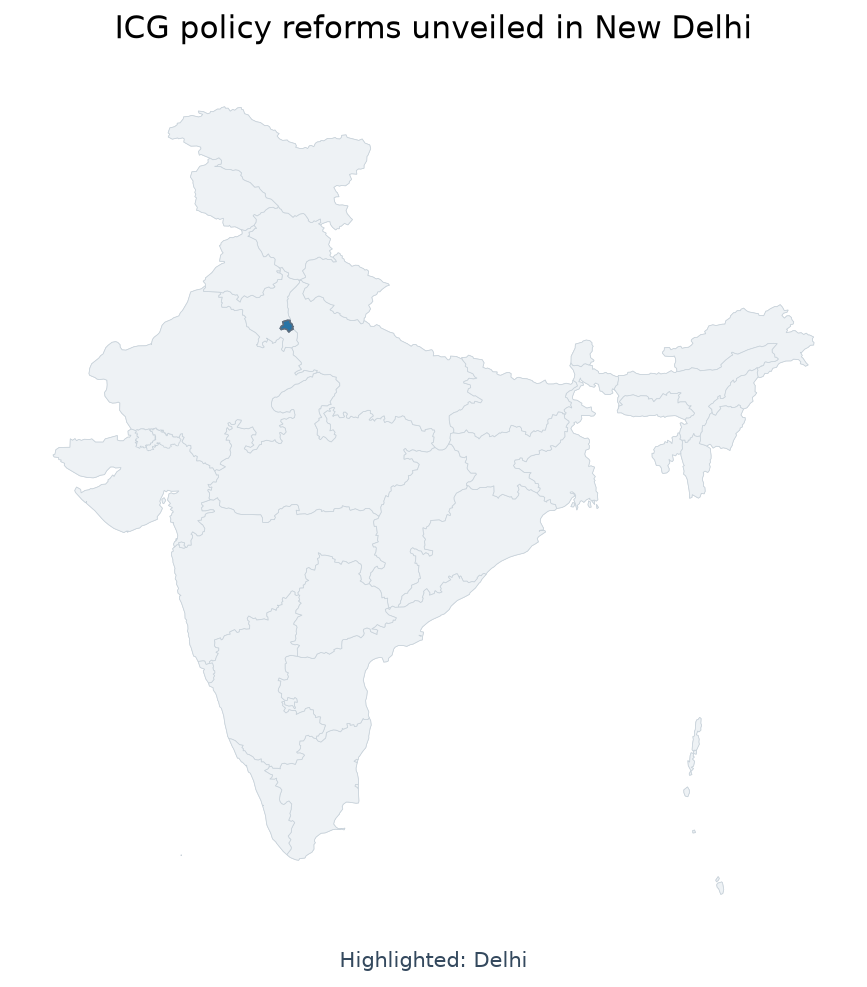
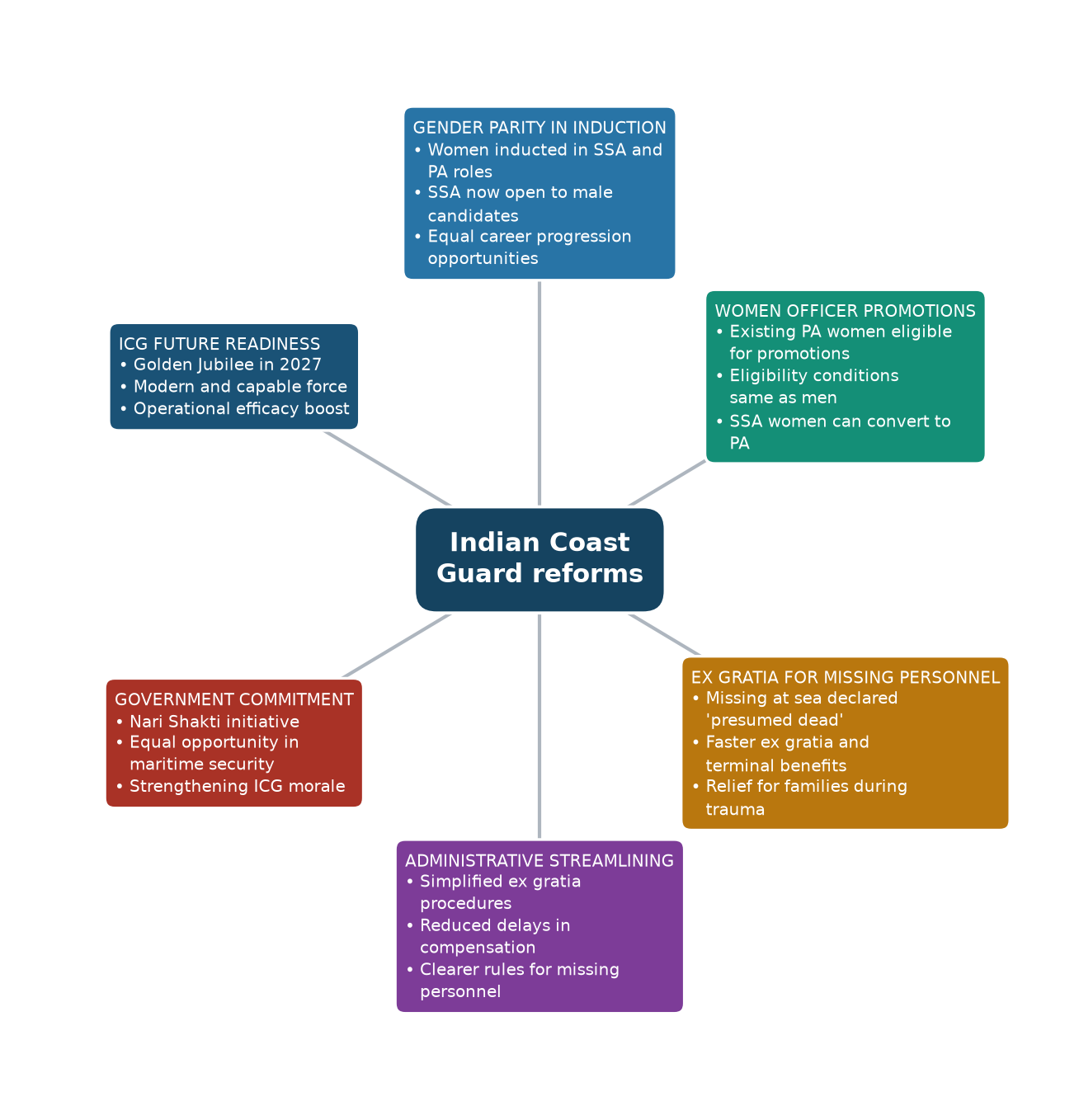
Map & concept mind-map: ICG policy reforms unveiled in New Delhi
Subject Relevance — Where This Topic Fits
- GS Paper III — Security: Challenges and their Management
- Prelims: Indian Coast Guard (ICG), Nari Shakti, ex gratia, gender-neutral induction, short service appointment (SSA), permanent appointment (PA), presumed death, terminal benefits
- Essay: Role of women in national security: Progress and challenges, Administrative reforms in defence services: Balancing efficiency and equity
Quick Revision: The Indian Coast Guard’s new reforms ensure gender parity in induction and streamline ex gratia for missing personnel, aligning with administrative efficiency goals.
Why is this in the news?
The Union Defence Minister, Shri Rajnath Singh, unveiled two significant policy reforms for the Indian Coast Guard (ICG) on 29 July 2026, aimed at promoting gender parity in officer induction and streamlining ex gratia procedures for personnel missing at sea. These reforms underscore the government’s commitment to inclusivity within maritime security while enhancing administrative efficiency for the families of personnel who make the ultimate sacrifice.
Background
- The Indian Coast Guard (ICG), established in 1978 under the Coast Guard Act, 1978, operates under the Ministry of Defence and is responsible for maritime law enforcement, search and rescue, and coastal security.
- Historically, the ICG has been a male-dominated force, with limited avenues for women officers, particularly in operational roles.
- The ICG’s golden jubilee in 2027 marks a milestone, necessitating modernisation and inclusivity to align with contemporary security paradigms.
- Ex gratia payments and terminal benefits for personnel missing at sea have often been delayed due to protracted administrative processes, causing distress to families.
- The reforms align with the government’s broader agenda of ‘Minimum Government, Maximum Governance’ by simplifying bureaucratic procedures.
What are the key reforms in the Indian Coast Guard?
- Gender-neutral induction framework: The ICG will now induct women officers into both short service appointments (SSA) and permanent appointments (PA) on equal terms with male officers, ensuring parity in career progression from the ab-initio training phase.
- Expansion of SSA to male candidates: The SSA scheme has been opened to male candidates, promoting inclusivity and flexibility in service tenures.
- Promotion eligibility for women officers: Existing PA women officers shall also be considered for promotion to higher positions subject to fulfilment of eligibility conditions. Existing serving women officers on SSA will also be provided an option to convert their service to PA, subject to stipulated conditions, enhancing career stability.
- Streamlined ex gratia for missing personnel: The policy empowers the ICG to declare personnel missing at sea as ‘presumed dead’ for ex gratia purposes, accelerating compensation and terminal benefits to next of kin.
- Administrative efficiency: The reforms reduce bureaucratic delays in processing ex gratia claims, ensuring timely support to families during emotional and financial distress.
- Operational morale enhancement: The reforms are expected to bolster the morale and operational efficacy of the ICG, reinforcing its role as a modern and inclusive maritime force.
Key Features
| Feature | Significance |
|---|---|
| Gender-neutral induction framework | Eliminates gender-based segregation in officer recruitment, aligning with constitutional provisions of equality (Article 14) and promoting ‘Nari Shakti’ in maritime security. |
| Inclusion of women in SSA and PA roles | Expands operational roles for women, ensuring equal career progression opportunities and operational readiness of the ICG. |
| Conversion option for SSA women officers to PA | Provides career flexibility, enabling retention of experienced women officers in permanent roles. |
| Presumed death declaration for missing personnel | Accelerates ex gratia disbursement, reducing administrative delays for families of personnel lost in service. |
| Streamlined ex gratia procedures | Ensures timely financial relief to next of kin, mitigating socio-economic vulnerabilities during crises. |
Why it Matters
Strategic/Operational
- Enhances operational efficacy by leveraging the full talent pool of the nation, including women, in maritime security operations.
- Strengthens the ICG’s preparedness for future challenges, including piracy, illegal migration, and maritime terrorism, by ensuring a diverse and motivated workforce.
- Improves morale and retention of personnel through transparent career progression policies and administrative reforms.
Social/Institutional
- Promotes gender parity in India’s defence services, setting a precedent for other paramilitary and armed forces.
- Demonstrates the government’s commitment to inclusive governance and the empowerment of women in traditionally male-dominated sectors.
- Reduces administrative burdens on families of personnel lost in service, aligning with the welfare objectives of the state.
Administrative/Reform
- Introduces progressive HR policies in the defence sector, reflecting adaptability to evolving societal norms and operational requirements.
- Streamlines bureaucratic processes, reducing red tape in critical areas such as ex gratia disbursement and personnel management.
Challenges
1. Operational Readiness in Gender-Integrated Forces
- Ensuring seamless integration of women officers into operational roles without compromising mission effectiveness or crew dynamics.
- Addressing logistical challenges in providing gender-specific infrastructure (e.g., accommodation, medical facilities) aboard ICG vessels.
- Training and sensitisation of male personnel to foster an inclusive and respectful working environment.
UPSC Link: GS Paper 3: Security Challenges
2. Administrative Delays in Ex Gratia Disbursement
- Mitigating delays in declaring personnel as ‘presumed dead’ due to the complexity of search and rescue operations at sea.
- Ensuring consistency in the application of ex gratia policies across different cases and regions.
- Balancing administrative efficiency with due diligence to prevent fraudulent claims.
UPSC Link: GS Paper 2: Governance
3. Socio-Economic Vulnerabilities of Affected Families
- Providing holistic support to families of personnel lost at sea, including financial literacy, counselling, and employment assistance.
- Ensuring that ex gratia and terminal benefits are sufficient to cover long-term needs, such as education and healthcare.
UPSC Link: GS Paper 1: Social Justice
Challenges — UPSC Perspective
| Issue | Concern |
|---|---|
| Infrastructure gaps for women officers | Lack of gender-specific facilities aboard ICG vessels may hinder operational deployment. |
| Cultural resistance in male-dominated units | Traditional biases could impede the integration of women officers in field roles. |
| Complexity in search and rescue operations | Prolonged uncertainty in declaring personnel missing at sea may delay ex gratia disbursement. |
| Administrative inconsistencies | Variations in policy application across regions could lead to inequities in compensation. |
| Long-term socio-economic impact on families | Insufficient ex gratia may not address the holistic needs of affected families. |
Way Forward
- Conduct periodic reviews of gender integration policies to assess operational and social outcomes, with feedback mechanisms for personnel.
- Expand gender-sensitisation programmes for all ICG personnel, including leadership training for commanding officers.
- Develop standard operating procedures (SOPs) for declaring personnel as ‘presumed dead’ to ensure uniformity and timeliness.
- Enhance infrastructure for women officers, including dedicated medical facilities and accommodation aboard vessels.
- Collaborate with NGOs and government agencies to provide holistic support to families of personnel lost at sea, including financial counselling.
- Establish a dedicated helpline or grievance redressal mechanism for personnel and their families to address administrative and operational concerns.
- Incorporate feedback from women officers and their male counterparts to refine induction and career progression policies.
UPSC Value Addition
Keywords for Mains Answer-Writing
Indian Coast Guard (ICG) · gender parity in armed forces · women-centric policy reforms · short service commission (SSC) in ICG · permanent commission in ICG · Nari Shakti · presumed death clause for missing personnel · ex gratia compensation for martyred ICG personnel · maritime security apparatus · operational efficacy of paramilitary forces
Constitutional & Policy Linkages
- Article 14: Equality before law and equal protection of laws.
- Article 15: Prohibition of discrimination on grounds of religion, race, caste, sex, or place of birth.
- Article 16: Equality of opportunity in matters of public employment.
Concept Flow
Policy reform announcement by Defence Minister → Gender-neutral induction framework introduced → Women officers inducted into SSA and PA roles → Career progression opportunities equalised → Operational readiness of ICG enhanced → Administrative reforms for ex gratia streamlined → Families of personnel receive timely financial relief → Morale and efficiency of ICG personnel improved → Contribution to ‘Nari Shakti’ and inclusive governance realised.
Prelims Practice Questions
Q1. Which of the following statements about the recent policy reforms in the Indian Coast Guard (ICG) is/are correct? 1. Women officers are now eligible for permanent commission in the ICG. 2. Short Service Commission (SSC) has been opened for male candidates. 3. The reforms include a ‘presumed death’ clause for ICG personnel missing at sea. 4. Ex gratia compensation is now granted immediately upon a personnel’s disappearance at sea.
- 1, 2 and 3 only
- 2 and 4 only
- 1, 3 and 4 only
- All of the above
Answer: 1, 2 and 3 only — Statement 1 is correct as the reforms allow women officers to be considered for permanent commission. Statement 2 is correct as SSC has been opened for male candidates. Statement 3 is correct as the reforms introduce a ‘presumed death’ clause for missing personnel. Statement 4 is incorrect as the reforms streamline but do not grant immediate ex gratia compensation.
Q2. The Indian Coast Guard (ICG) is set to achieve a significant milestone in 2027. Which of the following is correct about this milestone?
- Completion of 50 years of service
- Induction of 10,000 personnel
- Establishment of 50 coastal security stations
- Deployment of 50 offshore patrol vessels
Answer: Completion of 50 years of service — The ICG is marching toward its golden jubilee in 2027, marking 50 years of service since its establishment in 1977.
Mains Practice Question
✍ Critically examine the significance of the recent policy reforms unveiled by the Defence Minister for the Indian Coast Guard (ICG) in promoting gender parity and operational efficiency. How do these reforms align with broader national policies on women empowerment and maritime security?
Approach: Begin by outlining the key reforms: gender-neutral induction framework, opening SSC for males, permanent commission for women, and the ‘presumed death’ clause for missing personnel. Analyse their significance in promoting gender parity within the ICG and aligning with the ‘Nari Shakti’ initiative. Discuss the operational efficiency gains from streamlined ex gratia procedures. Conclude by linking these reforms to broader national policies such as the National Policy for Women Empowerment and the Sagarmala Project, emphasizing their role in strengthening maritime security.
Source: Times of India
Generated by AanyaAi for educational purpose.

- हिमाचल में डिजिटल भुगतान क्रांति: बिलासपुर अव्वल, महिलाओं की भागीदारी 93% तक पहुंची - September 23, 2026
- Himachal Pradesh Leads in Digital Payments: Bilaspur Tops, Women’s Role Rises - September 23, 2026
- केरल लोक सेवा आयोग ने उच्च न्यायालय में दायर किया मामला, सदस्यों के खिलाफ मामला रद्द करने की मांग - September 23, 2026

No Comments