


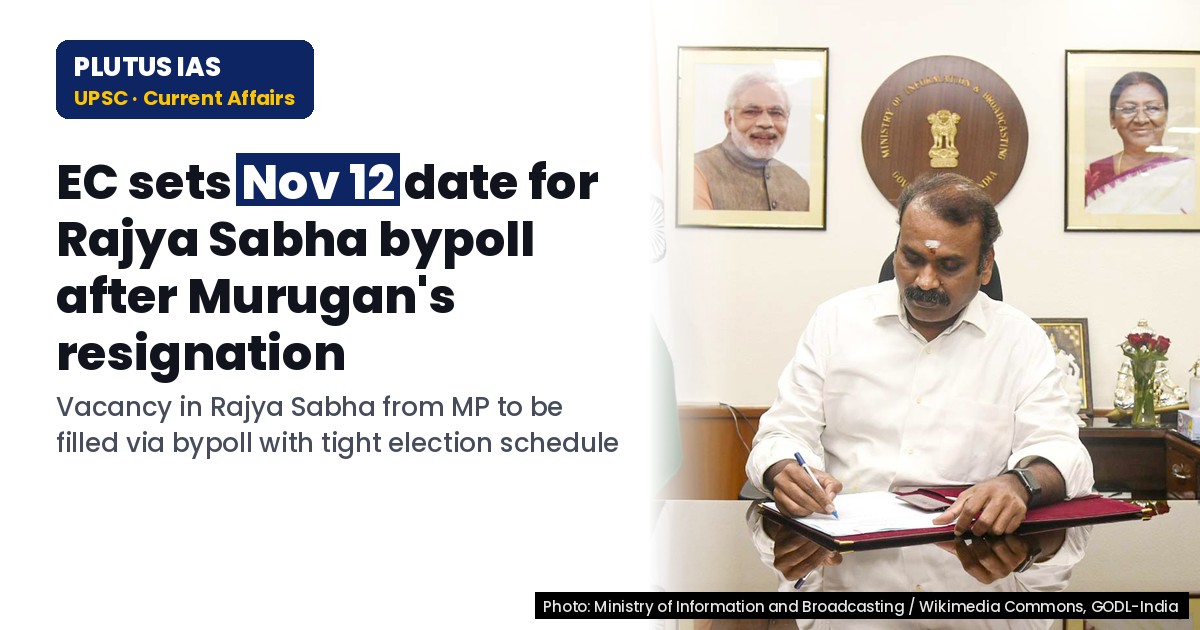
22 Oct Rajya Sabha Bypoll on November 12: Key Dates & Process Explained
✎ A Rajya Sabha by-election is conducted under the Representation of the People Act, 1951, to fill mid-term vacancies, with the Election Commission of India ensuring the process is completed expeditiously while adhering to…
Subject Relevance — Where This Topic Fits
- GS Paper II — Polity and Governance (Parliament and State Legislatures — functioning and conduct of elections) | GS Paper II — Constitutional Framework (Article 80 and provisions related to Rajya Sabha)
Quick Revision: A Rajya Sabha by-election is conducted under the Representation of the People Act, 1951, to fill mid-term vacancies, with the Election Commission of India ensuring the process is completed expeditiously while adhering to constitutional and statutory requirements.
Why is this in the news?
The Election Commission of India (ECI) has announced a by-election for a Rajya Sabha vacancy in Madhya Pradesh arising from the resignation of L. Murugan, with polling scheduled for November 12, 2026. This development underscores the constitutional and statutory framework governing Rajya Sabha elections, including the compressed timeline, preferential voting system, and measures to ensure electoral integrity. The event is significant for aspirants as it highlights the procedural and institutional dimensions of parliamentary representation and electoral governance in India.
Background
- The Rajya Sabha, or Council of States, is the upper house of Parliament, with members elected by the elected members of State Legislative Assemblies using a system of proportional representation by means of the single transferable vote.
- Article 80 of the Constitution of India specifies the composition of the Rajya Sabha, which includes 238 members elected by the States and Union Territories and 12 members nominated by the President for their special knowledge or practical experience in arts, science, sports, or social service.
- Vacancies in the Rajya Sabha can arise due to resignation, death, or disqualification of members, necessitating by-elections to ensure the continuity of representation.
- The Representation of the People Act, 1951, and the Conduct of Elections Rules, 1961, govern the process of elections to the Rajya Sabha, including the conduct of by-elections.
- The Election Commission of India (ECI) is the constitutional authority responsible for the superintendence, direction, and control of the preparation of electoral rolls and the conduct of all elections to Parliament and State Legislatures.
- The preferential voting system used in Rajya Sabha elections requires electors to mark their preferences on the ballot paper, necessitating strict measures to ensure the secrecy and integrity of the voting process.
What is a Rajya Sabha By-Election and How is it Conducted?
- A by-election to the Rajya Sabha is conducted to fill a vacancy that arises between general elections due to resignation, death, or disqualification of a member, ensuring the continuity of representation from the concerned State.
- The vacancy in the Rajya Sabha from Madhya Pradesh arose following the resignation of L. Murugan, whose term was originally scheduled to continue until April 2, 2030, highlighting the constitutional provision for mid-term vacancies.
- The Election Commission of India (ECI) is responsible for announcing and conducting the by-election, adhering to the statutory timeline prescribed under the Representation of the People Act, 1951, and the Conduct of Elections Rules, 1961.
- The by-election process includes the issuance of notifications, filing of nominations, scrutiny of nominations, withdrawal of candidatures, polling, and counting of votes, all to be completed within a compressed timeline to avoid prolonged vacancies.
- The preferential voting system in Rajya Sabha elections requires electors to mark their preferences on the ballot paper, typically using a specified pen to ensure the secrecy and integrity of the vote.
- The ECI has mandated the use of integrated violet colour sketch pens of pre-fixed specifications to prevent tampering or use of unauthorised writing instruments, thereby safeguarding the electoral process.
- Observers appointed by the ECI oversee the conduct of the election to ensure it is free, fair, and conducted in accordance with the highest standards of electoral integrity, including adherence to the Model Code of Conduct.
- The compressed timeline for the by-election, with polling on November 12, 2026, and completion by November 16, 2026, reflects the ECI’s commitment to expeditious resolution of vacancies while maintaining statutory compliance.
Key Features
| Feature | Significance |
|---|---|
| Vacancy arising from resignation | Ensures timely representation in the Rajya Sabha, maintaining constitutional balance in the Upper House of Parliament. |
| Tight election schedule | Expedites the electoral process while adhering to statutory timelines under the Representation of the People Act, 1951. |
| Mandatory use of violet sketch pens | Prevents tampering with ballot papers and ensures the integrity of the preferential voting system in Rajya Sabha elections. |
| Appointment of observers | Enhances transparency and fairness by monitoring the election process to uphold electoral integrity. |
| Compressed polling timeline | Minimises the duration of the vacancy while ensuring compliance with legal and procedural requirements. |
Why it Matters
Constitutional and Legal
- The by-election is mandated by Article 80(4) of the Constitution, which requires the Rajya Sabha to be filled in a manner prescribed by Parliament to ensure continuous representation.
- The Representation of the People Act, 1951, governs the conduct of elections to the Council of States, including provisions for by-elections and the electoral process.
- The Election Commission’s role in conducting elections is derived from Article 324, which vests it with superintendence, direction, and control over all elections.
Electoral Integrity
- The use of pre-specified violet sketch pens is a measure to prevent fraud and ensure the secrecy of the ballot, aligning with the principles of free and fair elections enshrined in the Constitution.
- Observers appointed by the Election Commission act as independent monitors to ensure adherence to electoral laws and prevent malpractices.
Parliamentary Representation
- The vacancy in the Rajya Sabha from Madhya Pradesh must be filled expeditiously to maintain the state’s representation in the Upper House, which plays a critical role in legislative processes such as the passage of bills and constitutional amendments.
- The Rajya Sabha’s composition ensures federal representation, and timely by-elections uphold this constitutional mandate.
Challenges
1. Ensuring Electoral Integrity
- Preventing the use of unauthorised writing instruments to maintain the secrecy and validity of ballots.
- Mitigating the risk of tampering or fraud during the compressed election timeline.
- Ensuring that the preferential voting system is not compromised by external influences.
UPSC Link: GS-II: Electoral Reforms and Challenges
2. Logistical and Administrative Hurdles
- Conducting the election within a tight schedule while ensuring all statutory requirements are met.
- Deploying observers and election officials across polling stations to maintain transparency and fairness.
- Coordinating with state authorities in Madhya Pradesh to facilitate the electoral process.
UPSC Link: GS-II: Election Management and Administration
3. Maintaining Political Neutrality
- Avoiding any perception of bias in the conduct of the election, given the high stakes of political representation.
- Ensuring that the Election Commission’s directives are implemented without interference or favouritism.
UPSC Link: GS-II: Role of Constitutional Bodies
Challenges — UPSC Perspective
| Issue | Concern |
|---|---|
| Unauthorised writing instruments | Risk of ballot tampering or invalidation due to non-compliance with prescribed voting tools. |
| Short election timeline | Potential for logistical bottlenecks in conducting polling, scrutiny, and counting within the stipulated period. |
| Observer deployment | Ensuring adequate and impartial monitoring across all stages of the election process. |
| State coordination | Facilitating smooth collaboration between the Election Commission and state authorities for election logistics. |
| Preferential voting integrity | Preventing manipulation of the ranked-choice voting system used in Rajya Sabha elections. |
Way Forward
- Conduct voter awareness campaigns in Madhya Pradesh to educate electors on the use of violet sketch pens and the preferential voting system.
- Deploy sufficient observers and election officials to ensure rigorous monitoring of polling stations and counting centres.
- Strengthen coordination between the Election Commission, state administration, and local authorities to address logistical challenges.
- Enforce strict penalties for violations of the prescribed voting procedures to deter tampering or fraud.
- Publish a detailed timeline and guidelines for political parties and candidates to facilitate compliance with electoral norms.
- Ensure transparency in the declaration of results by adhering to the prescribed counting procedures and timelines.
- Conduct post-election reviews to identify areas for improvement in future electoral processes.
UPSC Value Addition
Keywords for Mains Answer-Writing
Election Commission of India · Rajya Sabha by-elections · Representation of the People Act, 1951 · Council of States · Constitutional provisions for parliamentary vacancies · Electoral integrity in Rajya Sabha elections · Integrated violet sketch pens · Electoral observers · Statutory timelines for by-elections · Preferential voting system in Rajya Sabha · Constitutional mandate for timely representation · Role of the Election Commission under Article 324 · Vacancy in Rajya Sabha due to resignation · Electoral process transparency and fairness
Constitutional & Policy Linkages
- {‘Article 80(4)’: ‘Filling of vacancies in Rajya Sabha by election.’}
- {‘Article 324’: “Election Commission’s powers and duties.”}
- {‘Article 325’: ‘No discrimination in electoral rolls on grounds of religion, race, caste, or sex.’}
Concept Flow
Resignation of a Rajya Sabha member → Vacancy in the Upper House → Constitutional requirement for timely filling of the vacancy → Election Commission announces by-election schedule → Notification issued under Representation of the People Act → Candidates file nominations → Scrutiny of nominations → Withdrawal of candidatures → Polling day with preferential voting → Counting of votes → Declaration of results → Filling of the vacancy to restore representation
Prelims Practice Questions
Q1. Consider the following statements regarding the Election Commission of India (ECI):
1. The ECI is a constitutional body established under Article 324 of the Constitution of India.
2. The ECI conducts elections to the Rajya Sabha using a system of proportional representation by means of the single transferable vote.
3. The ECI has the power to disqualify candidates for electoral malpractices under the Representation of the People Act, 1951.
4. The ECI can mandate the use of specific writing instruments during elections to ensure secrecy and integrity.
How many of the above statements are correct?
- Only one
- Only two
- Only three
- All four
Answer: All four — Statements 1, 2, and 4 are correct. Statement 3 is incorrect because the power to disqualify candidates for electoral malpractices lies with the courts or the President under the relevant provisions of the Constitution and the Representation of the People Act, not solely with the ECI.
Q2. Assertion (A): The Election Commission of India (ECI) has directed the use of integrated violet sketch pens during Rajya Sabha by-elections to prevent tampering and ensure the secrecy of the ballot.
Reason (R): The use of unauthorised writing instruments can compromise the integrity of the preferential voting system used in Rajya Sabha elections.
In the context of the above two statements, which one of the following is correct?
- Both A and R are true, and R is the correct explanation of A
- Both A and R are true, but R is NOT the correct explanation of A
- A is true, but R is false
- A is false, but R is true
Answer: Both A and R are true, and R is the correct explanation of A — Both Assertion (A) and Reason (R) are true, and Reason (R) correctly explains Assertion (A). The ECI’s directive on integrated violet sketch pens is specifically aimed at preventing tampering and maintaining the secrecy of the ballot in the preferential voting system used for Rajya Sabha elections.
Q3. Match the following electoral processes with their respective timelines as prescribed by the Election Commission of India for a Rajya Sabha by-election:
Column I (Process) | Column II (Timeline)
———————————————–|————————–
A. Issue of notification | 1. November 2, 2026
B. Last date for filing nominations | 2. October 26, 2026
C. Scrutiny of nominations | 3. November 3, 2026
D. Withdrawal of candidatures | 4. November 5, 2026
E. Polling day | 5. November 12, 2026
- A-2, B-1, C-3, D-4, E-5
- A-1, B-2, C-3, D-4, E-5
- A-2, B-1, C-4, D-3, E-5
- A-3, B-2, C-1, D-4, E-5
Answer: A-2, B-1, C-3, D-4, E-5 — The correct match is A-2 (Issue of notification: October 26, 2026), B-1 (Last date for filing nominations: November 2, 2026), C-3 (Scrutiny of nominations: November 3, 2026), D-4 (Withdrawal of candidatures: November 5, 2026), and E-5 (Polling day: November 12, 2026).
Mains Practice Question
✍ The Election Commission of India (ECI) has recently announced a by-election to fill a vacancy in the Rajya Sabha arising from a resignation, adhering to a compressed statutory timeline. Critically examine the constitutional and statutory framework governing such by-elections, including the role of the ECI, the preferential voting system, and the measures adopted to ensure electoral integrity. Also, analyse the significance of timely representation in the Council of States for the federal structure of India. (15 Marks)
Approach: MODEL-ANSWER SKELETON:
1. **Constitutional and Statutory Framework** (5 points):
– Article 80 of the Constitution: Composition of Rajya Sabha and provision for filling casual vacancies (Article 80(4)).
– Representation of the People Act, 1951: Sections governing casual vacancies and by-elections (e.g., Section 151A).
– Role of the Election Commission under Article 324: Superintendence, direction, and control of elections.
– Statutory timelines: Representation of the People (Conduct of Elections to the Council of States) Rules, 1964, and their rationale for expeditious completion.
2. **Preferential Voting System and Electoral Integrity** (5 points):
– Proportional representation by means of the single transferable vote (STV) as prescribed under Article 80(4) and the Representation of the People Act.
– Measures adopted by the ECI: Use of integrated violet sketch pens to prevent tampering and ensure secrecy.
– Deployment of electoral observers to oversee the process and ensure fairness.
– Legal provisions against electoral malpractices (e.g., Section 123 of the Representation of the People Act).
3. **Significance for Federal Structure** (5 points):
– Role of Rajya Sabha as a federal chamber representing states and union territories.
– Timely representation ensures continuity in legislative processes and upholds the principle of federal governance.
– Impact of vacancies on the functioning of parliamentary committees and legislative business.
– Comparative perspective: Contrast with the Lok Sabha, where vacancies are filled through byelections without proportional representation.
Balance of views: Cite constitutional provisions, statutory rules, and ECI directives. Conclude with the importance of maintaining electoral integrity and federal balance.
Source: orissapost.com
Generated by AanyaAi for educational purpose.
Related guides on our sites
- Current affairs for upsc 2026
- Best PSIR optional coaching for upsc
- Best PSIR optional teacher for upsc
- Best teacher of PSIR optional for upsc

- Rajya Sabha Bypoll on November 12: Key Dates & Process Explained - October 22, 2026
- सिम्बेक्स-2026: भारत-सिंगापुर नौसैनिक अभ्यास विशाखापत्तनम में शुरू, जानिए महत्वपूर्ण बिंदु - October 22, 2026
- PM-DAKSH Scheme: Key Features for UPSC & State PCS Aspirants - October 22, 2026

No Comments