


07 Aug Rajya Sabha Chairman urges Centre to bring Amit Shah amid Opposition protests
✎ The Rajya Sabha Chairman’s role in directing the Centre to consider the Opposition’s demand for the Home Minister’s presence underscores the constitutional principle that the executive is accountable to Parliament, and the Rules…
Subject Relevance — Where This Topic Fits
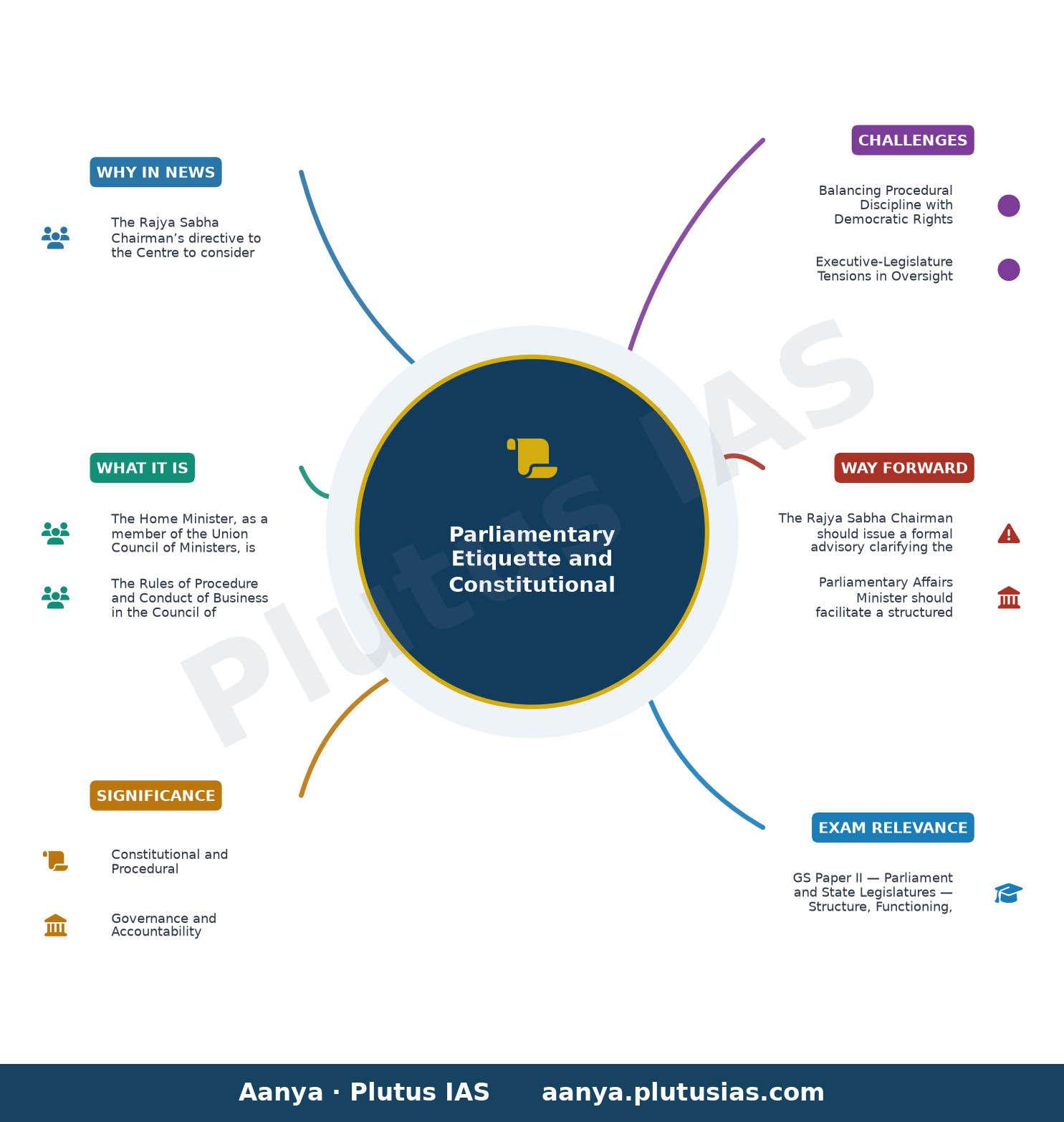
- GS Paper II — Parliament and State Legislatures — Structure, Functioning, Conduct of Business, Powers & Privileges and Issues Arising out of these
- Prelims: Rajya Sabha, Zero Hour, Leader of Opposition, Rules of Procedure and Conduct of Business in the Council of States, 1961, Article 85 of the Constitution
- Essay: Parliamentary Democracy: The Role of Opposition in Ensuring Accountability, The Balance Between Parliamentary Privileges and Democratic Accountability
Quick Revision: The Rajya Sabha Chairman’s role in directing the Centre to consider the Opposition’s demand for the Home Minister’s presence underscores the constitutional principle that the executive is accountable to Parliament, and the Rules of Procedure and Conduct of Business in the Council of States, 1961, serve as the procedural framework for such accountability.
Why is this in the news?
The Rajya Sabha Chairman’s directive to the Centre to consider the Opposition’s demand for the presence of Union Home Minister Amit Shah in the House highlights the constitutional and procedural dimensions of parliamentary accountability, particularly in the context of alleged executive excesses during a public protest. This episode underscores the tension between the executive’s discretion and the legislature’s oversight role, framed within the Rules of Procedure and Conduct of Business in the Council of States, 1961, and the broader principles of parliamentary democracy.
Background
- The July 20, 2026 protest by youngsters against paper leaks in Parliament led to a crackdown by security forces, prompting Opposition MPs to demand accountability from the Union Home Minister.
- The Opposition, led by Congress leader Mallikarjun Kharge, has consistently raised the issue in the Rajya Sabha, invoking slogans such as ‘Amit Shah jawaab do, Sadan mein aao’ to compel the Home Minister’s presence for a statement.
- The Rajya Sabha Chairman, Vice-President C P Radhakrishnan, intervened by urging the Centre to consider the Opposition’s request, reflecting the Chair’s role in facilitating dialogue between the executive and legislature.
- The Parliamentary Affairs Minister, Kiren Rijiju, cited Rules 235 and 240 of the Rules of Procedure and Conduct of Business in the Council of States, 1961, to argue against repetitive interruptions by the Opposition, highlighting procedural constraints on parliamentary debates.
- The episode reflects the recurring friction between the ruling dispensation and the Opposition over the scope of parliamentary debates, particularly on issues perceived as politically sensitive or involving executive actions.
Parliamentary Accountability and the Role of the Home Minister in the Rajya Sabha
- The Home Minister, as a member of the Union Council of Ministers, is accountable to Parliament for the actions of the Ministry of Home Affairs, including the deployment and conduct of security forces during public protests or law-and-order situations.
- The Rules of Procedure and Conduct of Business in the Council of States, 1961, govern the conduct of business in the Rajya Sabha, including the procedures for raising matters of public importance, interruptions, and the role of the Chairman in maintaining decorum.
- Rule 235 empowers the Chairman to direct members to discontinue speeches that are irrelevant or repetitive, while Rule 240 allows the Chairman to intervene if a member persists in raising the same matter without substantial new information or context.
- The Leader of the Opposition (LoP) in the Rajya Sabha, Mallikarjun Kharge, invoked the principle of parliamentary accountability by demanding the Home Minister’s presence to address allegations of executive excesses, a demand rooted in the constitutional obligation of the executive to respond to legislative scrutiny.
- The Chairman’s directive to the Centre to consider the Opposition’s request reflects the delicate balance between executive privilege and legislative oversight, where the Chair acts as an arbiter to ensure that parliamentary proceedings remain within the bounds of constitutional propriety.
- The Opposition’s tactic of sloganeering and repeated interruptions, while constitutionally permissible under the rules of debate, often escalates tensions and risks disrupting the orderly conduct of parliamentary business, necessitating the Chairman’s intervention.
- The episode also highlights the procedural constraints on new members and Opposition MPs, who may face challenges in having their voices heard amid procedural objections raised by the ruling dispensation.
Key Features
| Feature | Significance |
|---|---|
| Rajya Sabha Chairman’s directive to the Centre | Reinforces the constitutional role of the Chairman as the final authority in parliamentary proceedings, ensuring adherence to procedural norms while balancing democratic expectations. |
| Opposition’s demand for Home Minister’s presence | Highlights the Opposition’s constitutional right to seek accountability from the executive, particularly on issues of national security and governance. |
| Parliamentary Rules invoked (Rules 235 & 240) | Demonstrates the procedural framework governing parliamentary debates, interruptions, and the Chair’s discretion in maintaining decorum. |
| Leader of Opposition’s assertion of rights | Emphasises the constitutional status of the Leader of Opposition and their role in holding the government accountable. |
| Adjournment of the House due to protests | Illustrates the dynamic between legislative functioning and disruptive tactics, testing the Chair’s authority to restore order. |
Why it Matters
Constitutional and Procedural
- The episode underscores the constitutional mandate of the Rajya Sabha as a deliberative body where the Opposition can demand explanations from the executive, even if the Home Minister is not a member of the House.
- The Chairman’s intervention reflects the delicate balance between procedural discipline (Rules 235 & 240) and the democratic right to protest, a core feature of parliamentary democracy.
- The Leader of Opposition’s assertion of rights highlights the institutional role of the Opposition in a parliamentary system, as recognised under Article 75(1) and the Rules of Procedure.
Governance and Accountability
- The Opposition’s demand for the Home Minister’s presence is rooted in the principle of ministerial accountability to Parliament, a cornerstone of the Westminster-style parliamentary system adopted in India.
- The protest stems from allegations of excessive use of force by security forces during a public demonstration, a matter that falls under the Home Ministry’s jurisdiction, necessitating executive accountability.
- The episode reflects the tension between executive authority and legislative oversight, particularly in matters of internal security and law enforcement.
Parliamentary Ethics and Decorum
- The invocation of Rules 235 (interruptions) and 240 (repetition/irrelevance) by the Parliamentary Affairs Minister underscores the need for structured debate and the Chair’s role in maintaining parliamentary decorum.
- The Leader of Opposition’s refusal to accept procedural constraints on his remarks challenges the Chair’s authority, raising questions about the limits of parliamentary free speech.
Challenges
1. Balancing Procedural Discipline with Democratic Rights
- The Chair must navigate the fine line between enforcing parliamentary rules and accommodating legitimate Opposition demands for accountability.
- Disruptions, while a part of democratic expression, risk undermining the House’s ability to function, necessitating a calibrated response from the Chair.
- The Opposition’s insistence on the Home Minister’s presence, despite procedural constraints, tests the limits of parliamentary conventions.
UPSC Link: GS-II: Parliament and State Legislatures
2. Executive-Legislature Tensions in Oversight
- The demand for the Home Minister’s presence reflects a broader challenge of ensuring executive accountability to the legislature, particularly on contentious issues like internal security.
- The Home Ministry’s reluctance to engage directly in the Rajya Sabha may stem from concerns over political accountability or the complexities of inter-ministerial coordination.
- Such episodes risk eroding public trust in institutions if perceived as evasions of parliamentary scrutiny.
UPSC Link: GS-II: Executive and Legislature
3. Maintaining Parliamentary Decorum Amidst Polarisation
- The escalation of protests and adjournments highlights the challenge of maintaining decorum in a polarised political environment.
- The Leader of Opposition’s defiance of procedural norms, while rooted in democratic principles, risks normalising disruptive tactics in parliamentary proceedings.
- The Chair’s role in restoring order becomes critical in preventing a slide into chaos, which could undermine the institution’s credibility.
UPSC Link: GS-II: Parliament and State Legislatures
4. Public Perception and Institutional Trust
- Allegations of excessive force by security forces, if unaddressed, can erode public confidence in the state’s commitment to democratic values and human rights.
- The Opposition’s demand for accountability, while legitimate, may be perceived as politically motivated, complicating the narrative around institutional trust.
- The media’s role in amplifying such episodes can either strengthen democratic accountability or deepen societal divisions.
UPSC Link: GS-II: Role of Media and Civil Society
Challenges — UPSC Perspective
| Issue | Concern |
|---|---|
| Procedural vs. Democratic Rights | Risk of undermining parliamentary democracy if procedural discipline stifles legitimate Opposition demands. |
| Executive Reluctance to Engage | Potential erosion of public trust in institutions if the executive avoids direct accountability. |
| Polarisation and Decorum | Normalisation of disruptive tactics could weaken the institution’s credibility. |
| Media Amplification | Risk of deepening societal divisions or reinforcing political narratives over substantive governance issues. |
| Institutional Trust | Long-term impact on public confidence in Parliament’s ability to address citizen grievances. |
| Rule of Law vs. Political Expediency | Tension between adhering to parliamentary rules and addressing public anger over perceived injustices. |
Way Forward
- The Rajya Sabha Chairman should issue a formal advisory clarifying the procedural and constitutional grounds for the Opposition’s demand, ensuring transparency in decision-making.
- Parliamentary Affairs Minister should facilitate a structured discussion on the July 20 protest and alleged excesses, possibly through a short-notice debate or a ministerial statement.
- The Home Ministry should proactively engage with the Opposition, either directly or through written responses, to address concerns without compromising security or strategic interests.
- Parliamentary Rules Committee should review Rules 235 and 240 to balance the need for decorum with the democratic right to protest, ensuring clarity and fairness.
- Political parties should adopt a code of conduct for parliamentary behaviour, discouraging disruptive tactics while upholding the Opposition’s right to hold the executive accountable.
- Media outlets should contextualise such episodes, distinguishing between legitimate demands for accountability and politically motivated disruptions to inform public discourse.
- Civil society organisations and legal experts should document incidents of alleged excesses by security forces, providing impartial evidence to support parliamentary scrutiny.
- The Opposition should explore alternative mechanisms, such as adjournment motions or calling attention notices, to ensure sustained pressure on the executive without violating parliamentary norms.
UPSC Value Addition
Keywords for Mains Answer-Writing
Rajya Sabha Chairperson’s role · Parliamentary etiquette and decorum · Union Home Minister’s accountability · Opposition’s right to question executive · Rules of Procedure and Conduct of Business in the Rajya Sabha (Rules 235 and 240) · Parliamentary Affairs Minister’s function · Constitutional provisions on parliamentary proceedings (Article 75, 85, 105) · Role of the Leader of the Opposition · Parliamentary sovereignty vs executive accountability · Protests and interruptions in Parliament · Constitutional conventions in parliamentary democracy · Parliamentary committees and their functions
Constitutional & Policy Linkages
- Rules of Procedure and Conduct of Business in the Rajya Sabha: Rules 235 and 240.
Concept Flow
July 20 public protest → Allegations of excessive force by security forces → Opposition demand for Home Minister’s presence in Rajya Sabha → Chair’s directive to Centre to consider request → Opposition protests and slogans → Parliamentary Affairs Minister invokes Rules 235 & 240 → Adjournment of House → Chair’s intervention to balance procedural discipline and democratic rights → Leader of Opposition asserts constitutional rights → Executive-Legislature tension over accountability → Potential erosion of institutional trust → Need for structured debate or ministerial statement → Review of parliamentary rules for clarity and fairness.
Prelims Practice Questions
Q1. Consider the following statements regarding the role of the Rajya Sabha Chairman in the Indian Parliament:
1. The Chairman of the Rajya Sabha is also the ex-officio Vice-President of India.
2. The Chairman has the power to adjourn the House in case of unruly behaviour.
3. The Chairman can direct the Union Home Minister to appear before the House if the Opposition demands it.
How many of the above statements are correct?
- Only one
- Only two
- All three
- None
Answer: All three — Statements 1 and 2 are correct. The Chairman of the Rajya Sabha is the ex-officio Vice-President of India (Statement 1). The Chairman has the power to adjourn the House in case of unruly behaviour (Statement 2). Statement 3 is incorrect as the Chairman can only ‘consider the request’ for the Home Minister’s presence, not direct it.
Q2. Assertion (A): The Parliamentary Affairs Minister acts as a bridge between the executive and the legislature.
Reason (R): The Parliamentary Affairs Minister is responsible for facilitating the smooth conduct of parliamentary proceedings and ensuring that government business is transacted efficiently.
Options:
A. Both A and R are true, and R is the correct explanation of A.
B. Both A and R are true, but R is not the correct explanation of A.
C. A is true, but R is false.
D. A is false, but R is true.
Answer: ? — Both Assertion (A) and Reason (R) are true, and Reason (R) correctly explains Assertion (A). The Parliamentary Affairs Minister plays a crucial role in coordinating between the executive and the legislature, ensuring that parliamentary proceedings are conducted smoothly.
Q3. Match the following parliamentary rules with their respective functions:
Column I (Rule Number) | Column II (Function)
1. Rule 235 | A. Deals with the conduct of members and the maintenance of order
2. Rule 240 | B. Pertains to the admissibility of questions and resolutions
3. Rule 256 | C. Governs the procedure for raising matters of urgent public importance
4. Rule 193 | D. Regulates the repetition or irrelevance of remarks by members
Options:
A. 1-A, 2-D, 3-C, 4-B
B. 1-B, 2-A, 3-D, 4-C
C. 1-D, 2-A, 3-B, 4-C
D. 1-A, 2-B, 3-D, 4-C
Answer: ? — The correct match is: 1-A (Rule 235 deals with the conduct of members and the maintenance of order), 2-D (Rule 240 regulates the repetition or irrelevance of remarks by members), 3-C (Rule 256 governs the procedure for raising matters of urgent public importance), and 4-B (Rule 193 pertains to the admissibility of questions and resolutions).
Mains Practice Question
✍ The Rajya Sabha Chairman’s directive to the Centre to ‘consider the request’ for the Union Home Minister’s presence in the House underscores the evolving dynamics of parliamentary accountability in India. Critically examine the constitutional and conventional frameworks that govern the executive’s accountability to Parliament, with particular reference to the role of the Chairman of the Rajya Sabha and the Leader of the Opposition. (15 Marks)
Approach: MODEL-ANSWER SKELETON:
1. **Constitutional Framework**:
– Article 75(3) – Collective responsibility of the Council of Ministers to the Lok Sabha (not explicitly extended to Rajya Sabha, but convention exists).
– Article 85 – Sessions of Parliament and prorogation; Article 105 – Powers and privileges of Parliament.
– Article 77(3) – Conduct of business of the Government of India.
– Role of the President under Article 74(1) – Aid and advice of the Council of Ministers.
2. **Parliamentary Conventions and Rules**:
– Convention of ministerial accountability to Parliament, including the Rajya Sabha, especially on matters of national importance.
– Rules of Procedure and Conduct of Business in the Rajya Sabha: Rules 235 (maintenance of order) and Rule 240 (repetition or irrelevance of remarks).
– Role of the Chairman as the presiding officer (Article 89) – maintaining decorum and ensuring fair debate.
3. **Institutional Dynamics**:
– The Chairman’s role as a neutral arbiter in maintaining parliamentary decorum and facilitating constructive debate.
– The Leader of the Opposition’s constitutional recognition under the Salary and Allowances of Leaders of Opposition in Parliament Act, 1977, and their role in holding the executive accountable.
– The concept of ‘parliamentary sovereignty’ vs. ‘executive accountability’ – how interruptions and protests reflect democratic participation but must be balanced with legislative efficiency.
4. **Recent Context and Challenges**:
– The July 2026 protests and the demand for the Home Minister’s presence in the Rajya Sabha.
– The Opposition’s right to question the executive on matters of national importance, including alleged excesses by security forces.
– The tension between parliamentary etiquette (e.g., Rules 235 and 240) and the Opposition’s democratic right to protest.
5. **Critical Analysis**:
– **Strengths**: The Rajya Sabha Chairman’s directive reflects the evolving nature of parliamentary accountability, where the executive is increasingly held to account in both Houses.
– **Weaknesses**: Over-reliance on interruptions and protests may undermine the legislative process and dilute the quality of debate.
– **Way Forward**: Strengthening parliamentary committees (e.g., Standing Committees on Home Affairs) to address such issues proactively, reducing the need for disruptive protests.
6. **Conclusion**:
– The Chairman’s role is pivotal in balancing parliamentary decorum with the Opposition’s right to question the executive.
– A nuanced approach is required to ensure that parliamentary accountability does not become a tool for political grandstanding, while also ensuring that the executive remains answerable to the legislature.
Source: The Indian Express
Generated by AanyaAi for educational purpose.

- Gurugram’s groundwater extraction exceeds limit by 212%; HC seeks ban - October 4, 2026
- स्वतंत्रता सेनानी श्यामजी कृष्ण वर्मा की जन्म जयंती पर पीएम का श्रद्धांजलि - October 4, 2026
- KWML’s Feasibility Reports for Water Metro in 18 Cities: UPSC & PCS Insights - October 3, 2026

No Comments