


07 Aug Rajya Sabha Chairman Urges Centre to Bring Amit Shah for House Debate
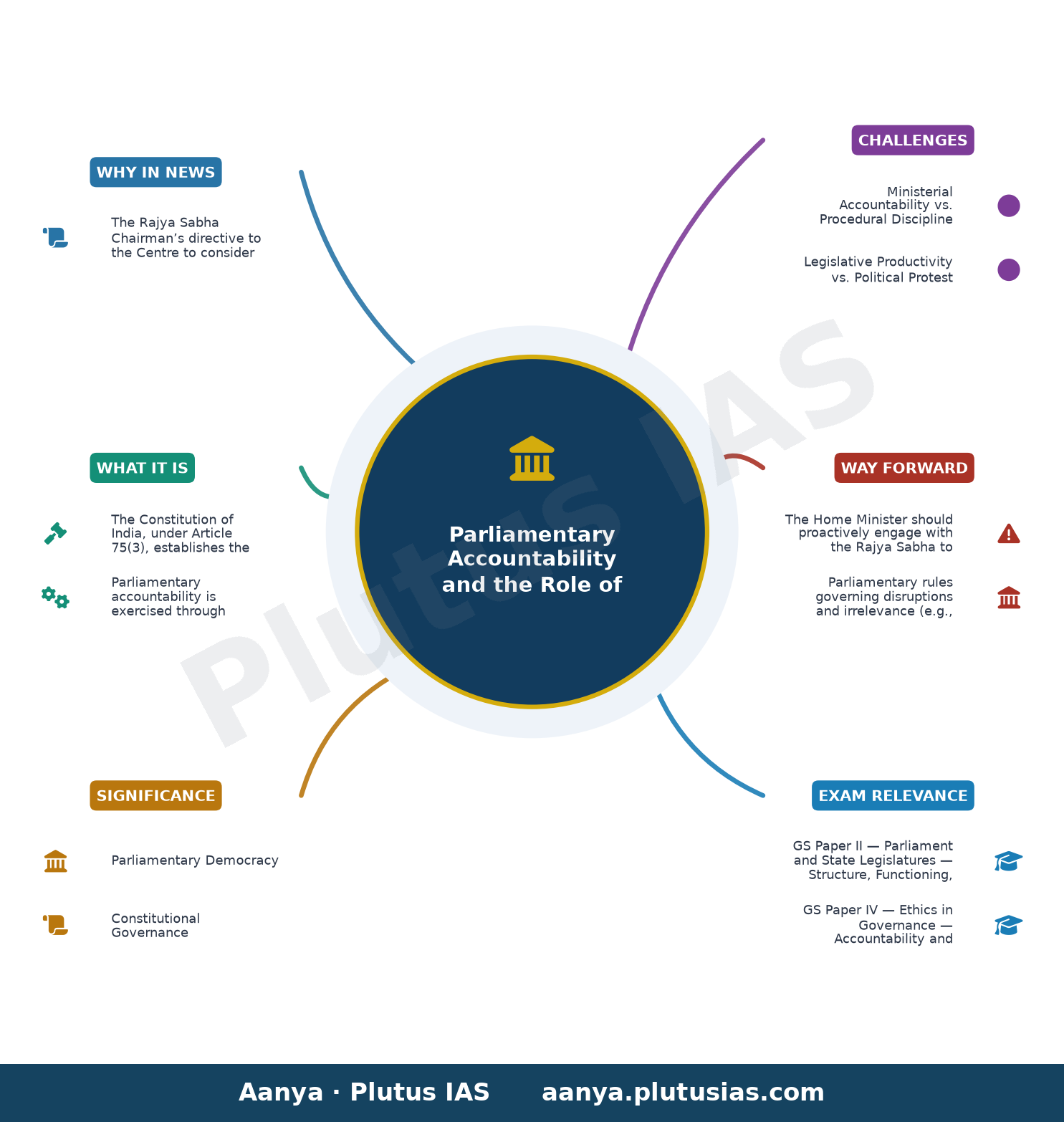
✎ The Rajya Sabha Chairman’s directive to the Centre to consider the Opposition’s demand for the Home Minister’s presence underscores the constitutional principle that the executive must be held accountable to the legislature…
Subject Relevance — Where This Topic Fits
- GS Paper II — Parliament and State Legislatures — Structure, Functioning, Conduct of Business, Powers & Privileges and Issues Arising out of these | GS Paper IV — Ethics in Governance — Accountability and Ethical Responsiveness of Civil Servants
- Prelims: Rajya Sabha, Zero Hour, Rule 240 of Rajya Sabha Rules of Procedure, Leader of Opposition, Parliamentary Affairs Minister, Union Home Minister, Paper Leak Protests 2026, Parliamentary Privileges
- Essay: Parliamentary Democracy: The Necessity of Executive Accountability to the Legislature, Ethics in Governance: The Role of Opposition in a Parliamentary System
Quick Revision: The Rajya Sabha Chairman’s directive to the Centre to consider the Opposition’s demand for the Home Minister’s presence underscores the constitutional principle that the executive must be held accountable to the legislature, particularly in matters involving allegations of state excesses.
Why is this in the news?
The Rajya Sabha Chairman’s directive to the Centre to consider the Opposition’s demand for the presence of Union Home Minister Amit Shah to address allegations of security force excesses during the July 2026 protest highlights a critical constitutional confrontation between executive accountability and legislative oversight. This episode underscores the tension between parliamentary norms and political exigencies, particularly in the context of a high-stakes protest over alleged paper leaks and subsequent crackdowns.
Background
- The July 2026 protest in New Delhi involved young demonstrators marching towards Parliament to protest alleged paper leaks in competitive examinations, a recurring issue in India’s governance landscape.
- Security forces were deployed to manage the protest, leading to allegations of excessive use of force, including lathi charges and detentions, which became a focal point of political debate.
- The Opposition, led by the Congress party, demanded the presence of the Union Home Minister in the Rajya Sabha to address these allegations, invoking parliamentary traditions of ministerial accountability.
- The Rajya Sabha Chairman, acting as the Presiding Officer, intervened to mediate between the Opposition’s demand and the Government’s reluctance to accede to it, citing procedural rules to regulate the conduct of business.
- The exchange between the Leader of Opposition, Mallikarjun Kharge, and the Parliamentary Affairs Minister, Kiren Rijiju, highlighted the procedural and substantive dimensions of parliamentary debates, including the invocation of Rules 235 and 240 of the Rajya Sabha Rules of Procedure.
- The episode reflects broader concerns about the erosion of parliamentary traditions, including the diminishing role of the Opposition in holding the executive accountable.
What is the Constitutional and Procedural Framework Governing Ministerial Accountability in Parliament?
- The Constitution of India, under Article 75(3), establishes the principle of collective responsibility of the Council of Ministers to the Lok Sabha, though the Rajya Sabha also plays a critical role in scrutinising executive actions through debates, questions, and motions.
- Parliamentary accountability is exercised through mechanisms such as Question Hour, Zero Hour, Calling Attention Notices, and Half-an-Hour Discussions, where ministers are expected to respond to queries raised by Members of Parliament.
- The Rajya Sabha Rules of Procedure and Conduct of Business, 1964, govern the conduct of business, including the rights of members to raise issues and the obligations of ministers to respond. Rule 240, cited during the proceedings, empowers the Chairman to intervene when a member repeats the same matter without substantial new information.
- The Leader of Opposition (LoP) in the Rajya Sabha, recognised as a statutory position under the Salary and Allowances of Leaders of Opposition in Parliament Act, 1977, plays a pivotal role in ensuring executive accountability by raising critical issues and demanding ministerial responses.
- The concept of ‘Parliamentary Supremacy’ is balanced by the doctrine of ‘Ministerial Responsibility’, wherein ministers are expected to justify their actions or policies in the House, failing which they may face censure or resignation.
- The Rajya Sabha Chairman, as the Presiding Officer, acts as a neutral arbiter to ensure that parliamentary proceedings are conducted in accordance with established norms and rules, balancing the rights of the Opposition with the Government’s prerogative to govern.
- The demand for the Home Minister’s presence in the Rajya Sabha is rooted in the principle that the executive must be held accountable for the actions of its agencies, particularly when allegations of human rights violations or excessive use of force arise.
Key Features
| Feature | Significance |
|---|---|
| Rajya Sabha Chairman’s directive to the Centre | Demonstrates the constitutional authority of the Chairman under Article 89(2) to regulate proceedings and ensure accountability of the Executive. |
| Opposition’s demand for Home Minister’s presence | Highlights the parliamentary principle of ministerial accountability to the House, particularly on issues of national security and law enforcement. |
| Parliamentary Rules 235 and 240 invoked | Illustrates the procedural mechanisms to maintain decorum and relevance in debates, balancing democratic expression with legislative discipline. |
| Zero Hour disruption and adjournment | Showcases the dynamic tension between legislative procedure and political protest, a recurring feature in parliamentary democracy. |
| Leadership of Opposition’s response to procedural objections | Emphasizes the role of the Leader of the Opposition in articulating dissent and ensuring executive scrutiny within parliamentary norms. |
Why it Matters
Parliamentary Democracy
- The incident underscores the foundational principle of ministerial accountability, where the Executive (Home Minister) is expected to respond to the Legislature (Rajya Sabha) on critical issues such as alleged excesses by security forces.
- The Opposition’s demand reflects the constitutional right to hold the government accountable, a cornerstone of democratic governance.
- The procedural tussle highlights the need for a balance between unrestricted debate and adherence to parliamentary rules to prevent chaos.
Constitutional Governance
- The Chairman’s intervention exemplifies the constitutional role of the Vice-President (as Chairman of the Rajya Sabha) in maintaining order and ensuring the smooth functioning of the House.
- The invocation of Rules 235 and 240 demonstrates the application of parliamentary procedure to regulate debates and prevent repetition or irrelevance, safeguarding the dignity of the House.
- The exchange between the Leader of the Opposition and the Parliamentary Affairs Minister reflects the institutional checks and balances embedded in the Constitution.
Law and Order
- The protest on July 20, 2026, and the subsequent demand for accountability, tie directly to the governance of law enforcement agencies, a subject under the Union Home Ministry’s purview.
- The Opposition’s insistence on the Home Minister’s presence signifies concerns over the conduct of security forces, raising questions about the rule of law and human rights during protests.
Political Accountability
- The episode illustrates the adversarial nature of parliamentary democracy, where the Opposition challenges the Executive’s actions and demands explanations for perceived lapses.
- The procedural objections raised by the Parliamentary Affairs Minister underscore the government’s efforts to control disruptions, reflecting the tension between governance and political opposition.
Challenges
1. Ministerial Accountability vs. Procedural Discipline
- Balancing the Executive’s duty to respond to parliamentary queries with the need to maintain order and relevance in debates poses a persistent challenge.
- The Opposition’s demand for the Home Minister’s presence risks disrupting routine parliamentary proceedings, necessitating careful handling by the Chair.
- Procedural rules (e.g., Rules 235 and 240) may be invoked to curb disruptions, but their strict application could stifle legitimate democratic protest.
UPSC Link: Parliamentary Procedures and Conduct of Business
2. Legislative Productivity vs. Political Protest
- Frequent disruptions and adjournments due to political protests hinder the legislative process, delaying the passage of crucial bills and discussions.
- The Opposition’s use of slogans and sloganeering as a tool of protest, while constitutionally permitted, often leads to procedural conflicts and reduced productivity.
- The government’s reliance on procedural rules to manage disruptions may be perceived as an attempt to suppress dissent, raising concerns about democratic backsliding.
UPSC Link: Parliamentary Functioning and Legislative Process
3. Law Enforcement Accountability in Democratic Governance
- The demand for accountability over alleged excesses by security forces during protests highlights the tension between maintaining public order and respecting civil liberties.
- The Home Minister’s absence from the House to address these concerns raises questions about the Executive’s responsiveness to parliamentary scrutiny.
- The episode reflects broader societal concerns about the use of force by state agencies and the need for transparent mechanisms to investigate such incidents.
UPSC Link: Role of Executive in Law and Order
4. Role of the Chairman in Maintaining Order
- The Chairman’s directive to the Centre to consider the Opposition’s request reflects the delicate balance between allowing democratic expression and ensuring the House’s smooth functioning.
- The Chairman’s intervention in procedural disputes (e.g., invoking Rules 235 and 240) demonstrates the need for impartiality and firmness in regulating parliamentary conduct.
- The episode underscores the challenges faced by the Chair in managing high-decibel political confrontations while upholding the dignity of the House.
UPSC Link: Constitutional Role of the Chairman
Challenges — UPSC Perspective
| Issue | Concern |
|---|---|
| Ministerial accountability to Parliament | Risk of executive evasion of parliamentary scrutiny on critical governance issues. |
| Procedural discipline vs. democratic protest | Potential suppression of legitimate dissent under the guise of maintaining order. |
| Legislative productivity | Frequent disruptions leading to delays in passing essential legislation. |
| Law enforcement accountability | Concerns over transparency and justice in cases of alleged excesses by security forces. |
| Role of the Chairman in regulating debates | Challenges in maintaining impartiality and order amid political confrontations. |
| Opposition’s right to protest vs. government’s control | Tension between oppositional politics and the government’s efforts to manage parliamentary proceedings. |
Way Forward
- The Home Minister should proactively engage with the Rajya Sabha to address concerns over alleged excesses by security forces, ensuring transparency and accountability.
- Parliamentary rules governing disruptions and irrelevance (e.g., Rules 235 and 240) should be reviewed to balance the need for order with the right to dissent.
- The Chairman should issue clear guidelines to the House on the permissible limits of protest, ensuring that democratic expression does not undermine legislative productivity.
- The Opposition should channel its demands for accountability through formal parliamentary processes, such as calling attention motions or adjournment motions, to avoid procedural conflicts.
- The government should establish an independent mechanism to investigate allegations of excesses by security forces, ensuring timely and transparent redressal.
- Parliamentary Affairs Minister should facilitate structured dialogues between the government and the Opposition to address procedural grievances and improve legislative efficiency.
- The Rajya Sabha Secretariat should conduct periodic training sessions for MPs on parliamentary procedures and decorum to reduce procedural conflicts.
- The media and civil society should play a constructive role in highlighting parliamentary proceedings, fostering public awareness and accountability.
UPSC Value Addition
Keywords for Mains Answer-Writing
Parliamentary accountability · Rajya Sabha Chairman’s role · Leader of Opposition · Parliamentary Rules 235 and 240 · Union Home Minister’s presence in Parliament · Zero Hour and adjournments · Parliamentary Affairs Minister · Opposition protests and slogans · Parliamentary disruption · Constitutional provisions on Parliamentary conduct · Role of the Vice-President as Rajya Sabha Chairman · Parliamentary ethics and decorum · Parliamentary Rules and procedures · Parliamentary accountability of the executive
Constitutional & Policy Linkages
- {‘article’: ‘Article 89(2) – Role of Chairman’, ‘note’: ‘Constitutional authority to regulate proceedings’}
- {‘article’: ‘Article 75(3) – Collective responsibility’, ‘note’: ‘Ministerial accountability to Parliament’}
- {‘article’: ‘Article 105 – Privileges of Parliament’, ‘note’: ‘Freedom of speech in legislative bodies’}
- {‘article’: ‘Article 118 – Rules of Procedure’, ‘note’: ‘Power to make rules for conduct of business’}
Concept Flow
July 20, 2026 protest → Alleged excesses by security forces → Opposition demands Home Minister’s presence in Rajya Sabha → Chairman directs Centre to consider request → Procedural objections raised (Rules 235, 240) → Zero Hour disruptions and adjournment → Leader of Opposition defends protest rights → Chairman reiterates demand for Home Minister’s presence → Procedural conflict resolved temporarily, but underlying issues persist
Prelims Practice Questions
Q1. Consider the following statements regarding the Rules of Procedure in the Rajya Sabha:
1. Rule 235 pertains to seeking an end to interruptions in the House.
2. Rule 240 allows members to repeat their remarks without restriction.
3. The Chairman of the Rajya Sabha is also the Vice-President of India.
How many of the above statements are correct?
- Only one
- Only two
- All three
- None
Answer: Only two — Statement 1 is correct as Rule 235 deals with seeking an end to interruptions. Statement 2 is incorrect; Rule 240 pertains to irrelevance or repetition. Statement 3 is correct; the Chairman of the Rajya Sabha is the Vice-President of India.
Q2. Assertion (A): The Rajya Sabha Chairman can direct the Union Home Minister to appear in the House to respond to questions.
Reason (R): The Chairman of the Rajya Sabha, being the Vice-President of India, holds a constitutional position that enables such directives.
Options:
A. Both A and R are true, and R is the correct explanation of A.
B. Both A and R are true, but R is not the correct explanation of A.
C. A is true, but R is false.
D. A is false, but R is true.
- A
- B
- C
- D
Answer: B — The assertion (A) is true; the Chairman can consider requests for the Home Minister’s presence. The reason (R) is also true; the Chairman’s constitutional role as Vice-President enables such directives. However, R is not the direct explanation of A, as the directive is based on parliamentary rules and conventions rather than solely on constitutional authority.
Q3. Match the following Parliamentary Rules with their correct descriptions:
Column I (Rule Number)
A. Rule 235
B. Rule 240
C. Rule 250
Column II (Description)
1. Pertains to irrelevance or repetition in speeches
2. Pertains to seeking an end to interruptions
3. Pertains to the conduct of Zero Hour
Options:
A. A-2, B-1, C-3
B. A-1, B-2, C-3
C. A-3, B-1, D-2
D. A-2, B-3, C-1
- A
- B
- C
- D
Answer: A — Rule 235 pertains to seeking an end to interruptions. Rule 240 pertains to irrelevance or repetition. Rule 250 is not mentioned in the context and is not relevant here.
Mains Practice Question
✍ ‘The Rajya Sabha Chairman’s directive to the Centre to consider the Opposition’s demand for the Union Home Minister’s presence reflects the evolving dynamics of parliamentary accountability in India.’ Critically examine the statement with reference to the constitutional role of the Rajya Sabha Chairman, parliamentary rules, and contemporary political developments. (15 Marks)
Approach: MODEL-ANSWER SKELETON:
1. Introduction: Define parliamentary accountability and its significance in a parliamentary democracy. Briefly introduce the Rajya Sabha Chairman’s role as the Vice-President of India (Art. 64, 89).
2. Constitutional and Parliamentary Framework:
– Role of the Rajya Sabha Chairman in maintaining decorum and ensuring accountability (Art. 89, Rules of Procedure).
– Relevant parliamentary rules: Rule 235 (seeking end to interruptions) and Rule 240 (irrelevance or repetition).
– The Leader of Opposition’s role in holding the executive accountable.
3. Contemporary Context:
– Recent incident: Opposition’s demand for the Home Minister’s presence in the Rajya Sabha post-July 20 protests.
– Chairman’s directive to the Centre and the political reactions (e.g., Kiren Rijiju’s invocation of rules, Mallikarjun Kharge’s counterarguments).
4. Critical Analysis:
– Strengths: How the Chairman’s intervention upholds parliamentary norms and ensures executive accountability.
– Limitations: Challenges in enforcing such directives (e.g., executive non-compliance, political polarization).
– Comparison with the Lok Sabha Speaker’s role in similar contexts.
5. Conclusion: Balance between parliamentary sovereignty and executive autonomy. Suggest reforms to strengthen parliamentary accountability (e.g., codifying the Chairman’s powers, enhancing the Leader of Opposition’s role).
Source: The Indian Express
Generated by AanyaAi for educational purpose.

- Karnataka HC rules against insurance condition on tractor-trailers for hire/reward use - October 3, 2026
- युवा संगम: सिक्किम-राजस्थान सांस्कृतिक आदान-प्रदान से सीखें विरासत - October 3, 2026
- Karnataka Launches Praja Seva Legal Aid Centre for Court Case Resolution - October 3, 2026

No Comments