


07 Aug Rajya Sabha Clears ₹54,067 Crore Appropriation Bill: Key Details for UPSC & PCS
✎ The Appropriation Bill is a constitutional necessity under Article 114 to regularise excess expenditure from the Consolidated Fund of India, ensuring parliamentary accountability and fiscal discipline.
Subject Relevance — Where This Topic Fits
- GS Paper III — Indian Economy: Issues relating to Planning, Mobilisation of Resources, Growth, Development and Employment | GS Paper III — Government Budgeting and Fiscal Policy | GS Paper II — Parliament and State Legislatures — Structure, Functioning, Conduct of Business, Powers & Privileges and Issues Arising out of these
- Prelims: Appropriation Bill, Excess Grant, Public Accounts Committee (PAC), Article 114 of the Constitution, Fiscal Responsibility and Budget Management (FRBM) Act, Jammu & Kashmir Reorganisation Act, 2019, Debt Restructuring, Union-State Financial Relations
- Essay: The Role of Parliament in Financial Accountability: Balancing Fiscal Prudence and Development Needs, Federalism in Fiscal Policy: Centre-State Financial Relations in Post-Article 370 Jammu and Kashmir
Quick Revision: The Appropriation Bill is a constitutional necessity under Article 114 to regularise excess expenditure from the Consolidated Fund of India, ensuring parliamentary accountability and fiscal discipline.
Why is this in the news?
The Rajya Sabha’s clearance of the Appropriation Bill for ₹54,067 crore in August 2026 underscores critical aspects of India’s parliamentary financial procedures, fiscal federalism, and the Centre’s fiscal commitments to Union Territories such as Jammu and Kashmir. The Bill’s passage amid Opposition protests highlights procedural democracy in budgetary governance, while the Finance Minister’s remarks on debt repayment and fiscal support for J&K reflect the Centre’s evolving fiscal strategy post-Article 370 abrogation. This development is significant for UPSC aspirants as it intersects constitutional provisions, parliamentary accountability, and macroeconomic policy.
Background
- The Appropriation Bill is a constitutional requirement under Article 114 of the Constitution, mandating parliamentary approval for expenditure from the Consolidated Fund of India beyond the amounts authorised by the Finance Bill.
- Excess expenditure arises when actual spending exceeds the initially approved budget, necessitating retrospective approval through an Appropriation Bill to regularise such spending.
- The Public Accounts Committee (PAC) scrutinises excess expenditure and submits reports to Parliament, as seen in the 39th Report presented to the Lok Sabha in April 2026, which examined the excess demands.
- The excess expenditure of ₹54,067 crore in 2026 pertains to the financial year 2022-23, indicating a lag in parliamentary approval typical of the budgetary cycle.
- The abrogation of Article 370 in August 2019 and the subsequent bifurcation of Jammu and Kashmir into two Union Territories necessitated substantial fiscal restructuring, including debt restructuring and enhanced financial support.
- Fiscal federalism in India requires the Centre to balance fiscal discipline with developmental and administrative needs of Union Territories, particularly those emerging from special constitutional status.
What is the Appropriation Bill?
- The Appropriation Bill is a legislative instrument introduced in Parliament to authorise expenditure from the Consolidated Fund of India.
- It is mandated by Article 114 of the Constitution, which requires prior parliamentary approval for any expenditure from the Consolidated Fund beyond the amounts authorised by the Finance Bill.
- The Bill is presented after the Union Budget and is distinct from the Finance Bill, which deals with taxation and revenue measures.
- It regularises excess expenditure incurred during a financial year, ensuring compliance with parliamentary financial oversight and fiscal accountability.
- The Appropriation Bill does not alter tax rates or introduce new taxes; its primary function is to allocate funds for approved expenditures.
- The Bill is passed by both Houses of Parliament and receives the President’s assent to become law, thereby legalising the expenditure.
- In cases of excess expenditure, the Bill retroactively approves spending that exceeded the initially sanctioned budget, subject to PAC scrutiny.
Key Features
| Feature | Significance |
|---|---|
| Appropriation Bill, 2026 | Legislative instrument authorising excess expenditure of ₹54,067 crore incurred during 2022-23, ensuring constitutional compliance under Article 114 of the Constitution. |
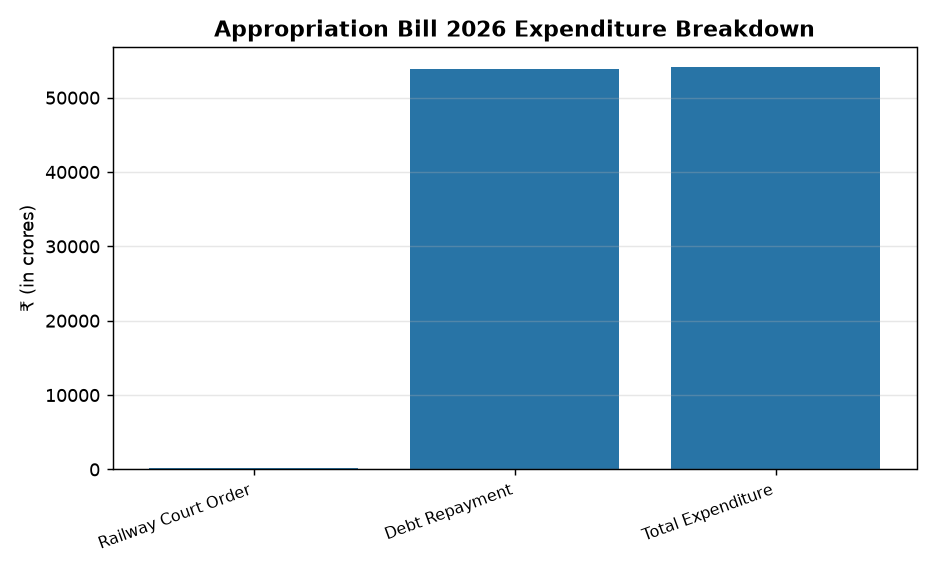
| Public Accounts Committee (PAC) scrutiny | Excess demands examined by PAC, with ₹53,871 crore attributed to debt repayment and ₹196.44 crore to a court order, demonstrating parliamentary oversight of executive expenditure. |
| Debt repayment allocation (₹53,871 crore) | Largest component of excess expenditure, reflecting the Union government’s fiscal consolidation strategy and adherence to FRBM Act norms. |
| Railways court-ordered expenditure (₹196.44 crore) | Expenditure arising from judicial directives, highlighting the intersection of judicial pronouncements and fiscal governance. |
| Jammu & Kashmir financial assistance | Union government’s commitment to meet salary, pension, and debt restructuring needs post-Article 370 abrogation, with additional ₹5,000 crore annual support for 2024-25 and 2025-26. |
Why it Matters
Fiscal Governance
- Validates excess expenditure incurred during 2022-23 through parliamentary appropriation, ensuring constitutional legitimacy under Article 114.
- Demonstrates adherence to the Fiscal Responsibility and Budget Management (FRBM) Act, 2003, by prioritising debt repayment as a key fiscal correction measure.
- Highlights the role of the Public Accounts Committee in scrutinising executive expenditure, reinforcing parliamentary accountability.
- Expenditure arising from judicial directives underscores the need for inter-institutional coordination between the judiciary and the executive in fiscal management.
Federal Financial Relations
- Centralised assumption of Jammu & Kashmir’s salary and pension liabilities (₹13,000 crore annually) post-Article 370 abrogation, reflecting a shift in fiscal federalism.
- Debt restructuring and additional financial support (₹5,000 crore annually for two years) for J&K and Ladakh, indicating targeted fiscal federalism to address post-reorganisation challenges.
- Constitutional provisions under Article 370’s abrogation continue to influence fiscal transfers, with implications for the Union government’s expenditure commitments.
Parliamentary Processes
- Rajya Sabha’s passage of the Appropriation Bill amid Opposition protests and walkouts highlights the procedural challenges in legislative functioning, particularly during Monsoon Sessions.
- Adjournment of proceedings due to disruptions underscores the need for structured debates and consensus-building in fiscal legislation.
- Finance Minister’s detailed response to Opposition queries on J&K’s financial needs demonstrates the government’s accountability in fiscal policy communication.
Challenges
1. Fiscal Discipline vs. Development Expenditure
- Prioritisation of debt repayment (₹53,871 crore) may constrain developmental expenditure, raising concerns about growth-oriented fiscal policy.
- Balancing fiscal consolidation with social sector allocations remains a persistent challenge, particularly in fiscally stressed regions like Jammu & Kashmir.
UPSC Link: GS3: Indian Economy – Fiscal Policy
2. Judicial-Executive Fiscal Overlaps
- Expenditure arising from court orders (e.g., ₹196.44 crore for Railways) highlights the need for pre-emptive legal risk assessment in expenditure planning.
- Potential delays in judicial pronouncements may lead to unplanned fiscal commitments, disrupting budgetary allocations.
UPSC Link: GS2: Judiciary – Judicial Activism
3. Parliamentary Disruptions and Fiscal Legislation
- Frequent adjournments and walkouts during fiscal debates risk delaying critical appropriations, impacting government operations.
- Opposition’s demand for Home Minister’s presence reflects broader political tensions, which may hinder constructive fiscal discussions.
UPSC Link: GS2: Parliament – Legislative Procedures
4. Post-Abatement Fiscal Management in J&K
- Sustained financial support (₹13,000 crore annually for salaries/pensions) places long-term fiscal pressure on the Union budget.
- Ensuring equitable development post-Article 370 abrogation requires balancing immediate fiscal support with long-term capacity-building in the region.
UPSC Link: GS2: Federalism – Centre-State Relations
5. Transparency in Excess Expenditure
- Public scrutiny of PAC reports is essential to ensure that excess expenditure is justified and aligned with public interest.
- Lack of detailed breakdowns in media reports may obscure the rationale behind specific allocations, necessitating greater transparency.
UPSC Link: GS4: Ethics in Governance – Transparency
Challenges — UPSC Perspective
| Issue | Concern |
|---|---|
| Debt repayment dominance in expenditure | Potential crowding-out of developmental and social sector spending, impacting inclusive growth. |
| Judicial interventions in fiscal allocations | Unplanned expenditure commitments may derail budgetary discipline and fiscal targets. |
| Parliamentary disruptions during fiscal debates | Delays in appropriation processes may lead to temporary fund shortages for critical schemes. |
| Sustained fiscal burden on J&K post-Article 370 | Long-term strain on Union finances without commensurate revenue generation in the region. |
| Lack of granularity in excess expenditure reporting | Obscures public understanding of fiscal priorities and accountability mechanisms. |
Way Forward
- Strengthen pre-budget legal risk assessment to anticipate and mitigate court-ordered expenditures, reducing fiscal surprises.
- Enhance parliamentary time management during Monsoon Sessions to ensure uninterrupted fiscal debates and timely appropriations.
- Institute a dedicated fiscal federalism review mechanism to assess the long-term financial implications of post-Article 370 policies on Union finances.
- Publish detailed PAC reports in accessible formats to improve transparency and public scrutiny of excess expenditure.
- Balance debt repayment with targeted developmental allocations, particularly for fiscally stressed regions like Jammu & Kashmir.
- Explore innovative financing models (e.g., public-private partnerships) to reduce the Union’s fiscal burden in post-abrogation regions.
- Conduct periodic audits of expenditure arising from judicial directives to ensure alignment with national fiscal priorities.
- Foster cross-party consensus on fiscal governance to minimise disruptions during critical legislative processes.
UPSC Value Addition
Keywords for Mains Answer-Writing
Appropriation Bill · Parliamentary financial procedures · Public Accounts Committee (PAC) · excess expenditure · Article 114 of the Constitution · Comptroller and Auditor General (CAG) · Jammu and Kashmir financial assistance · Article 370 abrogation · Union Finance Ministry · Rajya Sabha proceedings · debt repayment obligations · railway expenditure under court order
Constitutional & Policy Linkages
- [‘Article 114’, ‘Constitutional provision for appropriation bills authorising government expenditure.’]
- [‘Article 282’, ‘Discretionary grants-in-aid to states, relevant for J&K’s post-abrogation fiscal support.’]
- [‘Seventh Schedule’, ‘Division of fiscal powers between Union and States, impacting Centre-State financial relations.’]
Concept Flow
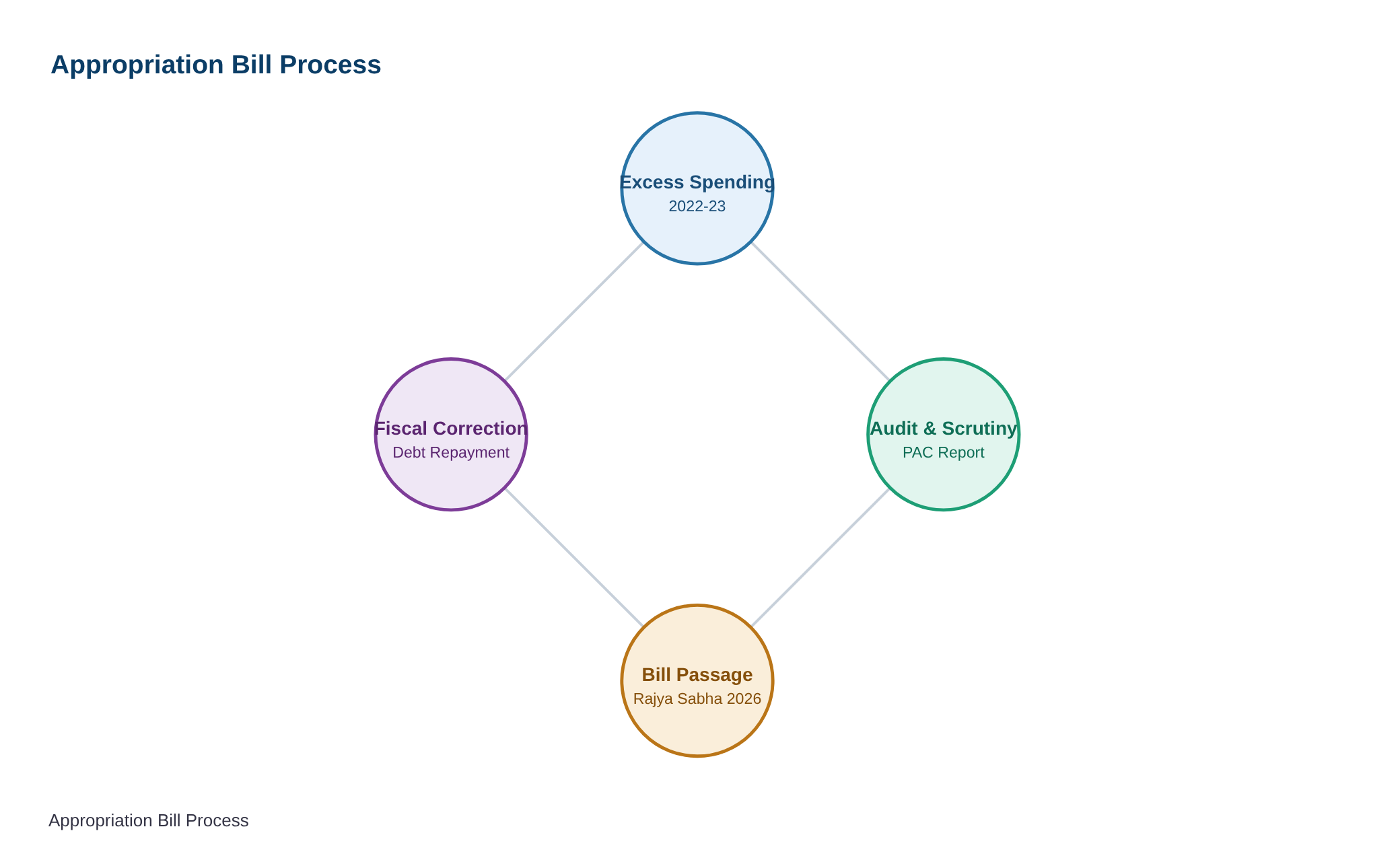
Excess expenditure incurred during 2022-23 → Parliamentary scrutiny by Public Accounts Committee → Presentation of PAC Report to Lok Sabha → Rajya Sabha considers Appropriation Bill, 2026 → Passage of Bill authorising ₹54,067 crore expenditure. → Debt repayment (₹53,871 crore) and court-ordered expenditure (₹196.44 crore) → Scrutiny for constitutional and fiscal compliance → Legislative approval → Implementation. → Article 370 abrogation → Union assumption of J&K’s salary/pension liabilities (₹13,000 crore annually) → Debt restructuring and additional ₹5,000 crore annual support → Fiscal federalism implications. → Judicial directives → Unplanned fiscal commitments → PAC scrutiny → Parliamentary debate → Appropriation Bill clearance. → Parliamentary disruptions during Monsoon Session → Adjournments and walkouts → Delayed fiscal legislation → Potential operational gaps in government expenditure. → FRBM Act, 2003 compliance → Debt repayment prioritisation → Fiscal consolidation → Impact on developmental expenditure. → Public Accounts Committee oversight → Transparency in excess expenditure → Accountability in fiscal governance.
Prelims Practice Questions
Q1. Consider the following statements regarding the Appropriation Bill in the Indian Parliament:
1. The Appropriation Bill is introduced to give legal sanction to the withdrawal of money from the Consolidated Fund of India.
2. The Appropriation Bill is passed by the Lok Sabha only.
3. The Public Accounts Committee examines excess expenditure after the Appropriation Bill is passed.
4. The Appropriation Bill is a constitutional requirement under Article 114 of the Constitution.
How many of the above statements are correct?
- Only one
- Only two
- Only three
- All
Answer: All — Statements 1, 3, and 4 are correct. The Appropriation Bill authorises withdrawal from the Consolidated Fund (Art. 114), and the PAC examines excess expenditure post-passage. Statement 2 is incorrect as the Rajya Sabha also considers the Bill.
Q2. Assertion (A): The excess expenditure of ₹54,067 crore was cleared by the Public Accounts Committee (PAC) before the Appropriation Bill was passed.
Reason (R): The PAC examines excess expenditure only after the Appropriation Bill is passed by Parliament.
- Both A and R are true, and R is the correct explanation of A
- Both A and R are true, but R is not the correct explanation of A
- A is true but R is false
- A is false but R is true
Answer: A is false but R is true — Assertion (A) is true as the PAC examined the excess expenditure before the Bill was passed. Reason (R) is false because the PAC examines excess expenditure before the Appropriation Bill is returned to the President for assent.
Q3. Which of the following is NOT a component of the excess expenditure approved by the Appropriation Bill, 2026, as per the Union Finance Minister’s statement?
- Debt repayment obligations amounting to ₹53,871 crore
- Expenditure on Jammu and Kashmir Police salaries and pensions
- Court-ordered expenditure for the Ministry of Railways
- Subsidies for food grains under the National Food Security Act
Answer: ? — The excess expenditure of ₹54,067 crore included debt repayment (₹53,871 crore) and a court-ordered railway expenditure (₹196.44 crore). Subsidies under NFSA were not mentioned as part of this excess.
Mains Practice Question
✍ The Appropriation Bill, 2026, was passed by the Rajya Sabha to authorise excess expenditure of ₹54,067 crore. Critically examine the constitutional and parliamentary mechanisms governing such excess expenditure in India. Also, discuss the role of the Public Accounts Committee (PAC) in ensuring financial accountability. (15 Marks)
Approach: MODEL-ANSWER SKELETON:
1. Constitutional Basis: Article 114 of the Constitution and the role of the Appropriation Bill in authorising excess expenditure from the Consolidated Fund. Contrast with the Annual Financial Statement (Art. 112) and the demands for grants.
2. Parliamentary Procedures: Passage of the Bill in Lok Sabha and Rajya Sabha, including the role of the Speaker/Chairperson and the President’s assent (Art. 114(3)).
3. Role of the Comptroller and Auditor General (CAG): Auditing excess expenditure and submitting reports to the PAC (Art. 149).
4. Public Accounts Committee (PAC): Composition (chaired by an Opposition MP), functions (examining excess expenditure, calling officials, and recommending corrective measures), and its 39th Report cited in the case.
5. Financial Accountability Mechanisms: CAG’s audit reports, PAC’s recommendations, and the Union Finance Ministry’s compliance. Highlight the balance between executive flexibility and parliamentary oversight.
6. Contemporary Context: Link the excess expenditure to debt repayment and court-ordered liabilities, and discuss how such mechanisms ensure fiscal discipline despite political pressures.
Source: The Hindu
Generated by AanyaAi for educational purpose.

- संयुक्त राष्ट्र पैनल ने AI एजेंटों की बढ़ती शक्ति पर सुरक्षा बढ़ाने की चेतावनी दी - September 21, 2026
- UN Panel Warns: AI Agents May Outpace Human Control Safeguards - September 21, 2026
- तमिलनाडु में मुर्गे की लड़ाई पर पूर्ण प्रतिबंध नहीं: डीजीपी कार्यालय ने मद्रास उच्च न्यायालय को बताया - September 21, 2026

No Comments