


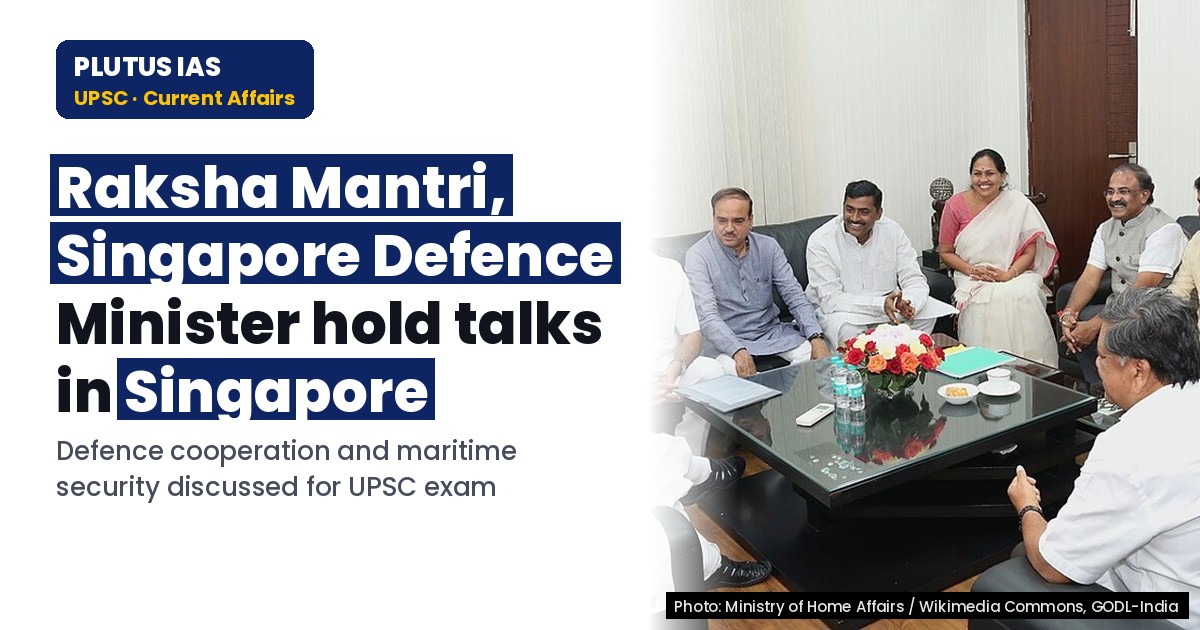
28 Oct Raksha Mantri Meets Singapore Defence Minister: Key Outcomes for UPSC
✎ The ADMM-Plus is a key ASEAN-led platform for regional security cooperation, and India-Singapore defence engagements within this framework focus on maritime security, counter-terrorism, and defence technology collaboration.
Subject Relevance — Where This Topic Fits
- GS Paper II — International Relations — Bilateral, Regional and Global Groupings and Agreements involving India and/or affecting India’s interests
- Prelims: ASEAN, ADMM-Plus, Defence Cooperation Agreement, Maritime Security, ASEAN Outlook on the Indo-Pacific
Quick Revision: The ADMM-Plus is a key ASEAN-led platform for regional security cooperation, and India-Singapore defence engagements within this framework focus on maritime security, counter-terrorism, and defence technology collaboration.
Why is this in the news?
The bilateral meeting between India’s Raksha Mantri and Singapore’s Defence Minister on the sidelines of the 13th ASEAN Defence Ministers’ Meeting-Plus (ADMM-Plus) underscores the evolving defence and strategic partnership between India and Singapore within the broader framework of ASEAN-centric regional security architecture. This engagement is significant in the context of India’s Act East Policy and Singapore’s role as a key interlocutor in the Indo-Pacific region.
Background
- The ADMM-Plus is a platform established in 2010 to facilitate dialogue and cooperation among ASEAN and eight dialogue partner countries, including India and Singapore, on regional security challenges.
- India and Singapore have maintained a robust defence partnership since the signing of the Defence Cooperation Agreement in 2003, which has been periodically updated to reflect evolving security dynamics.
- Singapore is a critical partner for India in the ASEAN region, particularly in areas such as maritime security, counter-terrorism, and defence technology collaboration.
- The ADMM-Plus framework includes mechanisms for confidence-building measures (CBMs) and practical cooperation in areas such as humanitarian assistance and disaster relief (HADR), maritime security, and counter-terrorism.
- India’s Act East Policy, launched in 2014, aims to deepen economic, strategic, and cultural ties with the Asia-Pacific region, with defence cooperation forming a key pillar.
- Singapore’s strategic location in the Strait of Malacca and its role as a hub for global trade make it a vital partner for India’s maritime security and connectivity initiatives.
What is the ADMM-Plus and India-Singapore Defence Cooperation?
- The ASEAN Defence Ministers’ Meeting-Plus (ADMM-Plus) is a multilateral platform that brings together ASEAN member states and eight dialogue partners, including India and Singapore, to enhance regional security cooperation.
- Established in 2010, the ADMM-Plus serves as a mechanism for dialogue, confidence-building, and practical cooperation on issues such as maritime security, counter-terrorism, and humanitarian assistance and disaster relief (HADR).
- India and Singapore have a long-standing defence partnership, formalised through the Defence Cooperation Agreement (DCA) signed in 2003 and updated periodically to address emerging security challenges.
- Key areas of cooperation between India and Singapore include maritime domain awareness, joint military exercises (e.g., SIMBEX), defence technology collaboration, and capacity-building initiatives.
- Singapore’s strategic importance in the Indo-Pacific region, particularly in the Strait of Malacca, aligns with India’s interests in ensuring regional stability and maritime security.
- The ADMM-Plus framework includes eight Expert Working Groups (EWGs) focused on areas such as maritime security, counter-terrorism, cybersecurity, and humanitarian assistance, providing a structured platform for dialogue and cooperation.
- India’s participation in the ADMM-Plus reflects its commitment to ASEAN-centric regional security architecture and its broader engagement with the Indo-Pacific region.
- Defence cooperation with Singapore also supports India’s broader strategic objectives, including the development of its indigenous defence manufacturing capabilities and the promotion of regional stability.
Key Features
| Feature | Significance |
|---|---|
| Bilateral Defence Dialogue Framework | Provides a structured mechanism for regular high-level consultations between India and Singapore, enhancing defence cooperation under the ASEAN-India strategic partnership. |
| ADMM-Plus Mechanism | A multilateral platform for ASEAN and its eight dialogue partners to strengthen regional security architecture, with India as an active participant. |
| Defence Industrial Collaboration | Explores avenues for joint research, development, and manufacturing in defence technologies, aligning with India’s ‘Make in India’ initiative. |
| Maritime Security Cooperation | Focuses on counter-piracy, anti-terrorism, and freedom of navigation, critical for safeguarding sea lanes in the Indo-Pacific region. |
Why it Matters
Strategic
- Reinforces India’s Act East Policy by deepening defence ties with Southeast Asian nations, particularly Singapore, a key maritime partner.
- Strengthens regional security architecture through the ADMM-Plus framework, addressing non-traditional and traditional threats in the Indo-Pacific.
- Facilitates joint exercises, technology transfer, and capacity-building initiatives to enhance interoperability among armed forces.
Economic
- Opens avenues for defence industrial collaboration, including co-development and co-production of defence equipment, boosting domestic manufacturing.
- Promotes investment in defence start-ups and MSMEs, aligning with India’s push for self-reliance in defence production (Atmanirbhar Bharat).
Geopolitical
- Demonstrates India’s commitment to a rules-based maritime order, countering unilateral actions in the South China Sea.
- Enhances India’s strategic autonomy by diversifying defence partnerships beyond traditional allies.
Challenges
1. Regulatory and Procedural Hurdles
- Differences in defence procurement policies and export control regimes may delay collaboration projects.
- Bureaucratic delays in approvals for technology transfer and joint ventures can hinder progress.
UPSC Link: Defence Procurement Procedure (DPP)
2. Technological Asymmetry
- Singapore’s advanced defence R&D capabilities may outpace India’s, requiring targeted upskilling and investment.
- Ensuring equitable access to dual-use technologies remains a challenge.
UPSC Link: Defence Technology and Trade Initiative (DTTI)
3. Geopolitical Constraints
- Balancing relations with multiple stakeholders in the Indo-Pacific while avoiding alignment with any bloc.
- Navigating sensitivities related to maritime disputes in the region.
UPSC Link: Indo-Pacific Oceans Initiative (IPOI)
Challenges — UPSC Perspective
| Issue | Concern |
|---|---|
| Defence Procurement Delays | Bureaucratic and legal hurdles in approving joint projects under the DPP. |
| Technology Transfer Restrictions | Stringent export controls by partner nations limit access to critical defence technologies. |
| Interoperability Gaps | Differences in military doctrines and equipment standards hinder seamless joint operations. |
| Maritime Domain Awareness | Limited real-time data-sharing mechanisms for counter-piracy and anti-terrorism operations. |
Way Forward
- Accelerate the implementation of the Defence Technology and Trade Initiative (DTTI) to fast-track joint projects.
- Establish a dedicated inter-ministerial task force to streamline approvals for defence collaborations with Singapore.
- Enhance maritime domain awareness through joint patrols and information-sharing mechanisms under the ADMM-Plus framework.
- Invest in upskilling and R&D partnerships to bridge technological gaps in defence manufacturing.
- Strengthen cybersecurity protocols for defence collaborations to mitigate risks of data breaches.
- Promote defence start-ups and MSMEs through targeted funding and incubation support.
- Conduct regular bilateral and multilateral exercises to improve interoperability and operational readiness.
UPSC Value Addition
Keywords for Mains Answer-Writing
ASEAN Defence Ministers’ Meeting-Plus · bilateral defence cooperation · India-Singapore defence relations · defence logistics · maritime security · defence industrial collaboration · defence technology transfer · Regional security architecture · ADMM-Plus framework · defence diplomacy · strategic partnership · defence manufacturing · exclusive economic zone (EEZ) security · counter-terrorism in maritime domain · defence logistics sharing
Concept Flow
India-Singapore bilateral defence dialogue → Strengthening of ASEAN-India strategic partnership → Enhanced regional security architecture via ADMM-Plus. → Defence industrial collaboration → Joint R&D and manufacturing → Promotion of ‘Make in India’ and Atmanirbhar Bharat. → Maritime security cooperation → Counter-piracy and anti-terrorism initiatives → Safeguarding sea lanes in the Indo-Pacific. → Technology transfer and export control regimes → Regulatory hurdles → Need for streamlined approval processes. → Interoperability gaps → Joint exercises and capability-building → Improved operational readiness.
Prelims Practice Questions
Q1. Consider the following statements regarding the ASEAN Defence Ministers’ Meeting-Plus (ADMM-Plus):
1. It is a platform for ASEAN and its eight dialogue partners to strengthen security and defence cooperation.
2. India is a founding member of the ADMM-Plus framework.
3. The ADMM-Plus includes maritime security as one of its five priority areas of cooperation.
4. The ADMM-Plus was established in 2010.
How many of the above statements are correct?
- Only one
- Only two
- Only three
- All four
Answer: All four — Statements 1, 2, and 4 are correct. Statement 3 is incorrect as maritime security is one of the seven priority areas of cooperation under ADMM-Plus, not five.
Q2. Assertion (A): The India-Singapore Defence Cooperation Agreement (DCA) signed in 2017 facilitates logistics support between the armed forces of both countries.
Reason (R): The agreement enables reciprocal provision of logistic support, supplies, and services during joint exercises, training, and humanitarian assistance operations.
In the context of the above two statements, which one of the following is correct?
- Both A and R are true, and R is the correct explanation of A.
- Both A and R are true, but R is NOT the correct explanation of A.
- A is true, but R is false.
- A is false, but R is true.
Answer: Both A and R are true, but R is NOT the correct explanation of A. — Both the Assertion (A) and Reason (R) are factually correct, and the Reason (R) accurately explains the Assertion (A) as the DCA indeed facilitates reciprocal logistic support between India and Singapore.
Q3. Which of the following is NOT a priority area of cooperation under the ASEAN Defence Ministers’ Meeting-Plus (ADMM-Plus) framework?
- Maritime security
- Counter-terrorism
- Peacekeeping operations
- Humanitarian assistance and disaster relief
Answer: Peacekeeping operations — Counter-terrorism is not listed as a priority area under the ADMM-Plus framework. The seven priority areas are maritime security, counter-piracy, humanitarian assistance and disaster relief, military medicine, counter-terrorism, peacekeeping operations, and cyber security.
Mains Practice Question
✍ The bilateral defence engagement between India and Singapore has intensified in recent years, exemplified by high-level interactions such as the recent bilateral talks held on the sidelines of the 13th ASEAN Defence Ministers’ Meeting-Plus (ADMM-Plus). In this context, critically analyse the significance of the India-Singapore defence partnership for India’s Act East Policy and its broader strategic objectives in the Indo-Pacific region. (15 Marks)
Approach: MODEL-ANSWER SKELETON:
1. **Introduction (2 Marks)**
– Briefly define India’s Act East Policy (AEP) and its objectives, including economic integration, strategic partnerships, and regional stability in the Indo-Pacific.
– Mention the role of defence diplomacy as a key pillar of AEP.
2. **India-Singapore Defence Partnership: Key Components (4 Marks)**
– **Defence Logistics Agreement (DCA) 2017**: Facilitates reciprocal logistic support, supplies, and services during joint exercises and operations.
– **Maritime Security Cooperation**: Focus on ensuring freedom of navigation, counter-piracy, and EEZ security in the South China Sea and Indian Ocean.
– **Defence Industrial Collaboration**: Joint ventures in defence manufacturing, technology transfer, and R&D (e.g., BrahMos Aerospace, naval shipbuilding).
– **Training and Exercises**: Regular joint military exercises (e.g., SIMBEX, MAITREE) and professional military education exchanges.
3. **Strategic Significance for India’s Act East Policy (5 Marks)**
– **Indo-Pacific Security Architecture**: Singapore’s strategic location as a hub for maritime trade and defence logistics enhances India’s reach in Southeast Asia.
– **Counterbalancing China**: Strengthening ties with Singapore helps India diversify its partnerships and reduce over-reliance on any single power in the region.
– **Economic and Technological Synergies**: Singapore’s role as a financial and technological hub complements India’s defence modernisation efforts.
– **Multilateral Engagement**: Singapore’s participation in ADMM-Plus and other ASEAN-led mechanisms provides India with a platform to shape regional security norms.
4. **Challenges and Limitations (3 Marks)**
– **Divergent Strategic Interests**: Differences in threat perceptions (e.g., Singapore’s focus on non-traditional security vs. India’s concerns over China’s assertiveness).
– **Operational Constraints**: Logistical and bureaucratic hurdles in implementing defence agreements.
– **Geopolitical Balancing Act**: Singapore’s policy of equidistance among major powers may limit the depth of defence cooperation with India.
5. **Conclusion (1 Mark)**
– Reiterate the importance of the India-Singapore defence partnership as a cornerstone of India’s Act East Policy and Indo-Pacific strategy, while acknowledging the need for sustained engagement to address challenges.
Source: PIB (Press Information Bureau)
Generated by AanyaAi for educational purpose.
Related guides on our sites
- Best PSIR optional coaching for upsc
- Best PSIR optional teacher for upsc
- Best teacher of PSIR optional for upsc
- Best PSIR optional coaching in delhi for UPSC

- Raksha Mantri Meets Singapore Defence Minister: Key Outcomes for UPSC - October 28, 2026
- संयुक्त राष्ट्र की चेतावनी: जलवायु परिवर्तन से महासागर की कार्बन सोखने की क्षमता कमजोर हो रही है - October 28, 2026
- UPSC Focus: How Corporate Affairs Ministry Earned ₹10.5L via E-Waste in Special Campaign 6.0 - October 28, 2026

No Comments