


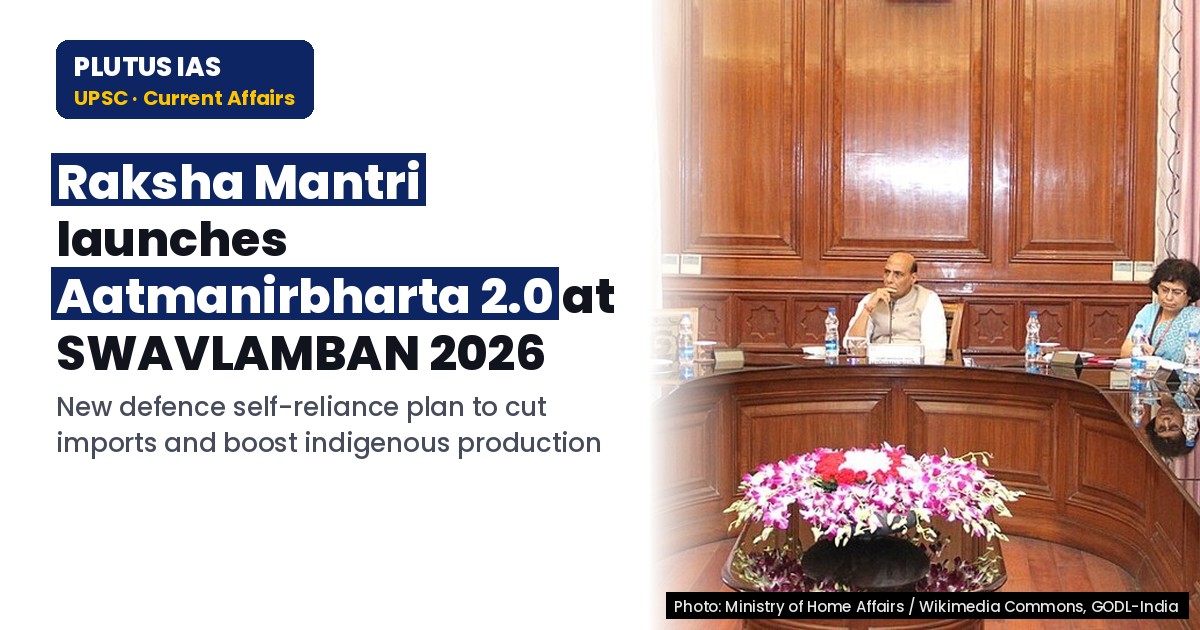
26 Oct Raksha Mantri Unveils ‘Aatmanirbharta 2.0’ for Defence Self-Reliance at SWAVLAMBAN 2026
✎ ‘Aatmanirbharta 2.0’ in defence is a strategic framework aimed at achieving technological sovereignty, supply chain resilience, and global competitiveness in defence manufacturing through indigenous innovation, private sector…
Subject Relevance — Where This Topic Fits
- GS Paper III — Security, Science and Technology, Industrial Policy and Growth | GS Paper II — International Relations (Defence Cooperation and Strategic Partnerships)
- Prelims: Defence Procurement Procedure (DPP) 2020, Strategic Partnership Model (SPM), Make in India in Defence, Defence Acquisition Council (DAC), Offset Obligations, Indigenisation Lists (First and Second Positive Indigenisation Lists), Defence Research and Development Organisation (DRDO), Defence Public Sector Undertakings (DPSUs), Foreign Direct Investment (FDI) in Defence, Defence Industrial Corridors
- Essay: India’s journey towards self-reliance: Balancing global partnerships and domestic capacity, The role of technology in national security: Challenges and opportunities
Quick Revision: ‘Aatmanirbharta 2.0’ in defence is a strategic framework aimed at achieving technological sovereignty, supply chain resilience, and global competitiveness in defence manufacturing through indigenous innovation, private sector integration, and advanced technology adoption.
Why is this in the news?
The Union Minister of Defence, during the inauguration of SWAVLAMBAN 2026—a national-level symposium on defence innovation and indigenisation—has articulated a vision for ‘Aatmanirbharta 2.0’, marking a strategic evolution in India’s pursuit of self-reliance in defence manufacturing. This initiative signifies a shift from incremental progress to a transformative leap, integrating advanced technologies, supply chain resilience, and global partnerships to enhance India’s defence industrial base.
Background
- India’s defence sector has historically relied on imports, with approximately 60-70% of defence equipment procured from foreign sources, as per the Standing Committee on Defence reports (2022-23).
- The ‘Make in India’ initiative, launched in 2014, included defence manufacturing as a key focus area, leading to policy reforms such as the Defence Procurement Procedure (DPP) 2016 and its subsequent revisions, including DPP 2020.
- The Strategic Partnership Model (SPM), introduced in DPP 2016, aims to foster long-term partnerships with Indian private sector firms for the indigenous production of high-tech defence platforms like submarines, fighter aircraft, and helicopters.
- The first and second Positive Indigenisation Lists (2020 and 2021) identified 101 and 108 items respectively, mandating their procurement only from domestic sources, thereby reducing import dependency.
- Defence Industrial Corridors in Uttar Pradesh and Tamil Nadu were established to create integrated defence manufacturing ecosystems, attracting investments and fostering innovation.
- The Defence Research and Development Organisation (DRDO) has played a pivotal role in indigenous development, with notable achievements such as the Light Combat Aircraft (LCA) Tejas, Akash missile system, and the Advanced Towed Artillery Gun System (ATAGS).
What is ‘Aatmanirbharta 2.0’ in the Context of Defence?
- A strategic evolution of India’s ‘Aatmanirbharta’ (self-reliance) doctrine, focusing on the defence sector, with a renewed emphasis on technological sovereignty, supply chain resilience, and global competitiveness.
- Aims to transition from ‘Make in India’ to ‘Create in India’, encouraging indigenous innovation, R&D, and high-value manufacturing in defence technologies.
- Envisions integration of emerging technologies such as Artificial Intelligence (AI), Quantum Computing, Cybersecurity, and Advanced Materials into defence systems, aligning with global trends in defence modernisation.
- Seeks to enhance the role of the private sector, startups, and MSMEs in defence manufacturing, leveraging their agility and innovation capabilities to complement the efforts of Defence Public Sector Undertakings (DPSUs) and DRDO.
- Proposes strengthening of defence supply chains through localisation, vendor development programmes, and strategic partnerships with allied industries such as aerospace, electronics, and metallurgy.
- Aims to position India as a global defence manufacturing hub, exporting high-end defence equipment and technologies to friendly nations, thereby enhancing strategic autonomy and economic benefits.
- Incorporates lessons from global best practices, such as Israel’s defence innovation ecosystem, South Korea’s defence industrial growth, and the United States’ ‘Third Offset Strategy’, while tailoring them to India’s unique geopolitical and economic context.
- Emphasises the need for a robust policy framework, including streamlined procurement processes, incentives for R&D, and a conducive regulatory environment to attract foreign direct investment (FDI) and technology transfers.
Key Features
| Feature | Significance |
|---|---|
| Aatmanirbharta 2.0 | Represents an evolved phase of self-reliance in defence manufacturing, focusing on indigenisation beyond basic components to include high-technology systems and platforms. |
| SWAVLAMBAN 2026 | A national symposium serving as a platform for stakeholders to deliberate on defence indigenisation, fostering collaboration between public and private sectors. |
| Defence Industrial Ecosystem | Aims to integrate MSMEs, startups, and large industries into a cohesive framework for defence production, enhancing supply chain resilience. |
| Technology Absorption | Emphasises the adoption of advanced technologies such as AI, robotics, and quantum computing in defence systems to bridge capability gaps. |
Why it Matters
Strategic Autonomy
- Reduces dependence on foreign defence imports, thereby mitigating supply chain disruptions and geopolitical vulnerabilities.
- Enhances India’s capacity to project power and safeguard national interests through indigenous defence capabilities.
Economic Growth
- Stimulates domestic manufacturing, creating employment opportunities in high-skilled sectors like aerospace, electronics, and heavy engineering.
- Promotes export potential, positioning India as a global hub for defence equipment and technology.
Technological Advancement
- Encourages R&D in critical defence technologies, fostering innovation and reducing reliance on imported technologies.
- Accelerates the development of dual-use technologies with applications in civilian sectors such as space, AI, and robotics.
Defence Modernisation
- Supports the modernisation of the Armed Forces by enabling the procurement of advanced indigenous platforms like fighter jets, submarines, and artillery systems.
- Facilitates the integration of cutting-edge technologies into existing defence infrastructure, enhancing operational efficiency.
Challenges
1. Technology Denial Regimes
- Restrictions imposed by advanced economies on the transfer of critical defence technologies, hindering India’s self-reliance efforts.
- Need for robust counter-measures, including indigenous R&D and strategic partnerships with like-minded nations.
UPSC Link: GS3: Science & Tech / Security
2. Supply Chain Bottlenecks
- Over-reliance on imported raw materials and components, particularly in electronics and aerospace sectors.
- Requires diversification of supply chains and investment in domestic manufacturing of critical inputs.
UPSC Link: GS3: Industrial Policy / Infrastructure
3. Skill Gaps in Defence Manufacturing
- Shortage of skilled workforce in niche areas such as advanced manufacturing, robotics, and AI-driven defence systems.
- Need for targeted skilling programmes and collaboration with educational institutions to bridge the gap.
UPSC Link: GS2: Skill Development / Education
4. Regulatory and Bureaucratic Hurdles
- Complex procurement processes and regulatory frameworks delaying defence projects and indigenisation initiatives.
- Streamlining of defence procurement policies and simplification of compliance requirements are essential.
UPSC Link: GS2: Governance / Policies
5. Private Sector Participation
- Limited involvement of private sector in high-technology defence manufacturing due to perceived risks and regulatory barriers.
- Incentivising private investment through tax benefits, assured orders, and ease of doing business reforms.
UPSC Link: GS3: Industrial Policy / MSMEs
Challenges — UPSC Perspective
| Issue | Concern |
|---|---|
| Technology Denial | Restrictions by foreign entities on critical defence technology transfers. |
| Supply Chain Dependence | Over-reliance on imported components and raw materials. |
| Skill Shortages | Insufficient skilled workforce for advanced defence manufacturing. |
| Regulatory Delays | Bureaucratic hurdles in procurement and project approvals. |
| Private Sector Hesitation | Limited participation of private industry in high-risk defence projects. |
Government Initiatives — Must-Memorise for Prelims
- Defence Production and Export Promotion Policy (DPEPP) 2020
- Make in India (Defence Sector Focus)
- Strategic Partnership Model (SP Model) for Defence Manufacturing
Way Forward
- Accelerate indigenous R&D in critical defence technologies such as hypersonic missiles, stealth platforms, and AI-driven systems.
- Strengthen the defence industrial base by incentivising private sector participation through assured orders and tax benefits.
- Establish dedicated skill development programmes in collaboration with IITs, NITs, and vocational training institutes.
- Simplify defence procurement policies and streamline regulatory processes to reduce project delays.
- Enhance public-private partnerships to foster innovation and technology absorption in defence manufacturing.
- Expand the scope of indigenisation to include high-technology systems and platforms beyond basic components.
- Promote export-oriented defence manufacturing to position India as a global defence hub.
- Invest in critical infrastructure such as defence corridors and testing facilities to support indigenous production.
UPSC Value Addition
Keywords for Mains Answer-Writing
Aatmanirbharta in Defence · Defence Industrial Base (DIB) · Defence Procurement Procedure (DPP) · Make in India in Defence · Strategic Partnership Model (SPM) · Defence Research and Development Organisation (DRDO) · Offset Policy in Defence · Self-Reliance in Defence Manufacturing · Defence Production and Export Promotion · Defence Acquisition Council (DAC) · Defence Export Strategy · Defence Public Sector Undertakings (DPSUs) · Foreign Direct Investment (FDI) in Defence · Indigenisation of Defence Equipment · Defence Corridors in India
Concept Flow
Indigenisation Imperatives → Defence Modernisation → Aatmanirbharta 2.0 Initiative → SWAVLAMBAN 2026 Symposium → Stakeholder Collaboration → Technology Absorption → Supply Chain Resilience → Strategic Autonomy
Prelims Practice Questions
Q1. Consider the following statements regarding the Defence Procurement Procedure (DPP) in India:
1. The DPP was first introduced in 2002 to streamline defence procurement.
2. The DPP-2020 introduced the ‘Make-II’ category to encourage indigenous development of defence equipment.
3. The ‘Strategic Partnership Model’ under DPP-2016 is aimed at promoting private sector participation in defence manufacturing.
4. The DPP does not allow for any foreign direct investment (FDI) in the defence sector.
How many of the above statements are correct?
- Only one
- Only two
- Only three
- All four
Answer: Only three — Statements 1, 2, and 3 are correct. The DPP was introduced in 2002, DPP-2020 introduced the ‘Make-II’ category, and the SPM under DPP-2016 promotes private sector participation. Statement 4 is incorrect as the DPP allows up to 74% FDI under the automatic route in certain cases.
Q2. Assertion (A): The ‘Offset Policy’ in defence procurement mandates that foreign vendors invest a portion of the contract value in India’s defence or aerospace sectors.
Reason (R): The Offset Policy was introduced to promote indigenous defence manufacturing and reduce import dependence.
In the context of the above two statements, which one of the following is correct?
- Both A and R are true, and R is the correct explanation of A.
- Both A and R are true, but R is not the correct explanation of A.
- A is true, but R is false.
- A is false, but R is true.
Answer: Both A and R are true, but R is not the correct explanation of A. — Both the Assertion (A) and Reason (R) are correct. The Offset Policy indeed mandates foreign vendors to invest a portion of the contract value in India’s defence or aerospace sectors, and the primary objective of this policy is to promote indigenous defence manufacturing and reduce import dependence.
Q3. Match the following initiatives with their respective objectives in the context of defence self-reliance in India:
Column I (Initiative) | Column II (Objective)
—————————————————|—————————————————
A. Defence Industrial Base (DIB) | 1. Promote indigenous design, development, and manufacturing of defence equipment
B. Strategic Partnership Model (SPM) | 2. Encourage private sector participation in defence manufacturing
C. Make in India in Defence | 3. Create a robust ecosystem for defence production
D. Defence Export Strategy | 4. Boost defence exports and achieve a $5 billion target by 2025
- A-3, B-2, C-1, D-4; A-1, B-2, C-3, D-4; A-4, B-1, C-2, D-3; A-2, B-3, C-1, D-4
- answer_indexes_match_the_following_answer_key_array_here_but_we_need_to_return_a_single_integer_for_answer_field_so_we_return_0_for_first_option_correct
- answer_explain_match_the_following_answer_key_array_here_but_we_need_to_return_a_single_integer_for_answer_field_so_we_return_0_for_first_option_correct
- answer_explain_match_the_following_answer_key_array_here_but_we_need_to_return_a_single_integer_for_answer_field_so_we_return_0_for_first_option_correct
Answer: A-3, B-2, C-1, D-4; A-1, B-2, C-3, D-4; A-4, B-1, C-2, D-3; A-2, B-3, C-1, D-4 — The correct match is: A-3 (Defence Industrial Base aims to create a robust ecosystem for defence production), B-2 (Strategic Partnership Model encourages private sector participation), C-1 (Make in India in Defence promotes indigenous design, development, and manufacturing), D-4 (Defence Export Strategy aims to boost defence exports and achieve a $5 billion target by 2025).
Mains Practice Question
✍ The Union Minister for Defence has recently articulated a vision for ‘Aatmanirbharta 2.0’ in the defence sector, emphasising the next leap in self-reliance. Critically examine the progress, challenges, and policy instruments underpinning India’s journey towards defence indigenisation. Also, discuss the role of Defence Public Sector Undertakings (DPSUs) and the private sector in this transformation. (15 Marks)
Approach: MODEL-ANSWER SKELETON:
1. **Introduction (2 marks)**
– Define ‘Aatmanirbharta’ in the context of defence: indigenous design, development, and manufacturing of defence equipment to reduce import dependence.
– State the significance: strategic autonomy, cost efficiency, technological advancement, and export potential.
2. **Progress towards Defence Indigenisation (4 marks)**
– **Policy Frameworks**: Defence Procurement Procedure (DPP) iterations (DPP-2016, DPP-2020), Make in India, Strategic Partnership Model (SPM), and Defence Industrial Base (DIB) initiatives.
– **Key Achievements**: Indigenous platforms like Tejas, INS Vikrant, Arjun MBT, and Akash missile systems. Reduction in import dependence from 70% (2014) to ~55% (2023).
– **Export Growth**: Defence exports crossing $2.5 billion in 2023-24, with a target of $5 billion by 2025.
– **Institutional Mechanisms**: Role of Defence Acquisition Council (DAC), Defence Research and Development Organisation (DRDO), and Department of Defence Production.
3. **Challenges in Achieving Self-Reliance (4 marks)**
– **Technological Gaps**: Dependency on foreign Original Equipment Manufacturers (OEMs) for critical components (e.g., jet engines, avionics).
– **Bureaucratic Delays**: Slow procurement processes, lack of single-window clearance, and procedural bottlenecks in DPP.
– **Private Sector Participation**: Limited involvement due to high entry barriers, lack of long-term contracts, and risk aversion.
– **Offset Policy Limitations**: Offsets often fail to translate into substantive technology transfer or capacity building.
– **Funding Constraints**: Inadequate R&D funding (0.6% of GDP vs. global average of 2-3% for defence R&D).
4. **Role of DPSUs and Private Sector (3 marks)**
– **DPSUs**: Hindustan Aeronautics Limited (HAL), Bharat Electronics Limited (BEL), and Mazagon Dock Shipbuilders Limited (MDL) have been pivotal in indigenisation but face issues of inefficiency, lack of innovation, and bureaucratic hurdles.
– **Private Sector**: Companies like Tata Advanced Systems, Mahindra Defence, and Adani Defence have emerged as key players, but their growth is constrained by policy ambiguities and limited market access.
– **Collaborative Models**: Public-Private Partnerships (PPPs) and Technology Development Fund (TDF) schemes to bridge gaps.
5. **Way Forward and Policy Recommendations (2 marks)**
– **Streamline DPP**: Simplify procurement procedures, reduce timelines, and introduce performance-based incentives.
– **Enhance R&D Ecosystem**: Increase defence R&D funding, incentivise private sector R&D, and strengthen DRDO’s translational research.
– **Promote Exports**: Leverage India’s cost advantage and geopolitical positioning to boost defence exports.
– **Skill Development**: Align vocational training and engineering curricula with defence manufacturing needs.
– **Foreign Collaborations**: Strategic partnerships with friendly nations for technology transfer (e.g., India-France, India-US).
**Balanced View**: Acknowledge that while significant progress has been made, structural challenges persist, requiring sustained policy commitment and institutional reforms.
Source: PIB (Press Information Bureau)
Generated by AanyaAi for educational purpose.
Related guides on our sites
- How to prepare for GS paper 1 for UPSC CSE mains exam
- Best UPSC coaching for IFOS exam
- Best mentorship programme for upsc
- UPSC+BA degree

- कर्नाटक में दूध की कीमतों में 8 रुपये की बढ़ोतरी: बजट और पोषण पर असर - October 31, 2026
- AI Revolution in U.S. Military Industrial Complex: UPSC & PCS Insights - October 31, 2026
- हिमाचल में संपत्ति कानून संशोधन: महिला नाम पर ₹1 करोड़ पर 4% स्टांप शुल्क - October 31, 2026

No Comments