


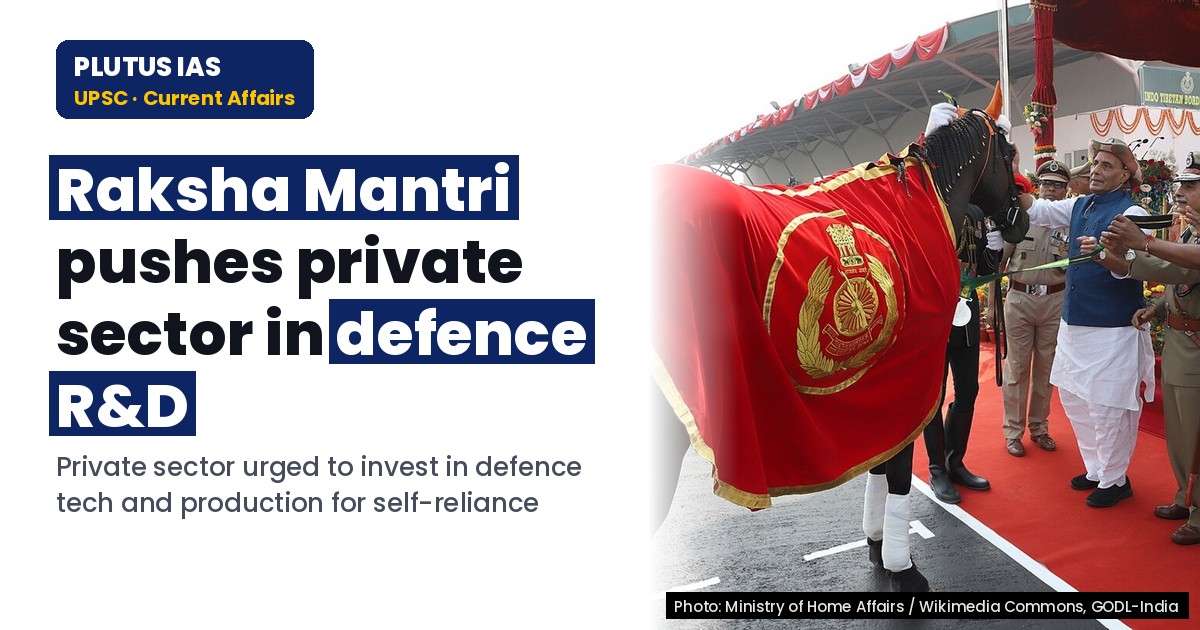
09 Oct Raksha Mantri Urges Private Sector to Boost Defence R&D & Production
✎ The SIDM Champion Awards 2026 are a policy instrument to incentivise indigenous defence manufacturing, reduce import dependence, and enhance India’s global competitiveness in the defence sector under the Atmanirbhar Bharat…
Subject Relevance — Where This Topic Fits
- GS Paper III — Security Challenges and their Management in Border Areas; Linkages of Organised Crime with Terrorism | GS Paper III — Effects of Liberalisation on the Economy, Changes in Industrial Policy and their Effects on Industrial Growth
- Prelims: Defence Procurement Procedure (DPP), Make in India, Atmanirbhar Bharat, Defence Industrial Licensing, Strategic Partnership Model (SPM), Offset Policy, SIDM, Defence Production and Export Promotion Policy (DPEPP) 2020, Public Sector Undertakings (PSUs) in Defence: HAL, BDL, MDL, GRSE, BEL, Private Sector Defence Manufacturers: Tata Advanced Systems, Mahindra Defence, Adani Defence, Bharat Forge
- Essay: Technological Sovereignty and National Security: Balancing Innovation and Self-Reliance, The Role of Public-Private Partnerships in India’s Strategic Sectors
Quick Revision: The SIDM Champion Awards 2026 are a policy instrument to incentivise indigenous defence manufacturing, reduce import dependence, and enhance India’s global competitiveness in the defence sector under the Atmanirbhar Bharat initiative.
Why is this in the news?
The Raksha Mantri’s presentation of the SIDM Champion Awards 2026 underscores the government’s sustained emphasis on recognising excellence in defence manufacturing while simultaneously calling for accelerated private sector participation, increased investment in research and development (R&D), and enhancement of domestic defence production capacity. This initiative aligns with broader national objectives of achieving self-reliance in defence production as articulated under the Atmanirbharta vision and the Defence Production and Export Promotion Policy (DPEPP) 2020.
Background
- The Union Budget 2023-24 allocated ₹1.62 lakh crore for the capital outlay of the Defence Ministry, reflecting a commitment to modernise the armed forces and reduce import dependence.
- The Defence Production and Export Promotion Policy (DPEPP) 2020 aims to achieve a turnover of ₹1.75 lakh crore in defence goods and services by 2025, with exports contributing ₹35,000 crore.
- India’s defence imports have declined from 46% in 2016 to 36% in 2021, indicating progress in indigenous production, though significant reliance on imports persists in critical technologies.
- The Strategic Partnership Model (SPM), introduced in the Defence Procurement Procedure (DPP) 2016, seeks to foster collaboration between the public and private sectors in manufacturing platforms such as fighter aircraft, helicopters, submarines, and armoured vehicles.
- The Society of Indian Defence Manufacturers (SIDM) is an apex body representing the private sector in defence manufacturing, established in 2007 to promote indigenous defence production and act as an interface between industry and the government.
What is the SIDM Champion Awards 2026?
- The SIDM Champion Awards are instituted by the Society of Indian Defence Manufacturers (SIDM) to recognise and felicitate outstanding contributions by Indian defence manufacturers in innovation, quality, and export performance.
- The awards aim to incentivise excellence in indigenous defence production, thereby supporting the government’s vision of reducing import dependence and enhancing the global competitiveness of India’s defence industry.
- Categories under the awards typically include innovation in defence technology, contribution to indigenisation, export achievements, and overall excellence in defence manufacturing.
- The awards serve as a platform to showcase successful case studies of public-private partnerships in defence, highlighting models of collaboration that can be replicated across the sector.
- The initiative aligns with the broader policy framework of the Defence Production and Export Promotion Policy (DPEPP) 2020, which seeks to position India as a global defence manufacturing hub.
- The awards also underscore the importance of R&D investment, as many winners are recognised for developing indigenous technologies or significantly enhancing existing platforms.
- The ceremony provides an opportunity for industry stakeholders to engage with policymakers, fostering a conducive ecosystem for defence manufacturing and export promotion.
- The awards are expected to catalyse further investment in defence manufacturing, particularly from the private sector, by demonstrating the viability and profitability of indigenous production.
Key Features
| Feature | Significance |
|---|---|
| SIDM Champion Awards 2026 | Recognises excellence in indigenous defence manufacturing, fostering innovation and quality benchmarks within the private sector. |
| Private Sector Participation Drive | Encourages MSMEs and large industries to contribute to defence production, aligning with the ‘Make in India’ paradigm for strategic autonomy. |
| R&D Investment Emphasis | Highlights the critical role of sustained research and development in enhancing defence technologies and reducing import dependence. |
| Defence Production Capacity Enhancement | Aims to scale up domestic manufacturing of defence equipment to meet current and projected operational requirements. |
| Integration of Academia-Industry Collaboration | Promotes partnerships between defence PSUs, private firms, and academic institutions for skill development and technology transfer. |
Why it Matters
Economic
- Boosts indigenous defence manufacturing, reducing import bills and strengthening the ‘Atmanirbhar Bharat’ initiative in defence production.
- Enhances MSME competitiveness, creating high-skilled employment and integrating them into global supply chains.
- Stimulates R&D investment, fostering a knowledge-driven defence industrial base with long-term economic multipliers.
- Encourages FDI and technology transfers in niche defence segments, diversifying revenue streams for private players.
Strategic
- Reduces strategic vulnerability by decreasing reliance on foreign defence suppliers, particularly in critical technologies.
- Enhances operational readiness of the Armed Forces through accelerated indigenisation of defence platforms and components.
- Strengthens self-reliance in defence manufacturing, aligning with the vision of ‘Aatmanirbharta’ in national security.
- Facilitates rapid scaling of production during exigencies, ensuring uninterrupted supply of defence equipment.
Industrial
- Promotes a robust defence industrial ecosystem, integrating large-scale industries with MSMEs for end-to-end production.
- Encourages adoption of advanced manufacturing techniques (e.g., AI, robotics, additive manufacturing) in defence production.
- Fosters innovation through challenge-based awards, incentivising breakthroughs in niche defence technologies.
- Enhances export potential of indigenous defence products, positioning India as a reliable global defence supplier.
Governance
- Demonstrates the government’s commitment to institutionalising private sector participation in defence production via structured recognition and incentives.
- Aligns with the Defence Production Policy 2020, which seeks to achieve a turnover of ₹1.75 lakh crore in defence manufacturing by 2025.
- Highlights the role of nodal agencies (e.g., SIDM, DRDO, DPSUs) in facilitating technology transfer and capacity-building.
- Reinforces the principle of ‘minimum government, maximum governance’ by leveraging private sector dynamism.
Challenges
1. Regulatory and Procedural Bottlenecks
- Complexity in defence procurement processes (e.g., DPP 2020) delays project approvals and increases compliance burdens.
- Stringent offset obligations under foreign defence deals often hinder MSME integration and technology absorption.
- Lack of a unified single-window clearance mechanism for defence manufacturing projects.
UPSC Link: DPP 2020, Defence Procurement Procedure
2. Technology and Skill Gaps
- Inadequate indigenous R&D in critical defence technologies (e.g., hypersonic missiles, AI-driven systems).
- Shortage of skilled manpower in advanced manufacturing, particularly in niche domains like cybersecurity and electronic warfare.
- Limited collaboration between academia and industry, resulting in suboptimal technology transfer.
UPSC Link: DRDO, Technology Development Fund
3. Financial and Market Constraints
- High capital expenditure required for defence manufacturing, deterring MSMEs from entering the sector.
- Volatile demand cycles in defence procurement, creating cash-flow uncertainties for private players.
- Limited access to long-term financing for R&D-intensive defence projects.
UPSC Link: Defence Production Policy 2020
4. Global Competition and Export Barriers
- Aggressive pricing and quality benchmarks set by established global defence manufacturers (e.g., USA, Russia, Israel).
- Non-tariff barriers (e.g., ITAR regulations) imposed by foreign governments on defence technology exports.
- Perception of Indian defence products as low-cost, high-risk alternatives in global markets.
UPSC Link: Defence Exports, SCOMET
5. Infrastructure and Logistics Deficiencies
- Inadequate testing and certification infrastructure for indigenous defence products.
- Logistical challenges in transporting heavy defence equipment to remote operational theatres.
- Dependence on foreign ports and logistics chains for critical defence supplies.
UPSC Link: Defence Logistics, Infrastructure Development
Challenges — UPSC Perspective
| Issue | Concern |
|---|---|
| Defence Procurement Delays | Projects face prolonged approval cycles due to multi-layered scrutiny and bureaucratic inertia. |
| Offset Policy Ambiguity | MSMEs struggle to meet offset obligations, limiting their participation in large defence contracts. |
| R&D Funding Gaps | Insufficient public-private funding for high-risk, high-reward defence technologies. |
| Skill Mismatch in Workforce | Defence manufacturing requires specialised skills not adequately addressed by current education systems. |
| Export Certification Hurdles | Lack of streamlined certification processes for indigenous defence products to enter global markets. |
| Supply Chain Vulnerabilities | Over-reliance on imported components creates bottlenecks during geopolitical disruptions. |
Government Initiatives — Must-Memorise for Prelims
- Defence Production and Export Promotion Policy (DPEPP) 2020
- Technology Development Fund (TDF) Scheme
- Make in India (Defence Sector Focus)
- Strategic Partnership Model (SPM) under DPP 2020
Way Forward
- Accelerate single-window clearances for defence manufacturing projects through the ‘Defence India Startup Challenge’ (DISC) platform.
- Expand the scope of the Technology Development Fund (TDF) to include MSMEs in high-risk R&D projects with 100% funding support.
- Establish dedicated defence manufacturing corridors (e.g., Tamil Nadu, Uttar Pradesh) with plug-and-play infrastructure and tax incentives.
- Strengthen academia-industry linkages via MoUs between DRDO, IITs, and private defence firms for joint R&D and skill development.
- Rationalise offset policy to reduce compliance burdens on MSMEs while ensuring technology absorption in critical sectors.
- Develop a national defence export strategy with streamlined certification and marketing support for indigenous products.
- Enhance testing and certification infrastructure by upgrading DRDO labs and partnering with global certification bodies.
- Promote public-private partnerships (PPPs) for defence logistics, including cold-chain storage and rapid deployment hubs.
UPSC Value Addition
Keywords for Mains Answer-Writing
Defence Production · Make in India · Defence Industrial Base · Strategic Partnership Model · Defence Research and Development Organisation (DRDO) · Public-Private Partnership (PPP) in Defence · Atmanirbhar Bharat in Defence · Defence Procurement Procedure (DPP) · Offset Policy · Defence Corridors · Indigenisation of Defence Equipment · Defence Export Promotion · Defence Manufacturing Ecosystem · Technology Transfer in Defence
Concept Flow
Private sector defence manufacturing → Enhanced indigenous capacity → Reduced import dependence → Strategic autonomy → Alignment with ‘Aatmanirbhar Bharat’ vision → MSME participation → Employment generation → Economic growth → Integration with global supply chains → Export competitiveness → R&D investment → Technological innovation → Defence modernisation → Operational superiority → National security → Defence production awards (SIDM Champion Awards) → Recognition of excellence → Benchmarking → Industry-wide adoption of best practices → Quality enhancement → Academia-industry collaboration → Skill development → Technology transfer → Indigenous innovation → Sustainable defence ecosystem
Prelims Practice Questions
Q1. Consider the following statements regarding the Defence Procurement Procedure (DPP) in India:
1. The DPP is notified by the Ministry of Defence to govern the acquisition of defence equipment.
2. The DPP includes provisions for the Strategic Partnership Model to promote indigenous defence manufacturing.
3. The DPP mandates 100% FDI in defence manufacturing under the automatic route.
4. The DPP allows for the procurement of defence equipment through the ‘Buy (Global)’ category only.
How many of the above statements are correct?
- Only one
- Only two
- Only three
- All
Answer: Only three — Statements 1 and 2 are correct as the DPP is notified by the Ministry of Defence and includes the Strategic Partnership Model. Statement 3 is incorrect as 100% FDI is allowed under the automatic route only for certain categories, not mandatorily. Statement 4 is incorrect as the DPP includes multiple procurement categories such as ‘Buy (Indian)’, ‘Buy and Make (Indian)’, and ‘Buy (Global)’.
Q2. Assertion (A): The Defence Research and Development Organisation (DRDO) is the primary agency responsible for the design and development of defence equipment in India.
Reason (R): The DRDO operates under the administrative control of the Ministry of Defence and is tasked with achieving self-reliance in critical defence technologies.
In the context of the above two statements, which of the following is correct?
- Both A and R are true, and R is the correct explanation of A.
- Both A and R are true, but R is NOT the correct explanation of A.
- A is true, but R is false.
- A is false, but R is true.
Answer: Both A and R are true, but R is NOT the correct explanation of A. — Both the Assertion (A) and Reason (R) are true. The DRDO is indeed the primary agency for defence R&D in India and operates under the Ministry of Defence, making R the correct explanation of A.
Q3. Match the following columns related to defence indigenisation initiatives in India:
Column I (Initiative) | Column II (Description)
———————————————–|——————————————-
A. Make in India | 1. Aims to promote indigenous defence manufacturing and reduce imports
B. Defence Corridors | 2. Dedicated industrial zones for defence manufacturing in Uttar Pradesh and Tamil Nadu
C. iDEX (Innovations for Defence Excellence) | 3. Promotes start-ups and MSMEs in defence innovation
D. Srijan Portal | 4. A digital platform for indigenisation and defence procurement
Choose the correct match:
- A-1, B-2, C-3, D-4
- A-2, B-1, C-4, D-3
- A-3, B-4, C-1, D-2
- A-4, B-3, C-2, D-1
Answer: A-1, B-2, C-3, D-4 — The correct matches are: A-1 (Make in India aims to promote indigenous defence manufacturing), B-2 (Defence Corridors are dedicated industrial zones in Uttar Pradesh and Tamil Nadu), C-3 (iDEX promotes start-ups and MSMEs in defence innovation), and D-4 (Srijan Portal is a digital platform for indigenisation and defence procurement).
Mains Practice Question
✍ The Government of India has been emphasizing the need for greater private sector participation and enhanced defence production capacity in the defence sector. In this context, critically examine the role of the Strategic Partnership Model (SPM) in achieving self-reliance in defence manufacturing. Also, analyse the challenges faced by the private sector in leveraging this model effectively. (15 Marks)
Approach: MODEL-ANSWER SKELETON:
1. **Introduction (2 marks)**
– Briefly define the Strategic Partnership Model (SPM) and its objective of promoting indigenous defence manufacturing.
– Contextualise with the broader goal of ‘Atmanirbhar Bharat’ in defence.
2. **Role of SPM in Achieving Self-Reliance (5 marks)**
– **Indigenisation**: SPM aims to create a robust defence industrial base by involving private sector players in the production of high-tech defence equipment.
– **Technology Transfer**: Facilitates transfer of technology from foreign Original Equipment Manufacturers (OEMs) to Indian partners, enhancing domestic capabilities.
– **Capacity Building**: Encourages investment in defence manufacturing infrastructure, including Defence Corridors in Uttar Pradesh and Tamil Nadu.
– **Defence Exports**: SPM can position India as a global defence manufacturing hub, aligning with the Defence Export Promotion Council’s objectives.
– **Policy Support**: SPM is part of the Defence Procurement Procedure (DPP) 2020, which provides a structured framework for private sector participation.
3. **Challenges Faced by the Private Sector (5 marks)**
– **High Entry Barriers**: Significant capital investment required for defence manufacturing, coupled with long gestation periods for returns.
– **Regulatory Hurdles**: Complex procurement processes, delays in approvals, and bureaucratic bottlenecks.
– **Technology Gaps**: Limited in-house R&D capabilities in the private sector, leading to reliance on foreign collaborations.
– **Offset Obligations**: High offset requirements (up to 50%) under the DPP can be challenging for private players to fulfil.
– **Competition from DPSUs**: Dominance of Defence Public Sector Undertakings (DPSUs) like HAL, BEL, and MDL in defence production.
– **Skilled Workforce**: Shortage of skilled manpower in niche areas like aerospace, naval systems, and advanced electronics.
4. **Way Forward (3 marks)**
– **Policy Reforms**: Simplify procurement processes, reduce bureaucratic delays, and provide financial incentives (e.g., tax breaks, subsidies) for private sector participation.
– **R&D Investment**: Increase funding for defence R&D through initiatives like iDEX and Technology Development Fund (TDF).
– **Skill Development**: Strengthen vocational training and higher education linkages to build a skilled workforce.
– **Public-Private Partnerships (PPP)**: Foster collaborations between DPSUs and private sector to leverage complementary strengths.
– **Export Promotion**: Streamline export procedures and provide marketing support to position Indian defence products globally.
5. **Conclusion (1 mark)**
– Summarise the critical role of SPM in achieving self-reliance while acknowledging the need for addressing structural challenges to fully realise its potential.
Source: PIB (Press Information Bureau)
Generated by AanyaAi for educational purpose.
Related guides on our sites
- How to prepare for GS paper 1 for UPSC CSE mains exam
- Best UPSC coaching for IFOS exam
- Best mentorship programme for upsc
- UPSC+BA degree

- Raksha Mantri Urges Private Sector to Boost Defence R&D & Production - October 9, 2026
- आईएमडी द्वारा चक्रवात एवं समुद्री मौसम चेतावनी सेवा पर कार्यशाला आयोजित - October 9, 2026
- RBI OBICUS Survey Q2 2026-27: Key for UPSC Economy & Governance Prep - October 9, 2026

No Comments