


20 Jul Ram Temple Donation Theft: SIT Report Exposes Administrative Lapses & Reforms Needed
Subject Relevance — Where This Topic Fits
- GS Paper II — Governance, Accountability, and Transparency | GS Paper IV — Ethics, Integrity, and Aptitude
- Prelims: Special Investigation Team (SIT), Standard Operating Procedures (SOPs), Embezzlement, Supervisory lapses, Temple administration, Donation management
- Essay: Ethical Governance and Public Trust in Institutions, The Role of Accountability in Maintaining Institutional Integrity
Quick Revision: The Ram Temple SIT report highlights critical administrative and supervisory lapses, underscoring the imperative for robust Standard Operating Procedures and professional governance in institutions handling public donations to ensure transparency and prevent malfeasance.
Why is this in the news?
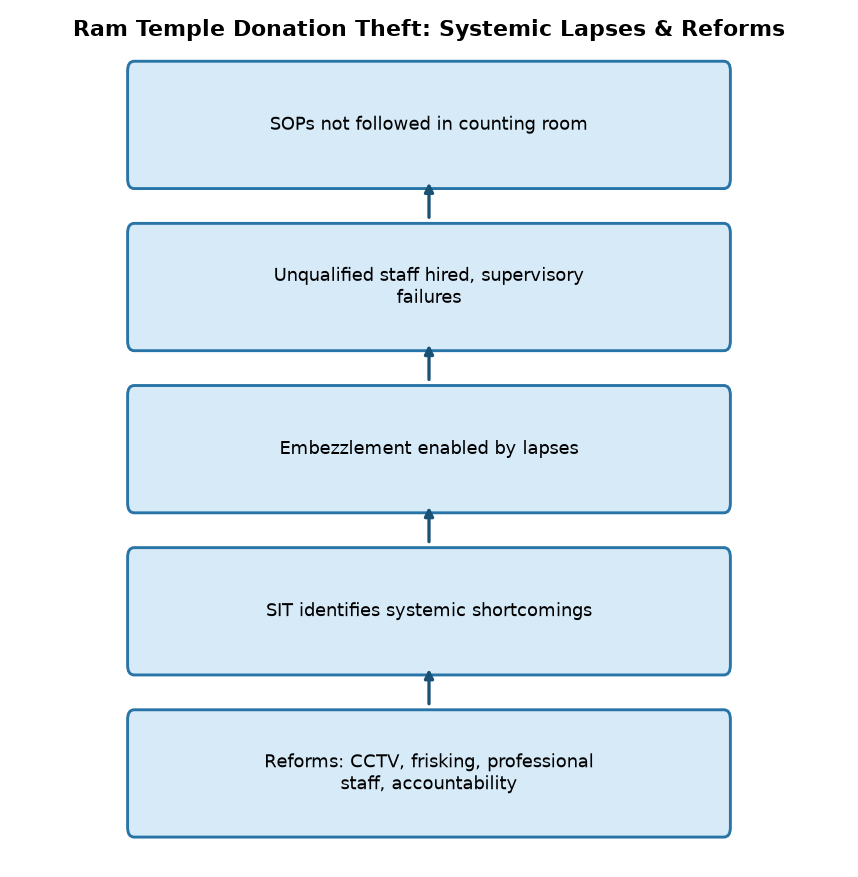
A Special Investigation Team (SIT), constituted by the Uttar Pradesh Government, has finalised its report concerning allegations of donation theft at the Ram Temple in Ayodhya. The report highlights significant administrative and supervisory lapses, including non-adherence to standard operating procedures and the engagement of unqualified personnel in critical operations, leading to embezzlement by lower-level staff. The findings underscore systemic deficiencies in the temple’s donation management system, prompting recommendations for enhanced security and professionalisation of operations.
Background
- The SIT was established on June 13 by the Uttar Pradesh Government to investigate allegations of siphoning off cash donations at the Ram Temple.
- The investigation’s remit expanded beyond the immediate theft to identify systemic shortcomings in the temple’s donation management.
- Preliminary findings led to the registration of First Information Reports (FIRs) and arrests of individuals implicated in the theft.
- The final report, now complete, is scheduled to be presented to the Supreme Court.
- The report specifically points to a failure in adhering to standard operating procedures (SOPs) in counting room operations and the recruitment of unqualified individuals.
- Supervisory deficiencies were identified as a key enabler for the embezzlement activities.
- The culpability for the theft was primarily attributed to operational staff at lower levels, though management’s role in hiring and oversight was questioned.
- The temple, being a relatively new establishment, was contrasted with institutions like the Tirumala Tirupati Devasthanams, which possess decades of administrative experience.
- The SIT comprises senior officials, including the Lucknow Divisional Commissioner, Inspector General of Police (Lucknow range), and the UP Government’s Special Secretary (Finance).
Standard Operating Procedures (SOPs) and Governance in Public Institutions
- Standard Operating Procedures (SOPs) are a set of step-by-step instructions compiled by an organisation to help workers carry out routine operations. They aim to achieve efficiency, quality output, and uniformity of performance while reducing miscommunication and failure to comply with industry regulations.
- In the context of public and religious institutions handling significant public donations, robust SOPs are crucial for ensuring transparency, accountability, and the prevention of financial irregularities.
- Governance in public institutions encompasses the systems and processes by which they are directed and controlled, ensuring effective, ethical, and accountable management of resources and operations.
- Key elements of good governance include transparency in decision-making, accountability for actions, integrity in conduct, and adherence to established rules and regulations.
- Supervisory oversight is an integral component of governance, involving the monitoring of operations and personnel to ensure compliance with SOPs and to detect and prevent malpractices.
- Lapses in supervision can create opportunities for embezzlement, fraud, and other forms of misconduct, eroding public trust in the institution.
- The engagement of qualified and professionally vetted personnel is essential for sensitive operations, particularly those involving financial transactions and asset management, to mitigate risks of internal theft and corruption.
- Technological interventions, such as enhanced CCTV surveillance, secure data storage, and systematic record-keeping of assets, are vital for strengthening security protocols and improving accountability in donation management.
- Regular audits and independent reviews are necessary to assess the effectiveness of existing SOPs and governance frameworks, identifying areas for improvement and ensuring continuous compliance.
Key Features
| Feature | Significance |
|---|---|
| SIT Formation and Mandate | Highlights governmental responsiveness to allegations of financial impropriety in public trusts and religious institutions, demonstrating commitment to accountability. |
| Identification of Systemic Lapses | Reveals critical deficiencies in operational protocols, supervisory mechanisms, and personnel management within a newly established large-scale religious institution. |
| Focus on Lower-Level Embezzlement | Indicates that while the scale of siphoning was limited to operational staff, the underlying institutional weaknesses enabled such activities. |
| Recommendations for Future Reforms | Provides a blueprint for strengthening governance, transparency, and security in the management of public donations, applicable to similar institutions. |
| Comparison with Established Institutions | Acknowledges the learning curve for new establishments, drawing parallels with experienced bodies like Tirumala Tirupati Devasthanams to contextualise challenges. |
Why it Matters
Governance and Accountability
- The SIT’s investigation and report underscore the imperative for robust governance structures and accountability mechanisms in all public-facing institutions, including religious trusts.
- It highlights the state’s role in ensuring transparency and preventing malfeasance, even in autonomous bodies managing public donations.
Institutional Management
- The findings reveal the critical importance of establishing and strictly adhering to Standard Operating Procedures (SOPs) for financial operations, particularly in cash-handling environments.
- It emphasises the necessity of professional, vetted personnel and rigorous supervisory oversight to prevent embezzlement and maintain public trust.
Public Trust and Perception
- Allegations and subsequent investigations into donation theft can significantly erode public trust in religious institutions and their management.
- Proactive measures and transparent reforms, as suggested by the SIT, are crucial for restoring and maintaining public confidence in the integrity of such organisations.
Challenges
1. Ensuring Robust Internal Controls
- Implementing and enforcing stringent internal control systems, especially for cash and artefact management, to mitigate risks of theft and fraud.
- Developing comprehensive SOPs that cover all aspects of donation handling, from collection to accounting, and ensuring their consistent application.
UPSC Link: Ethics in Public Administration
2. Personnel Management and Vetting
- Recruiting qualified and trustworthy personnel for sensitive roles, particularly those involving financial transactions, and conducting thorough background checks.
- Minimising reliance on outsourced or temporary staff for critical operations to reduce vulnerabilities and enhance accountability.
UPSC Link: Human Resource Management
3. Supervisory Oversight and Accountability
- Establishing clear lines of supervisory responsibility and holding management accountable for lapses in oversight.
- Implementing regular audits and reviews of financial processes to detect and address irregularities promptly.
UPSC Link: Accountability and Ethical Governance
4. Leveraging Technology for Transparency
- Integrating advanced surveillance technologies, such as high-resolution CCTV with adequate storage, to monitor sensitive areas.
- Implementing digital record-keeping for donations and artefacts to enhance transparency and traceability.
UPSC Link: e-Governance and Technology
Challenges — UPSC Perspective
| Issue | Concern |
|---|---|
| Non-adherence to SOPs | Facilitates opportunities for embezzlement and operational inconsistencies, undermining financial integrity. |
| Unqualified/Outsourced Personnel | Increases vulnerability to theft due to lack of proper vetting, training, and potential conflicts of interest. |
| Supervisory Lapses | Allows malpractices to persist undetected over time, indicating a failure in management oversight and accountability. |
| Inadequate Surveillance Infrastructure | Hinders effective monitoring and evidence collection, making it difficult to deter or investigate financial irregularities. |
| Institutional Deficiencies | Indicates a broader systemic weakness in establishing robust governance frameworks, particularly in nascent organisations. |
Way Forward
- Implement comprehensive Standard Operating Procedures (SOPs) for all donation handling, counting, and recording processes, ensuring strict adherence.
- Strengthen CCTV surveillance in all sensitive areas, including counting rooms, with high-resolution cameras and sufficient backup storage capacity.
- Introduce mandatory frisking protocols for personnel entering and exiting areas where donations are handled to deter and detect pilferage.
- Ensure that only professionally vetted and dedicated staff, free from external allegiances, are engaged in donation management, avoiding random outsourced personnel.
- Establish clear lines of accountability for supervisory staff, holding them responsible for oversight failures and ensuring regular internal audits.
- Utilise digital record-keeping for all donations, including cash and artefacts, to enhance transparency, traceability, and reduce manual error.
- Conduct regular training and sensitisation programmes for all staff involved in donation management regarding ethical conduct and security protocols.
- Benchmark operational and governance practices against established, well-managed religious institutions to incorporate best practices and learn from their experience.
UPSC Value Addition
Keywords for Mains Answer-Writing
Temple administration reforms · Donation management transparency · Accountability in religious institutions · SIT recommendations · Systemic deficiencies · Supervisory lapses · Internal control mechanisms · Good governance in trusts · Financial integrity · CCTV surveillance · Professionalisation of staff · Ethical management
Concept Flow
Allegations of donation theft at Ram Temple → Uttar Pradesh Government constitutes Special Investigation Team (SIT) → SIT identifies administrative and supervisory lapses, unqualified personnel → SIT submits final report with reform pointers → Recommendations for strengthened surveillance, professional staff, accountability → Implementation of reforms to enhance transparency and prevent future malpractices
Prelims Practice Questions
Q1. Consider the following statements regarding Special Investigation Teams (SITs) in India:
1. An SIT can be constituted by the Supreme Court of India or a State Government.
2. The primary objective of an SIT is to investigate specific cases and identify systemic shortcomings.
3. Recommendations made by an SIT are always binding on the government.
Which of the statements given above is/are correct?
- 1 only
- 1 and 2 only
- 2 and 3 only
- 1, 2 and 3
Answer: 1 and 2 only — Statement 1 is correct: SITs can be formed by both the Supreme Court (e.g., Black Money SIT) and state governments (as in the Ram Temple case). Statement 2 is correct: SITs are formed for specific investigations and often identify broader systemic issues. Statement 3 is incorrect: While SIT recommendations carry significant weight, they are not always legally binding; governments typically consider and implement them.
Q2. Which of the following measures are generally considered essential for ensuring transparency and preventing embezzlement in large-scale donation handling operations?
1. Robust CCTV surveillance with adequate storage capacity.
2. Implementation of Standard Operating Procedures (SOPs) for cash counting and artefact registration.
3. Regular frisking of personnel entering and exiting donation handling areas.
4. Engagement of professional staff with no allegiance to top management.
Select the correct answer using the code given below:
- 1 and 2 only
- 3 and 4 only
- 1, 2, 3 and 4
- 1, 2 and 4 only
Answer: 1, 2, 3 and 4 — All four statements describe measures that are generally considered essential for enhancing transparency and preventing financial irregularities in donation management. Robust surveillance, adherence to SOPs, personnel frisking, and professional, unbiased staffing collectively contribute to a secure and accountable system.
Mains Practice Question
✍ The recent report on donation theft at the Ram Temple highlights administrative and supervisory lapses, alongside systemic deficiencies in donation management. In light of this, critically analyse the challenges faced by large religious institutions in ensuring financial transparency and accountability. Suggest comprehensive measures that can be adopted to strengthen internal control mechanisms and prevent embezzlement, drawing parallels with best practices in public administration.
Approach: Candidates should begin by acknowledging the significance of the Ram Temple report’s findings regarding administrative and supervisory lapses. The analysis should then delve into the inherent challenges faced by large religious institutions, such as the sheer volume of donations, reliance on volunteers, lack of professional management, and potential for conflicts of interest. The answer should then propose comprehensive measures, including the implementation of robust SOPs, enhanced technological surveillance, professionalisation of staff, independent audits, and clear accountability structures, drawing parallels with principles of good governance and financial management in public administration. Conclude by emphasizing the importance of public trust and ethical stewardship.
Source: The Indian Express
Generated by AanyaAi for educational purpose.


No Comments