


21 Jul Rare Earth Permanent Magnet Demand in India by 2030: Key Challenges & Policy Response
Subject Relevance — Where This Topic Fits
- GS Paper II — International Relations (Critical Mineral Supply Chains) | GS Paper III — Science and Technology (Industrial Policy, Technology Missions) | GS Paper III — Economy (Manufacturing and Industrial Policy)
- Prelims: Rare Earth Elements (REEs), NdFeB magnets, MMDR Act 2015, Critical Minerals, Atmanirbhar Bharat, Supply Chain Resilience, Permanent Magnets, Electric Vehicles, Wind Turbines, Industrial Policy 2025
- Essay: India’s Strategic Transition: From Resource Endowment to Industrial Self-Reliance in Critical Minerals
Quick Revision: India’s 2030 REPM demand is projected at 8,220 MTPA, with critical gaps in midstream/downstream processing necessitating a ₹7,280 crore scheme to boost domestic sintered rare earth magnet production.
Why is this in the news?
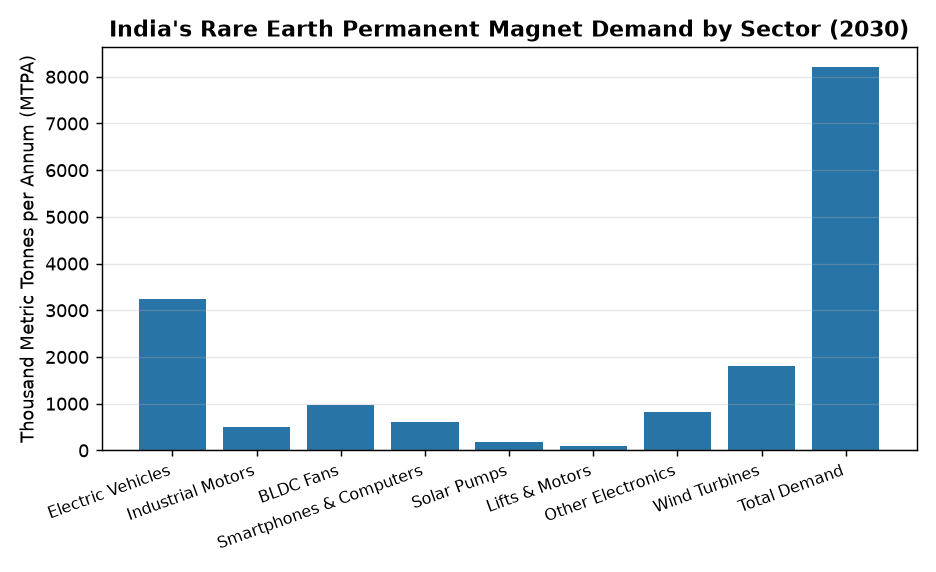
The Press Information Bureau (PIB) released an official assessment of India’s Rare Earth Permanent Magnet (REPM) demand projections for 2030, highlighting a projected total consolidated demand of 8,220 metric tonnes per annum (MTPA) across key sectors. This assessment underscores India’s critical dependence on imports for downstream REPM applications despite substantial upstream rare earth element (REE) resources, prompting the Union Cabinet’s approval of a ₹7,280 crore scheme to boost domestic production of sintered rare earth magnets.
Background
- India possesses significant rare earth element (REE) resources, with the Geological Survey of India (GSI) estimating 767 million tonnes of REE ore deposits post-MMDR (Mines and Minerals Development and Regulation) Amendment Act, 2015.
- The MMDR Act 2015 streamlined mineral exploration and mining policies, enabling systematic resource assessment and commercial exploitation of REEs.
- India has established upstream capabilities in mining, separation, and oxide refining of REEs but lacks industrial-scale midstream and downstream capacities for conversion into permanent magnets.
- Current domestic production of sintered NdFeB (Neodymium-Iron-Boron) magnets is insufficient to meet demand, necessitating imports for applications such as electric vehicles, wind turbines, and electronics.
- The Union Cabinet approved a ₹7,280 crore scheme on 26 November 2025 to promote domestic manufacturing of sintered rare earth permanent magnets, notified on 15 December 2025.
- The scheme aligns with India’s broader strategic objectives under ‘Atmanirbhar Bharat’ (Self-Reliant India) and the National Mineral Policy to reduce import dependence in critical mineral supply chains.
What are Rare Earth Permanent Magnets (REPMs)?
- Rare Earth Permanent Magnets (REPMs), particularly NdFeB (Neodymium-Iron-Boron) magnets, are high-performance magnets with exceptional magnetic strength-to-weight ratios, enabling compact and efficient designs in modern technologies.
- REPMs are essential components in electric vehicles (EVs), wind turbines, industrial motors, consumer electronics (smartphones, computers), and energy-efficient appliances (BLDC fans, solar pumps).
- India’s projected demand for REPMs by 2030 is 8,220 MTPA, with the highest demand anticipated from the electric vehicle sector (3,250 MTPA), followed by wind turbines (1,800 MTPA) and industrial motors (500 MTPA).
- The production of REPMs involves a multi-stage process: mining of REE ores, beneficiation, separation into individual REEs, refining into oxides, conversion to metals, alloying, and finally magnet manufacturing.
- India currently lacks midstream and downstream industrial-scale capabilities for converting REE oxides into metals, alloys, and magnets, necessitating imports for downstream applications.
- The MMDR Act 2015 and subsequent policy reforms have facilitated exploration and resource estimation, but structural gaps in processing and manufacturing persist.
- The ₹7,280 crore scheme aims to bridge these gaps by incentivizing domestic production of sintered REPMs, reducing import dependence and enhancing supply chain resilience.
- Institutions such as IREL (India) Limited, Defence Metallurgical Research Laboratory (DMRL), and Bhabha Atomic Research Centre (BARC) have been instrumental in assessing REPM demand and developing indigenous technologies.
Key Features
| Feature | Significance |
|---|---|
| Estimated Rare Earth Permanent Magnet (REPM) demand by 2030 (8,220 MTPA) | Quantifies India’s projected industrial and technological reliance on REPMs across sectors, highlighting strategic importance for energy transition and electronics manufacturing. |
| Current upstream capabilities (mining, separation, oxide refining) | Demonstrates India’s existing strengths in early-stage rare earth processing, reducing import dependency in primary stages. |
| Critical gap in midstream and downstream capacities (oxide-to-metal, metal-to-alloy, alloy-to-magnet) | Identifies systemic bottleneck in India’s rare earth value chain, necessitating import of sintered NdFeB magnets for downstream applications. |
| Cabinet approval of ₹7,280 crore scheme (26 Nov 2025) for indigenous sintered REPM production | Signals government commitment to self-reliance in critical materials, aligning with ‘Atmanirbhar Bharat’ and reducing external vulnerabilities in strategic sectors. |
| Geological Survey of India’s expanded REE resource assessment (767 million tonnes) | Underscores India’s latent potential in rare earth reserves, requiring targeted investment in extraction and processing technologies. |
Why it Matters
Economic
- REPMs are essential inputs for high-growth sectors: electric vehicles (EVs), renewable energy (wind turbines), and consumer electronics, positioning India to capitalize on global supply chain shifts.
- Indigenous production of sintered REPMs can reduce import bills, estimated at billions annually, while creating high-value manufacturing jobs in midstream and downstream industries.
- Enhances India’s competitiveness in global clean energy markets by securing stable supply chains for permanent magnets used in motors and generators.
Strategic
- Rare earth elements (REEs) are designated as ‘critical minerals’ by India, essential for defence, aerospace, and nuclear applications, necessitating domestic production for strategic autonomy.
- Reduces geopolitical risks associated with import dependence, particularly from China, which dominates 80% of global rare earth supply chains.
- Supports India’s commitments under international climate agreements by enabling large-scale deployment of REPM-dependent green technologies.
Industrial
- Fills a critical gap in India’s industrial value chain, transitioning from raw material exporter to high-tech magnet manufacturer, aligning with ‘Make in India’ priorities.
- Encourages R&D collaboration between public institutions (BARC, DMRL) and private sector to innovate in rare earth processing and magnet production technologies.
- Stimulates ancillary industries, including precision engineering and advanced materials, fostering a broader ecosystem of high-tech manufacturing.
Environmental
- Promotes circular economy principles by incentivizing domestic recycling of rare earths from e-waste, reducing environmental degradation from informal mining and processing.
- Supports India’s renewable energy targets (e.g., 500 GW by 2030) by ensuring local availability of REPMs for wind turbines and solar pumps, reducing lifecycle emissions.
Challenges
1. Technological and Industrial Capability Gap
- India lacks industrial-scale midstream and downstream facilities for converting oxides to metals, alloys, and magnets, necessitating significant capital and R&D investments.
- Dependence on imported technology for sintered NdFeB magnet production, which may involve intellectual property constraints and higher costs.
- Skilled workforce shortages in rare earth processing and magnet manufacturing, requiring targeted vocational training and higher education initiatives.
UPSC Link: GS3: Industrial Policy, Science & Tech
2. Resource Extraction and Processing Bottlenecks
- Despite vast REE reserves (767 million tonnes), challenges persist in economically viable extraction due to low ore grades, complex mineralogy, and environmental regulations.
- Limited domestic separation and refining capacities, leading to reliance on imported intermediates, which increases costs and supply chain vulnerabilities.
- Environmental and social concerns surrounding rare earth mining, including soil degradation, water pollution, and community displacement, necessitating sustainable mining practices.
UPSC Link: GS3: Mineral Resources, Environment
3. Policy and Regulatory Hurdles
- Fragmented regulatory framework for rare earth mining and processing, with overlapping jurisdictions between central and state authorities.
- Lack of clear incentives for private sector participation in rare earth value chains, despite government schemes, due to perceived risks and long gestation periods.
- Need for streamlined environmental clearances and mining leases to accelerate project implementation without compromising ecological safeguards.
UPSC Link: GS2: Government Policies, GS3: Environment
4. Market and Supply Chain Risks
- Volatility in global rare earth prices, influenced by geopolitical tensions and speculative trading, impacting the financial viability of domestic projects.
- Competition from established global players (e.g., China, USA) with mature supply chains and economies of scale, posing challenges for Indian manufacturers to achieve cost competitiveness.
- Dependence on imported raw materials (e.g., rare earth oxides) for domestic magnet production, creating secondary supply chain vulnerabilities.
UPSC Link: GS3: International Trade, Economic Development
5. Geopolitical and Security Concerns
- China’s dominance in rare earth supply chains poses a strategic risk, as evidenced by past export restrictions, necessitating diversification of supply sources.
- Potential for monopsony power by foreign firms in technology transfer and joint ventures, limiting India’s control over critical technologies.
- Need for robust cybersecurity measures to protect proprietary technologies in rare earth processing and magnet manufacturing.
UPSC Link: GS2: International Relations
Challenges — UPSC Perspective
| Issue | Concern |
|---|---|
| Midstream/downstream capacity deficit | India lacks facilities to convert oxides to metals/alloys/magnets, forcing reliance on imports for downstream applications. |
| High capital and R&D requirements | Indigenous REPM production demands significant investment in technology, infrastructure, and skilled labour. |
| Environmental and social costs of mining | Rare earth extraction risks soil/water degradation and community displacement, requiring sustainable practices. |
| Geopolitical supply chain risks | Dependence on China for rare earths exposes India to trade disruptions and price volatility. |
| Regulatory fragmentation | Overlapping jurisdictions and unclear policies delay project approvals and deter private investment. |
| Technological dependence on imports | Limited domestic expertise in sintered NdFeB magnet production necessitates foreign technology collaboration. |
Government Initiatives — Must-Memorise for Prelims
- Scheme for Promotion of Manufacturing of Sintered Rare Earth Permanent Magnets (REPMs) (approved 26 Nov 2025, notified 15 Dec 2025)
Way Forward
- Accelerate investment in midstream and downstream rare earth processing facilities through public-private partnerships and PLI schemes.
- Establish dedicated R&D hubs in collaboration with institutions like BARC, DMRL, and IITs to innovate in extraction, separation, and magnet production technologies.
- Develop a national rare earth resource inventory and mapping programme to identify high-grade deposits and optimize mining strategies.
- Implement a phased import substitution strategy, starting with high-demand sectors (e.g., EVs, wind turbines) to reduce reliance on foreign magnets.
- Strengthen vocational training programmes in rare earth processing, metallurgy, and magnet manufacturing to address skill shortages.
- Formulate a comprehensive policy framework for sustainable rare earth mining, including environmental safeguards, community engagement, and circular economy principles.
- Enhance international partnerships to diversify supply chains, including joint ventures with resource-rich countries (e.g., Australia, USA, Canada).
- Incentivize domestic recycling of rare earths from e-waste through subsidies and regulatory mandates to reduce primary extraction pressures.
UPSC Value Addition
Keywords for Mains Answer-Writing
Rare Earth Elements (REEs) · Permanent Magnets · Critical Minerals · Atmanirbhar Bharat Mission · Mineral Security · Downstream Industry · Midstream Capabilities · MMDR Amendment Act 2015 · Geological Survey of India (GSI) · Industrial Policy for Rare Earths · Electric Vehicle (EV) Supply Chain · Wind Energy Sector
Concept Flow
Rising demand for REPMs in EVs, renewables, and electronics → Assessment of domestic resource potential (GSI survey) → Identification of midstream/downstream capability gaps → Cabinet approval of ₹7,280 crore scheme → Implementation of industrial policy for indigenous REPM production → Reduction in import dependence → Strengthening of ‘Atmanirbhar Bharat’ in critical minerals → Enhanced strategic autonomy and economic competitiveness.
Prelims Practice Questions
Q1. Which of the following sectors is NOT identified as a major consumer of Rare Earth Permanent Magnets (REPM) in India by 2030 according to the Rare Earth Sustainable Management Plan?
- Electric Vehicles (2/3/4 wheelers)
- Solar-powered pumps
- Nuclear reactors
- Wind turbines
Answer: Nuclear reactors — The sectors listed in the plan include Electric Vehicles, Solar-powered pumps, and Wind turbines, but nuclear reactors are not mentioned as a major consumer of REPMs.
Q2. Under the MMDR Amendment Act, 2015, the Geological Survey of India (GSI) has upgraded India’s Rare Earth Element (REE) ore resource estimates to approximately:
- 567 million tonnes
- 678 million tonnes
- 767 million tonnes
- 876 million tonnes
Answer: 767 million tonnes — The Press Information Bureau release explicitly states that GSI has upgraded India’s REE ore resources to 767 million tonnes under the MMDR Amendment Act, 2015.
Q3. Which of the following best describes India’s current industrial capacity in the Rare Earth Permanent Magnet (REPM) supply chain?
- India has full upstream, midstream, and downstream capabilities for REPM production.
- India lacks upstream capabilities but has midstream and downstream capacities.
- India has upstream and midstream capabilities but lacks downstream industrial-scale conversion for REPMs.
- India is self-sufficient in REPM production and does not rely on imports.
Answer: India has upstream and midstream capabilities but lacks downstream industrial-scale conversion for REPMs. — The release highlights that India has upstream capabilities (mining, separation, oxide refining) but lacks midstream and downstream industrial-scale conversion for REPMs, necessitating imports.
Mains Practice Question
✍ Analyze the strategic significance of India’s Rare Earth Permanent Magnet (REPM) supply chain in the context of the Atmanirbhar Bharat Mission. Discuss the challenges in achieving self-reliance and suggest policy measures to enhance India’s position in the global REPM market.
Approach: Begin by defining REPMs and their critical applications in sectors like electric vehicles, wind energy, and electronics. Examine India’s current REE resource endowment (767 million tonnes) and its upstream capabilities (mining, separation, oxide refining) under the MMDR Amendment Act, 2015. Highlight the gaps in midstream (oxide-to-metal) and downstream (metal-to-alloy-to-magnet) industrial capacities, which necessitate imports. Discuss the Rare Earth Sustainable Management Plan (2025) with a ₹7,280 crore outlay to boost indigenous REPM production. Conclude with policy recommendations such as incentivizing FDI in midstream/downstream industries, strengthening R&D in REPM technologies, and leveraging international partnerships (e.g., with Australia, Japan) to secure critical mineral supply chains.
Source: PIB (Press Information Bureau)
Generated by AanyaAi for educational purpose.

- एनजीटी ने आगरा के प्रदूषित तालाबों पर 10 सप्ताह में रिपोर्ट मांगी, अतिक्रमण हटाने के निर्देश - September 22, 2026
- NGT Orders Probe into Agra’s Encroached & Polluted Water Bodies in 10 Weeks - September 22, 2026
- यूएनजीए 2026: युद्ध, एआई और सुधार – दुनिया के नेता क्या करेंगे? (UPSC दृष्टिकोण) - September 22, 2026

No Comments