


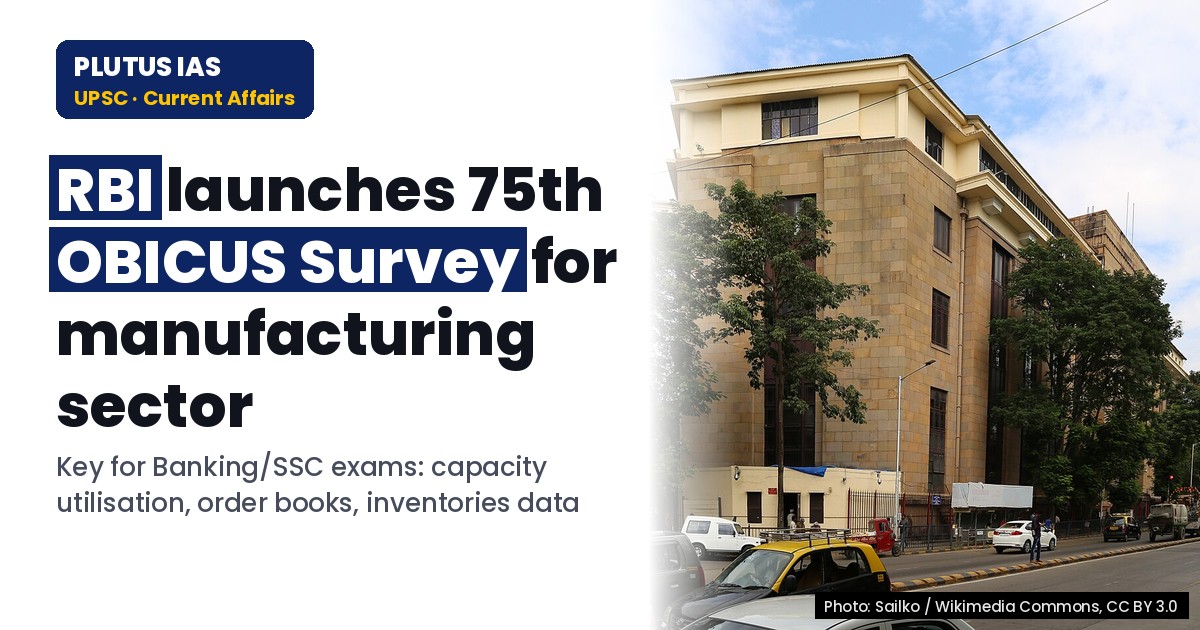
09 Oct RBI OBICUS Survey Q2 2026-27: Key for UPSC Economy & Governance Prep
✎ OBICUS is a quarterly RBI survey that provides high-frequency data on manufacturing sector order books, inventories, and capacity utilisation, serving as a key input for monetary policy and industrial analysis.
Subject Relevance — Where This Topic Fits
- GS Paper III — Indian Economy (Industrial Sector, Monetary Policy, Data Collection and Surveys)
- Prelims: OBICUS, Capacity Utilisation, Quarterly Survey, Manufacturing Sector, Monetary Policy Inputs, RBI Surveys, Industrial Data, Work-in-Progress (WiP), Raw Material Inventories, Finished Goods (FG)
- Essay: The role of data-driven policy formulation in economic governance, Industrialisation and macroeconomic stability: the interplay of production, inventory and demand
Quick Revision: OBICUS is a quarterly RBI survey that provides high-frequency data on manufacturing sector order books, inventories, and capacity utilisation, serving as a key input for monetary policy and industrial analysis.
Why is this in the news?
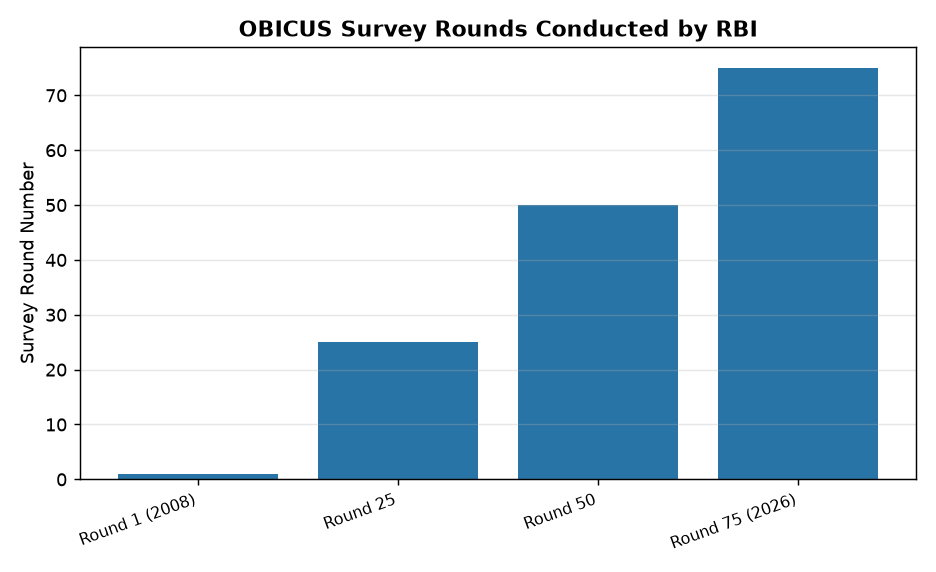
The Reserve Bank of India (RBI) has initiated the 75th round of the Quarterly Order Books, Inventories and Capacity Utilisation Survey (OBICUS) for the reference period July–September 2026. This survey is a critical input for monetary policy formulation, providing high-frequency, disaggregated data on manufacturing sector dynamics including order flows, inventory levels, and capacity utilisation. The launch underscores the RBI’s ongoing commitment to evidence-based policymaking in an evolving industrial landscape.
Background
- The OBICUS survey has been conducted quarterly by the RBI since 2008, making it one of the longest-running high-frequency enterprise surveys in India.
- Capacity utilisation (CU) data from OBICUS are used to assess the gap between actual and potential output in the manufacturing sector, aiding in the calibration of monetary and industrial policies.
- The survey’s findings are published regularly on the RBI’s website, contributing to transparency and public understanding of industrial trends.
- OBICUS complements other RBI surveys such as the Industrial Outlook Survey (IOS) and the Services Sector Survey, forming a robust data ecosystem for macroeconomic analysis.
- The survey’s confidential treatment of company-level data ensures voluntary participation and accurate reporting from manufacturing enterprises.
- OBICUS data are aligned with the National Industrial Classification (NIC) and are used by policymakers, researchers, and market participants to analyse cyclical and structural trends in manufacturing.
What is the Order Books, Inventories and Capacity Utilisation Survey (OBICUS)?
- OBICUS is a quarterly survey conducted by the Reserve Bank of India (RBI) to collect granular data on the manufacturing sector’s order books, inventory levels, and capacity utilisation.
- The survey covers quantitative metrics such as new orders received, backlog of orders, pending orders, and item-wise production in quantity and value during the reference quarter.
- It collects detailed inventory data, categorised into finished goods (FG), work-in-progress (WiP), and raw materials (RM), providing insights into supply chain dynamics and production bottlenecks.
- Capacity utilisation (CU) is estimated from the survey responses, reflecting the extent to which installed manufacturing capacity is being utilised in a given quarter.
- The survey targets a representative sample of manufacturing companies across industries, ensuring sectoral and regional diversity in responses.
- Company-level data are treated as confidential and are never disclosed, fostering trust and voluntary participation among enterprises.
- OBICUS data are critical for monetary policy formulation, as they provide real-time indicators of demand, supply, and utilisation trends in the manufacturing sector.
- The survey also captures reasons for changes in production or installed capacity, offering qualitative insights into industrial behaviour and constraints.
Key Features
| Feature | Significance |
|---|---|
| Quarterly Frequency | Ensures high-frequency, timely data for real-time economic monitoring and policy adjustments. |
| Manufacturing Sector Focus | Provides granular insights into industrial activity, a critical component of GDP and employment. |
| Order Books Data | Tracks new orders, backlog, and pending orders to assess demand-side dynamics and business confidence. |
| Inventory Breakdown | Differentiates between raw materials, work-in-progress, and finished goods, revealing supply-chain bottlenecks or overstocking. |
| Capacity Utilisation (CU) Estimation | Measures the extent to which installed capacity is being utilised, indicating under/over-investment and production gaps. |
Why it Matters
Monetary Policy & Inflation Management
- Informs the RBI’s bi-monthly Monetary Policy Committee (MPC) decisions by providing forward-looking indicators of demand-pull inflationary pressures.
- Helps distinguish between demand-driven and supply-side inflation by correlating order books with inventory levels.
- Supports the calibration of policy rates (Repo, Reverse Repo) based on actual industrial utilisation trends rather than lagged GDP data.
Industrial Policy & Investment Decisions
- Guides the Union and State governments in designing sector-specific interventions (e.g., PLI schemes, MSME support) by identifying high-growth or distressed segments.
- Assists businesses in strategic planning, such as capacity expansion, inventory management, or workforce allocation, based on CU trends.
- Enables investors to assess sectoral attractiveness and risk profiles for equity or debt financing in manufacturing.
Macroeconomic Forecasting
- Serves as a leading indicator for GDP growth projections, complementing other high-frequency data like PMI and IIP.
- Provides a cross-sectional view of industrial performance across states and sectors, aiding regional policy formulation.
- Facilitates the analysis of structural shifts, such as the impact of global supply chain disruptions or domestic policy changes (e.g., GST, customs duties).
Data Governance & Confidentiality
- Upholds statistical confidentiality (per the Collection of Statistics Act, 2008) by aggregating firm-level data, preventing competitive harm.
- Ensures methodological rigour through stratified sampling, reducing sampling bias in industrial estimates.
- Promotes transparency by publishing aggregated findings, fostering trust in RBI’s data dissemination.
Challenges
1. Sampling Bias and Representativeness
- Non-response or under-representation of SMEs may skew results, as larger firms dominate the survey frame.
- Temporal lags in data collection (e.g., Q2 2026 data released in Q3 2026) may reduce its utility for near-term policy.
- Sectoral concentration risks (e.g., over-reliance on capital goods) could misrepresent broader industrial trends.
UPSC Link: Statistical System in India (Mains: GS-III, Economic Development)
2. Data Quality and Interpretation
- Subjectivity in responses (e.g., firms overstating backlog to signal demand) may distort CU estimates.
- Lack of harmonisation with other datasets (e.g., CMIE Prowess) complicates cross-validation of trends.
- Seasonal variations (e.g., festive demand spikes) may require adjustment to isolate structural trends.
UPSC Link: Data Interpretation and Analytics (Mains: GS-III, Economic Development)
3. Confidentiality vs. Transparency Trade-offs
- Aggregation levels (e.g., state-wise vs. national) must balance granularity with disclosure risks.
- Firm-level data leaks could erode trust in RBI’s statistical apparatus, undermining future surveys.
- Publication delays in aggregated reports may reduce the survey’s policy relevance.
UPSC Link: Data Governance and Ethics (Mains: GS-II, Governance)
4. Methodological Limitations
- CU estimates rely on self-reported installed capacity, which may not reflect actual utilisation due to efficiency gaps.
- Absence of qualitative inputs (e.g., labour shortages, raw material constraints) limits holistic assessment.
- No integration with services sector data (e.g., ITC-HS) restricts a full picture of the economy.
UPSC Link: Economic Survey Methodology (Mains: GS-III, Economic Development)
Challenges — UPSC Perspective
| Issue | Concern |
|---|---|
| Response Rate | Low participation from SMEs may skew results toward large-scale industries. |
| Data Lag | Quarterly release cycles may not align with real-time policy needs. |
| Sectoral Coverage | Over-representation of capital goods may mislead broader industrial trends. |
| Subjectivity in Responses | Firms may misreport backlog or inventories to influence policy perception. |
| Cross-Dataset Harmonisation | Lack of alignment with CMIE or IIP complicates trend analysis. |
Way Forward
- Enhance survey coverage by incentivising SME participation through digital onboarding and simplified forms.
- Integrate OBICUS data with other high-frequency indicators (e.g., PMI, IIP) for a composite industrial index.
- Publish sectoral and state-wise disaggregated reports with a lag of 4-6 weeks to improve granularity.
- Conduct periodic methodological reviews to address sampling biases and improve data quality.
- Develop a real-time dashboard for policymakers, linking OBICUS trends to MPC decisions.
- Collaborate with NSDC and MSME Ministry to align survey data with skill-gap and employment trends.
- Strengthen confidentiality protocols to prevent data leaks while maintaining public trust.
- Expand the survey to include services sector components for a more comprehensive economic outlook.
UPSC Value Addition
Keywords for Mains Answer-Writing
Quarterly Order Books, Inventories and Capacity Utilisation Survey (OBICUS) · Reserve Bank of India (RBI) · manufacturing sector surveys · capacity utilisation estimation · monetary policy formulation · industrial production data · economic indicators · quantitative data collection · economic policy tools · data confidentiality in surveys · manufacturing sector statistics · RBI monetary policy inputs
Concept Flow
Manufacturing sector performance → Data collection via OBICUS survey → Aggregation and analysis → Capacity utilisation (CU) estimation → Policy formulation (RBI/MPC) → Industrial growth and inflation outcomes → Feedback loop to economic planning.
Prelims Practice Questions
Q1. Consider the following statements about the Reserve Bank of India’s Order Books, Inventories and Capacity Utilisation Survey (OBICUS):
1. OBICUS is conducted quarterly by the RBI since 2008.
2. The survey collects data on new orders, backlog of orders, and inventories of raw materials, work-in-progress, and finished goods.
3. The survey results are published only in aggregated form and individual company data is disclosed to the public.
4. The survey provides inputs for monetary policy formulation.
How many of the above statements are correct?
- Only one
- Only two
- Only three
- All four
Answer: Only three — Statements 1, 2, and 4 are correct. Statement 3 is incorrect because individual company data is treated as confidential and never disclosed.
Q2. Assertion (A): The RBI’s Quarterly Order Books, Inventories and Capacity Utilisation Survey (OBICUS) is primarily designed to assess the financial health of individual manufacturing companies.
Reason (R): The survey collects quantitative data on new orders, inventories, and production levels, which are used to estimate capacity utilisation.
Options:
A. Both A and R are true, and R is the correct explanation of A.
B. Both A and R are true, but R is not the correct explanation of A.
C. A is true, but R is false.
D. A is false, but R is true.
Answer: ? — Assertion (A) is false because OBICUS is not designed to assess the financial health of individual companies but to gather macroeconomic data for monetary policy. Reason (R) is true as the survey collects data on orders, inventories, and production to estimate capacity utilisation.
Q3. Match the following columns related to the RBI’s OBICUS survey:
Column I (Survey Component)
A. New orders received during the quarter
B. Backlog of orders at the beginning of the quarter
C. Inventories at the end of the quarter
D. Capacity utilisation estimation
Column II (Data Type Collected)
1. Quantitative data on production and installed capacity
2. Breakup between raw materials, work-in-progress, and finished goods
3. Orders pending at the start of the quarter
4. Orders received during the reference period
Options:
A. A-4, B-3, C-2, D-1
B. A-1, B-2, C-3, D-4
C. A-3, B-4, C-1, D-2
D. A-2, B-1, C-4, D-3
Answer: ? — Correct matching: A-4 (New orders received during the quarter), B-3 (Backlog of orders at the beginning of the quarter), C-2 (Inventories at the end of the quarter), D-1 (Capacity utilisation estimation).
Mains Practice Question
✍ The Reserve Bank of India’s Quarterly Order Books, Inventories and Capacity Utilisation Survey (OBICUS) is a critical tool for macroeconomic analysis and monetary policy formulation. Critically examine the role of OBICUS in India’s economic governance, with particular reference to its data collection methodology, confidentiality provisions, and contribution to policy-making. Also, analyse how such surveys enhance the reliability of industrial production data in India. (15 Marks)
Approach: MODEL-ANSWER SKELETON:
1. **Introduction (1 mark)**: Define OBICUS and its objective as a quarterly survey of the manufacturing sector since 2008, conducted by the RBI to gather quantitative data on orders, inventories, and capacity utilisation.
2. **Data Collection Methodology (4 marks)**:
– Specify the components surveyed: new orders, backlog of orders, pending orders, inventories (raw materials, work-in-progress, finished goods), production levels, and installed capacity.
– Highlight the reference period (July–September 2026 for Round 75) and the targeted group of manufacturing companies.
– Mention the dual participation model: selected companies approached directly and voluntary participation via downloadable questionnaires.
3. **Confidentiality and Data Integrity (3 marks)**:
– Emphasise the RBI’s commitment to confidentiality under the survey guidelines, treating company-level data as non-disclosable.
– Discuss the safeguards in place (e.g., authentication, secure email submission) to ensure data integrity and respondent trust.
4. **Contribution to Monetary Policy (3 marks)**:
– Explain how OBICUS data informs the RBI’s assessment of industrial activity, demand-supply dynamics, and inflationary pressures.
– Link the survey’s findings to the RBI’s policy tools, such as repo rate adjustments, liquidity management, and credit policy.
5. **Enhancing Industrial Production Data Reliability (3 marks)**:
– Compare OBICUS with other data sources (e.g., IIP, ASI) to highlight its role in triangulating industrial performance.
– Discuss how OBICUS mitigates gaps in official statistics by providing granular, timely, and sector-specific insights.
6. **Conclusion (1 mark)**: Summarise the survey’s significance in strengthening India’s macroeconomic governance framework and its limitations (e.g., sample size, sectoral coverage).
Source: RBI
Generated by AanyaAi for educational purpose.
Related guides on our sites
- UPSC EPFO syllabus
- Best PSIR optional coaching for upsc
- Best economics optional coaching for upsc
- Best PSIR optional teacher for upsc

- RBI OBICUS Survey Q2 2026-27: Key for UPSC Economy & Governance Prep - October 9, 2026
- मध्य प्रदेश में 3800 करोड़ की मैक्केन फूड परियोजना: 2000 रोज़गार सृजन - October 9, 2026
- NTA Reforms: Parliamentary Panel’s 382nd Report Key Recommendations - October 9, 2026

No Comments