


05 Aug RBI Policy Impact: Analysts Warn of Conditional Market Calm in UPSC Exam Context
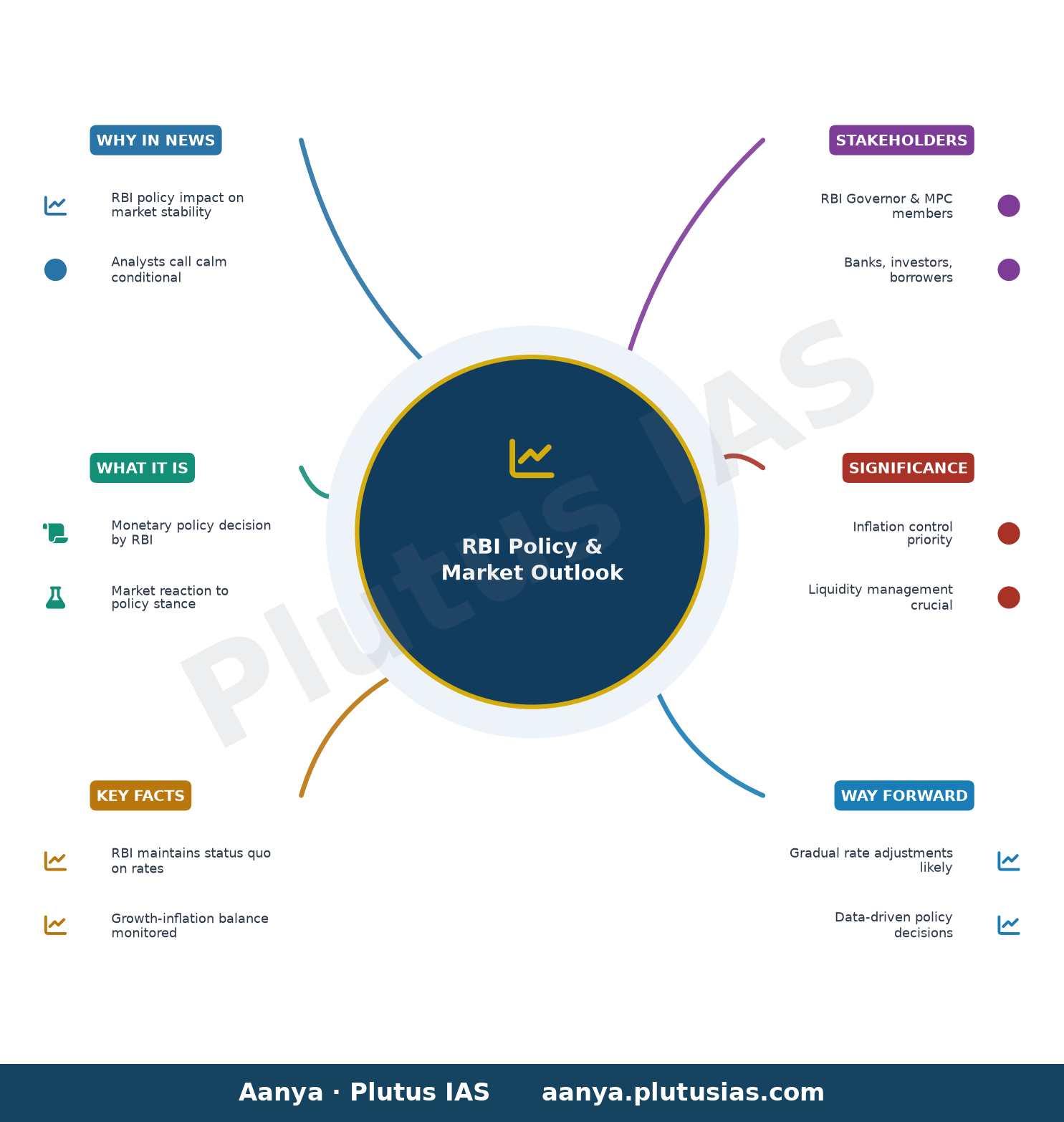
✎ RBI policy decisions are pivotal for market stability and inflation control, with a conditional calm outlook.
Relevance for UPSC & State PCS: Polity & Governance
The Reserve Bank of India’s (RBI) recent policy stance has drawn cautious optimism from analysts, who argue that the current calm in financial markets is contingent on multiple factors, including global liquidity conditions and domestic inflation dynamics. The central bank’s decision to maintain a balanced approach—neither overly hawkish nor dovish—reflects its priority to support growth while keeping inflationary pressures in check. This nuanced stance is particularly relevant for UPSC aspirants studying monetary policy frameworks, as it highlights the RBI’s role in balancing macroeconomic objectives within a volatile global environment. For State PCS candidates, understanding such policy nuances can provide insights into how fiscal and monetary tools interact in governance, especially in managing inflation and employment.
Analysts have pointed out that the RBI’s conditional calm is tied to external risks, such as geopolitical tensions and fluctuating commodity prices, which could disrupt supply chains and stoke inflation. The central bank’s emphasis on liquidity management and credit flow underscores its proactive role in stabilizing markets without resorting to aggressive rate hikes. This approach is crucial for UPSC aspirants preparing for questions on economic governance, as it demonstrates the RBI’s adaptive strategies in response to global uncertainties. For State PCS officers, recognizing these policy signals can aid in designing localized economic interventions, particularly in sectors sensitive to interest rate movements.
The market’s muted reaction to the RBI’s policy signals also reflects investor confidence in the central bank’s credibility, though analysts warn that this calm could dissipate if inflation persists or growth falters. The RBI’s communication strategy, which balances transparency with caution, serves as a case study for UPSC candidates studying governance and policy communication. State PCS aspirants, meanwhile, can draw parallels between the RBI’s approach and state-level economic policies, where fiscal prudence and inflation control are equally critical. The conditional nature of the current calm thus becomes a learning point for both national and subnational policymakers.
For UPSC aspirants, the RBI’s policy outlook offers a lens to examine broader themes like inflation targeting, financial inclusion, and the impact of global financial cycles on domestic policy. State PCS candidates, tasked with grassroots economic governance, can use this analysis to understand how macroeconomic policies trickle down to local economies. The RBI’s cautious optimism, therefore, is not just a market sentiment but a reflection of the complex interplay between governance, economics, and public welfare—a framework essential for both civil service examinations.
Source: Business Standard
Practice Questions
Q1. According to recent analysts’ assessments, what is the primary condition for market stability as per the RBI policy outlook?
- Unconditional support from global central banks
- Stable domestic inflation within the RBI’s target range
- Calm in financial markets being entirely dependent on fiscal policies
- Market calm being conditional on external factors like global economic conditions
Answer
Market calm being conditional on external factors like global economic conditions — Analysts have indicated that the calm in financial markets is not unconditional but is largely dependent on external factors such as global economic conditions, despite the RBI’s policy measures.
Q2. What does the phrase ‘Calm is conditional’ imply in the context of RBI policy and market outlook?
- Markets will remain stable regardless of RBI actions
- Market stability is guaranteed by RBI’s monetary policies alone
- Market calm depends on factors beyond RBI’s direct control
- RBI policies will ensure market stability without any conditions
Answer
Market calm depends on factors beyond RBI’s direct control — The phrase suggests that market stability is not solely determined by RBI policies but is also influenced by external economic conditions, making the calm conditional on broader factors.
Generated by AanyaAi for educational purpose.

- ट्रम्प का ईरान युद्ध का बचाव: संयुक्त राष्ट्र में भारत-प्रशांत पर प्रभाव - September 22, 2026
- Trump Defends Iran War at UNGA: Key Implications for UPSC & State PCS - September 22, 2026
- अंडमान-निकोबार के उपराज्यपाल ने प्रधानमंत्री से की बैठक, जानें मुख्य बिंदु - September 22, 2026

No Comments