


22 Sep Trump Defends Iran War at UNGA: Key Implications for UPSC & State PCS
✎ The doctrine of pre-emptive military action, while asserted by some states as a necessary security measure, remains legally contentious under the UN Charter and is subject to stringent conditions of imminence, necessity, and…
Subject Relevance — Where This Topic Fits
- GS Paper II — International Relations — International Institutions (UN), Regional Organisations (GCC), Bilateral and Multilateral Diplomacy | GS Paper II — International Relations — India’s Foreign Policy — Strategic Alliances and Regional Stability (Middle East) | GS Paper III — Security Challenges — Internal Security, External State and Non-State Threats
- Prelims: United Nations General Assembly (UNGA), Strait of Hormuz, Gulf Cooperation Council (GCC), Pre-emptive strike doctrine, Article 51 of the UN Charter, Non-Aligned Movement (NAM), Proxy warfare, Cartel violence in Latin America
- Essay: The Moral and Legal Dimensions of Pre-emptive Military Action in International Relations, The Role of Multilateral Institutions in Managing Regional Conflicts and Ensuring Global Peace
Quick Revision: The doctrine of pre-emptive military action, while asserted by some states as a necessary security measure, remains legally contentious under the UN Charter and is subject to stringent conditions of imminence, necessity, and proportionality.
Why is this in the news?
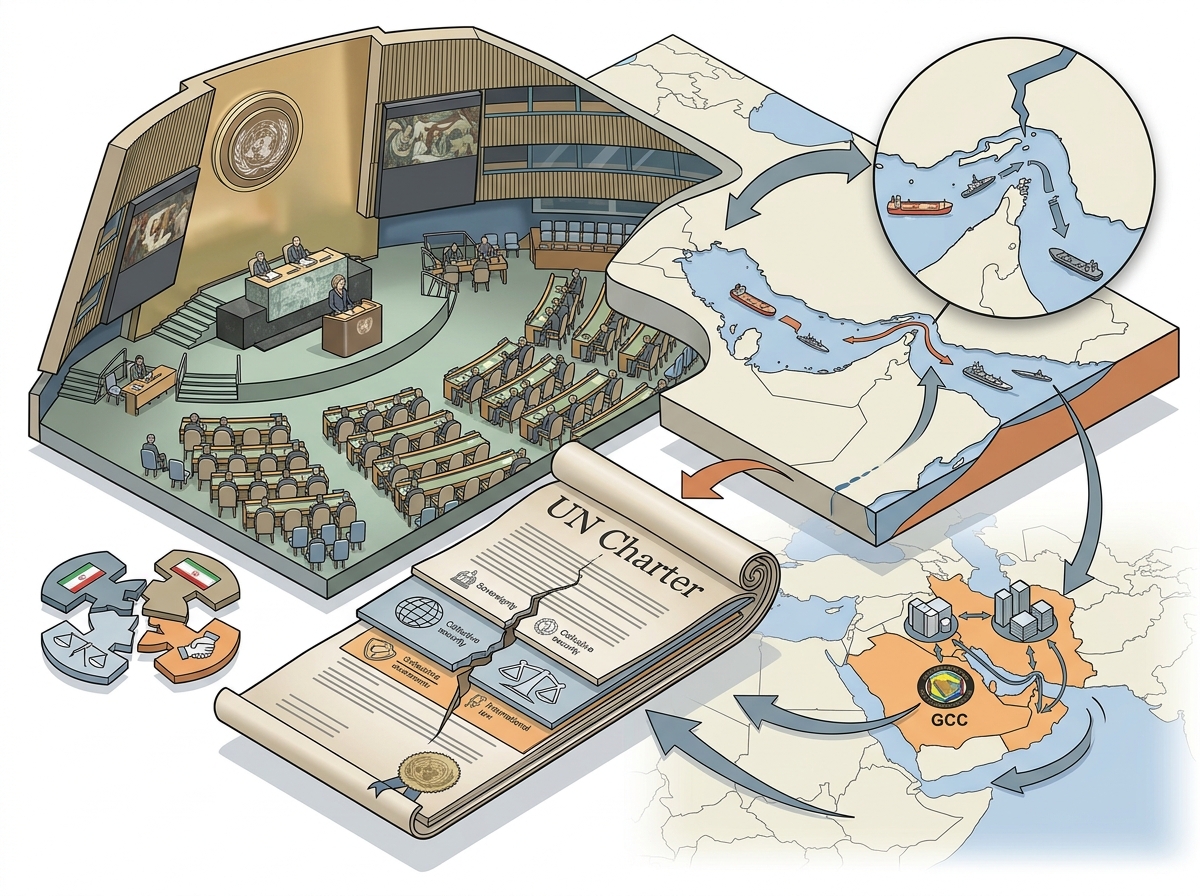
The 2026 address by the President of the United States at the United Nations General Assembly (UNGA) highlighted the escalation of the Iran conflict, including the assertion of a pre-emptive military doctrine, the strategic significance of the Strait of Hormuz, and the implications for regional security frameworks such as the Gulf Cooperation Council (GCC). The address underscored the United States’ stance on countering perceived Iranian aggression through military action, the diplomatic fallout with Iran, and the broader geopolitical repercussions for global order.
Background
- The United Nations Charter, adopted in 1945, enshrines the principle of sovereign equality of states and prohibits the use of force except in cases of self-defence or with Security Council authorisation (Article 2(4) and Article 51).
- The Strait of Hormuz, a critical chokepoint for global oil transit, has been a flashpoint in US-Iran relations, with recurring threats to its closure by Iran in response to sanctions and perceived encroachments.
- The Gulf Cooperation Council (GCC), established in 1981, comprises six Arab states (Bahrain, Kuwait, Oman, Qatar, Saudi Arabia, and the United Arab Emirates) and serves as a platform for economic and security cooperation in the Gulf region.
- The doctrine of pre-emptive military action, articulated in the 2002 US National Security Strategy, asserts the right to strike first against imminent threats, a concept that has been both praised and criticised in international law.
- The Iran nuclear deal (JCPOA), signed in 2015 and abandoned by the United States in 2018, remains a contentious issue in global non-proliferation efforts and regional security dynamics.
- Proxy warfare and support for non-state actors have been persistent features of the US-Iran conflict, with both sides leveraging regional allies and militant groups to advance strategic interests.
Understanding the Doctrine of Pre-emptive Military Action and its Legal and Strategic Implications
- The doctrine of pre-emptive military action posits that a state may use force against another state if it perceives an imminent and unavoidable threat, even in the absence of an actual attack. This doctrine is rooted in the concept of anticipatory self-defence, which is not explicitly codified in the UN Charter but has been interpreted through state practice and judicial rulings.
- Article 51 of the UN Charter recognises the inherent right of individual or collective self-defence if an armed attack occurs, but does not explicitly address pre-emptive action. The International Court of Justice (ICJ) in the *Nicaragua v. United States* (1986) case emphasised that the use of force must be proportional and necessary, limiting the scope of pre-emptive action.
- The United States’ 2002 National Security Strategy formalised the doctrine of pre-emptive action, citing the need to address emerging threats such as terrorism and weapons of mass destruction before they materialise into direct attacks. This doctrine has been invoked in subsequent US military interventions, including in Iraq (2003), though its legality remains contested.
- The Strait of Hormuz is a vital maritime route, through which approximately 20% of the world’s oil supply passes daily. Disruptions to its flow can trigger global energy crises, making it a strategic chokepoint in US-Iran relations and a focal point in international maritime security debates.
- The Gulf Cooperation Council (GCC) plays a pivotal role in regional security, with member states often aligning with the United States on issues such as counter-terrorism, maritime security, and countering Iranian influence. The GCC’s collective security framework, including the Peninsula Shield Force, is designed to deter external aggression and internal threats.
- Proxy warfare involves indirect conflict between states through non-state actors, such as militias or insurgent groups. In the context of US-Iran relations, proxy warfare has manifested in conflicts across the Middle East, including in Syria, Yemen, and Iraq, complicating efforts to achieve regional stability.
- The principle of proportionality in international humanitarian law (IHL) requires that any military action must be commensurate with the threat posed. Violations of this principle can lead to accusations of disproportionate force and violations of international law.
- The United Nations Security Council (UNSC) holds primary responsibility for maintaining international peace and security. Any unilateral military action by a state, including pre-emptive strikes, must be justified under international law and, ideally, receive UNSC authorisation to avoid legal and diplomatic repercussions.
Key Features
| Feature | Significance |
|---|---|
| UN General Assembly Address | Provides a platform for global leaders to articulate national positions, influence international opinion, and set diplomatic agendas. |
| U.S.-Iran Conflict Escalation | Represents a critical inflection point in Middle Eastern geopolitics, with implications for global energy security and regional stability. |
| Strait of Hormuz Closure Threat | A strategic chokepoint for global oil transit; any disruption could trigger supply chain disruptions and price volatility. |
| Multilateral Alliances (GCC Nations) | Demonstrates the role of regional blocs in shaping responses to transnational threats, including terrorism and maritime security. |
| Shield of the Americas Initiative | Highlights the intersection of domestic security priorities (cartel violence) with international diplomacy and counter-terrorism cooperation. |
Why it Matters
Strategic Security
- The U.S. stance on Iran underscores the enduring challenge of balancing deterrence with de-escalation in nuclear-armed regional conflicts.
- The Strait of Hormuz, a critical maritime route, remains a flashpoint for proxy conflicts, necessitating coordinated international responses.
- Regional alliances (e.g., GCC) are pivotal in managing asymmetric threats, including Iran-backed militant groups.
Economic Implications
- Disruptions in the Strait of Hormuz could destabilize global oil markets, given that ~20% of the world’s petroleum passes through this route.
- Sanctions or military actions targeting Iran may lead to secondary economic effects, such as inflation in fuel prices or supply chain bottlenecks.
- The Shield of the Americas initiative reflects a shift toward integrating regional security frameworks to combat transnational crime networks.
Diplomatic Dynamics
- The UNGA address exemplifies the use of multilateral forums to legitimize unilateral actions, a recurring theme in U.S. foreign policy.
- Iran’s delegation walkout highlights the fragility of diplomatic engagement in high-stakes geopolitical disputes.
- Bilateral meetings (e.g., with UK, Japan, Ukraine) signal the prioritization of alliances in addressing shared security concerns.
Domestic Political Impact
- The timing of the address, amid U.S. midterm elections, underscores the interplay between foreign policy and electoral politics.
- The president’s framing of the Iran conflict as a test of resolve may influence public perception of leadership and national security priorities.
Challenges
1. Escalation of U.S.-Iran Hostilities
- Risk of unintended military escalation due to miscalculation or miscommunication between adversarial states.
- Potential for regional spillover, including attacks on Gulf states or proxy conflicts in Syria, Iraq, or Yemen.
- Erosion of diplomatic channels, reducing avenues for crisis de-escalation.
UPSC Link: GS Paper 2: International Relations
2. Global Energy Security
- Vulnerability of critical maritime chokepoints (e.g., Strait of Hormuz) to disruption, with cascading effects on oil prices and inflation.
- Dependence on Middle Eastern oil supplies for major economies, including India, which imports ~85% of its crude oil.
UPSC Link: GS Paper 3: Energy Security
3. Multilateral Coordination Failures
- Divergent national interests among allies (e.g., U.S., EU, GCC) may hinder unified responses to regional threats.
- Limited effectiveness of international institutions (e.g., UN, IAEA) in mediating conflicts between sovereign states.
UPSC Link: GS Paper 2: International Organizations
4. Domestic Polarization and Governance
- Foreign policy decisions (e.g., war initiation) becoming entangled in domestic political narratives, complicating long-term strategic planning.
- Potential erosion of public trust in institutions if foreign engagements are perceived as partisan or destabilizing.
UPSC Link: GS Paper 2: Polity and Governance
5. Humanitarian and Refugee Crises
- Prolonged conflict in Iran could exacerbate refugee flows into neighboring countries (e.g., Turkey, Pakistan), straining resources.
- Risk of civilian casualties and infrastructure damage in urban centers, requiring international humanitarian intervention.
UPSC Link: GS Paper 1: Social Issues
Challenges — UPSC Perspective
| Issue | Concern |
|---|---|
| Unintended Escalation | Risk of rapid military escalation due to miscommunication or miscalculation between adversaries. |
| Energy Supply Disruptions | Potential for global oil price volatility if critical maritime routes (e.g., Strait of Hormuz) are compromised. |
| Regional Spillover Effects | Likelihood of conflict spreading to neighboring states via proxy groups or direct military engagements. |
| Diplomatic Fragmentation | Difficulty in maintaining unified international responses due to divergent national interests. |
| Humanitarian Impact | Increased civilian displacement and infrastructure damage, necessitating global aid coordination. |
| Domestic Political Fallout | Erosion of public trust in governance if foreign policy decisions are perceived as destabilizing or partisan. |
Way Forward
- Strengthen crisis communication channels between adversarial states to prevent miscalculation and unintended escalation.
- Enhance maritime security cooperation with Gulf Cooperation Council nations to safeguard critical chokepoints like the Strait of Hormuz.
- Promote diplomatic engagement through neutral third-party mediators to de-escalate tensions and restore dialogue.
- Invest in diversified energy supply chains to mitigate risks associated with regional conflicts affecting oil transit routes.
- Expand humanitarian aid frameworks to address potential refugee crises and civilian protection in conflict zones.
- Conduct structured bilateral and multilateral dialogues to align national interests and foster collective responses to regional threats.
- Monitor and address domestic political narratives to ensure foreign policy decisions remain insulated from partisan influences.
UPSC Value Addition
Keywords for Mains Answer-Writing
United Nations General Assembly · International conflict resolution mechanisms · UN Charter Chapter VII · Collective security · Sovereignty and non-intervention · Unilateral military action · International humanitarian law · Diplomatic immunity · Multilateralism vs unilateralism · UN Security Council veto power · Iran-US relations · Strait of Hormuz · Midterm elections and foreign policy · Media freedom and access to information
Concept Flow
U.S.-Iran diplomatic tensions escalate → Threat of Strait of Hormuz closure → Global energy supply disruption → Price volatility in oil markets → Inflationary pressures globally → Strain on economies dependent on Middle Eastern oil (e.g., India) → Regional alliances (GCC) mobilize for collective security → U.S. initiates military action → Risk of unintended escalation → Humanitarian crises and refugee flows → International humanitarian intervention required → Diplomatic channels collapse → Long-term geopolitical realignment.
Prelims Practice Questions
Q1. Consider the following statements regarding the United Nations General Assembly (UNGA) and the United Nations Security Council (UNSC):
1. The UNGA is the principal deliberative, policymaking and representative organ of the UN.
2. Decisions on important questions, including those on peace and security, require a two-thirds majority of the present and voting members in the UNGA.
3. The UNSC has primary responsibility for the maintenance of international peace and security under the UN Charter.
4. Any permanent member of the UNSC can veto any substantive resolution, including those related to Chapter VII actions.
How many of the above statements are correct?
- Only one
- Only two
- Only three
- All
Answer: All — Statements 1, 3, and 4 are correct. Statement 2 is incorrect because decisions on important questions in the UNGA require a two-thirds majority of the members present and voting, but this does not include decisions on peace and security, which are primarily handled by the UNSC under Chapter VII of the UN Charter.
Q2. Assertion (A): The President of the United States, while addressing the UN General Assembly, referred to the ‘Shield of Americas’ initiative, which is a regional security framework launched by the US.
Reason (R): The initiative aims to combat transnational threats such as violent cartels and drug trafficking through multilateral cooperation in Latin America.
In the context of the above two statements, which of the following is correct?
- Both A and R are true, and R is the correct explanation of A.
- Both A and R are true, but R is NOT the correct explanation of A.
- A is true, but R is false.
- A is false, but R is true.
Answer: Both A and R are true, but R is NOT the correct explanation of A. — Both the assertion and reason are factually accurate. The ‘Shield of Americas’ initiative, as mentioned in the context, is indeed a regional security framework launched by the US to combat transnational threats through multilateral cooperation in Latin America. The reason correctly explains the assertion.
Q3. Match the following provisions of the UN Charter with their respective chapters:
Column I (Chapter) Column II (Provision)
A. Chapter VI 1. Action with respect to threats to the peace, breaches of the peace, and acts of aggression
B. Chapter VII 2. Pacific settlement of disputes
C. Chapter IX 3. International economic and social cooperation
D. Chapter X 4. Economic and Social Council (ECOSOC)
Select the correct match:
- A-2, B-1, C-3, D-4
- A-1, B-2, C-3, D-4
- A-3, B-4, C-1, D-2
- A-4, B-3, C-2, D-1
Answer: A-2, B-1, C-3, D-4 — The correct matches are: A (Chapter VI) – 2 (Pacific settlement of disputes), B (Chapter VII) – 1 (Action with respect to threats to the peace, breaches of the peace, and acts of aggression), C (Chapter IX) – 3 (International economic and social cooperation), and D (Chapter X) – 4 (Economic and Social Council).
Mains Practice Question
✍ The assertion of unilateral military action by a State, even in the face of perceived threats, challenges the foundational principles of the United Nations Charter, particularly the doctrines of sovereignty, non-intervention, and collective security. Critically examine the legal and normative implications of such assertions in the context of contemporary international relations. (15 Marks)
Approach: MODEL-ANSWER SKELETON:
1. **Introduction**: Briefly define the principles of sovereignty, non-intervention, and collective security as enshrined in the UN Charter (Articles 2(1), 2(4), and 2(7)).
2. **Legal Framework**:
– UN Charter Chapter VII (Articles 39-51): Conditions for the use of force (threat to peace, breach of peace, act of aggression) and the role of the UNSC.
– ICJ Nicaragua Case (1986): Criteria for self-defence and prohibited use of force.
– Doctrine of ‘Responsibility to Protect’ (R2P): Limits and controversies.
3. **Normative Challenges**:
– Unilateralism vs Multilateralism: Erosion of collective decision-making (UNSC veto dynamics).
– Sovereignty vs Humanitarian Intervention: Case studies (e.g., Kosovo 1999, Iraq 2003).
– Preemptive strikes and the Caroline Test: Legal thresholds.
4. **Contemporary Context**:
– Recent examples of unilateral military actions (e.g., US-led interventions, Iran-US tensions).
– Impact on diplomatic immunity and media freedom (e.g., bans on news outlets at international forums).
5. **Conclusion**: Weigh the balance between State sovereignty and international accountability. Argue for strengthening multilateral institutions to prevent unilateral excesses while acknowledging State security concerns.
Key thinkers: Hans Morgenthau (realism), Hedley Bull (international society), Thomas Franck (legitimacy in international law).
Source: orissapost.com
Generated by AanyaAi for educational purpose.
Related guides on our sites
- Current affairs for upsc 2026
- How to prepare for GS paper 1 for UPSC CSE mains exam
- Best PSIR optional coaching for upsc
- Best PSIR optional teacher for upsc

- Trump Defends Iran War at UNGA: Key Implications for UPSC & State PCS - September 22, 2026
- अंडमान-निकोबार के उपराज्यपाल ने प्रधानमंत्री से की बैठक, जानें मुख्य बिंदु - September 22, 2026
- UPSC Alert: Andaman & Nicobar LG Meets PM on 22 Sep 2026 - September 22, 2026

No Comments