


01 Aug RBI to Auction ₹24,000 Crore Treasury Bills on Aug 5, 2026: Key Details for UPSC & PCS
✎ Treasury Bills are zero-coupon, short-term government securities issued at a discount to face value, with maturities of 91, 182, or 364 days, auctioned by the RBI to meet fiscal needs and facilitate liquidity in the money market.
Subject Relevance — Where This Topic Fits
- GS Paper III — Indian Economy: Money and Banking, Government Budgeting and Fiscal Policy
- Prelims: Treasury Bills (T-Bills), Public Debt Management, Fiscal Deficit, Monetary Policy Framework, RBI’s E-Kuber System, Retail Direct Scheme, Non-Competitive Bidding, Primary Market Auctions
- Essay: The Role of Fiscal Instruments in Sustainable Development, Financial Inclusion and Retail Investor Participation in Capital Markets
Quick Revision: Treasury Bills are zero-coupon, short-term government securities issued at a discount to face value, with maturities of 91, 182, or 364 days, auctioned by the RBI to meet fiscal needs and facilitate liquidity in the money market.
Why is this in the news?
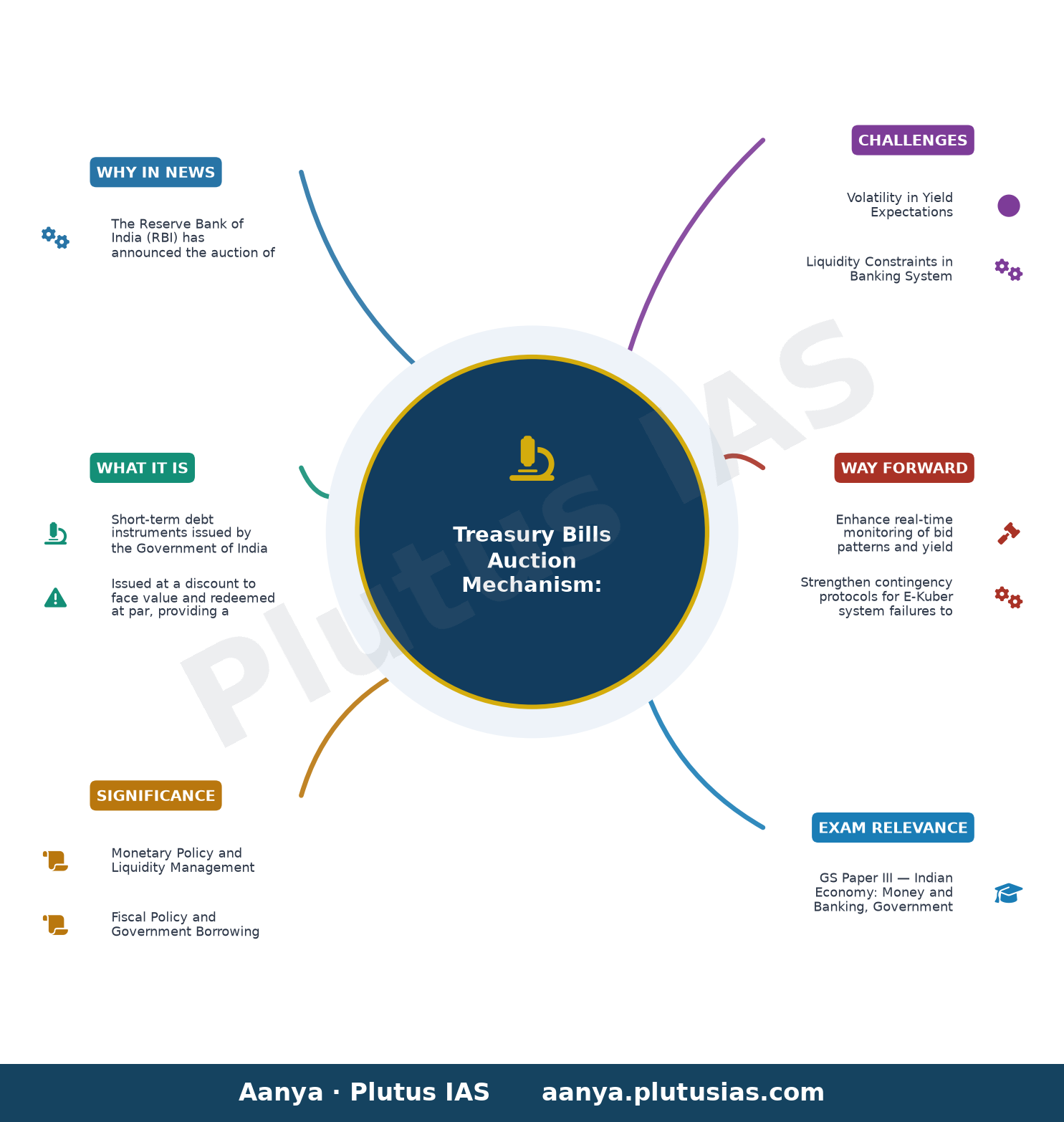
The Reserve Bank of India (RBI) has announced the auction of 91-day, 182-day, and 364-day Treasury Bills (T-Bills) for a total notified amount of ₹24,000 crore on August 5, 2026, with settlement on August 6, 2026. This auction is a routine exercise in India’s public debt management, reflecting the government’s ongoing requirement for short-term borrowing to meet fiscal obligations. The auction mechanism, including competitive and non-competitive bidding, underscores the RBI’s role in ensuring liquidity and price discovery in the money market while facilitating retail investor participation through the Retail Direct portal.
Background
- Treasury Bills are short-term government securities issued by the Government of India to meet its immediate cash requirements, typically for a period of less than one year.
- The RBI, acting as the government’s debt manager, conducts auctions for T-Bills on behalf of the Ministry of Finance to ensure transparent and efficient borrowing.
- T-Bills are issued at a discount to their face value and redeemed at par, making them attractive for investors seeking low-risk, liquid instruments.
- The auction process follows a multiple-price method, where successful bidders pay the price they bid, ensuring market-based price discovery.
- Retail investors can participate in T-Bill auctions through the RBI’s Retail Direct Scheme, launched in November 2021 to democratise access to government securities.
- The notified amounts for T-Bills are determined based on the government’s fiscal needs and market conditions, with allocations subject to the General Notification F.No.4(2)-B(W&M)/2018 dated March 26, 2025.
What are Treasury Bills?
- Short-term debt instruments issued by the Government of India with maturities of 91 days, 182 days, and 364 days.
- Issued at a discount to face value and redeemed at par, providing a fixed return to investors without periodic interest payments.
- Primary instruments used by the government to finance its fiscal deficit and manage liquidity in the short term.
- Traded in the secondary market, offering liquidity to investors and serving as a benchmark for short-term interest rates.
- Auctioned by the RBI on a weekly basis, with the notified amount determined by the government’s borrowing calendar.
- Governed by the General Notification issued by the Ministry of Finance.
- Eligible for investment by banks, financial institutions, provident funds, and retail investors through the Retail Direct portal.
- Play a critical role in the transmission of monetary policy by influencing short-term interest rates in the economy.
Key Features
| Feature | Significance |
|---|---|
| Notified Amount (₹24,000 crore) | Ensures adequate liquidity for Government of India’s short-term borrowing needs while maintaining fiscal discipline. |
| Auction Date: 05 August 2026 | Aligns with RBI’s regular liquidity management operations to stabilise money market conditions. |
| Settlement Date: 06 August 2026 | Facilitates timely credit to the government’s account for expenditure commitments. |
| Price-based auction with multiple price method | Promotes transparency and market-determined pricing for Treasury Bills. |
| Non-competitive allocation for retail investors (max 5%) | Encourages broader participation in government securities, enhancing financial inclusion. |
| Electronic bidding via E-Kuber system | Reduces operational risks, ensures efficiency, and broadens bidder participation. |
Why it Matters
Monetary Policy and Liquidity Management
- Treasury Bills serve as a primary instrument for the RBI to conduct Open Market Operations (OMOs), influencing short-term interest rates and liquidity in the banking system.
- The auction structure (91/182/364-day T-Bills) allows the RBI to manage liquidity across different maturity profiles, balancing inflation and growth objectives.
- Yield signals from these auctions reflect market expectations of future interest rates, providing critical inputs for monetary policy formulation.
Fiscal Policy and Government Borrowing
- The notified amount (₹24,000 crore) represents a portion of the Government of India’s Ways and Means Advances (WMA) and short-term borrowings to meet revenue expenditure.
- T-Bills are a cost-effective source of financing for the government, as they typically carry lower interest rates compared to market borrowings for longer durations.
- Regular auctions ensure a predictable borrowing calendar, reducing market uncertainty and crowding-out effects on private sector credit.
Market Development and Investor Participation
- The inclusion of retail investors via the Retail Direct portal democratises access to government securities, fostering a culture of saving and investment.
- Non-competitive bidding for state governments, provident funds, and foreign central banks enhances the depth and stability of the secondary market for T-Bills.
- Transparent auction mechanisms and settlement processes strengthen investor confidence in sovereign debt instruments.
Macroeconomic Stability
- T-Bill auctions act as a benchmark for pricing other money market instruments, including commercial paper and certificates of deposit.
- Stable T-Bill yields contribute to predictable borrowing costs for the government and private sector, supporting long-term economic planning.
- The RBI’s role in ensuring smooth settlement and minimising operational risks reinforces systemic stability in the financial sector.
Challenges
1. Volatility in Yield Expectations
- Sudden shifts in macroeconomic indicators (e.g., inflation, GDP growth) can lead to unpredictable bid patterns, causing yield volatility.
- Global financial conditions, such as US Federal Reserve policy shifts, may influence foreign investor participation and domestic yield curves.
UPSC Link: GS-III: Monetary Policy & Inflation
2. Liquidity Constraints in Banking System
- Inadequate liquidity in the banking system may result in subdued participation, leading to higher bid-cover ratios and elevated yields.
- Structural issues, such as high Statutory Liquidity Ratio (SLR) requirements, can limit banks’ ability to subscribe to T-Bills.
UPSC Link: GS-III: Banking Sector Reforms
3. Operational and Technical Risks
- System failures in the E-Kuber platform or Retail Direct portal could disrupt auction processes, necessitating contingency measures.
- Delays in settlement or payment failures may erode investor confidence and disrupt secondary market trading.
UPSC Link: GS-III: Financial Market Infrastructure
4. Fiscal Discipline and Debt Sustainability
- Excessive reliance on short-term borrowings (T-Bills) may signal fiscal stress, increasing rollover risks and long-term debt servicing burdens.
- Frequent auctions could crowd out private sector borrowing, particularly in a high-interest-rate environment.
UPSC Link: GS-III: Fiscal Policy & FRBM Act
Challenges — UPSC Perspective
| Issue | Concern |
|---|---|
| Yield Volatility | Disrupts monetary policy transmission and increases borrowing costs for the government. |
| Liquidity Shortages | Reduces bid participation, leading to higher yields and inefficient resource allocation. |
| Operational Failures | Delays in settlement or bidding disruptions undermine market confidence. |
| Fiscal Stress Indicators | Excessive short-term borrowings may signal unsustainable fiscal policies. |
| Global Spillovers | Foreign investor sentiment can cause sudden capital outflows, affecting domestic yields. |
Way Forward
- Enhance real-time monitoring of bid patterns and yield movements to pre-empt volatility in T-Bill auctions.
- Strengthen contingency protocols for E-Kuber system failures to ensure uninterrupted auction processes.
- Promote financial literacy campaigns to increase retail investor participation in government securities.
- Coordinate with the Ministry of Finance to align T-Bill issuance with broader fiscal consolidation goals.
- Expand the investor base by incentivising participation from mutual funds, insurance companies, and pension funds.
- Conduct periodic reviews of the Retail Direct portal to address technical glitches and improve user experience.
- Collaborate with SEBI to integrate T-Bill auctions with secondary market liquidity mechanisms.
- Assess the feasibility of introducing longer-tenure T-Bills (e.g., 540-day) to diversify the maturity profile of government borrowings.
UPSC Value Addition
Keywords for Mains Answer-Writing
Treasury Bills · Government Securities · Public Debt Management · Money Market Instruments · RBI Auction Mechanism · Non-Competitive Bidding · Retail Direct Scheme · Fiscal Policy and Debt · Capital Market Reforms · Liquidity Management · Yield Curve · Monetary Policy Transmission · Debt Market Instruments · Auction of Government Securities · Public Debt Office (PDO)
Concept Flow
Government of India’s fiscal deficit → Requires short-term borrowing → RBI conducts T-Bill auctions → Notified amounts and maturity profiles determined → Bidding via E-Kuber system → Competitive and non-competitive allocations → Yield determination → Settlement and credit to government account → Impact on liquidity and interest rates → Transmission to broader financial markets.
Prelims Practice Questions
Q1. Consider the following statements regarding Treasury Bills (T-Bills) in India: 1. Treasury Bills are issued by the Reserve Bank of India on behalf of the Government of India. 2. Treasury Bills are long-term debt instruments with maturities ranging from 1 year to 30 years. 3. Treasury Bills are issued at a discount and redeemed at par. 4. Individuals can participate in Treasury Bill auctions only through competitive bidding. How many of the above statements are correct?
- Only one
- Only two
- Only three
- All four
Answer: Only three — Statement 1 is correct as T-Bills are issued by RBI on behalf of the Government. Statement 2 is incorrect because T-Bills have maturities of 91 days, 182 days, and 364 days, not up to 30 years. Statement 3 is correct as T-Bills are zero-coupon securities issued at a discount and redeemed at face value. Statement 4 is incorrect because individuals can participate through non-competitive bidding as well.
Q2. Assertion (A): The auction of Treasury Bills in India uses a multiple price method. Reason (R): The multiple price method ensures uniform yield for all successful bidders in the auction.
- Both A and R are true, and R is the correct explanation of A
- Both A and R are true, but R is not the correct explanation of A
- A is true but R is false
- A is false but R is true
Answer: A is false but R is true — Assertion (A) is correct as the auction of Treasury Bills in India indeed uses a multiple price method where successful bidders pay the price they bid. However, Reason (R) is incorrect because the multiple price method does not ensure uniform yield; yields vary based on the bid price.
Q3. Match the following columns related to Treasury Bills in India: Column I (Maturity Period) — Column II (Type of Treasury Bill) 1. 91 days — A. Treasury Bill 2. 182 days — B. Cash Management Bill 3. 364 days — C. Treasury Bill 4. Less than 91 days — D. Treasury Bill Select the correct match:
- 1-C, 2-D, 3-A, 4-B
- 1-A, 2-C, 3-D, 4-B
- 1-B, 2-A, 3-C, 4-D
- 1-C, 2-A, 3-D, 4-B
Answer: 1-A, 2-C, 3-D, 4-B — The correct matches are: 91 days (C), 182 days (A), 364 days (D), and less than 91 days (B). Treasury Bills are issued for 91, 182, and 364 days, while Cash Management Bills are issued for periods less than 91 days to manage temporary cash flow mismatches.
Mains Practice Question
✍ The auction of short-term Government securities such as Treasury Bills plays a pivotal role in India’s public debt management and monetary policy transmission. Critically examine the significance of Treasury Bills in the Indian financial ecosystem, with particular reference to their role in liquidity management, fiscal discipline, and the functioning of the money market. Also, analyse the implications of the multiple price method used in their auction. (15 Marks)
Approach: MODEL-ANSWER SKELETON:
1. **Introduction (2 marks)**: Define Treasury Bills (T-Bills) as zero-coupon, short-term government securities issued by the RBI on behalf of the Government of India, with maturities of 91, 182, and 364 days.
2. **Role in Liquidity Management (4 marks)**:
– T-Bills act as a tool for the RBI to absorb or inject liquidity in the banking system.
– They serve as collateral in repo operations, facilitating short-term liquidity adjustments.
– High liquidity in T-Bills enhances the efficiency of the call money market and stabilises overnight rates.
3. **Fiscal Discipline and Public Debt Management (4 marks)**:
– T-Bills are a key instrument for meeting the Government’s short-term borrowing requirements without resorting to long-term debt.
– They help in managing the fiscal deficit by providing a predictable and transparent borrowing mechanism.
– The auction process ensures market-determined pricing, promoting fiscal prudence.
4. **Money Market Functioning (3 marks)**:
– T-Bills provide a risk-free benchmark for pricing other money market instruments (e.g., commercial paper, certificates of deposit).
– They enhance the depth and breadth of the secondary market for government securities.
– The presence of T-Bills reduces the cost of funds for the government and corporates.
5. **Multiple Price Method: Implications (2 marks)**:
– The multiple price method ensures that successful bidders pay the price they bid, reflecting their individual demand and valuation.
– It promotes competitive bidding and discourages collusive practices, ensuring efficient price discovery.
– However, it may lead to higher borrowing costs for the government if bids are overly aggressive.
6. **Conclusion (1 mark)**: Summarise the critical role of T-Bills in maintaining macroeconomic stability, ensuring fiscal discipline, and strengthening the financial ecosystem, while acknowledging the trade-offs in the auction mechanism.
Source: RBI
Generated by AanyaAi for educational purpose.

- मानसून सत्र: ओडिशा विधानसभा में विपक्ष का प्रमुख मुद्दा एमएमडीआर बिल - September 19, 2026
- Odisha Assembly Monsoon Session: MMDR Bill Withdrawal Key Demand - September 19, 2026
- मध्य प्रदेश में स्वास्थ्य सेवाओं का विस्तार: पीपीपी मॉडल और एमबीबीएस सीटों में वृद्धि - September 19, 2026

No Comments