


09 Aug RBI Warns of Persistent Bank Margin Stress in June 2026: NIM Falls to 3.21%
 Net Interest MarginsDeposit costsCredit growthDeposit mobilization
✎ Net Interest Margin (NIM) compression in Indian banks is driven by high deposit costs, credit growth outpacing deposit accretion, and FCNR(B) liabilities, necessitating a rebalancing of asset-liability portfolios to restore…
Subject Relevance — Where This Topic Fits
- GS Paper III — Indian Economy and Issues Relating to Planning, Mobilization of Resources, Growth, Development and Employment
- Prelims: Net Interest Margin (NIM), Monetary Policy Transmission, FCNR(B) Deposits, Liquidity Coverage Ratio, Priority Sector Lending
- Essay: Economic Reforms and Financial Sector Stability: Balancing Growth and Sustainability
Quick Revision: Net Interest Margin (NIM) compression in Indian banks is driven by high deposit costs, credit growth outpacing deposit accretion, and FCNR(B) liabilities, necessitating a rebalancing of asset-liability portfolios to restore profitability.
Why is this in the news?
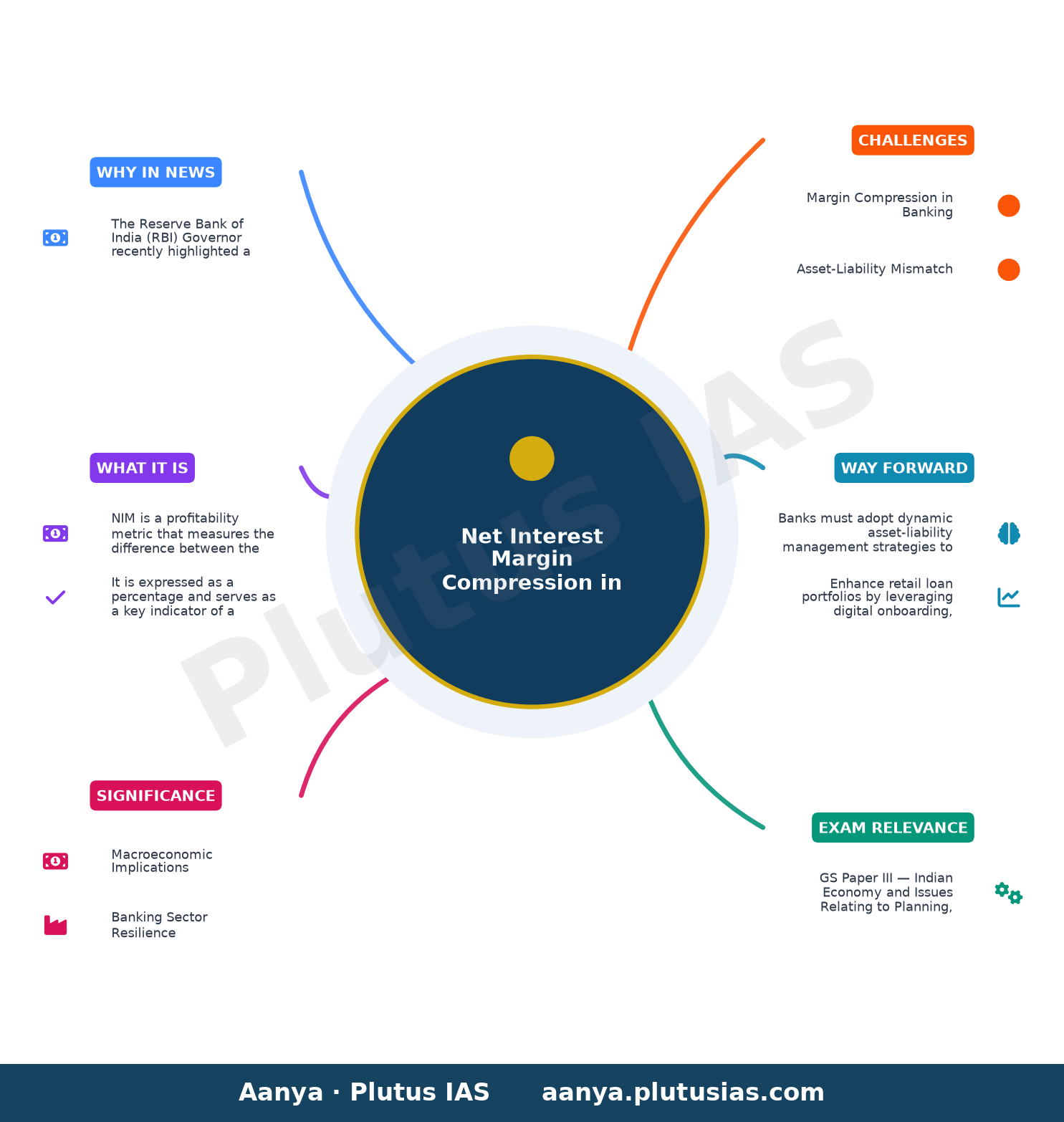
The Reserve Bank of India (RBI) Governor recently highlighted a sustained decline in the banking sector’s net interest margins (NIM) to 3.21% in June 2026 from 3.26% a year earlier, signaling structural challenges in deposit mobilization, credit growth dynamics, and external sector liabilities. This trend has prompted lenders to reassess their medium-term profitability models amid expectations of continued pressure from high deposit costs, geopolitical risks, and regulatory constraints.
Background
- The NIM, defined as the difference between interest earned and interest paid relative to earning assets, is a critical indicator of banking profitability and efficiency.
- India’s banking sector has witnessed robust credit growth in recent years, outpacing deposit accretion, which exerts upward pressure on deposit rates and compresses margins.
- The FCNR(B) deposit scheme, which allows non-resident Indians to hold foreign currency deposits in India, has introduced additional liquidity but at competitive rates, further straining NIMs.
- Operating expenses, including branch expansion, technology adoption, and specialist hiring, have risen, offsetting gains from scale economies in some cases.
- The RBI’s monetary policy stance, particularly the calibration of the repo rate and liquidity operations, plays a pivotal role in determining the cost of funds and, consequently, NIMs.
What is Net Interest Margin (NIM)?
- NIM is a profitability metric that measures the difference between the interest income generated by banks and the amount of interest paid out to lenders (such as depositors), relative to the bank’s interest-earning assets (e.g., loans, investments).
- It is expressed as a percentage and serves as a key indicator of a bank’s core operating performance, excluding non-interest income or expenses like fees, trading gains, or provisions.
- NIM is influenced by the spread between lending rates and deposit rates, the composition of the asset portfolio (e.g., retail vs. corporate loans), and the cost of funds.
- A declining NIM signals compression in profitability, which may necessitate higher loan pricing, cost rationalization, or a shift in asset-liability management strategies.
- The RBI monitors NIM trends as part of its financial stability assessments, given their implications for systemic risk and monetary policy transmission.
- In India, NIMs are also affected by external sector dynamics, such as the FCNR(B) scheme, which introduces foreign currency liabilities at market-determined rates.
- Banks with higher retail loan exposure typically enjoy more stable NIMs due to the stickiness of retail deposits and the premium on retail lending rates.
- Public sector banks (PSBs) often report lower NIMs compared to private banks due to their larger balance sheets, lower risk appetite, and higher operational costs.
Key Features
| Feature | Significance |
|---|---|
| Net Interest Margin (NIM) | NIM is the difference between interest income generated by banks and the amount of interest paid out to lenders, relative to interest-earning assets. A declining NIM indicates compression in profitability from core lending operations, which may necessitate adjustments in asset-liability management or pricing strategies. |
| Credit Growth vs Deposit Growth | Sustained credit growth outpacing deposit growth intensifies competition for funds, driving up deposit costs and compressing margins. This imbalance reflects structural liquidity constraints in the banking system. |
| Foreign Currency Non-Resident (FCNR) Deposits | FCNR(B) deposits, particularly those mobilised under the RBI’s foreign exchange management scheme, introduce volatility in funding costs and liquidity, often at lower yields, thereby exerting downward pressure on NIM. |
| Retail vs Corporate Loan Mix | Retail loans typically command higher interest rates than corporate loans, which are often bulk and competitively priced. A shift toward lower-yielding corporate loans directly reduces NIM, while an increase in retail lending may support margin recovery. |
| Operating Expenses (OPEX) | Rising OPEX—driven by branch expansion, technology adoption, and specialist hiring—erodes pre-provisioning operating profits (PPOP), limiting the scope for margin expansion despite revenue growth. |
Why it Matters
Macroeconomic Implications
- Declining NIMs signal a potential slowdown in the transmission of monetary policy to lending rates, as banks absorb policy rate hikes rather than passing them fully to borrowers, thereby dampening the effectiveness of RBI’s rate actions.
- Persistent margin stress may constrain banks’ ability to extend credit at competitive rates, particularly to retail borrowers, thereby influencing consumption and investment dynamics in the economy.
- A sustained compression in NIMs could reduce banks’ profitability, leading to lower capital buffers and potentially impacting financial stability, especially if credit growth remains robust while deposit mobilisation lags.
Banking Sector Resilience
- Despite margin pressures, the banking sector’s robust health—evidenced by strong asset quality and capital adequacy—provides a buffer against systemic risks, reducing the likelihood of a credit crunch.
- The divergence in NIM performance between public and private sector banks highlights the latter’s greater sensitivity to funding cost fluctuations, underscoring the need for diversified liability structures.
- Banks’ cautious stance on margin guidance reflects uncertainty in macroeconomic conditions, including geopolitical risks, liquidity conditions, and the trajectory of policy rates.
Monetary Policy Transmission
- The RBI Governor’s emphasis on margin stress underscores the challenge of achieving a balanced transmission of monetary policy, where rate hikes are not fully offset by corresponding increases in lending rates due to competitive pressures.
- High deposit costs, driven by intense competition for funds, may limit the passthrough of policy rate cuts to deposit rates, thereby constraining banks’ ability to reduce lending rates even in a dovish policy environment.
Challenges
1. Margin Compression in Banking
- Sustained decline in NIMs erodes profitability, particularly for private sector banks with higher cost structures and greater reliance on market-based funding.
- Intense competition for deposits, driven by credit growth outpacing deposit mobilisation, inflates funding costs and compresses spreads.
- Structural shift toward lower-yielding corporate loans and the dilutive impact of FCNR(B) deposits exacerbate margin pressures.
- Rising operating expenses, including technology investments and branch expansion, further strain profitability despite revenue growth.
UPSC Link: Economic Survey 2023-24: Banking Sector Performance
2. Asset-Liability Mismatch
- The mismatch between credit growth and deposit growth creates liquidity strains, forcing banks to rely on higher-cost wholesale funding or borrowings from the RBI’s Standing Deposit Facility (SDF).
- Prolonged mismatch may lead to a build-up of systemic risks, particularly if credit quality deteriorates in a high-interest-rate environment.
- Banks’ ability to manage this mismatch is constrained by regulatory liquidity coverage ratio (LCR) and net stable funding ratio (NSFR) requirements.
UPSC Link: RBI’s Liquidity Management Framework
3. Policy Transmission Inefficiencies
- Banks’ reluctance to fully pass on policy rate hikes to lending rates, due to competitive pressures, undermines the intended impact of monetary policy on inflation and growth.
- High deposit costs limit the scope for reducing lending rates even in a rate-cutting cycle, delaying the transmission of monetary easing to the real economy.
UPSC Link: RBI’s Monetary Policy Report 2024
Challenges — UPSC Perspective
| Issue | Concern |
|---|---|
| Declining NIMs | Erosion of core profitability, particularly for private sector banks, with potential long-term implications for capital adequacy and credit growth. |
| Credit-Deposit Mismatch | Intensified competition for funds, higher deposit costs, and liquidity constraints, leading to margin compression and systemic risks. |
| FCNR(B) Deposit Volatility | Lower-yielding foreign currency deposits increase funding cost volatility and dilute NIMs, complicating liability management. |
| Retail vs Corporate Loan Mix | Shift toward lower-yielding corporate loans reduces NIMs, while retail loan growth remains constrained by high interest rates. |
| Rising Operating Expenses | Technology investments, branch expansion, and specialist hiring inflate costs, eroding pre-provisioning operating profits. |
Way Forward
- Banks must adopt dynamic asset-liability management strategies to align credit growth with deposit mobilisation, including targeted deposit campaigns and product innovation.
- Enhance retail loan portfolios by leveraging digital onboarding, flexible repayment options, and competitive pricing to offset the drag from corporate lending.
- Rationalise operating expenses by prioritising high-ROI technology investments (e.g., AI-driven credit underwriting) and optimising branch networks.
- Diversify funding sources by tapping long-term instruments such as bonds and debentures, reducing reliance on volatile wholesale markets.
- Monitor FCNR(B) deposit flows and their impact on liquidity and NIMs, while exploring hedging strategies to mitigate foreign exchange risks.
- Strengthen internal risk management frameworks to anticipate liquidity shocks and credit quality deterioration in a high-interest-rate environment.
- Collaborate with the RBI to explore measures that enhance monetary policy transmission, such as calibrated adjustments to the cash reserve ratio (CRR) or statutory liquidity ratio (SLR).
UPSC Value Addition
Keywords for Mains Answer-Writing
Net Interest Margin (NIM) · Banking sector profitability · Reserve Bank of India (RBI) · Deposit mobilization · Credit growth · Foreign Currency Non-Resident (FCNR) deposits · Banking regulation · Macroeconomic factors affecting banks · Net Interest Margin trajectory · Operating expenses in banking · Retail vs. corporate loan mix · Banking sector resilience
Concept Flow
High policy rates (RBI repo rate) → Increased deposit costs for banks → Intense competition for funds → Credit growth outpaces deposit growth → Asset-liability mismatch → Margin compression (NIM decline) → FCNR(B) deposit inflows → Lower-yielding funds → Reduced interest income → Further NIM dilution → Shift toward corporate loans (lower yields) → Reduced interest margins → Pressure on profitability → Rising operating expenses (technology, branches) → Higher cost base → Erosion of pre-provisioning profits → Uncertain macroeconomic conditions (geopolitics, inflation) → Cautious bank guidance → Limited scope for margin recovery in near term
Prelims Practice Questions
Q1. Consider the following statements regarding Net Interest Margin (NIM) in the Indian banking sector:
1. NIM is calculated as the difference between interest earned and interest expended by banks, divided by earning assets.
2. A decline in NIM indicates improving profitability for banks.
3. High credit growth relative to deposit growth can exert pressure on NIM.
4. FCNR(B) deposits are exempt from contributing to NIM calculations.
How many of the above statements are correct?
- Only one
- Only two
- Only three
- All
Answer: Only three — Statement 1 is correct: NIM is defined as (Interest Earned – Interest Expended) / Earning Assets. Statement 2 is incorrect: a decline in NIM indicates shrinking profitability. Statement 3 is correct: high credit growth without proportional deposit growth strains NIM. Statement 4 is incorrect: FCNR(B) deposits impact NIM through their associated costs and leverage.
Q2. Assertion (A): The Reserve Bank of India (RBI) has recently flagged a decline in the banking sector’s Net Interest Margins (NIM) for the year ended June 2026.
Reason (R): Elevated operating expenses and high deposit costs have contributed to the compression of NIM in the Indian banking system.
Options:
A. Both A and R are true, and R is the correct explanation of A.
B. Both A and R are true, but R is not the correct explanation of A.
C. A is true, but R is false.
D. A is false, but R is true.
- A
- B
- C
- D
Answer: B — Assertion (A) is true as RBI Governor Sanjay Malhotra flagged the decline in NIM. Reason (R) is also true and correctly explains the assertion, as elevated operating expenses and high deposit costs are cited as key factors for NIM compression.
Q3. Match the following terms related to banking sector profitability with their correct descriptions:
Column I:
1. Net Interest Margin (NIM)
2. FCNR(B) deposits
3. Operating Expenses
4. Credit Growth
Column II:
A. Foreign currency deposits from non-resident Indians, often used by banks for liquidity management.
B. The rate at which banks lend money to customers, which impacts profitability.
C. The difference between interest earned and interest paid, expressed as a percentage of earning assets.
D. Expenses incurred by banks in day-to-day operations, including branch expansion and technology spending.
Options:
1-C, 2-A, 3-D, 4-B
1-A, 2-C, 3-B, 4-D
1-D, 2-A, 3-C, 4-B
1-C, 2-D, 3-A, 4-B
- 1-C, 2-A, 3-D, 4-B
- 1-A, 2-C, 3-B, 4-D
- 1-D, 2-A, 3-C, 4-B
- 1-C, 2-D, 3-A, 4-B
Answer: 1-C, 2-A, 3-D, 4-B — 1-C: NIM is correctly described as the difference between interest earned and interest paid, expressed as a percentage of earning assets. 2-A: FCNR(B) deposits are foreign currency deposits from non-resident Indians. 3-D: Operating expenses include branch expansion, technology spending, and other operational costs. 4-B: Credit growth refers to the rate at which banks lend money to customers, impacting profitability.
Mains Practice Question
✍ Examine the factors contributing to the compression of Net Interest Margins (NIM) in the Indian banking sector as highlighted by the Reserve Bank of India. Also, discuss the potential implications of persistently low NIM for the banking system and the broader economy. (15 Marks)
Approach: MODEL-ANSWER SKELETON:
1. **Definition and Significance of NIM** (1 mark):
– NIM = (Interest Earned – Interest Expended) / Earning Assets. It is a key indicator of banking sector profitability and operational efficiency.
2. **Factors Contributing to NIM Compression** (6 marks):
– **High Deposit Costs**: Elevated interest rates on deposits (e.g., savings and term deposits) squeeze margins.
– **Credit Growth Outpacing Deposit Growth**: Strong demand for loans without proportional deposit growth strains liquidity and NIM.
– **FCNR(B) Deposits**: Foreign currency non-resident deposits, while providing liquidity, incur higher costs and may dilute NIM.
– **Operating Expenses**: Branch expansion, technology adoption, and specialist hiring increase costs, reducing profitability.
– **Loan Mix Shift**: Lower-yielding corporate loans replacing high-yielding retail loans compress margins.
– **Macroeconomic Factors**: Geopolitical developments, monetary policy (e.g., repo rate hikes), and liquidity conditions.
3. **Implications of Persistently Low NIM** (6 marks):
– **For Banks**: Reduced profitability may limit capital adequacy, constrain lending capacity, and pressure shareholder returns.
– **For Economy**: Lower credit availability for businesses and individuals, potentially slowing economic growth.
– **For Depositors**: Lower returns on savings and fixed deposits.
– **For Investors**: Reduced attractiveness of banking stocks, impacting market sentiment.
– **Regulatory Concerns**: RBI may intervene to ensure financial stability, e.g., through liquidity adjustments or policy guidance.
4. **Way Forward** (2 marks):
– Banks may focus on retail loan growth (higher yields), optimize deposit mix, and improve operational efficiency.
– RBI’s role in balancing liquidity, credit growth, and monetary policy to stabilize NIM.
Source: Mint
Generated by AanyaAi for educational purpose.


No Comments