


06 Aug RBI’s 2026 Draft Credit Facility Rules for NBFCs: Key Changes Explained for UPSC
✎ The draft directions aim to strengthen the regulatory framework for NBFCs by enhancing prudential norms, risk management, and transparency in credit facilities, thereby mitigating systemic risks and aligning with global best…
Subject Relevance — Where This Topic Fits
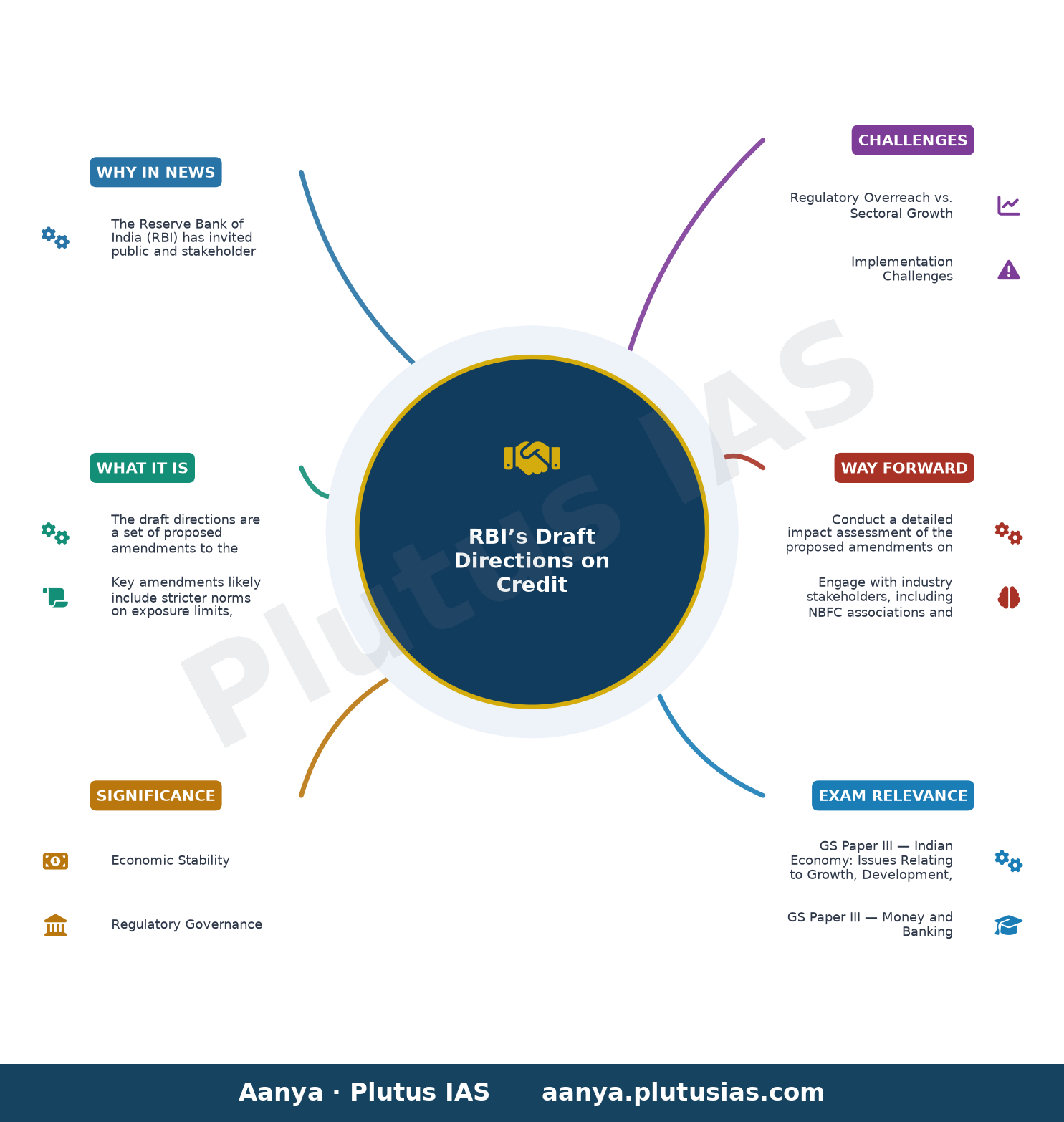
- GS Paper III — Indian Economy: Issues Relating to Growth, Development, and Employment | GS Paper III — Money and Banking | GS Paper III — Financial Sector Regulation and Supervision
- Prelims: Non-Banking Financial Companies (NBFCs), Credit Facilities Regulations, Reserve Bank of India (RBI) Directions, Systemic Risk in Financial Sector, Regulatory Arbitrage, Financial Stability and Supervision, Basel III Norms, Liquidity Coverage Ratio (LCR), Capital Adequacy Ratio (CAR), Credit Risk Management
- Essay: The Role of Regulatory Bodies in Ensuring Financial Stability: A Case Study of RBI’s Approach to NBFCs, Balancing Innovation and Regulation in India’s Financial Sector: Lessons from RBI’s Draft Directions
Quick Revision: The draft directions aim to strengthen the regulatory framework for NBFCs by enhancing prudential norms, risk management, and transparency in credit facilities, thereby mitigating systemic risks and aligning with global best practices.
Why is this in the news?
The Reserve Bank of India (RBI) has invited public and stakeholder comments on the draft ‘Reserve Bank of India (Non-Banking Financial Companies – Credit Facilities) Amendment Directions, 2026’. This regulatory initiative aims to refine the existing framework governing credit facilities extended by NBFCs, addressing emerging risks in the financial sector, enhancing transparency, and aligning with global best practices in prudential regulation. The draft directions reflect RBI’s proactive stance in pre-empting systemic vulnerabilities while fostering a resilient and inclusive financial ecosystem.
Background
- NBFCs play a pivotal role in financial inclusion by catering to underserved segments such as MSMEs, retail borrowers, and infrastructure financing, often bridging gaps left by traditional banking institutions.
- The sector’s rapid expansion has also introduced systemic risks, including liquidity mismatches, excessive leverage, and interconnectedness with the broader financial system, necessitating robust regulatory oversight.
- RBI’s regulatory framework for NBFCs has evolved through multiple iterations, including the introduction of the Scale-Based Regulatory (SBR) framework in 2021, which categorised NBFCs into four layers based on their size, activity, and risk profile.
- The existing directions on credit facilities for NBFCs, primarily governed by the RBI Master Direction on NBFCs (Reserve Bank of India Directions, 2021), are being amended to address gaps exposed by recent macroeconomic shocks, technological disruptions, and global financial reforms.
- The draft directions are part of RBI’s broader agenda to harmonise domestic regulations with international standards, such as the Basel III framework, while ensuring adaptability to India’s unique economic context.
What are the Reserve Bank of India (Non-Banking Financial Companies – Credit Facilities) Amendment Directions, 2026?
- The draft directions are a set of proposed amendments to the existing regulatory framework governing credit facilities extended by NBFCs, aimed at enhancing prudential norms, risk management, and transparency in lending operations.
- Key amendments likely include stricter norms on exposure limits, enhanced disclosure requirements, and stricter governance standards for NBFCs, particularly those classified under higher layers of the Scale-Based Regulatory (SBR) framework.
- The directions seek to address systemic risks arising from interconnected lending, liquidity mismatches, and excessive leverage within the NBFC sector, aligning with RBI’s mandate to safeguard financial stability.
- Proposed measures may include mandatory liquidity buffers, stricter asset classification norms, and enhanced reporting requirements to ensure real-time monitoring of credit risk exposures.
- The draft also aims to curb regulatory arbitrage by ensuring that NBFCs adhere to prudential norms commensurate with their risk profiles, thereby reducing the likelihood of contagion effects in the financial system.
- Stakeholder feedback is invited to refine the draft, ensuring that the final directions balance regulatory rigour with the operational realities of NBFCs, particularly smaller and mid-sized entities.
- The directions are expected to complement existing regulations such as the RBI’s Master Direction on NBFCs (2021), the Framework for Resolution of Stressed Assets, and the guidelines on Large Exposure Framework (LEF).
- The amendment directions are part of RBI’s broader strategy to foster a resilient financial sector, in line with global standards such as the Basel III framework, while addressing India-specific challenges.
Key Features
| Feature | Significance |
|---|---|
| Draft Amendment Directions, 2026 | Proposes regulatory amendments to the framework governing credit facilities extended by Non-Banking Financial Companies (NBFCs), aiming to enhance prudential norms and risk management. |
| Public Consultation Process | Invites feedback from regulated entities and stakeholders by August 28, 2026, ensuring participatory and transparent regulatory development. |
| Scope of Credit Facilities | Likely covers aspects such as exposure limits, asset classification, provisioning requirements, and governance standards for NBFCs. |
| Regulatory Clarity | Seeks to address ambiguities in existing directions, thereby reducing compliance burden and improving operational efficiency for NBFCs. |
| Risk Mitigation | Introduces stricter norms to curb systemic risks arising from excessive leverage or misaligned credit practices in the NBFC sector. |
Why it Matters
Economic Stability
- Strengthens the financial resilience of NBFCs, a critical segment of India’s credit ecosystem, thereby reducing systemic risk to the broader economy.
- Enhances investor confidence by imposing stricter prudential norms, which may attract greater institutional investments into the NBFC sector.
- Aligns with global best practices in non-bank financial intermediation, particularly in areas such as leverage ratios and asset quality monitoring.
Regulatory Governance
- Demonstrates the Reserve Bank of India’s (RBI) proactive stance in regulating shadow banking entities to prevent financial contagion.
- Ensures uniformity in regulatory treatment across NBFCs, reducing regulatory arbitrage and promoting a level playing field.
- Facilitates early intervention mechanisms to address emerging risks before they escalate into systemic crises.
Credit Market Dynamics
- May influence the cost and availability of credit for MSMEs and retail borrowers, depending on the stringency of the proposed norms.
- Could lead to consolidation in the NBFC sector, with smaller players exiting or merging to comply with enhanced regulatory requirements.
- May reduce instances of predatory lending practices by imposing stricter governance and disclosure norms.
Macroeconomic Impact
- Supports the RBI’s objective of maintaining price stability by ensuring a stable credit supply without excessive risk-taking.
- Contributes to the government’s financial inclusion goals by ensuring that NBFCs operate within a robust regulatory framework.
- Reduces the likelihood of bailouts or public sector interventions in the event of NBFC distress, thereby protecting taxpayer interests.
Challenges
1. Regulatory Overreach vs. Sectoral Growth
- Risk of excessive regulation stifling innovation and growth in the NBFC sector, particularly for fintech-driven credit models.
- Potential for increased compliance costs, which may disproportionately affect smaller NBFCs and reduce their competitiveness.
UPSC Link: Economic Development: Role of NBFCs
2. Implementation Challenges
- Ensuring uniform compliance across diverse NBFCs, including housing finance companies, microfinance institutions, and asset finance companies.
- Addressing legacy issues such as high non-performing assets (NPAs) in the NBFC sector without triggering a credit crunch.
UPSC Link: Financial Sector Reforms
3. Systemic Risk Management
- Balancing the need for stricter norms with the risk of credit contraction, which could impact economic growth and employment.
- Preventing regulatory arbitrage where NBFCs circumvent norms by shifting activities to less-regulated entities.
UPSC Link: Monetary Policy and Financial Stability
4. Stakeholder Alignment
- Achieving consensus among regulated entities, industry associations, and policymakers on the proposed amendments.
- Ensuring that feedback from stakeholders is incorporated without diluting the core objectives of financial stability.
UPSC Link: Regulatory Governance and Accountability
5. Technological Disruption
- Adapting regulatory frameworks to account for the rapid digitization of credit delivery and the rise of algorithmic lending models.
- Addressing data privacy and cybersecurity risks in the context of digital credit platforms operated by NBFCs.
UPSC Link: Digital Economy and Financial Inclusion
Challenges — UPSC Perspective
| Issue | Concern |
|---|---|
| Compliance Costs | Increased operational expenses for NBFCs due to stricter norms, potentially reducing profitability and competitiveness. |
| Credit Contraction | Risk of reduced credit availability for borrowers, particularly MSMEs and low-income households, if NBFCs curtail lending. |
| Regulatory Arbitrage | Possibility of NBFCs shifting activities to less-regulated entities or jurisdictions to avoid compliance burdens. |
| Legacy NPAs | Existing high NPAs in the NBFC sector may require additional provisioning, straining capital adequacy ratios. |
| Fintech Integration | Balancing innovation in digital lending with the need for robust risk management and consumer protection. |
| Sectoral Consolidation | Smaller NBFCs may struggle to meet enhanced norms, leading to market consolidation and reduced diversity in credit providers. |
Way Forward
- Conduct a detailed impact assessment of the proposed amendments on NBFC operations, profitability, and credit growth.
- Engage with industry stakeholders, including NBFC associations and fintech firms, to gather feedback and refine the draft directions.
- Enhance supervisory mechanisms to ensure real-time monitoring of NBFC compliance with the amended norms.
- Strengthen data infrastructure to facilitate granular reporting by NBFCs on asset quality, leverage, and risk exposures.
- Develop phased implementation timelines to allow NBFCs adequate time to align with new requirements without disrupting credit flows.
- Promote financial literacy among borrowers to mitigate risks of over-indebtedness and ensure informed credit decisions.
- Collaborate with other financial regulators to address systemic risks arising from interconnectedness between banks and NBFCs.
- Establish a grievance redressal mechanism for borrowers affected by stricter lending norms imposed by NBFCs.
UPSC Value Addition
Keywords for Mains Answer-Writing
RBI Directions 2026 · Non-Banking Financial Companies (NBFCs) · Credit Facilities Regulation · Financial Sector Reforms · Regulatory Arbitrage · Systemic Risk in NBFCs · Basel III Norms · Financial Stability Board (FSB) · Corporate Governance in NBFCs · Shadow Banking System · Credit Risk Management · Financial Sector Legislative Reforms Commission (FSLRC) · RBI Act, 1934 · Financial Inclusion
Concept Flow
RBI identifies gaps in NBFC credit facility norms → Draft Amendment Directions, 2026 proposed → Public consultation initiated → Feedback analyzed and incorporated → Final directions issued → NBFCs align operations with new norms → Enhanced financial stability and reduced systemic risk → Sustainable credit growth in the economy
Prelims Practice Questions
Q1. Consider the following statements regarding the Reserve Bank of India (RBI) and its regulatory functions:
1. The RBI is the sole authority responsible for regulating Non-Banking Financial Companies (NBFCs) in India.
2. The RBI issues directions to NBFCs under the powers conferred by Section 45L of the RBI Act, 1934.
3. The RBI’s regulatory framework for NBFCs is primarily aimed at addressing systemic risks in the financial sector.
How many of the above statements are correct?
- Only one
- Only two
- All
- None
Answer: Only two — Statement 1 is correct as the RBI is the primary regulator for NBFCs under the RBI Act, 1934. Statement 2 is incorrect because the RBI issues directions under Section 45JA of the RBI Act, not Section 45L. Statement 3 is correct as the RBI’s regulatory framework for NBFCs is designed to mitigate systemic risks in the financial system.
Q2. Assertion (A): The Reserve Bank of India (RBI) has recently released draft directions aimed at enhancing the credit facilities framework for Non-Banking Financial Companies (NBFCs).
Reason (R): The draft directions are part of a broader effort to align NBFC regulations with international best practices and mitigate risks in the shadow banking sector.
In the context of the above two statements, which of the following is correct?
- Both A and R are true, and R is the correct explanation of A
- Both A and R are true, but R is not the correct explanation of A
- A is true, but R is false
- A is false, but R is true
Answer: Both A and R are true, and R is the correct explanation of A — Both the Assertion (A) and Reason (R) are true. The RBI has indeed released draft directions for NBFCs, and these directions are part of a broader effort to align regulations with international standards and mitigate risks in the shadow banking sector. The Reason (R) correctly explains the Assertion (A).
Q3. Which of the following is NOT a primary objective of the Reserve Bank of India (RBI) in regulating Non-Banking Financial Companies (NBFCs)?
- To ensure financial inclusion by promoting NBFCs in rural and semi-urban areas
- To mitigate systemic risks arising from the operations of NBFCs
- To align NBFC regulations with Basel III norms
- To eliminate all forms of regulatory arbitrage between banks and NBFCs
Answer: To eliminate all forms of regulatory arbitrage between banks and NBFCs — While the RBI aims to mitigate systemic risks, align regulations with Basel III norms, and promote financial inclusion, eliminating all forms of regulatory arbitrage between banks and NBFCs is not a primary objective. Regulatory arbitrage is a complex issue and cannot be entirely eliminated without significant structural changes.
Mains Practice Question
✍ The Reserve Bank of India (RBI) has proposed amendments to the regulatory framework governing credit facilities extended by Non-Banking Financial Companies (NBFCs) through the draft ‘Reserve Bank of India (Non-Banking Financial Companies – Credit Facilities) Amendment Directions, 2026’. Critically examine the rationale behind these amendments and their potential implications for the NBFC sector and the broader financial ecosystem in India. (15 Marks)
Approach: A full answer must include the following dimensions:
1. **Rationale for the Amendments**:
– Addressing systemic risks in the shadow banking sector (e.g., liquidity mismatches, interconnectedness with banks).
– Aligning NBFC regulations with international standards (e.g., Basel III norms, Financial Stability Board (FSB) recommendations).
– Mitigating regulatory arbitrage between banks and NBFCs to ensure a level playing field.
– Strengthening corporate governance and risk management frameworks in NBFCs.
2. **Key Provisions of the Draft Directions (if available in the RBI document)**:
– Enhanced disclosure norms for NBFCs.
– Stricter capital adequacy and liquidity requirements.
– Provisions for stress testing and resolution mechanisms.
– Governance reforms (e.g., board composition, risk management committees).
3. **Potential Implications**:
– **For NBFCs**: Increased compliance costs, reduced profitability, and potential consolidation in the sector. However, stronger regulation may enhance investor confidence and access to cheaper credit.
– **For Banks**: Reduced risk of contagion from NBFC failures, but potential for reduced competition in credit markets.
– **For Borrowers**: Possible tightening of credit availability, especially for MSMEs and low-income segments, unless alternative financing channels emerge.
– **For Financial Stability**: Reduced systemic risk but potential for regulatory arbitrage to shift to unregulated entities.
4. **Comparative Perspective**:
– Contrast with global practices (e.g., the Dodd-Frank Act in the US, EU’s Capital Requirements Regulation).
– Lessons from past NBFC crises (e.g., IL&FS, DHFL) and their role in shaping the amendments.
5. **Critique and Challenges**:
– Balancing regulation with innovation in the NBFC sector.
– Ensuring that amendments do not stifle financial inclusion.
– The role of state-level regulations (e.g., state cooperative banks) in the broader financial ecosystem.
6. **Conclusion**:
– A balanced view on whether the amendments strike the right balance between stability and growth in the NBFC sector.
Source: RBI
Generated by AanyaAi for educational purpose.

- मद्रास उच्च न्यायालय ने बोगस जाति प्रमाणपत्र के आधार पर आरक्षण का दावा करने वाले कर्मचारी को पेंशन देने से किया इनकार - September 20, 2026
- Madras HC Rejects Bogus Reservation Claim: Key Polity Implications for UPSC - September 20, 2026
- तेलंगाना उच्च न्यायालय ने पुलिस अधिकारी को अवमानना में एक माह की सजा सुनाई - September 19, 2026

No Comments